
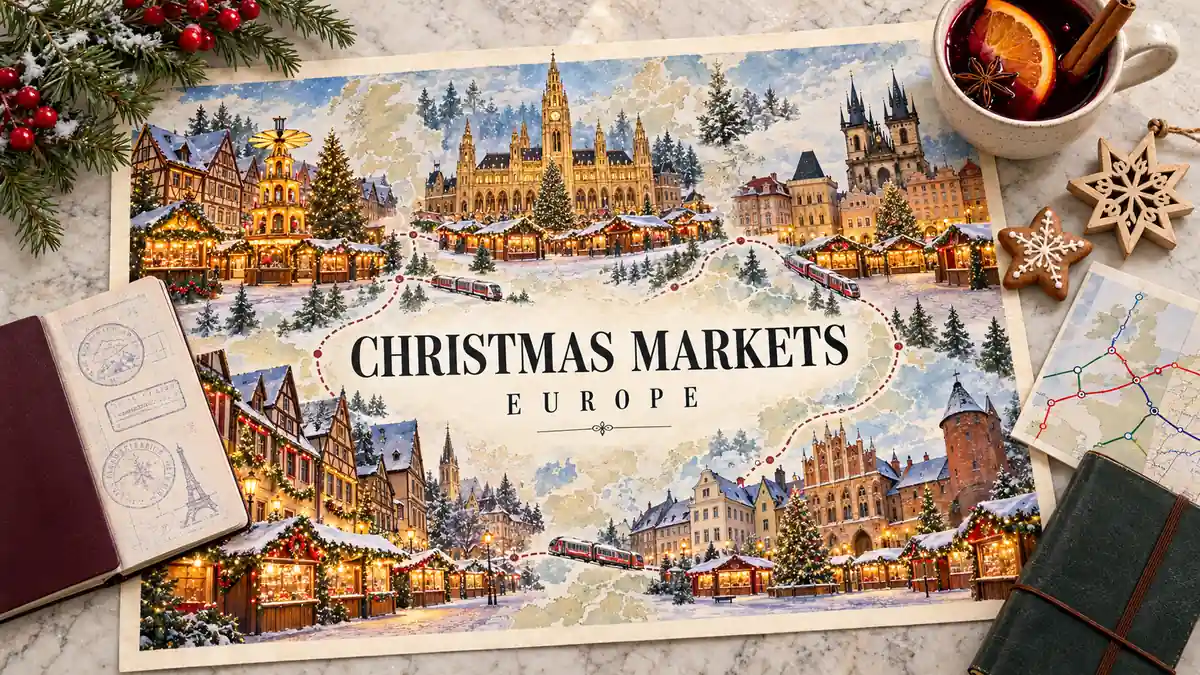
Choosing Christmas markets in Europe is a choice between regions and trip styles, not a hunt for one “best” market. The tradition runs through Advent, the four weeks of preparation before Christmas, and it looks different in each corner of the continent. Germany and Austria hold the classic version, Alsace and its western neighbours the village one, Central Europe the grand old-town squares, and the Nordics and Baltics the quieter, design-led or medieval one. Every region pours some form of mulled wine — called Glühwein in German-speaking countries — from wooden stalls that glow after dark. This guide matches each region to the traveler it suits, sets out how the season runs, and explains how to combine two or three markets in one trip. A single-city break counts as a full plan too: several cities run enough markets to fill a long weekend on their own.
Quick Answer
Germany and Austria are the classic first choice, with Alsace, Central Europe and the Nordics as the strongest alternatives. Choose by trip style (first visit, families, romance, fewer crowds) and by how many markets you combine. First-timers do best with one base city plus a market or two a short train ride away; quieter trips head north.
Trust Layer
Tripstou selection guide for travelers choosing between multiple places. Covers selection criteria, traveler fit, and trip value.
Produced with AI assistance and reviewed by Alex Perrut, working in tourism since 2015, for the Tripstou editorial team. See our editorial process for details.
Last factual review: October 1, 2026.
Official sources consulted: Your Europe (European Union), European Travel Commission.
Key Takeaways
- Germany and Austria are the safest first Christmas-market trip, with several traditional markets per city and the oldest markets of the tradition.
- Match the region to the trip: Alsace or Salzburg for romance, big German cities for families, Tallinn and Riga for fewer crowds.
- The most famous squares are the busiest, so weekdays early in the season beat the last two weekends before Christmas.
- A base city with one or two markets a short train ride away beats a long linear route for most first-timers.
- Most markets run from mid-to-late November to Christmas Eve and are mostly shut on Christmas Day, so confirm dates on each official site.
- Short breaks still work: a single city with several markets fills a long weekend, while the quieter Nordic and Baltic capitals suit a second trip.
Table of Contents
Germany and Austria Are the Heartland of Christmas Markets in Europe
Germany has the densest and most traditional Christmas markets in Europe, with Austria close behind. Most German and Austrian cities run several markets at once, and the oldest and most famous markets of the tradition sit here, from Dresden to Nuremberg. For a first trip built around the classic version, this is where to start.
Germany’s big cities work as clusters of markets. Nuremberg’s Christkindlesmarkt and Dresden’s Striezelmarkt are among the oldest in Europe, and both cities add smaller themed markets around the main one. Munich spreads its stalls across the old town, while Cologne runs several distinct markets within walking distance of the cathedral. One city can fill two days.
Austria adds the Alpine setting to the same tradition. Vienna puts its best-known market in front of the city hall and another at Schönbrunn Palace, Salzburg sets its stalls below the fortress, and Innsbruck lines its old town with the mountains as a backdrop. The Alpine towns are compact enough to walk end to end in an evening. Across the border, South Tyrol in northern Italy carries the same Alpine tradition, and the guide to Christmas markets in Italy covers the season across the country.
The famous squares carry the cost of their fame: they are the busiest markets in the region. In Nuremberg or Vienna, the smaller side markets a few streets away often give the better evening, with the same food and shorter queues for a mug of Glühwein.
Pick this if: it is your first Christmas-market trip and you want the classic version.
Alsace, Switzerland and the Low Countries: The Western Ring
Alsace delivers Europe’s most picturesque village markets, with Switzerland and the Low Countries a short hop away. Its half-timbered towns turn whole streets into markets, while Basel, Montreux and the Belgian and Dutch cities add compact city markets that fit a short break. The western ring suits travelers who value scenery over sheer market density.
The Strasbourg Christmas markets spread across the island centre around the cathedral, and Colmar fills its old town and the canal quarter known as Little Venice. The smallest villages, such as Riquewihr and Kaysersberg, need a car or a tour. Trains miss most of them. The guide to Christmas markets in France covers Strasbourg, Colmar and the village route in detail. For a city break in place of the villages, Paris at Christmas swaps half-timbered lanes for city lights and seasonal markets spread across the capital.
Switzerland adds lakeside and old-town settings: Basel’s market sits in the medieval centre, Montreux lines the shore of Lake Geneva, and Zurich runs several between the main station and the old town. Swiss trips sit at the top of the cost scale, which adds up fast on a multi-day route. Belgium pairs easily with the rest of the ring, with Brussels, Bruges and Ghent each running a market in the historic centre. Luxembourg City and Dutch cities such as Maastricht add smaller markets on the same circuit.
Alsace rewards a weekday visit more than anywhere else on this page, because its villages are small enough that weekend crowds fill a single street and stall to stall becomes a queue.
Pick this if: you want romance or photography on a short break.
Central Europe Beyond Austria: Prague, Budapest and Kraków
Prague, Budapest and Kraków give grand-square markets that chain together on one rail corridor through Vienna. Each city centres its main market on a historic old-town square, and the main legs take a few hours by train. That makes Central Europe the easiest region for a linear trip covering two or three cities.
Prague’s Old Town Square market is the region’s showpiece, with a second large market on Wenceslas Square. Budapest splits its season between Vörösmarty Square and the square in front of St Stephen’s Basilica. Kraków’s market fills the Main Market Square, one of the largest medieval squares in Europe. The setting is the draw.
Bratislava, Ljubljana and Zagreb are newer or smaller stops on the same corridor. Bratislava sits close to Vienna, which makes it the easiest add-on in the region, while Zagreb and Ljubljana turn their whole centres into Advent trails of lights and stalls. Each adds a country without adding much distance.
Route order matters more than route length here. Prague’s Old Town Square is among the most crowded markets in Europe, so plan Prague for weekdays and let the weekend fall on Budapest, where two main markets spread the crowd.
Pick this if: you want two or three capitals on one route.
Nordics, Baltics and Newer Markets for a Quieter Trip
The Nordics and Baltics offer the quietest, most atmospheric Christmas markets in Europe, traded against short winter days. Copenhagen and Stockholm bring the design-led version, while Tallinn and Riga set their markets in medieval old towns. Fewer tour groups reach this far north, so the squares feel local even on busy evenings.
Copenhagen’s best-known market sits inside Tivoli Gardens, the city’s historic amusement park, with smaller markets along Nyhavn and in the centre. Stockholm’s oldest market fills Stortorget in Gamla Stan, and the open-air museum at Skansen runs a traditional one. Candlelight, design stalls and Nordic food set both cities apart.
The Tallinn Christmas market gathers its stalls and tree on Town Hall Square inside the walled old town, and Riga’s main market fills Dome Square a short walk from the river. Edinburgh has grown into one of the larger newer markets outside the traditional heartland, with rides and stalls in Princes Street Gardens. The trade is cold, very short daylight and fewer markets per city. Pack for it.
The north works best as a second Christmas-market trip: after Germany, Tallinn and Riga show the same tradition at village scale inside a capital, and that contrast is the reason to go.
Pick this if: you have already done Germany or want fewer crowds.
Which Region Suits Your Trip? Christmas Markets by Traveler Type
First-timers should start in Germany or Austria; romance points to Alsace, fewer crowds to the Baltics. Families do best in big German cities, where markets add rides, children’s corners and plenty of hot food. Design-minded travelers belong in Copenhagen or Stockholm. Each match trades something, usually crowd levels against atmosphere or cost.
| Trip style | Best region | Why it fits | Main tradeoff |
|---|---|---|---|
| First-timers | Big-city clusters in Germany and Austria | Classic tradition with several markets in one city | The most famous squares are also the busiest |
| Families | Large German cities such as Munich or Cologne | Rides, hot food and room to move around | Evening crowds are hard going with small children |
| Romance | Alsace villages or Salzburg’s old town | Candlelit lanes, small scale and striking scenery | Busy weekends and villages that trains do not reach |
| Fewer crowds | Baltic capitals such as Tallinn and Riga | Medieval squares with far fewer tour groups | Cold, short days and one main market each |
| Design and Nordic style | Copenhagen and Stockholm in Scandinavia | Design-led stalls, candlelight and Nordic food | Fewer markets per city and high everyday prices |
Famous markets and smaller ones serve different trips. The headline squares give the postcard view and the widest choice of stalls, while a town of one market gives space, conversation with stallholders and a slower evening. Most good trips mix both. To build the wider trip around the markets, the Europe travel guide covers regions, routes and planning basics.
When Do Christmas Markets in Europe Open and Close?
Most Christmas markets in Europe open in mid-to-late November and close on or just before Christmas Eve. Many open with the start of Advent, and a minority stay open into early January. Dates shift every season, so check each market’s official site for the current dates before booking travel.
Many markets close early on Christmas Eve and stay shut on Christmas Day. The handful that continue past Christmas are mostly in larger cities, and some switch to a winter or New Year theme. A trip planned for the days between Christmas and New Year needs a market-by-market check.
Crowds follow a clear pattern. The opening days and weekday afternoons are the quietest times to visit, and the last two weekends before Christmas are the busiest of the season. The first week of the season is the window most visitors miss: stalls are fully stocked and the queues are short. Browse and shop by day, then come back after dark for the lights.
Daylight is short across northern Europe in December, and evenings are cold everywhere on this page; the guide to the best time to visit Europe covers winter weather by region.
How to Combine Two or Three Christmas Markets in One Trip
Base in one city and add one or two markets by short train rides. Save linear routes for trips of a week or more. A single hotel removes packing days and lets you return to the best market after dark. For most first-timers, this base-city method beats a long route through four or five cities.
Four ways to build the trip, each with its own catch:
- Base city plus day trips: suits first-timers and anyone with a long weekend or more; the tradeoff is that your reach stops where a short train ride ends.
- Short linear rail route: suits travelers with a week who want two or three countries, through Central Europe or along the Rhine; the tradeoff is a packing day at every move.
- River cruise: suits travelers who want a hands-off trip, often older travelers and groups; the tradeoff is fixed stops and short time in each market, with evenings tied to the ship’s schedule.
- Single city break: suits short-break travelers, including many flying in from the UK; the tradeoff is seeing only one city’s version of the tradition.
Pairings that work from one base include Nuremberg with Munich, Vienna with Bratislava or Budapest, and Strasbourg with Colmar by rail, adding the Alsace villages by car. Each pairing keeps the hotel fixed.
The base-city method depends on a fast line out of the base. Munich, Vienna and Strasbourg qualify; a Baltic capital does not, because the next market is a country away.
How long to give the trip:
- A long weekend: one city and its several markets, which fits a first taste or a short break from the UK.
- Four to five days: a base city plus two day trips, which fits first-timers who want variety without changing hotels.
- A week: a linear route through three cities, which fits travelers happy to trade packing days for more countries.
Rail passes, tickets and booking are covered in the guide to getting around Europe by train.
Tours and activities
Book skip-the-line tickets, day trips and local tours with free cancellation on most activities.
You can also browse everything on getyourguide.com.
Tripstou may earn a commission if you book through this link, at no extra cost to you.
What to Expect at a Christmas Market: Mulled Wine, Mug Deposits and Crafts
Expect open-air stalls, mulled wine served in a deposit mug, hot food and handmade ornaments, with entry free almost everywhere. You pay a small deposit with your first drink and get it back when you return the mug, or keep the mug as a souvenir. Markets look their best after dark.
The food runs to gingerbread, roasted nuts, grilled sausages and regional sweets. Craft stalls sell glass and wooden ornaments, candles, toys and local specialities, and many markets also serve a hot non-alcoholic punch for children. Quality varies from stall to stall, so the handmade pieces are worth seeking out.
Before you go:
- Mug deposit: return the mug to a stall at the same market for the refund; mugs often carry that market’s own design, which is why many visitors keep one.
- Cash: still useful at smaller stalls, even in cities where cards are widely taken.
- Timing: browse and buy by day, then return after dark for the lights and atmosphere.
- Clothing: dress for standing outdoors in the cold for hours, with warm shoes.
- Entry rules: Check the entry rules that apply to your passport before booking.
For packing, money and general safety on the wider trip, see the Europe travel tips guide.
Frequently Asked Questions
Are Christmas markets in Europe open on Christmas Day?
Most Christmas markets in Europe are closed on Christmas Day. Many also close early on Christmas Eve, so the last full evening is usually the one before. A minority, mostly in larger cities, reopen afterwards or keep running into the New Year, so a trip over the holiday itself needs a market-by-market check on official sites.
Which Christmas markets in Europe stay open after Christmas?
A minority of Christmas markets in Europe stay open after Christmas, some into early January, mostly in larger cities and a few Alpine and Nordic ones. Some switch to a winter or New Year theme. Dates change every season, so confirm the closing day on the market’s official site before planning a late-December trip.
How many days do you need for a Christmas market trip in Europe?
Plan four to five days for a first Christmas market trip in Europe. That covers one base city and two day trips without changing hotels. A long weekend covers one city with several markets, and a week allows a three-city rail route. Travelers flying in from North America should add a day for the overnight flight.
Is it better to visit Christmas markets during the day or at night?
Visit Christmas markets both during the day and after dark, because each gives something different. Daylight is best for browsing craft stalls, buying gifts and taking photos with shorter queues. After dark the lights come on and the atmosphere peaks, but so do the crowds, especially on weekend evenings. An early weekday evening gets the lights with fewer people.
How does the mug deposit at Christmas markets work?
The mug deposit is a small extra charge added to your first drink, refunded when you hand the mug back. Return it to a stall at the same market, since another market may use a different mug. Keeping it is common: the deposit becomes the price of a souvenir that often carries that market’s own design.
Can you do a Christmas market trip as a single city break?
Yes, a single city works well for a Christmas market break because the larger cities run several markets at once. Vienna, Munich, Cologne, Prague and Budapest can each fill a long weekend without a train ride. Pick one with a compact old town so you can walk between markets and return after dark.
Related Guides
- Christmas markets in France: Strasbourg, Colmar and the Alsace village route in detail.
- Europe travel guide: choose the countries and route around your market trip.
- Best time to visit Europe: winter weather and daylight by region.
- Getting around Europe: rail passes, tickets and booking for a multi-city route.
- Europe travel tips: packing, money and safety basics before you go.
- Strasbourg Christmas market: the island-centre markets around the cathedral, stall by stall.
- Tallinn Christmas market: the quieter Baltic alternative on Town Hall Square.
- Christmas in Italy: Alpine markets in the north and the season across the country.
Did this guide save you time or money? Tripstou is independent and reader-funded — if you'd like to give something back, you can support the site with a crypto contribution of any size.