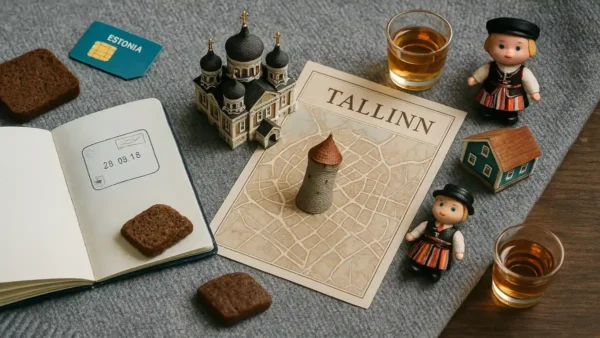

The Tallinn Christmas market fills one compact square inside a walled medieval Old Town. A tall tree stands at the centre, wooden stalls ring the edges, and the sky is dark by mid-afternoon, so the lights do most of the work. This guide answers two questions: whether a Christmas trip to Tallinn is worth it, and how to spend your time at the market well.
Set expectations early. This is one square, not a city-wide network of markets in the German style, and the Old Town around it is half the reason to come. Below you will find an honest verdict on scale, what to eat and drink, what is worth buying, when to go, how cold it gets and how to dress for it, the smaller local alternative at Balti Jaam, and the two winter add-ons that turn a market visit into a full evening.
Quick Answer
The Tallinn Christmas market is worth a trip for atmosphere, not size: one free square in the medieval Old Town. Go after dark on a weekday; 1–2 hours covers the stalls, longer with food and the weekend stage. For a smaller, more local take, add Balti Jaam Market in Telliskivi.
Trust Layer
Tripstou selection guide for travelers choosing between multiple places. Covers selection criteria, traveler fit, and trip value.
Produced with AI assistance and reviewed by Alex Perrut, working in tourism since 2015, for the Tripstou editorial team. See our editorial process for details.
Last factual review: October 1, 2026.
Official sources consulted: Visit Estonia, Estonian Ministry of Economic Affairs and Communications.
Key Takeaways
- Town Hall Square is one compact, free-to-enter square, so plan one atmospheric evening there and let the Old Town fill the rest of the weekend.
- Weekday evenings give the best balance: the tree and stalls are lit by mid-afternoon dark, and the square still has room to move.
- Market food carries a premium, so eat a proper meal in a café off the square and keep the stalls for glögi.
- Buy Estonian-made wool, wooden crafts and gingerbread; when the same item sits at the same price on several stalls, it is usually imported stock.
- Dress for standing still in December’s typical −5 °C to 2 °C (23–36 °F): boots, layers, hat and gloves beat one heavy coat.
- See Balti Jaam in Telliskivi by day for a smaller, food-led market, then Town Hall Square after dark, so both are at their best.
Table of Contents
Town Hall Square is the market worth the trip
Tallinn’s Christmas market fills Town Hall Square in the Old Town, is free to enter, and is worth the trip. Raekoja plats is a compact medieval square, so the market is small by German standards. It earns the journey for its setting: the old town hall, merchant houses and a tall tree, all lit after dark.
The square is the stage. A tall Christmas tree stands at the centre, wooden stalls ring it, and the town hall closes one side. A stage programme runs mainly on weekends. Santa’s house and a carousel give children their own corner.
Readers who know the big German markets should recalibrate. Tallinn has one main square, and you can walk the full loop of stalls in minutes. The market regularly appears in European best-of lists, and it is the setting that earns that reputation, not the stall count.
The market fills an evening; the Old Town around it fills a weekend. That is why Tallinn works as a short winter break and disappoints as a market crawl. Our Tallinn guide covers the city beyond the square.
Pick this if: you want one atmospheric evening in a medieval square and have no wish to spend a day hopping between markets.
What to eat and drink at the Tallinn Christmas market
Expect blood sausage with sauerkraut, roast pork, gingerbread and glögi in several flavours, including non-alcoholic. The stall food is hearty Estonian winter cooking, built for eating standing up in the cold. Glögi, the local mulled drink, is the one thing almost every visitor orders, and the alcohol-free version makes it work for children too.
- Blood sausage (verivorst): the classic Estonian Christmas dish, usually served hot with sauerkraut.
- Sauerkraut (hapukapsas): the standard side to sausage and pork, often stewed.
- Roast pork (seapraad): the filling plate if you plan to make the market your dinner.
- Gingerbread (piparkoogid): thin, spiced biscuits, eaten on the spot or bought as a gift.
- Glögi: hot mulled drink in several flavours, with a non-alcoholic version at most counters.
Hot drinks and plates come in reusable tableware with a small refundable deposit. Return the cup or plate to a stall and the deposit comes back.
Market prices carry a premium. Cafés just off the square are usually cheaper for a hot drink, and warmer for sitting down. Eat a proper meal off the square and save the market for one hot plate and a glögi: you get the stall experience where it counts and pay café prices for the rest.
What is worth buying, and what to skip
Wool knits, wooden crafts, gingerbread and local food gifts are the buys that justify market prices. The best of them are made locally and hard to find outside Estonia. Skip the stalls selling mass-produced ornaments, novelty hats and generic trinkets you could buy at any market in Europe, because nothing about them ties back to Tallinn.
- Wool and felt: mittens, socks and hats from local makers, useful the moment you buy them.
- Wooden crafts: carved pieces and wooden kitchenware from local makers.
- Gingerbread: the easy gift — light, flat to pack and seasonal.
- Local food gifts: honey, preserves and other packaged foods that travel well.
Ask the stallholder who made an item. Makers answer with a name or a village. Resellers shrug. When the same piece sits at the same price across several stalls, it is almost always imported stock, and that is the signal to keep walking.
Go after dark on a weekday for the best of it
Visit after dark on a weekday; the lights carry the square and the weekend crowds stay away. Tallinn is dark by mid-afternoon in December, so an evening visit needs no late night. Weekend afternoons and evenings are the busiest stretch, while weekday daytime is quietest but loses most of the glow.
| Visit window | Atmosphere | Crowds | Best for |
|---|---|---|---|
| Weekday daytime | Stalls open but the lights lose impact | Quietest time on the square | Unhurried shopping and photographing the stalls |
| Weekday after dark | Tree and stalls lit, square at its best | Steady but with room to move | Couples and first-time visitors after atmosphere |
| Weekend afternoon or evening | Lit square plus the stage programme | Busiest stretch of the whole week | Families who want the shows and Santa |
The market runs from late November through the Christmas holidays into early January, and the tree is lit at the start of Advent. The weeks before Christmas carry the most energy. Snow is likelier late in the season, and the run into early January is quieter. Stalls trade through the day into the evening, and hot-drink counters stay open later, latest on Friday and Saturday.
Weekend stage shows bring the best programme and the thickest crowd to the same hour. A family visit and a quiet one rarely fit the same evening, so pick the weekend for the children and a weeknight for yourself.
Staying inside or next to the Old Town makes the after-dark plan easy, because you walk back in minutes instead of waiting in the cold. Our guide to where to stay in Tallinn compares the areas.
Tallinn’s Christmas tree claim, and Riga’s
Tallinn claims one of the oldest public Christmas-tree traditions in Europe, a title Riga also claims. The two Baltic capitals have argued the point for years, and neither has conceded it. For a visitor, the tree matters for a simpler reason: it stands at the centre of the market, and its lighting opens the season.
Tallinn’s side of the story places its first tree on Town Hall Square in the 15th century. Riga points to an early tree of its own, and neither city accepts the other’s version.
Treat the claim as part of the story. It is not a fact you need to settle. The tree on the square is set up fresh each winter, and nothing about the visit turns on which city came first.
If Riga is also on your route, you can see both trees and judge the rivalry yourself. In Tallinn, the moment worth catching is simple. Stand under the lit tree on a clear, cold evening, with the town hall behind it.
How cold Tallinn gets in December, and what to wear
December in Tallinn typically runs from about −5 °C to 2 °C (23–36 °F), with a biting sea wind. It is dark by mid-afternoon. Dress for standing still outdoors, because a market visit is slow and the cobbles hold the cold; insulated boots, layers, a hat and gloves matter more than a heavy coat alone.
- Insulated boots with grip: Old Town cobbles turn slick with ice and packed snow.
- Thin layers under a windproof coat: easy to shed when you step into a warm café.
- Hat, gloves and a scarf: the sea wind finds every gap at the neck and wrists.
- Warm-up stops: plan a café break between rounds of the stalls.
Snow is likelier late in the season and never guaranteed. The lights and the Old Town carry the evening without it.
The short daylight works in the market’s favour. The square is already lit by the time the cold bites hardest, so one well-dressed hour after dark beats a long, chilly afternoon of waiting for the lights. If you are still choosing between a winter and a summer trip, our guide to the best time to visit Estonia weighs the seasons.
Balti Jaam is the local alternative
Balti Jaam Market in Telliskivi runs a smaller Christmas market that feels more local than Town Hall Square. It sits just outside the Old Town walls by the main railway station. The trade-off is clear: you lose the medieval setting but gain space, a food-led mix and a crowd made up more of residents than tour groups.
Balti Jaam is a covered market hall, so much of the browsing happens out of the wind. Food leads here, from street-food counters to local produce, and the Christmas stalls add a seasonal layer to the hall.
The Telliskivi creative quarter next door adds cafés, design shops and converted industrial buildings. It is smaller and plainer than the main square. There is no medieval backdrop. The walk from Town Hall Square is short, so the two combine easily in one day.
Do Balti Jaam by day and Town Hall Square after dark. The hall loses little in daylight, while the square needs its lights to look its best, so that order gives you both markets at their strongest.
Pick this if: you have already done the square and want food and a local crowd without the postcard setting.
What to pair with the market at Christmas
Pair the market with the Harju Street ice rink and a walk through the lit Old Town. The market itself is a one-to-two-hour centrepiece. The ice rink and the Old Town after dark stretch it into a full evening, and the rest of Tallinn turns that evening into a trip worth the cold.
Daylight is short, so plan it. Our list of things to do in Tallinn covers the museums and indoor sights that fill a winter day, and our guide to getting to and around Tallinn handles arrival. For a longer trip beyond the capital, start with the Estonia travel guide.
Harju Street ice rink
The Harju Street ice rink sits in the Old Town beside St Nicholas’ (Niguliste) Church, close to Town Hall Square and the stalls. It runs only when the weather is cold enough to hold the ice, so treat a skate as a bonus to confirm on the day, not a fixed part of the plan.
Pick this if: you are travelling with children or want something active between stalls.
The Old Town after dark
The Old Town’s decorated lanes, medieval walls and towers are lit after dark, and away from the square there is no queue to stand in. Climb from the lower town to the upper town for a view over the lit rooftops, then drop back down and duck into a café whenever the cold wins.
Pick this if: you want the Christmas atmosphere without the market crowd at all.
Tours and activities
Book skip-the-line tickets, day trips and local tours with free cancellation on most activities.
You can also browse everything on getyourguide.com.
Tripstou may earn a commission if you book through this link, at no extra cost to you.
Frequently Asked Questions
How long do you need at the Tallinn Christmas market?
One to two hours covers the stalls at Town Hall Square, because the market fills a single compact square. Allow longer if you eat there, catch the weekend stage programme or add the Harju Street ice rink. Treat it as one evening and give the rest of a short break to the Old Town.
When does the Tallinn Christmas market open?
The Tallinn Christmas market opens in late November and runs through the Christmas holidays into early January, with the tree lit at the start of Advent. Exact dates shift from year to year, so check the organiser’s official site before booking. Stalls trade daily from daytime into the evening.
Is the Tallinn Christmas market free?
Yes, the Tallinn Christmas market is free to enter, with no ticket or admission charge for Town Hall Square. You pay only for what you eat, drink or buy, and market prices carry a premium. Hot drinks and plates come with a small refundable deposit, returned when you hand back the cup or plate.
Is the Tallinn Christmas market worth it without snow?
Yes. The lit tree, the stalls and the medieval Old Town carry the atmosphere, and Tallinn is dark by mid-afternoon, so the lights do the work snow would otherwise do. Snow is likelier late in the season but never guaranteed, so treat it as a bonus rather than a reason to time the trip.
Can you visit the Tallinn Christmas market from Helsinki?
Yes, Tallinn sits across the Gulf of Finland from Helsinki, and the market works as a day trip or an overnight stay. Stay overnight if you can: the square looks its best after dark, and an evening visit is far easier when your bed is a short walk away instead of a crossing.
Is the Tallinn Christmas market good for children?
Yes, the Tallinn Christmas market suits families well. Santa’s house and a carousel give children their own corner, and the stage programme runs mainly on weekends. The Harju Street ice rink nearby adds a skate when the weather is cold enough. Plan café breaks to warm up, because standing still outdoors chills small children quickly.
Related Guides
- Tallinn travel guide — getting there, getting around and the city beyond the market square.
- Things to do in Tallinn — the sights that fill the short winter daylight.
- Where to stay in Tallinn — the areas that keep the after-dark market a short walk away.
- Best time to visit Estonia — whether a winter trip suits you better than summer.
- Estonia travel guide — how to extend a Tallinn Christmas break into a wider trip.
Did this guide save you time or money? Tripstou is independent and reader-funded — if you'd like to give something back, you can support the site with a crypto contribution of any size.