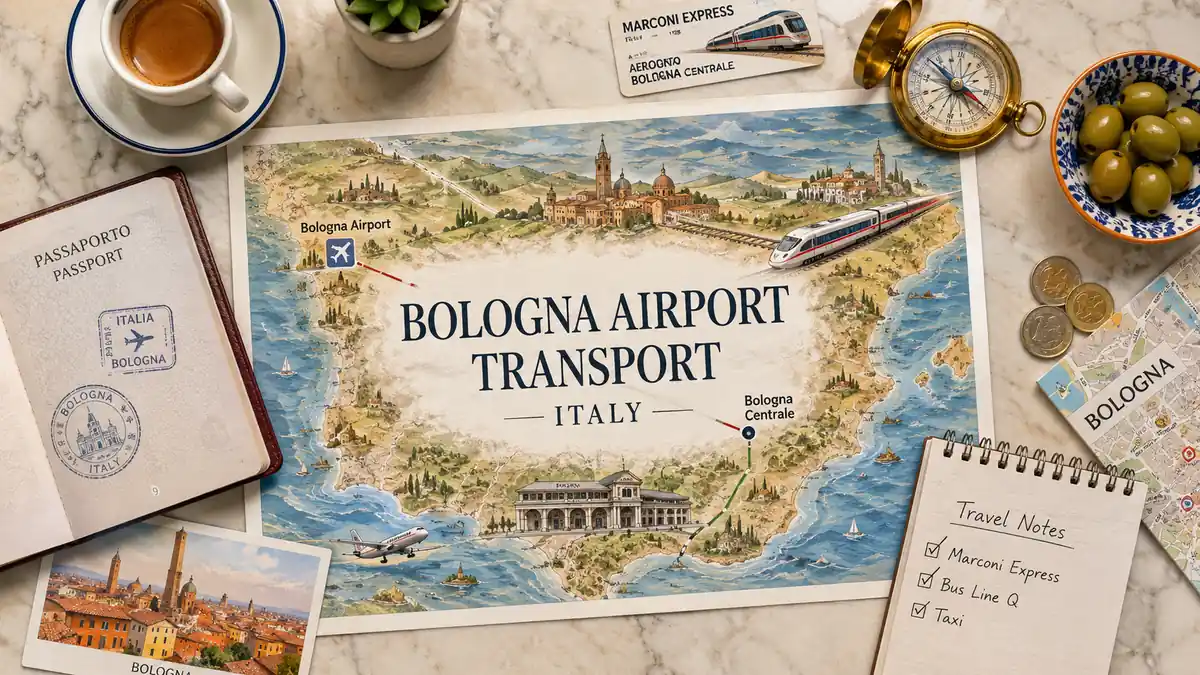
Bologna Airport sits about six kilometres northwest of the city centre, which makes the transfer a short problem with one obvious answer and a handful of exceptions. The Marconi Express monorail is the default: it leaves from a walkway off the terminal, crosses the city on an elevated track and stops at Bologna Centrale, the main railway station. Almost everyone should take it.
Two things catch travellers out, and both are settled below. The first is which bus actually serves the airport now, since the route has changed. The second is what happens after midnight, when the monorail stops and the night bus or a taxi is the only way in. This page covers fares, ticket mechanics, where you board at each end, when paying more for a taxi is the rational choice, and how to plan the return leg so you are not the person sprinting for the last departure.
Quick Answer
The Marconi Express monorail runs from Bologna Airport to Bologna Centrale in seven minutes for €12.80. Tper line Q costs €2.30 but takes around 30 minutes, so the trade is money against time and directness. Take the monorail unless price is the priority, you land after midnight, or a group is splitting a taxi.
Trust Layer
Tripstou planning guide for travelers resolving one travel decision. Covers the main variable, traveler context, and practical tradeoffs.
Produced with AI assistance and reviewed by Alex Perrut, working in tourism since 2015, for the Tripstou editorial team. See our editorial process for details.
Last factual review: July 27, 2026.
Official sources consulted: Italia.it, ENIT.
Key Takeaways
- Take the Marconi Express monorail: seven minutes from the terminal to Bologna Centrale, with departures every few minutes all day.
- Tper line Q is the cheap alternative at €2.30, but it costs you roughly half an hour instead.
- The monorail runs from 05:40 to midnight; after that, line Q covers the airport to Bologna Centrale.
- A metered taxi only wins for groups of four, bulky luggage, or destinations outside the compact centre.
- Your Marconi Express ticket also covers Tper city buses for 75 minutes, so the last mile is usually paid.
- Buy the open-date return on arrival, and leave time for the queue — the seven-minute ride is never the constraint.
Table of Contents
How do you get from Bologna Airport to the city centre?
Take the Marconi Express monorail: seven minutes from the terminal to Bologna Centrale. It is the right choice for almost every arriving traveller because it runs every few minutes, never sits in traffic, and delivers you to the city’s main rail station at €12.80 a head. The alternatives only make sense in specific circumstances.
| Option | Journey time | What you pay | Best for |
|---|---|---|---|
| Marconi Express monorail | 7 minutes, terminal to Bologna Centrale | €12.80 single, €23.30 open-date return | Almost every arrival within operating hours |
| Tper line Q bus | Around 30 minutes, traffic permitting | €2.30 standard urban Tper fare | Budget travellers carrying light luggage |
| Airport taxi | Roughly 15–30 minutes depending on traffic | Metered, typically about €20–30 plus surcharges | Groups, bulky luggage, destinations off-centre |
| Pre-booked private transfer | Similar to a taxi, door to door | Quoted when you book, not metered | Late arrivals and families wanting certainty |
Bologna is a forgiving airport city: the airport is close and the historic centre compact enough that once you reach Centrale, most of it is walkable — the Bologna travel guide sets out the rest. That geography is what makes the decision so simple. Distance is not the variable here. Directness is.
The monorail’s real advantage is not the seven minutes — it is that Bologna Centrale is where your onward train, city bus or short walk already starts, so the transfer ends exactly where the city begins. A cheaper bus that drops you somewhere else can cost you the saving back in a second connection.
How much does the Marconi Express cost?
A single Marconi Express ticket costs €12.80; a return is €23.30. The return is open-dated and valid for twelve months, so buying both legs on arrival costs you nothing in flexibility and saves a second transaction at the gate when you fly home. Families are covered by a separate, cheaper ticket.
The family ticket covers up to two adults and three children aged 5 to 16 travelling together, at €25.60 for a single journey and €48.90 for the return. Children up to the age of four travel free. For two parents with children, that is a materially different price from buying individual fares.
One property of the airport ticket is easy to miss: it also carries you onward on Tper city buses for 75 minutes from validation, so the last leg from Centrale to your accommodation is usually already paid for. How urban tickets, passes and validation work across the city belongs on the guide to getting around Bologna, not here.
The fare feels steep for a seven-minute ride, and travellers say so constantly. It is still usually the right purchase. You are buying twenty-odd minutes back, a guaranteed arrival time immune to ring-road traffic, and a bus transfer folded into the same ticket. Priced against a taxi it is cheap; priced against the bus it is a time purchase, and on a short city break time is the scarcer resource.
Buying a ticket and tapping in at the gate
You do not need to buy anything in advance. Contactless Pay&Go is built into the gates, and it is the fastest way through:
- Contactless Pay&Go: tap a contactless card or NFC device at the gate and travel. The card itself becomes the ticket, so there is nothing to print or validate separately.
- Ticket machines at the stations: available at both the airport station and Bologna Centrale, for single, return and family tickets.
- Online in advance: useful mainly if you want the return leg secured before you land, since it is open-dated anyway.
Use the same card for the same passenger throughout. Group travel is the one case where machine tickets are simpler than tapping.
How long does the Marconi Express take, and how often does it run?
The ride takes 7 minutes, with departures every 7 to 15 minutes. Up to eight trains run each way per hour, and the service operates from 05:40 to midnight, 365 days a year, so within those hours you can simply turn up at the platform without consulting a timetable first.
The line has three stations: Bologna Airport, Lazzaretto and Bologna Centrale. Lazzaretto serves the university and hospital district; almost all visitors ride the full length. The frequency is what makes the service feel effortless — you are rarely waiting longer than it takes to reach the platform.
The one thing worth planning around is the midnight cutoff. It is absolute: a delayed inbound will not hold the last departure. If your flight lands close to it, decide your backup before you fly, not in the arrivals hall; the after-midnight section below covers what runs instead.
Where you board at each end
- At the airport: the station sits on the terminal’s first floor, reached by a covered connecting walkway. You do not leave the building or cross a road.
- At Bologna Centrale: the entrance is off via Carracci, on the northern side of the station complex — a separate entrance from the main rail concourse, so allow a couple of minutes to reach it.
All three stations are step-free and served by lifts, which matters more with a suitcase than most people anticipate. From Centrale the last mile is short. The station sits on the northern edge of the centre, so accommodation on that side is a walk and the southern and western districts are one bus away — where to stay in Bologna covers which side suits which traveller, and getting around Bologna covers the bus.
What is the cheapest way from Bologna Airport to the centre?
The cheapest option is the Tper line Q bus at €2.30. It takes about half an hour instead of seven minutes and runs roughly every 30 minutes, so you are trading around ten euros against roughly 25 extra minutes and a less direct arrival into the city than the monorail delivers.
Line Q is the current airport bus. During the day it runs between the airport and Ospedale Maggiore, on the western side of the city, and it is a standard urban service — no airport premium, no dedicated luggage racks, and the same €2.30 fare as any other Tper bus. Marconi Express tickets are also accepted on it, which is useful if the monorail is out of service.
What you give up is directness as much as time. The bus shares the road, so half an hour is the good case and rush hour is the bad one; there is no luggage hold, and the daytime route does not deliver you to the main station, so an onward connection is often part of the plan. None of that matters much if you are travelling solo with a cabin bag and no fixed check-in time.
Line Q makes most sense when the saving is worth more to you than the arrival experience — a first day with nothing booked, a long stay where small savings compound, or a return flight you are in no hurry to reach. The calculation also shifts with party size: every extra passenger multiplies the monorail fare while the bus stays a fixed cost per head, so the gap widens rather than closes.
How do you get to the city centre after midnight?
After midnight the monorail is closed and line Q becomes the way in. Overnight the bus runs between the airport and Bologna Centrale at Piazzale Medaglie d’Oro, roughly half-hourly, taking around 30 minutes. The monorail restarts at 05:40, so the gap is short but entirely real.
The overnight routing is the useful detail here: at night line Q serves Bologna Centrale, which the daytime route does not, so a late landing still ends at the station. Check exact departures with Tper before you travel, since the night pattern is thinner than the daytime one and a missed bus is a long wait. A metered taxi is the other fallback, with night surcharges applied.
Do this check before you book the flight, not after. A cheap late arrival that lands after the last monorail costs you either a half-hour night bus with your luggage or a surcharged taxi, and that difference is often larger than the fare saving that made the flight attractive.
Taxis and Private Transfers: When Paying More Pays Off
A taxi to the centre is metered and typically runs about €20–30. The exact figure depends on your destination, traffic and time of day, and night and holiday surcharges apply on top. Journey time is roughly 15–30 minutes, because a taxi shares the same road as everyone else leaving the airport.
The arithmetic turns on party size. One or two people pay less on the monorail; four adults are paying four separate fares against a single meter, and the taxi becomes competitive somewhere around three passengers with luggage. The figure above is a guide, not a quote — the meter decides.
A taxi or pre-booked transfer genuinely wins in these cases:
- Four or more travellers splitting one metered fare between them
- Bulky or awkward luggage — sports kit, instruments, several large cases
- Small children, car seats, or anyone who cannot manage station steps and lifts easily
- A destination outside the compact centre, where Centrale is not the natural drop-off
- A very late arrival when the monorail has stopped and you want no waiting
Pre-booked private transfers work differently from taxis: you agree the price when you book and a driver meets you in arrivals, so the cost is known in advance instead of accumulating on a meter. That certainty is what you are paying for.
The family ticket quietly moves the break-even point. Two adults with children stay cheaper on the monorail well past the party size at which four adults would already have switched to a taxi, so families should price the family fare before assuming a group automatically makes a taxi worthwhile.
Tours and activities
Book skip-the-line tickets, day trips and local tours with free cancellation on most activities.
You can also browse everything on getyourguide.com.
Tripstou may earn a commission if you book through this link, at no extra cost to you.
How do you get from the city centre back to Bologna Airport?
Board at Bologna Centrale’s via Carracci entrance and leave more time than the ride needs. The constraint on the return is not the seven minutes but the walk across the city, finding the right entrance, the ticket gate and the queue — and, for early or late flights, the operating hours at each end.
If you bought an open-date return on arrival, this is where it pays off: the ticket is valid for twelve months, so there is nothing to buy and one less queue between you and the platform. Line Q is the cheap return by the same logic as the inbound leg, and the overnight routing means a pre-dawn departure before 05:40 still has a bus option as well as a taxi.
Build the return backwards from the last departure, not forwards from your hotel. Allow for reaching Centrale in the first place — crossing the city is its own leg, and the guide to getting around Bologna covers it — then the walk to the via Carracci entrance, then the gate. The monorail itself is the reliable part of the chain. Everything before it is not.
Frequently Asked Questions
Can you pay with a contactless card on the Marconi Express?
Yes. Contactless Pay&Go is built into the gates, so you tap a bank card or NFC device and travel — the card itself becomes the ticket, with nothing to print or validate. Each traveller taps their own card, so groups usually find machine tickets simpler.
Is there luggage space on the Marconi Express?
Yes. Each passenger can carry two bags free of charge, up to 80×50×50 cm each, which covers a normal checked case plus cabin baggage. Stations are step-free and lifts serve all three, so you never have to carry a case up stairs.
Do children travel free on the Marconi Express?
Children up to four years old travel free. From age five to sixteen they need a ticket, but the family fare covers up to two adults and three children on one purchase, which is cheaper than buying five individual singles. Price it before paying separately.
How far is Bologna Airport from the city centre, and can you walk it?
Bologna Airport sits about six kilometres northwest of the historic centre, so walking is possible in theory but not worth attempting with luggage. The monorail covers the same distance in seven minutes, and line Q does it for a fraction of the fare. Take one of them.
What happens if the Marconi Express is closed or there is a strike?
Replacement shuttle buses run during scheduled maintenance closures, which the operator announces in advance. If the line is down for any reason, Tper line Q accepts Marconi Express tickets, so the cheap bus becomes the fallback at no extra cost. A metered taxi is the faster backup.
How do you get from Bologna Airport to Florence, Modena or Ferrara?
Regional coaches leave directly from the airport, so you do not need to reach Bologna Centrale first. Modena takes around 50 minutes, Ferrara around an hour, and Florence and the Cesena–Rimini coast around 90 minutes each. Check departure times with the operator before relying on a connection.
Related Guides
Three pages carry on from here, depending on what you need next:
- Bologna travel guide — the full picture of the city: what to see, how long to stay, and how the compact centre fits together.
- Getting around Bologna — urban tickets, validation, passes, the ZTL and moving around the city once you have arrived.
- Where to stay in Bologna — which districts suit which travellers, and how each one relates to Bologna Centrale.
Did this guide save you time or money? Tripstou is independent and reader-funded — if you'd like to give something back, you can support the site with a crypto contribution of any size.