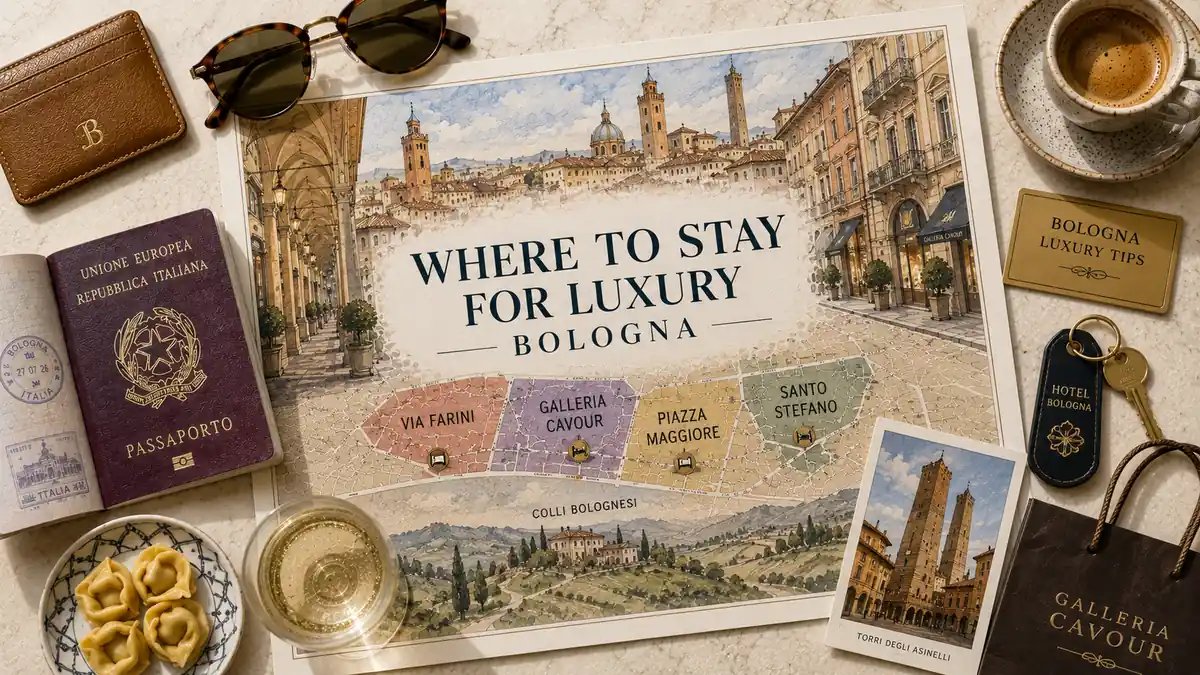
You have chosen Bologna and you are booking at the top of the market. The remaining decision is the address, and most guides answer it badly: they hand you a district list and mark a luxury price rung inside each one. That is not an answer. Bologna’s prestige is not spread evenly across the centro storico — it is concentrated on one specific axis, and “stay in the centre” puts you either on that axis or in the middle of a market crowd, depending on which street you pick. This page resolves the address. It names the best high-end base and who it suits, the calmest alternative inside the walls, the hills option outside them, the central area to rule out despite its location, and the arrival friction that matters when you turn up by car or private transfer. The property choice gets simple once the street is settled.
Quick Answer
Via Farini and the Galleria Cavour arcade are Bologna’s best luxury base, suiting travelers who want discreet elegance. The address buys quiet, boutique-lined streets and full walkability, in exchange for a less monument-facing setting than Piazza Maggiore. Choose Santo Stefano for the calmest residential base, or the Colli Bolognesi hills for space and a spa.
Trust Layer
Tripstou stay guide for travelers choosing where to base. Covers area atmosphere, budget, convenience, noise, and traveler fit.
Produced with AI assistance and reviewed by Alex Perrut, working in tourism since 2015, for the Tripstou editorial team. See our editorial process for details.
Last factual review: July 27, 2026.
Official sources consulted: Italia.it, ENIT.
Key Takeaways
- Bologna’s best luxury base is the Via Farini and Galleria Cavour axis: prestigious, quiet, boutique-lined and fully walkable.
- The core tradeoff is monuments against calm: Piazza Maggiore puts sights at the door and market noise under the window.
- Santo Stefano is the quietest high-end address inside the walls, which makes it the pick for light sleepers and longer stays.
- The Colli Bolognesi hills buy grounds, space and a spa, but require a car and turn the city into an excursion.
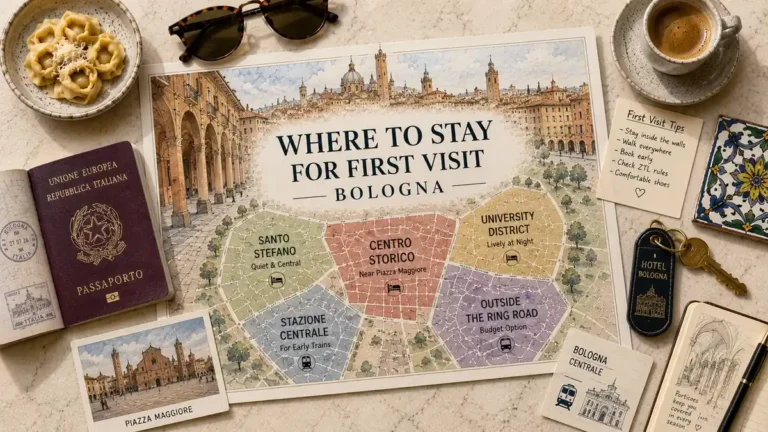
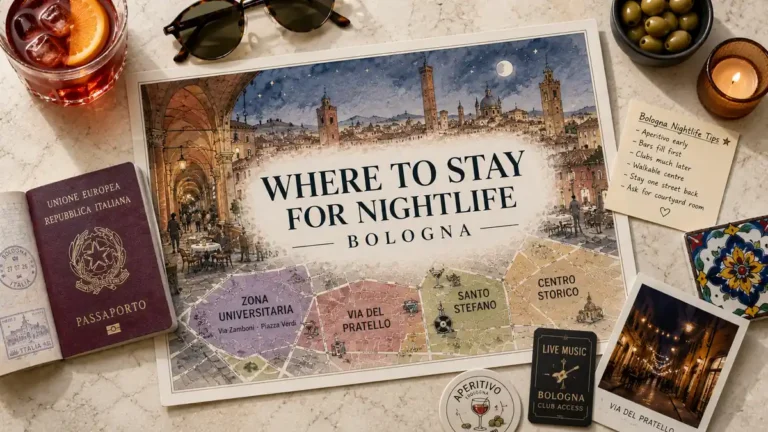
- Zona Universitaria is central and walkable yet structurally wrong for a luxury stay, because student evenings are the quarter’s design.
- Arriving by car is routine inside the restricted zone once your hotel registers the plate, so send it before you travel.
Table of Contents
Via Farini and Galleria Cavour are Bologna’s best luxury base
Via Farini and Galleria Cavour form Bologna’s best luxury base. The axis is the centro storico’s most prestigious and boutique-dense stretch, and its evenings stay quiet while everything historic remains on foot. It suits travelers who want a discreet, elegant address instead of a monument-facing one.
The axis runs from Via Farini through the glass-roofed Galleria Cavour arcade and on toward Via Santo Stefano, all of it inside the historic centre. This is Bologna’s money quarter in the old sense — jewellers, tailors and international fashion houses under the porticoes, with private apartments on the floors above. The frontage is expensive and unhurried.
Day to day it feels reserved. Shoppers pass through in the afternoon, the arcade empties early, and the evening volume that defines other parts of the centre never really arrives here. Everything in the historic core is walkable from the axis, so nothing about the stay requires transport or planning.
On price this is the top tier of the Bologna market, and it is also where the city’s high-end inventory concentrates: grand historic buildings and design-led small properties sit within a few blocks of each other along the same stretch. Once the area is settled, our guide to luxury hotels in Bologna handles the property choice.
The honest cost is the view. This is a shopping-and-residential address, so the window looks onto porticoes and boutique signage instead of towers or a piazza, and a first-time visitor who wants the monument outside the glass should read the next section.
In Bologna the prestige address and the postcard address are two different streets, which is unusual for an Italian city this size. Booking the famous square is a sightseeing decision; booking Via Farini is a comfort one.
Best for: travelers who want a discreet, elegant address with quiet streets and boutiques at the door.
Is the centro storico around Piazza Maggiore right for a luxury stay?
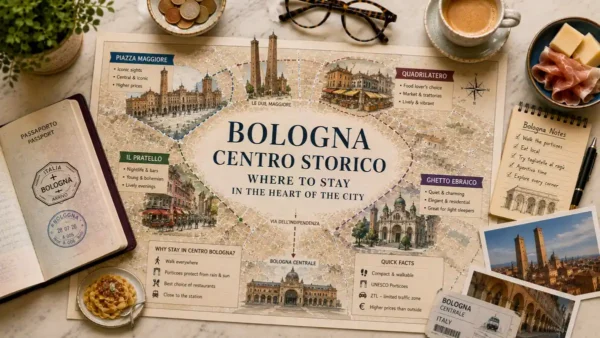
Yes, with one condition: you accept footfall. The ceremonial core around Piazza Maggiore and the Quadrilatero puts Bologna’s monuments outside the door and its market rhythm under the window. It is the right choice for a first high-end visit and the wrong one if quiet is what luxury means to you.
The area is the square itself, the Quadrilatero’s market lanes beside it, and the streets radiating out from both. It wakes early, since deliveries and market setup start well before the cafés do, stays busy through the day, and keeps a steady flow of people until the evening. None of that is nightlife noise. It is a working city centre heard at close range.
Convenience is the strongest argument for paying here. Nothing needs planning: every major sight, the porticoed shopping streets and the Via Farini axis are all a short walk from the door, and the high-end properties on this side trade on exactly that. On price it sits in the same high-end band as the axis, with square-facing rooms carrying the premium. For street-level depth on the district, read our guide to Bologna’s centro storico.
This address suits first-time high-end visitors and short trips, where location is doing real work — you see more because you walk less. It suits light sleepers, returning visitors and long stays poorly. Same historic centre, different stay entirely.
The noise here is a morning problem more than a late-night one, so the usual advice about booking away from bars misses the point. The question worth asking your hotel is which side of the building faces the market lanes.
Best for: first-time visitors who want the monuments and the Quadrilatero on the doorstep and accept a busier setting.
Santo Stefano is the quietest high-end address in Bologna
Santo Stefano is the quietest high-end address inside Bologna’s walls. It is the residential end of the same upscale axis, built of handsome heritage buildings and small-scale properties, and it stays genuinely calm after dark while remaining walkable to everything. It suits light sleepers and anyone booking a longer stay.
The character is residential first. Via Santo Stefano widens toward the basilica complex and its sloping piazza, and the buildings along it are houses and palazzi with a small number of boutique-scale stays folded in among them. Evenings are quiet in a way the rest of the centre is not, because people here are going home.
It sits inside the walls and stays walkable to the core, only a little further out, which is the entire point of choosing it. The tradeoff is that less happens at the door: fewer places to step into on impulse, and a longer walk back from dinner than from Piazza Maggiore. Price sits in the same high-end band as the Via Farini stretch.
For the full neighbourhood picture, see our Santo Stefano guide, and if the choice has narrowed to two, our centro vs Santo Stefano comparison settles it. This is the quietest luxury option in the city; only the hills are quieter, and they cost you the walk.
Quiet in Bologna tracks what the ground floors do more than how far you are from the square. Santo Stefano is calm because its ground floors are front doors, and that holds even on the stretch closest to the centre.
Best for: light sleepers and returning visitors who want the calmest, most residential high-end base.
The Colli Bolognesi hills trade the city for space, grounds and a spa
The Colli Bolognesi hills hold Bologna’s villa, resort and spa stays, outside the walls and above the city. They buy space, grounds and seclusion that no central address can offer. They suit travelers who want the property to be the trip more than they want to walk into town.
The hills begin immediately south of the city and climb quickly into open country. What you get is a self-contained stay: gardens and grounds, long views back over the rooftops, a pool or a spa as the centre of the day, and silence at night. Nothing inside the walls comes close to that.
A car is required. Every trip into the city becomes a drive that ends at the edge of the restricted zone, so Bologna turns into a planned excursion — a lunch, a museum, an evening out — instead of somewhere you wander into on foot.
On price the hills read as high-end in a different currency: you are paying for land and facilities, and the money buys square metres the centro storico cannot sell you. The hills win on longer stays, on trips where a car is already booked, and for travelers who want a rural base with the city as an occasional day out. They are a mistake on a short first visit and for anyone picturing a walk out to dinner each evening. If the wider trip is still taking shape, our Bologna guide covers the planning around it.
A hills stay works when the drive back up is the last event of the day. Going down and returning for a single dinner rarely feels worth it, so the honest version of this base is one city trip a day — build the itinerary that way and it is excellent.
Best for: travelers with a car who want space, grounds and a spa over city walking.
Zona Universitaria and the other areas to rule out for a luxury stay
Zona Universitaria is central, walkable and still the wrong base for a luxury stay. It is the student quarter, and loud, young evenings are the design of the place, not an accident. The station surrounds, the Fiera district and the outer residential quarters fail the same test for different reasons.
Zona Universitaria, around Via Zamboni, is genuinely characterful and close to everything, but it is built around student life and the volume that comes with it, and its accommodation stock follows that market rather than the high-end one. Read our Zona Universitaria guide if the character appeals anyway, or our centro vs Zona Universitaria comparison if you are weighing it against the historic core.
The other three go quickly. The streets around Bologna Centrale are convenient for arrivals and short on everything else at this budget: plain, busy, and without the character you are paying for. The Fiera district north-east of the centre exists for business travel — functional inventory, well organised, detached from the historic city you came to see. The outer residential quarters are calm and pleasant, and from them every element of the trip becomes a journey, which defeats the point of paying for a Bologna address.
Can you drive to your hotel inside Bologna’s ZTL?
Yes. Hotels inside Bologna’s restricted zone register their guests’ licence plates with the city, so arriving by car at a central address is routine and produces no fine. The one requirement is telling the hotel your plate — send it before arrival, or hand it over at the desk as you check in.
The ZTL covers the historic centre and operates 07:00–20:00 every day, enforced electronically at the entry points. Confirm the current window with your property when you book, since Italian cities revise access rules periodically.
In practice, plate registration is the whole procedure. Send the registration number and your arrival time when you book or a day or two ahead, and the hotel files it with the city; hire cars, private transfers and a simple drop-off at the door all work the same way. It matters more at this end of the market, because more guests arrive on four wheels.
Parking itself is handled property by property. Central hotels work through nearby garages or a valet arrangement, availability varies by building, and it is worth confirming at booking rather than on the day. Many properties can also issue a daily pass valid in the paid blue-line zones, so ask whether yours does before you plan to leave a car on the street.
One variable is easy to underestimate: luggage over porticoed and partly cobbled streets is harder work than it looks, and the closer a car can reach the door, the less that matters. Walking in from Bologna Centrale is fine with a light bag and unpleasant with a full set of cases.
Best luxury areas in Bologna by traveler type
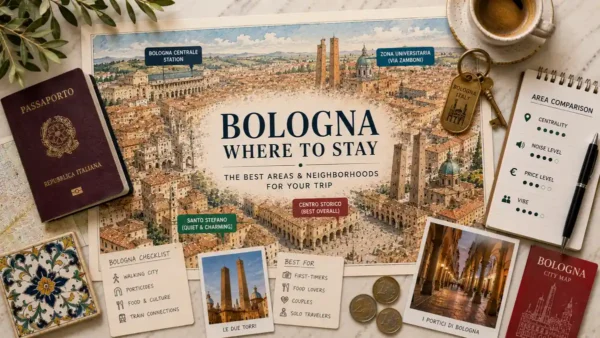
Each kind of high-end traveler has one clear Bologna address. First visits belong in the ceremonial centre, discretion belongs on Via Farini, quiet belongs in Santo Stefano, and space belongs in the hills. The list below matches traveler to area, and the table underneath shows what separates them.
- First-time high-end visitor → Piazza Maggiore and the Quadrilatero — the monuments are the reason you came, and here they are outside the door.
- Returning visitor or longer stay → Santo Stefano — the sightseeing pressure is gone, so residential calm earns more than central minutes.
- Light sleeper → Santo Stefano — the calmest address inside the walls, because its ground floors are front doors.
- Traveler who wants a discreet, elegant address → Via Farini and Galleria Cavour — prestige without the tourist flow at the entrance.
- Traveler arriving by car or private transfer → the Via Farini side of the centre — plate registration makes the ZTL a non-issue and the streets take a drop-off calmly.
- Traveler who wants space, grounds and a spa → the Colli Bolognesi hills — the only base where the property itself is the destination.
| Area | Character | Quiet | Walkable to the sights | Relative price |
|---|---|---|---|---|
| Via Farini and Galleria Cavour | Discreet, boutique-lined, residential above | Quiet through most evenings | Everything historic within an easy walk | Top of the high-end band |
| Piazza Maggiore and the Quadrilatero | Ceremonial, monumental, market-driven | Busy from early morning onward | The main sights are at the door | High-end, premium for square views |
| Santo Stefano | Residential, heritage, low-key | The calmest choice inside the walls | Walkable, slightly further from the core | High-end, comparable to the axis |
| Colli Bolognesi hills | Villa and resort stays with grounds | Silent, well outside the city | Not walkable; a car is required | High-end, paying for space and facilities |
If the budget question is more open than this page assumes, our full guide to where to stay in Bologna maps every area across every budget and traveler type.
Hotels and places to stay
Compare hotels, apartments and stays for your dates in one search.
Search hotels and stays on hotels.com →
Tripstou may earn a commission if you book through this link, at no extra cost to you.
Frequently Asked Questions
Where do the wealthy live in Bologna?
Bologna’s wealth concentrates on the Via Farini, Galleria Cavour and Via Santo Stefano axis inside the historic centre, the city’s most prestigious residential and retail stretch. The second concentration sits outside the walls in the Colli Bolognesi hills, where villas and private grounds replace apartments above the porticoes.
Is Bologna’s upscale area walkable to Piazza Maggiore and the main sights?
Yes. Bologna’s upscale axis sits inside the historic centre, and the walk to Piazza Maggiore and the main monuments runs under porticoes the whole way. No transport is needed, and the cover matters in rain and summer heat. That walkability is the main reason the axis beats an out-of-town base.
Is the centre of Bologna noisy at night?
Parts of it are. The Quadrilatero market lanes and the Zona Universitaria side around Via Zamboni carry the evening volume, while the Via Farini and Santo Stefano stretch stays quiet after dark. Choosing between them matters more than the hotel’s soundproofing when calm is the priority.
Do luxury hotels in Bologna have parking or valet?
Many do, through nearby garages or a valet arrangement, not on-site car parks. The historic centre is built of heritage palazzi, so few buildings have space for their own garage. Confirm the arrangement when you book, and give the hotel your plate so the restricted zone stops being an issue.
Is Santo Stefano too far from the centre for a short luxury trip?
No, but it is the wrong trade on a short trip. The walk to the monuments is easy, yet fewer places sit at the door, so short stays lose time and spontaneity. Book Santo Stefano when the trip is long enough that evening calm outweighs central convenience.
Does the Bologna trade fair season affect where you should stay?
It can. Bologna hosts large trade fairs, and citywide demand tightens when one is running, which narrows choice across every area, not just near the fairgrounds. Check whether your dates overlap a fair before you commit to an address, and book the area you want early.
Related Guides
- Luxury hotels in Bologna — the property shortlist once your area is chosen.
- Where to stay in Bologna — the full area map across all budgets and traveler types.
- Bologna’s centro storico — street-level detail on the ceremonial centre.
- Santo Stefano neighbourhood guide — the quiet, residential end of the upscale axis.
- Zona Universitaria guide — the university quarter in full.
- Centro vs Santo Stefano — the two-way choice resolved.
- Centro vs Zona Universitaria — central character against central calm.
- Bologna travel guide — wider city planning around your stay.
Did this guide save you time or money? Tripstou is independent and reader-funded — if you'd like to give something back, you can support the site with a crypto contribution of any size.