Two days in Hamburg work best as a Saturday and a Sunday. Spend Saturday in the centre: the Rathaus, then the Speicherstadt and HafenCity with the Elbphilharmonie Plaza, and the Reeperbahn after dark. Sunday starts early at the Fischmarkt and moves to the harbour at Landungsbrücken, with the Alter Elbtunnel and the public ferry 62, then on to the Michel. It ends with an afternoon in the Schanze or a late Miniatur Wunderland slot. The order is built around one fact: the Fischmarkt runs on Sunday only and closes mid-morning. Everything else can move around it.
The route assumes a weekend break, one base for two nights and no car. Each half-day covers one area on foot, and the harbour leg is one ferry ride on a normal transport ticket.
On This Page
Is two days enough for Hamburg?
Two days are enough for a first visit to Hamburg. They cover what most people come for: the harbour, the warehouse district with the centre, and St. Pauli. They do not leave time for the museums in any depth or for a day trip. One day only scratches the surface.
The route suits a first-time weekend break without a car, where the river and the brick warehouses matter more than the galleries. A third day is where the Kunsthalle, the Maritime Museum or an excursion to Lübeck fit. Two days give you the city’s shape, and the third gives it depth.
If Hamburg is one stop on a longer trip, the two days slot into the national route covered in our Germany travel guide, which handles the cities before and after it.
Does the season change the route?
The order stays the same all year. What changes with the season is how early Sunday starts, what Advent adds, and what replaces the ferry when it rains.
The Fischmarkt opens earlier from April to October than from November to March, so a summer Sunday starts at first light and a winter one a little later. The exact hours are under Day 2. In Advent the route passes two markets anyway, the Rathausmarkt market on Day 1 morning and Santa Pauli on Spielbudenplatz on Day 1 evening. Our guide to Germany’s Christmas markets covers them. On a wet day, swap the ferry leg for Miniatur Wunderland, the Kunsthalle or the Maritime Museum. The Hamburg Dungeon and the Chocoversum sit inside the Speicherstadt if you need one more indoor stop close to Day 1’s afternoon.
The route at a glance: Saturday on the water, Sunday from the Fischmarkt
Saturday is a compact walk from the centre down to the harbour, with the Elbphilharmonie Plaza as its high point and the Reeperbahn as its evening. Sunday is fixed by the Fischmarkt at dawn and follows the Elbe, so the two days barely cross the same ground.
| Day | Morning | Afternoon | Evening |
|---|---|---|---|
| Day 1 (Saturday) | Rathaus, Binnenalster, Deichstraße | Speicherstadt, HafenCity, Elbphilharmonie Plaza | Reeperbahn, Große Freiheit |
| Day 2 (Sunday) | Fischmarkt at dawn, then Landungsbrücken, Alter Elbtunnel, ferry 62 | St. Michaelis, then Sternschanze or a late Miniatur Wunderland slot | Free: dinner near your base |
Each half-day stays in one area, on foot, with one ferry ride in the whole weekend. Many other plans put the museums on the first day and the harbour on the second. That split falls apart on a Saturday arrival, because the market only trades on a Sunday morning. Putting the water-facing sights on Saturday keeps Sunday morning free for the one stop that cannot move.
Day 1: Rathaus to the Elbphilharmonie, then the Reeperbahn
Saturday runs downhill from the centre to the water. Start at the Rathaus and the Alster in the morning, reach the Speicherstadt and HafenCity after lunch for a pre-booked Plaza slot, and spend the night in St. Pauli. It is all on foot except the ride out to the Reeperbahn.
Morning: Rathaus, the Alster and the walk down to the warehouses
The Rathaus and its square are the obvious starting point, because every other Day 1 stop lies south of them, towards the river. From Rathausmarkt, walk under the Alsterarkaden and along Jungfernstieg on the Binnenalster. That is the city’s lake-and-arcade side, and you won’t see it again on this route. Then head south through Deichstraße, a street of old merchants’ houses, and past the ruined tower of the St. Nikolai memorial. Pick up a Franzbrötchen, the cinnamon pastry any bakery sells, along the way. The warehouses start a short walk further on.
Afternoon: Speicherstadt, HafenCity and the Elbphilharmonie Plaza
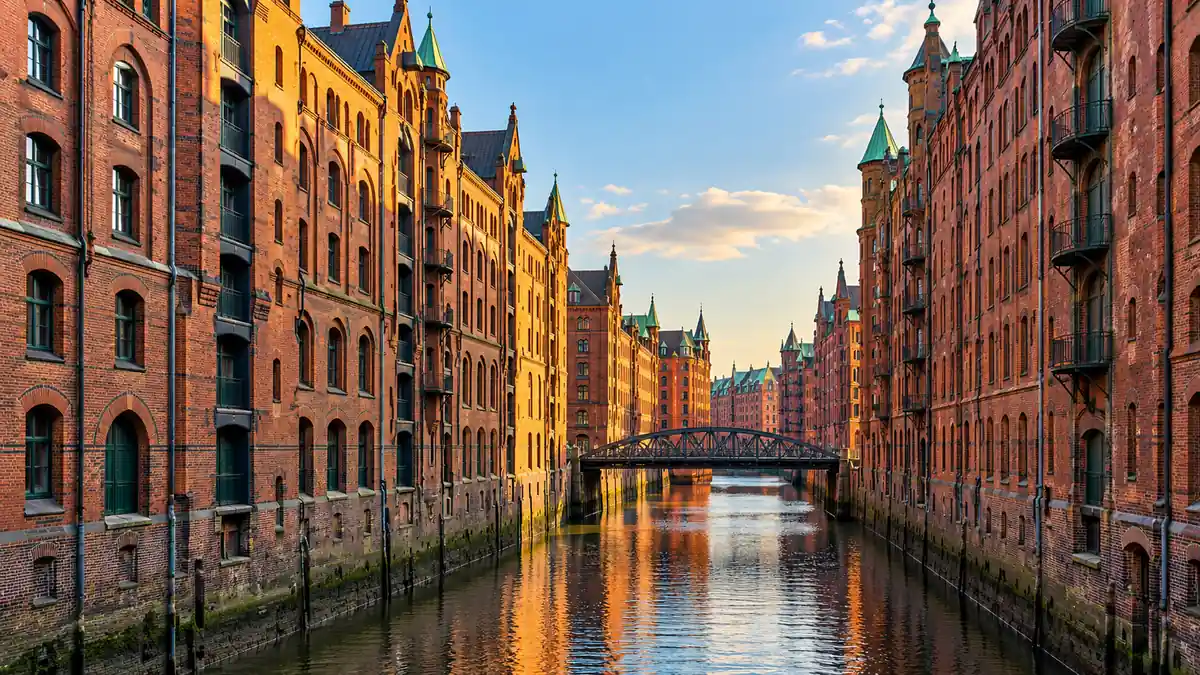
The afternoon belongs to the water. Cross into the Speicherstadt, the red-brick warehouse district built on canals, then carry on into HafenCity, the new quarter that ends at the Elbphilharmonie. The booked Plaza slot sets the pace. The open-air viewing level wraps around the building above the harbour, and it is the best view of Day 1.
Miniatur Wunderland is also in the Speicherstadt, but the route moves it to a late Sunday slot. A Saturday before mid-afternoon falls in its peak-demand window. If you already hold a Saturday Wunderland booking, fit it in here and push the Plaza later in the day. Leave west along the water towards Landungsbrücken on foot, or take the U-Bahn.
Evening: the Reeperbahn and Große Freiheit
The Reeperbahn is the evening because the street only comes alive after dark. Walk it end to end, then turn into Große Freiheit and stop at Beatles-Platz, where the band’s Hamburg years are marked in steel outlines. It is also next door to the Fischmarkt, so the night and the next dawn sit in the same corner of the city.
Skip it, or keep it short, if you want to be at the market when it opens. A late night and a dawn start rarely go together.
Day 2: Fischmarkt at dawn, then the harbour by ferry
Sunday starts before breakfast at the Fischmarkt, because the market closes at 9:30. From there the day stays by the river: Landungsbrücken, the Alter Elbtunnel and a ride out and back on ferry 62. Then it climbs to the Michel and ends either in the Schanze or at a late Miniatur Wunderland slot.
Dawn: the Sunday Fischmarkt
The Fischmarkt is held on Sunday only, by the Elbe in Altona, and closes at 9:30. It opens at 5:00 from April to October and at 7:00 from November to March. Stalls line the riverfront outside, and the Fischauktionshalle at the centre is the indoor half, with live music and a breakfast crowd. Arrive early, because by mid-morning the market is packing up. Walk east along the water to Landungsbrücken afterwards.
Late morning: Landungsbrücken, the Alter Elbtunnel and ferry 62
Landungsbrücken is the base for the rest of the morning. First go down into the Alter Elbtunnel, walk under the river to the south bank for the skyline view, and walk back.
Then board ferry 62 at Brücke 3, heading towards Finkenwerder. The boat passes the Blohm + Voss shipyard, the Fischauktionshalle, the Dockland building and Övelgönne, with the villas of Blankenese further downriver. Get off at Övelgönne for the museum harbour and the Elbe beach, then ride back. A normal HVV ticket covers the trip. Back at the piers, a Fischbrötchen at Brücke 10 is lunch.
Paid harbour cruise or the public ferry 62?
On this route the public ferry wins: it covers the same water on the same ticket, and you can get off at Övelgönne. A paid harbour cruise is only worth it if you want live commentary or the inner docks and warehouse canals, which a scheduled ferry does not enter.
That distinction matters because the commentary is the real product. The ferry shows you Blohm + Voss and the container cranes, but nobody tells you what you are looking at. If the shipyards and the Speicherstadt canals are why you came, a narrated cruise from Landungsbrücken can replace the ferry ride and take the same slot in the morning.
Hop-on hop-off buses solve a different problem. They suit travelers who would prefer not to walk Day 1 from the Rathaus to the harbour, and the circuit links the same areas. If that is your pace, you can book a bus pass and use it for the Saturday legs.
Afternoon: the Michel, then the Schanze or a late Wunderland slot
St. Michaelis, the Michel, is a short walk uphill from the piers and anchors the afternoon. The Krameramtswohnungen, a narrow court of old almshouse flats, are right beside it. Labskaus, the sailors’ hash of corned beef and potato, is the dish to order at the Old Commercial Room nearby.
The day then splits two ways:
- Sternschanze: walk north through Planten un Blomen into the Schanzenviertel for cafés, independent shops and a street-level end to the weekend. This is the choice for travelers who would sooner wander than queue.
- A late Miniatur Wunderland slot: take the online late slot, which is discounted and falls after the daytime rush. This is the ending for anyone travelling with children, or anyone who has wanted to see the model railway for years.
Tours and activities
Book skip-the-line tickets, day trips and local tours with free cancellation on most activities.
You can also browse everything on getyourguide.com.
Tripstou may earn a commission if you book through this link, at no extra cost to you.
What if your two days aren’t Saturday and Sunday?
If your two days are not a weekend, drop the Fischmarkt and keep the geography. Start the second day at Landungsbrücken with a Fischbrötchen at Brücke 10, and the rest of Day 2 stays the same. Nothing else on the route depends on the day of the week.
One thing improves on weekdays. Outside school holidays, demand at Miniatur Wunderland is lower, so a daytime slot becomes realistic and you can keep the afternoon free. Don’t reverse the days, though. Day 1’s Plaza slot and the Reeperbahn evening still work best as the opening day, and Day 2’s riverfront morning works on any day.
Book these two things before you arrive
Only two bookings decide whether this route works: a timed Miniatur Wunderland slot and an Elbphilharmonie Plaza slot. Everything else on the route is walk-up.
- Miniatur Wunderland: an advance ticket guarantees entry within your booked slot. Demand peaks between 9:00 and 15:00 and is worst on weekends and holidays. Without a booking, the wait at those times can run to hours. Late slots booked online are discounted, which is why the route puts Wunderland at the end of Sunday.
- Elbphilharmonie Plaza: a pre-booked Plaza ticket gives guaranteed access at the time you choose, so Saturday afternoon has a fixed point to build around. A concert ticket already includes Plaza access from two hours before the performance.
Book a Plaza slot online in advance and set the rest of Saturday afternoon around it.
Where to base yourself for two nights
Stay in one base for both nights. The choice is between the Altstadt and HafenCity side, where Day 1 starts at your door, and St. Pauli or Sternschanze, where the nightlife and the Sunday Fischmarkt are within walking distance.
The Altstadt and HafenCity side keeps sightseeing compact. The Rathaus, the Speicherstadt and the Plaza are all close, and you take the U-Bahn out to St. Pauli and back. It suits a weekend that leans towards architecture and the harbour, with quiet evenings.
St. Pauli and Sternschanze put the Reeperbahn and the Fischmarkt within walking distance. That decides it for anyone who plans to be at the market when it opens, because no early train is needed. Day 1 then begins with a ride into the centre instead.
On a two-day route, your Sunday start time should decide the base, not the room price. What a night costs, the bed tax and whether a Hamburg Card pays off are covered in our guide to what Germany costs per day.
Hotels and places to stay
Compare hotels, apartments and stays for your dates in one search.
Search hotels and stays on hotels.com →
Tripstou may earn a commission if you book through this link, at no extra cost to you.
How you move between stops: on foot, U-/S-Bahn and the ferries on one ticket
Most of the route is on foot. You need the U-Bahn or S-Bahn for two longer hops, out to the Reeperbahn and back from the west side. The harbour ferries run on the same HVV ticket or the Hamburg CARD. You won’t need a car or taxis.
On Day 1, the walk from the Rathaus through the Speicherstadt to the Elbphilharmonie is continuous, and only the move to St. Pauli justifies a train. On Day 2, the walk from the Fischmarkt to Landungsbrücken and up to the Michel is on foot, and the Schanze or the Wunderland ending is a short ride or walk. In practice, the ferry ride is just another transport journey. There is no separate boat ticket to buy.
Whether a Hamburg Card or a day ticket pays off depends on how many rides you take. It is worth it if the ferry, the two rail hops and your trip from the airport add up, and if the card includes discounts on entrances you would buy anyway. If you walk most of the route, single tickets often do the job.
With one day or three: what to cut and what to add
With one day, keep Day 1’s afternoon and evening and add the ferry. That means the Speicherstadt, HafenCity and the Plaza, a ride on ferry 62, and St. Pauli at night. Drop the Rathaus morning and the Fischmarkt. With three days, add one of Lübeck, Blankenese and Övelgönne by ferry, or Helgoland by ship.
Each option suits a different kind of third day:
- Lübeck: a second old town, compact and medieval, for anyone who wants Hanseatic architecture after Hamburg’s harbour modernity.
- Blankenese and Övelgönne: a slow day by the river, reached from Landungsbrücken by ferry, with a climb through Blankenese’s stairs quarter. No booking needed.
- Helgoland: a long day at sea to Germany’s offshore island, for travelers who count the boat trip as the point.
Helgoland is the only one of the three that needs planning ahead, because the day is built around the ship. If the open sea appeals, you can book this day trip from Hamburg. A wet third day follows the same swaps as the season section above. The one-day version loses the Fischmarkt, so there is no reason to fit a day trip around a Sunday.
How This Route Was Checked
This page plans one two-day route through Hamburg: its order, its pacing, the two bookings it depends on and how it shrinks to one day or stretches to three. It is not a Hamburg city guide, a things-to-do list, a hotel roundup or a guide to transport and costs.
Alex Perrut, working in tourism since 2015, went over this route for the Tripstou editorial team after it was written with AI assistance; our editorial process sets out how that works.
Official sources consulted: Hamburg Tourism (Fischmarkt), Hamburg Tourism (harbour ferries), Elbphilharmonie Hamburg, Miniatur Wunderland.
Two Questions Before You Go
How do you get from Hamburg Airport to the city centre?
Take the S-Bahn: it runs from the airport straight into the centre, so you won’t need a taxi. From the centre, either base is easy to reach, and the ride counts towards the Hamburg Card or day-ticket sums in the getting-around section.
What should you eat in Hamburg in two days?
Eat the three things the route already passes: a Franzbrötchen from a bakery on Saturday morning, a Fischbrötchen at Brücke 10 for Sunday lunch, and Labskaus at the Old Commercial Room by the Michel that afternoon. The Franzbrötchen is a flattened cinnamon pastry, the Fischbrötchen a fish roll eaten standing at the piers, and Labskaus a sailors’ hash of corned beef and potato. Together they cover the city’s sweet, quick and hearty sides without a detour, and the Fischmarkt adds a fourth option if you want breakfast at the stalls.
Keep Planning
- Germany travel guide: the wider Germany plan this Hamburg weekend fits into.
- Germany trip cost: what Hamburg and the rest of Germany cost per day, the Hamburg Card included.
- Germany’s Christmas markets: Hamburg’s markets, if your weekend falls in Advent.
Did this guide save you time or money? Tripstou is independent and reader-funded — if you'd like to give something back, you can support the site with a crypto contribution of any size.