The Munich Christmas markets to see first are the three in the Old Town that you can walk between: the Christkindlmarkt (Christ-child market) on Marienplatz, the Kripperlmarkt (nativity market) by St Peter’s Church, and the Christmas Village in the courtyard of the Residenz palace. Add the Medieval Christmas market at Wittelsbacherplatz for atmosphere and food. For a different kind of evening, swap in Tollwood on the Theresienwiese or Pink Christmas in the Glockenbachviertel. The core sits within a short walk, so one evening covers it.
Munich’s markets are not copies of each other. Some are civic and crowded, some are small and theatrical, a few are neighbourhood squares where locals meet after work. So the markets below are grouped by what they are for, with a walking order at the end, for a first Advent visit with a few evenings to spend.
Sources and Scope
This page picks Munich’s Christmas markets by character and by who each one suits, then sets a walking order between them; it is not a dated calendar of the season, a comparison of German cities or a guide to Munich’s sights.
Alex Perrut, working in tourism since 2015, went over this market selection for the Tripstou editorial team after it was written with AI assistance. How we work is set out in our editorial process.
Official sources consulted: Munich Christkindlmarkt (City of Munich), Munich official city portal.
Three Old Town markets are the core; add one more by mood
Marienplatz, the Kripperlmarkt and the Residenz Christmas Village are the core because they are the classic Munich Christmas scene and they sit minutes apart on foot. Marienplatz gives you the tall tree in front of the New Town Hall, the Kripperlmarkt next door keeps the nativity tradition, and the Residenz courtyard adds a village of huts inside the palace walls. Everything else is an add-on chosen by mood: the Medieval market for atmosphere, Tollwood or Pink Christmas for an evening off the traditional script, the Chinese Tower, Haidhausen or Schwabing for calm, and the Märchenbazar for children.
The shortlist carries one tension. The core is where the crowds are thickest, and the markets with the most character are the small ones, which fill up fast on weekend evenings. Pair one of each and the evening has both the postcard and the memory.
If you are still deciding which German city to spend Advent in, see Germany’s Christmas markets compared by city before committing to Munich.
| Market | Setting | Suits | Vibe |
|---|---|---|---|
| Marienplatz Christkindlmarkt | Main square, New Town Hall | First-timers | Classic, packed |
| Kripperlmarkt | Beside St Peter’s Church | Tradition and crafts | Quiet, specialist |
| Residenz Christmas Village | Palace courtyard | Photos, sheltered stroll | Alpine village |
| Sendlinger Tor | Old Town gate | End of the walk | Neighbourhood |
| Medieval market | Wittelsbacherplatz | Atmosphere and food | Costumed, theatrical |
| Pink Christmas | Stephansplatz, Glockenbachviertel | A social night out | Lively, stage shows |
| Tollwood | Theresienwiese | Alternative evening | Festival, eco-minded |
| Chinese Tower | English Garden | Calm afternoon | Park, relaxed |
| Haidhausen | Weißenburger Platz | A local evening | Small square |
| Märchenbazar | Tents; site varies | Families | Fairy-tale |
The Old Town classics you can walk between
Marienplatz, the Kripperlmarkt, the Residenz Christmas Village and Sendlinger Tor sit a short walk from each other and make the obvious first evening. Marienplatz is the one every visitor sees. The Kripperlmarkt, a few steps away, is the one most people walk past.
Marienplatz Christkindlmarkt
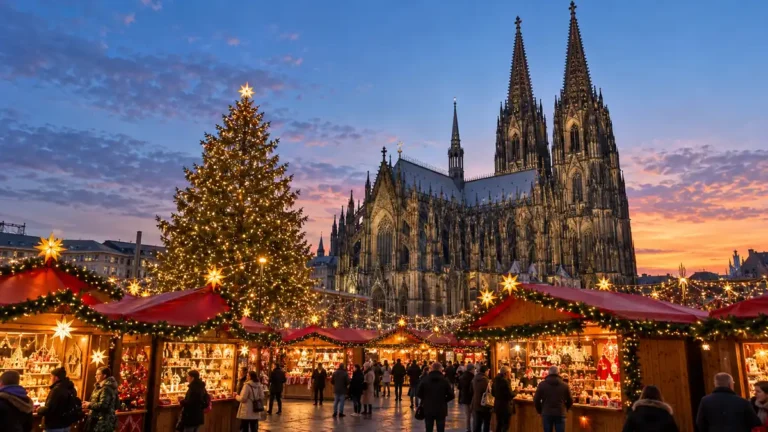
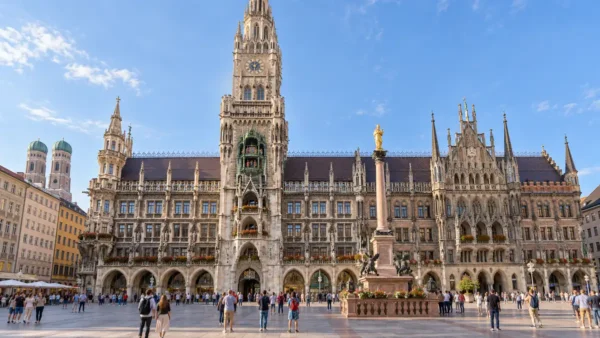
The Christkindlmarkt on Marienplatz is Munich’s flagship market, run by the City of Munich itself. A tall Christmas tree stands in front of the neo-Gothic New Town Hall, and the stalls spread out from the square into the streets around it. The market traces its roots to the medieval St Nicholas markets and has filled Marienplatz for decades. Expect the densest crowds in the city here, especially after dark at weekends.
Families with children can book the Himmelswerkstatt, a free craft workshop inside the Town Hall that requires registration. The market also lists barrier-free access, induction loops at the carol singing and guide dogs welcome among its accessibility features.
Marienplatz and the Old Town stalls around it are also the ground covered by guided Christmas-market food walks, where a guide explains what is in each mug and pan. That suits a first evening when you do not yet know a Dampfnudel from a Schupfnudel.
Kripperlmarkt by St Peter’s
The Kripperlmarkt sells nativity figures, crib buildings and the small parts to complete them, and the city describes it as probably Germany’s largest nativity market. Come here for the craft tradition, not the food. It is noticeably quieter than the main square despite standing right beside it.
Christmas Village in the Residenz courtyard
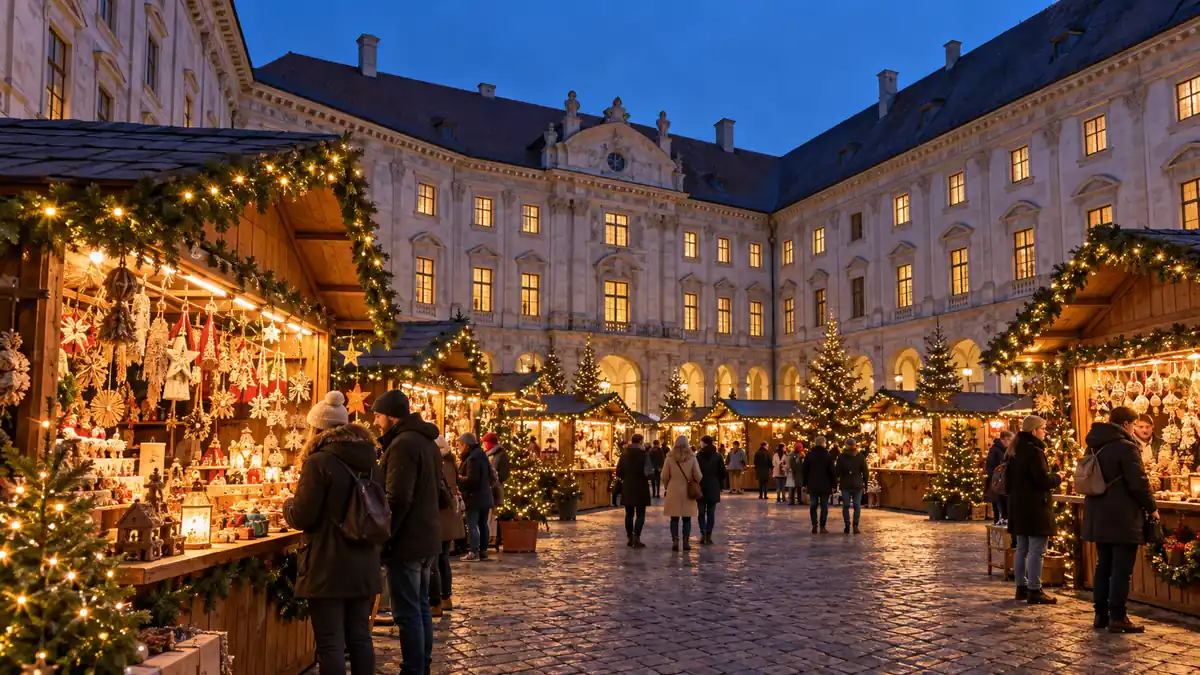
The Christmas Village fills the Kaiserhof courtyard of the Residenz, the former royal palace, with huts dressed to look like an alpine village. The palace walls make it feel sheltered from the wind and the traffic, and it photographs better than any other Old Town market. The catch: it is compact and close to the main crowds, so it fills at the same hours Marienplatz does.
Sendlinger Tor
The market at Sendlinger Tor is a neighbourhood-style market beside one of the surviving Old Town gates. It is small and needs little time, which makes it the natural last stop on a walk south from Marienplatz.
Viktualienmarkt, Munich’s permanent food market just behind Marienplatz, adds seasonal stalls in Advent and is worth a pass-through on the same walk.
Tours and activities
Book skip-the-line tickets, day trips and local tours with free cancellation on most activities.
You can also browse everything on getyourguide.com.
Tripstou may earn a commission if you book through this link, at no extra cost to you.
The Medieval market wins on atmosphere; Tollwood and Pink Christmas are the alternatives
The Medieval Christmas market (Mittelaltermarkt) at Wittelsbacherplatz, near Odeonsplatz, is the Munich market most visitors remember, thanks to its costumed stallholders and its Feuerzangenbowle. When you want something non-traditional, or a weekend evening with more room to move, Tollwood and Pink Christmas are the alternatives.
Medieval Christmas market at Wittelsbacherplatz
The Medieval market trades the fairy lights of the Old Town for wooden stalls and traders in period costume. Drinks come in clay mugs and food is served on wooden boards, which makes even a plain sausage feel like part of the show. It sits close to the Residenz, so it chains onto the core walk without a detour.
Its size is the drawback. The square is small, and on Friday and Saturday evenings the lanes between stalls jam solid; arrive while it is still light, or come on a weekday.
Pink Christmas on Stephansplatz
Pink Christmas is the LGBTQ+ community’s Christmas market in the Glockenbachviertel, with stage shows through the season. It makes for a fun, social evening, and everyone is welcome.
Tollwood winter festival on the Theresienwiese
Tollwood is a winter festival more than a Christmas market, held on the Theresienwiese, the same open ground used for Oktoberfest. The grounds and the Markt der Ideen (market of ideas) are free to enter, and the stalls focus on organic and fair-trade goods. Free grounds, ticketed shows: performances in the Grand Chapiteau tent cost extra. The festival closes with a ticketed New Year’s Eve party, which makes it the only market on this page that matters if you are in Munich over New Year.
- Choose the Medieval market if you want one evening that feels unlike anywhere else, and can live with the crush.
- Choose Pink Christmas if you want a social night built around stage performances.
- Choose Tollwood if you prefer a festival with sustainability at its heart, or you are staying into the New Year.
Which Munich Christmas markets are less touristy?
The Christmas market at the Chinese Tower in the English Garden is the calmest classic setting in Munich, while Haidhausen and Schwabing are neighbourhood markets where locals outnumber visitors. Families with young children should add the Märchenbazar.
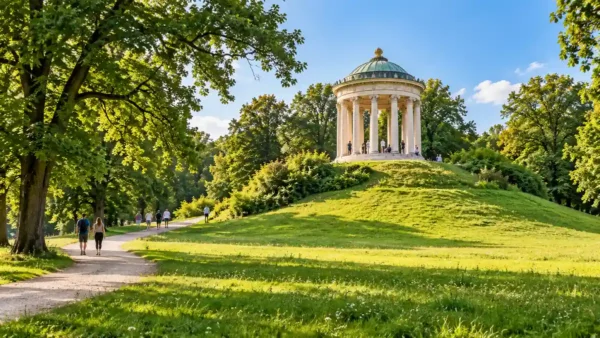
Chinese Tower, English Garden. The market gathers around the wooden pagoda in the middle of Munich’s big city park, reached by U-Bahn and a walk through the trees. The park setting slows everything down. Go in the afternoon for the most room.
Haidhausen. The Haidhausen market fills Weißenburger Platz, a small square in a residential district east of the Isar. Neighbours stop for a drink on the way home, which is exactly its appeal for a local-feeling evening.
Schwabing. Schwabing, the old artists’ quarter north of the centre, holds its own Christmas market with an arty, neighbourhood feel.
Märchenbazar. The Märchenbazar (fairy-tale bazaar) is a fairy-tale-themed market in tents, built around children. Its site changes between seasons, so look up the current location before you set out.
When are the Munich Christmas markets open, and when are they quietest?
The Munich Christmas market season runs from late November through Advent. Marienplatz stays open until Christmas Eve and closes early that day, while Tollwood stops just before Christmas apart from its New Year’s Eve party. Weekday daytime is the quietest window, and the lights come on from mid-afternoon because the sun sets early.
Most markets open from late morning into the evening, with shorter hours on Sundays at Marienplatz. Weekend evenings are the busiest time at Marienplatz and the Medieval market alike. A weekday visit that starts as dusk falls gets you the lights without the shoulder-to-shoulder queues.
That leaves the morning free. Spend it on Munich’s year-round sights and save the markets for the dark hours, when they look their best.
How many markets can you do in a day, and in what order?
One afternoon running into the evening covers the four or five Old Town markets on foot, and each outer market takes an extra evening of its own. Start at Marienplatz while there is still some daylight, then follow one of two routes:
- South: Marienplatz → Kripperlmarkt → Sendlinger Tor.
- North: Marienplatz → Residenz Christmas Village → Medieval market at Wittelsbacherplatz.
The northern route ends at the Medieval market, so it is the better choice if you want to eat dinner from the stalls. Fit both routes into one day only if you start early; most visitors enjoy two relaxed evenings more than one rushed one.
The outer markets are an easy U-Bahn ride. Head for the English Garden for the Chinese Tower, and take the U-Bahn to Theresienwiese station for Tollwood. Staying near the Old Town lets you walk between the core markets and back to bed. If you would like the Old Town and Viktualienmarkt explained before the market crowds build, book a guided walk for the daylight hours of your first day.
What to eat and drink at the stalls (and what the names mean)
Glühwein (hot spiced wine) and Feuerzangenbowle (a rum-soaked sugar cone set alight over a pot of punch) are the drinks to try, and gebrannte Mandeln (sugar-roasted almonds), Lebkuchen (spiced gingerbread), Bavarian sausages, Dampfnudeln (steamed sweet dumplings) and Schupfnudeln (pan-fried potato noodles) are the food. You will find them at every market on this page, because they belong to Bavarian markets in general.
The Medieval market serves the most memorable versions, with drinks in clay mugs and food on wooden boards. Tollwood’s stalls are the place for organic and fair-trade versions of the same staples. At Marienplatz, eat early: the queues at the sausage stands grow with the crowds. Every hot drink comes with a deposit on the mug, explained in the questions below.
Your Munich Market Shortlist
- Marienplatz, the Kripperlmarkt and the Residenz Christmas Village are the classic Munich trio, and they sit close enough to walk between in one evening.
- The Medieval market at Wittelsbacherplatz is the one most visitors remember for atmosphere and food, but its small square jams on Friday and Saturday evenings.
- Tollwood on the Theresienwiese and Pink Christmas in the Glockenbachviertel are the picks for an evening away from the traditional Christmas-market script.
- For a calmer market, go to the Chinese Tower in the English Garden in the afternoon, or to the neighbourhood squares of Haidhausen and Schwabing.
- A weekday visit that starts as dusk falls gives you the lights without the weekend-evening crush.
- One afternoon into evening covers the Old Town markets on foot; each outer market deserves an evening of its own.
Munich Market Questions
What is the Munich Krampus run, and where do you see it?
The Krampus run is a parade of costumed Krampus figures, the horned, shaggy companions of St Nicholas in Alpine folklore, through Munich’s Old Town on a December afternoon. It is part of the official Christkindlmarkt programme and draws dense crowds along the streets around Marienplatz. The day and the route change from one season to the next, so check the market’s official programme before you plan an afternoon around it.
Do the Munich Christmas markets cost money to enter?
No: the Old Town markets, the Medieval market and the neighbourhood markets are free to walk into, and you pay only for what you eat, drink or buy. Tollwood is the one place where tickets come in. Its grounds and the Markt der Ideen are free, while the shows in the Grand Chapiteau and the New Year’s Eve party are ticketed.
How does the Glühwein mug deposit work?
You pay a deposit, called Pfand, on top of the price of each hot drink, because it is served in a real mug instead of a paper cup. Hand the mug back to the stall that served you and the deposit is refunded. Keep it, and the mug is yours to take home as a souvenir.
Keep Planning Germany in Winter
- Germany’s best Christmas markets by city: how Munich compares with Nuremberg, Cologne, Dresden and Berlin.
- Planning a trip to Germany: routes, regions and the practical basics for the rest of your trip.
Did this guide save you time or money? Tripstou is independent and reader-funded — if you'd like to give something back, you can support the site with a crypto contribution of any size.