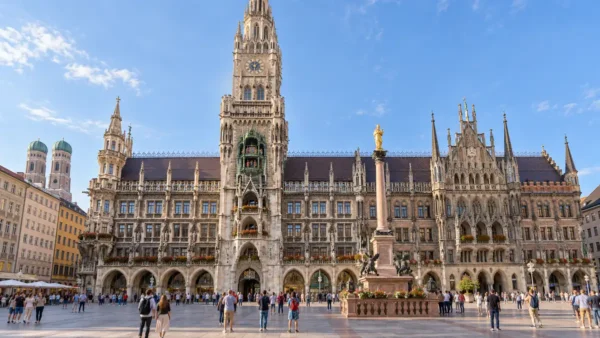
For one Berlin Christmas market on a first visit, choose WeihnachtsZauber at Gendarmenmarkt: it is the most polished market in the city, set between the German and French churches, and its small entry fee is the price of that polish. Pick Charlottenburg Palace instead if the setting matters most to you, or Rotes Rathaus if you are travelling with children who want the ice rink and the Ferris wheel. Choose by what you want first, then by area, because the big markets sit in clusters and two or three fit into one evening. Timing changes the list: only a few of the big central markets carry on past Christmas.
Berlin runs dozens of markets across its districts, more than any other German city, on a tradition that is centuries old. Nobody does them all on a short break. The useful work is choosing the right handful and stringing them into evenings.
On This Page
Which Berlin Christmas market should you pick?
Gendarmenmarkt is the pick for a classic, upmarket market; Charlottenburg Palace wins on setting; Rotes Rathaus is the family choice, with Alexanderplatz and Potsdamer Platz as the louder ride-and-slide alternatives. For something cosy and Nordic, go to the Lucia market at the Kulturbrauerei. The medieval market at RAW is the alternative-crowd answer. Domäne Dahlem, Schloss Britz, Alt-Rixdorf and Kollwitzplatz give the village feel, but only at weekends. Christmas Avenue at Nollendorfplatz is the queer market.
| Market | Area | What it is like | Entry | Open after Christmas |
|---|---|---|---|---|
| Gendarmenmarkt | Mitte | Polished crafts and food between two churches; the one-market pick | Small fee | Yes |
| Rotes Rathaus | Mitte | Ice rink and Ferris wheel by the Neptune Fountain; the family evening | Free | Yes |
| Schlossplatz / Humboldt Forum | Mitte | Historic backdrop beside Berlin Cathedral; the photo stop | Free | Yes |
| Alexanderplatz | Mitte | Big and busy under the TV Tower, with rides | Free | No |
| Potsdamer Platz | Mitte | Winter World with a toboggan run; activity over atmosphere | Free | Varies by season |
| Charlottenburg Palace | West | Lit palace facade and fire-cooked salmon; the strongest setting | Free | Yes, briefly |
| Breitscheidplatz | West | Traditional stalls by the Memorial Church; the Ku’damm stop | Free | Yes |
| Lucia, Kulturbrauerei | Prenzlauer Berg | Scandinavian theme in a brick courtyard; the cosy one | Free | No |
| Medieval market, RAW | Friedrichshain | Costumes, fire and mead; the alternative crowd | Small fee | No |
| Spandau old town | Spandau | Large and traditional in the old-town streets | Free | No |
| Christmas Avenue | Schöneberg | Berlin’s LGBTIQ* market at Nollendorfplatz | Free | No |
| Dahlem, Britz, Rixdorf, Kollwitzplatz | Outer districts and Prenzlauer Berg | Village-style neighbourhood markets | Britz and Dahlem charge | No, Advent weekends only |
The shortlist hides one real tradeoff. The most atmospheric central market charges and draws the thickest crowds, while the free big markets swap that polish for scale, rides and space to move. A first-timer who hates queues does better at Schlossplatz and Charlottenburg than at Gendarmenmarkt on a Saturday night.
Berlin’s strength is range: classic squares, a palace, a Nordic courtyard and a medieval yard all sit on one transit network. Readers still comparing Berlin with Nuremberg, Dresden or Cologne will find that choice in our guide to Christmas markets in Germany.
The Mitte markets you can string together in one evening
Four big markets sit within walking distance of each other in Mitte: Gendarmenmarkt, Schlossplatz by the Humboldt Forum, Rotes Rathaus and Alexanderplatz. One evening on foot covers most of what a first visit to Berlin’s markets is about. Winter World at Potsdamer Platz is the fifth, a short hop away.
WeihnachtsZauber at Gendarmenmarkt
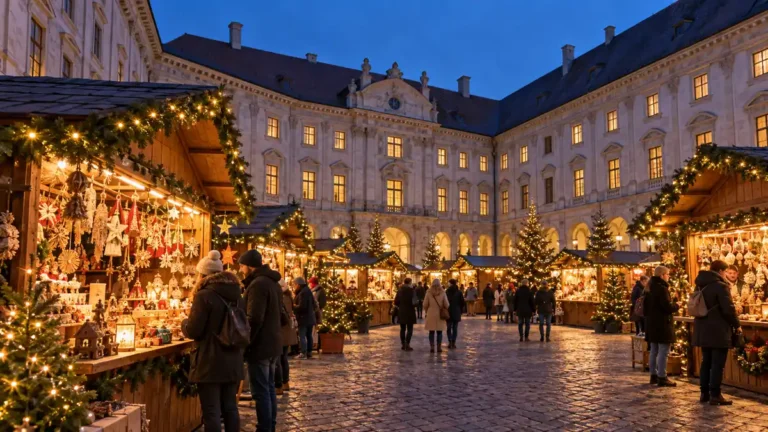
WeihnachtsZauber is Berlin’s showpiece market. It fills the square in front of the Konzerthaus, framed by the German and French churches, and no other Mitte market matches its setting after dark.
The stalls lean towards craft and quality food, a more curated mix than the free squares carry. The small entry fee keeps the square a little less packed and pays for that curation. If you can only do one market in Berlin, this is it: the postcard version, done well, for couples and first-timers.
Berliner Weihnachtszeit at Rotes Rathaus
Rotes Rathaus is the family market. It wraps around the Neptune Fountain between the Red Town Hall and St Mary’s Church, with an ice rink and a Ferris wheel among the stalls.
Children get rides, skating and Kinderpunsch; adults get a traditional market with room to move. Entry is free, so a long evening here costs less than a short one at Gendarmenmarkt. Come in the late afternoon with younger children, before the evening crowd builds.
Winter market at Schlossplatz / Humboldt Forum
The Schlossplatz market sits next to Berlin Cathedral, by the Humboldt Forum. The historic backdrop is the reason to come. It works as the natural stop between Gendarmenmarkt and Rotes Rathaus: one Glühwein and the best cathedral photo of the evening.
Alexanderplatz
Alexanderplatz is big, busy and full of rides, under the TV Tower. Most visitors pass through it on the way to or from the station, and that is the right amount of time to give it.
Winter World at Potsdamer Platz
Winter World trades the classic market look for activity, with a toboggan run among the modern towers. It suits groups of friends and older children who would sooner slide than browse.
Every landmark on this walk is a backdrop here. For the sights themselves, see our guide to Berlin’s sights.
Charlottenburg Palace is the one worth crossing the city for
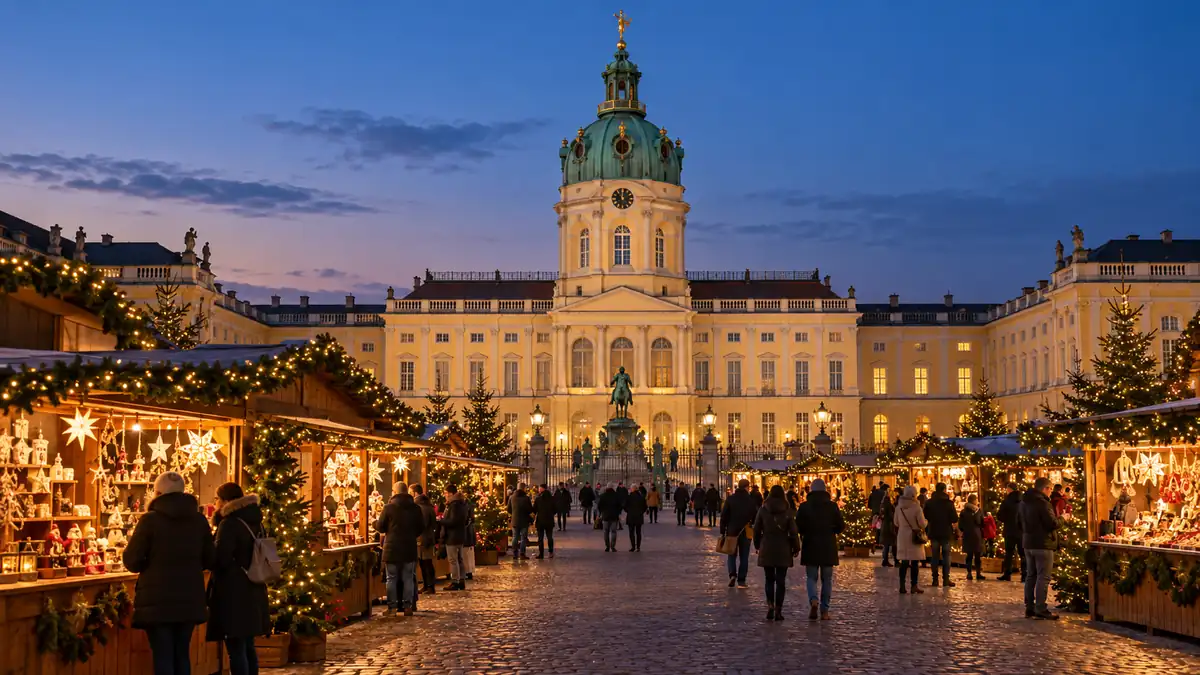
Charlottenburg Palace is the market that justifies the trip west: the palace facade is lit behind the stalls, and salmon cooks over open fires in front of it. Breitscheidplatz, by the Kaiser Wilhelm Memorial Church, is the easy add-on for anyone staying or shopping around the Ku’damm, and the two make one evening together.
Charlottenburg Palace market
The setting is the whole point. Stalls fill the space in front of the palace on Spandauer Damm, and the lit facade turns an ordinary Glühwein stop into the most photogenic evening of the season. Flammlachs, salmon slow-cooked on boards beside an open fire, is the dish people remember.
Couples and photographers get the most from it. It also anchors the best two-market plan in Berlin: Charlottenburg for the atmosphere, then Gendarmenmarkt on another evening for the classic.
Breitscheidplatz by the Memorial Church
The Breitscheidplatz market is central-west, convenient and traditional, laid out beside the Kaiser Wilhelm Memorial Church. It suits a traveler with a West Berlin base: a market on the way back from the shops, no detour needed.
Lucia, RAW and the markets that don’t feel like Christmas cards
Berlin’s alternative tier is its real differentiator, and the answer for anyone who finds the big squares generic. Three markets carry it: the Nordic Lucia market at the Kulturbrauerei in Prenzlauer Berg, the medieval market at the RAW site in Friedrichshain, and Christmas Avenue at Nollendorfplatz.
Lucia market at the Kulturbrauerei
The Lucia market sets a Scandinavian Christmas inside the brick courtyards of the Kulturbrauerei. Glögg stands in for Glühwein as the house drink, and the stalls lean Nordic. It is the cosiest market in Berlin, and the one for a slow evening with friends in Prenzlauer Berg.
Medieval market at RAW, Friedrichshain
The medieval market on the RAW site swaps fairy lights for fire, costumed traders and mead. It charges entry. Teenagers bored by wooden-hut markets and the alternative crowd are the ones it wins over, and it pairs naturally with an evening out in Friedrichshain.
Christmas Avenue at Nollendorfplatz
Christmas Avenue is Berlin’s LGBTIQ* Christmas market, at Nollendorfplatz in Schöneberg. The crowd comes for the community as much as the stalls.
Beyond the centre: Spandau’s old town and the weekend village markets
Spandau’s old-town market is the big traditional market outside the centre and runs through the season. Domäne Dahlem, Schloss Britz, Alt-Rixdorf and Kollwitzplatz are smaller village-style markets held only on Advent weekends or Sundays, so they suit a trip that includes a weekend.
Spandau old town
The Spandau market spreads through the old-town streets around St Nikolai and the Markt, and it is one of the largest in Berlin. It feels like a small-town German market, not a capital-city one. It earns its place on a second or third visit, or when you are staying in the west.
Dahlem, Britz, Rixdorf and Kollwitzplatz: weekend-only
Domäne Dahlem holds its market on a farm estate, the most rural setting in the city and an easy family outing. Schloss Britz in Neukölln runs a Nordic-themed market in the palace grounds. The Alt-Rixdorf market fills Richardplatz in the old village core of Neukölln. Kollwitzplatz in Prenzlauer Berg has a neighbourhood market on Advent Sundays, the one locals walk to.
Potsdam, with markets of its own, is an easy S-Bahn ride away for a traveler with a spare afternoon.
Which Berlin Christmas markets are free?
Most of Berlin’s big Christmas markets are free to walk into. Gendarmenmarkt is the recognised exception, with a small entry fee, and a few alternative and weekend markets (RAW, Schloss Britz, Domäne Dahlem and Holzmarkt) also charge.
The Gendarmenmarkt fee is worth paying once. It buys a curated craft market, a little more space between stalls and the finest square in Mitte. Skip it on a second Mitte evening, when the free squares pour the same Glühwein.
A free evening is easy to build. Rotes Rathaus, Schlossplatz and Alexanderplatz make a no-fee Mitte walk; Breitscheidplatz and Charlottenburg Palace do the same in the west. What you spend goes on food, drinks and the mug deposit.
Which markets stay open after Christmas?
Most Berlin markets close just before Christmas, but a few of the big central ones stay open between Christmas and New Year: Gendarmenmarkt, Rotes Rathaus, Schlossplatz by the Humboldt Forum and Breitscheidplatz, with Charlottenburg Palace running until just after Christmas. Some continue into the first days of January. Expect reduced hours or a closure on Christmas Eve.
The season opens in late November, most markets around the start of Advent. The fullest choice runs through the first three weeks of December, when every tier is open. The weekend-only markets end with Advent.
Between Christmas and New Year, plan around Mitte. A break in that week still gets a full market evening on the big central squares, but not the Nordic, medieval or village markets. Alexanderplatz is not on the late list either: its last day is Boxing Day. Berliner Weihnachtszeit at Rotes Rathaus carries on into early January, and so does the ice rink at Potsdamer Platz, which runs separately from Winter World. Check the market’s own page before a Christmas Eve visit.
How many markets can you do in a 2–4 night break?
Two or three markets per evening is realistic when they sit in one area, so a short break covers five to eight markets without rushing. The natural split is one evening in Mitte, one in the west and one for the alternative tier.
- One evening: walk the Mitte string from Gendarmenmarkt to Schlossplatz to Rotes Rathaus, ending at Alexanderplatz for the train. It suits a weekend that is mostly about the city itself.
- Two evenings: add Charlottenburg Palace, with Breitscheidplatz on the way back. That gives you the classic and the most beautiful setting.
- Three evenings: add Lucia and RAW for the alternative side of Berlin, or swap in Spandau and one village market if your stay covers a Saturday or Sunday.
Staying in Mitte puts most big markets within walking distance. A public transport day ticket covers an evening that crosses districts, such as Lucia in Prenzlauer Berg followed by RAW in Friedrichshain.
Arrival, neighbourhoods and the rest of the trip are covered in our Berlin travel guide.
What to eat and drink: Glühwein, Feuerzangenbowle and the stall classics
Glühwein is the default drink, ordered mit Schuss when you want a shot of spirits in it. Feuerzangenbowle, mulled wine with a rum-soaked sugar cone set alight above it, is the showpiece. Eierpunsch, a warm egg punch, and the alcohol-free Kinderpunsch are the alternatives. Bratwurst and currywurst are the baseline food. Look for Flammlachs at Charlottenburg Palace, and for glögg with reindeer sausage at the Nordic markets.
Beyond those, the stall classics repeat across the city. Langos, a fried flatbread with sour cream and cheese, and Handbrot, a filled bread baked to order, are the filling choices. Flammkuchen is the thin, crisp tart for sharing; roasted almonds scent every square. Baumstriezel, the chimney cakes turned over coals, are the sweet one. Charlottenburg is the market to eat at, Lucia the one to drink at.
Your first hot drink comes with a mug and a deposit, explained in the next section.
Mugs, cash and crowds: how Berlin’s markets work
Pay a refundable deposit on your mug and hand it back for the refund, or keep it as a souvenir. Carry cash, because many stalls prefer it or take nothing else. Go on a weekday afternoon or early evening: Friday and Saturday nights are the crush.
How does the mug deposit work?
The mug deposit is added to the price of your first hot drink and refunded when you return the mug. Hand it back at the market where you bought it. Many markets print their own design, which is why so many visitors keep one instead.
Do the stalls take cards?
Some stalls take cards, but many are cash-only or prefer cash, especially the small food and craft stands. Bring enough cash for an evening of food and drinks so a stall’s card policy never decides where you eat.
When are the markets least crowded?
Weekday afternoons and early evenings are the calmest time at every Berlin market. Friday and Saturday evenings slow the Mitte squares to a shuffle. The markets with rinks, Rotes Rathaus and Potsdamer Platz, draw families from the afternoon, so take children there early and save the late evening for Gendarmenmarkt or Lucia.
Berlin in winter beyond the markets: rinks, light trails and closed museums
In Berlin in winter, the markets fill the evening and the day goes to skating, light trails and indoor sights. Skate at Rotes Rathaus, Potsdamer Platz or the rink on Bebelplatz, and walk the Christmas Garden light trail at the Botanical Garden. Plan around two things: many museums close on Christmas Eve and New Year’s Eve, and it is dark by late afternoon and cold.
The short daylight sets the rhythm. Pair a daytime sight with the market area you will be in that evening, so the walk from one to the other happens as the lights come on. Our guide to things to do in Berlin covers the sights around each market square.
A river cruise on the Spree through the government district is the cold-day alternative to a walking tour. On a heated boat you see the riverside landmarks seated and out of the wind, which suits an afternoon too raw for long walks.
Tours and activities
Book skip-the-line tickets, day trips and local tours with free cancellation on most activities.
You can also browse everything on getyourguide.com.
Tripstou may earn a commission if you book through this link, at no extra cost to you.
The Short Version
- If you only see one Berlin Christmas market, make it WeihnachtsZauber at Gendarmenmarkt, where a small entry fee buys the most polished square in the city.
- Families get the most from Rotes Rathaus, a free market with an ice rink and a Ferris wheel around the Neptune Fountain.
- For something unlike the postcard squares, the Nordic Lucia market at the Kulturbrauerei and the medieval market at RAW are Berlin’s alternative tier.
- Group markets by area and two or three fit into one evening, so Mitte, the west and the alternative tier make a natural three-evening split.
- Between Christmas and New Year only the big central markets are still open, so plan that week around Mitte and leave the Nordic, medieval and village markets for early December.
- Carry cash for the stalls and expect a refundable deposit on your first mug, which you can hand back or keep as a souvenir.
About This Selection
This page picks among Berlin’s named Christmas markets by atmosphere, setting, who each suits and whether it runs past Christmas. It is not a dated market calendar, a Berlin sightseeing or trip-planning guide, or a comparison with other German cities.
Alex Perrut, working in tourism since 2015, went over this market selection for the Tripstou editorial team; the page was written with AI assistance. How we work is set out in our editorial process.
Official sources consulted: visitBerlin, Berlin.de city portal.
Keep Planning Berlin
- Berlin travel guide: the rest of the trip, from arrival to neighbourhoods and budget.
- Germany’s Christmas market cities: how Berlin compares with Nuremberg, Dresden and Cologne, if your city is not decided yet.
- Things to do in Berlin: the sights that fill the daylight hours around the market squares.
Did this guide save you time or money? Tripstou is independent and reader-funded — if you'd like to give something back, you can support the site with a crypto contribution of any size.