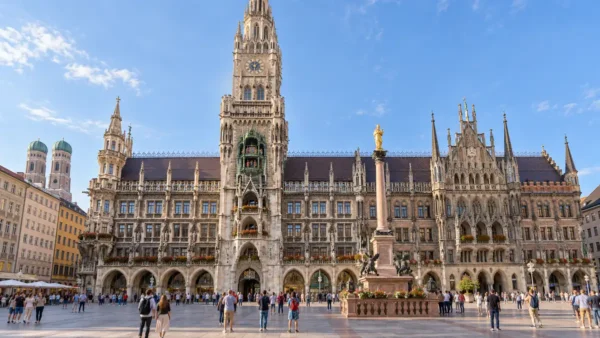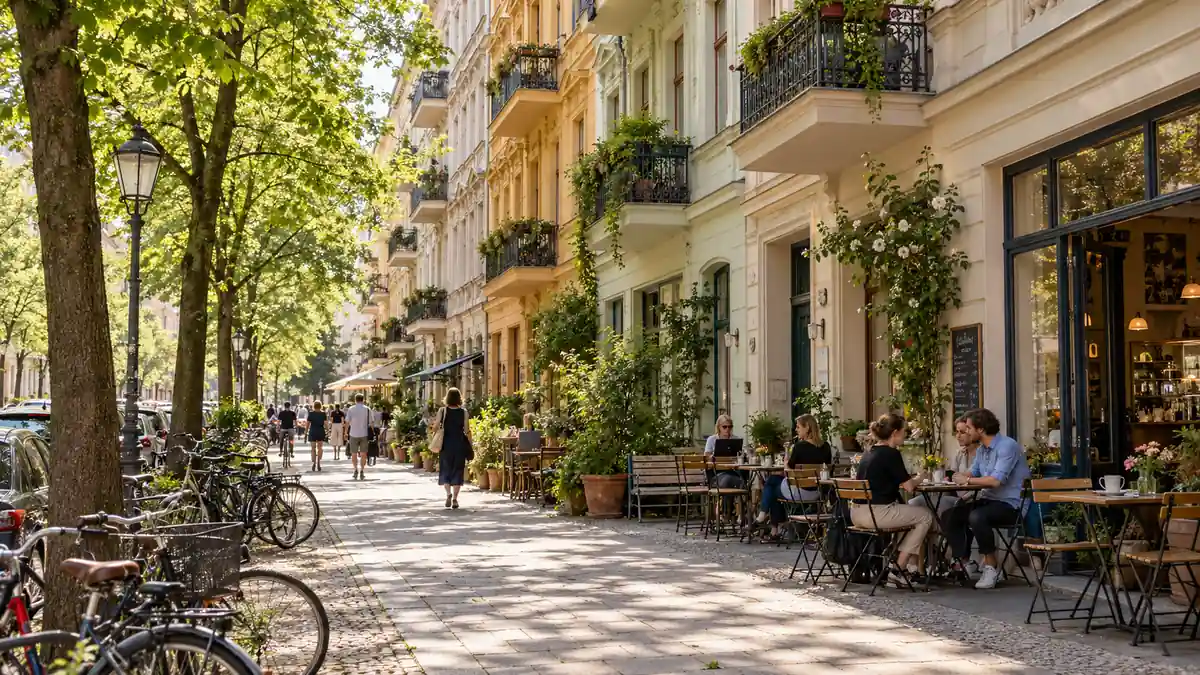
For a first stay in Berlin, book Mitte on its Hackescher Markt and Spandauer Vorstadt side. The big landmarks and the main S-Bahn and U-Bahn stations are within walking range, so every sightseeing day starts short. The catch is that Mitte prices at the top of the city and goes quiet and corporate after dark in its government blocks. Travelers whose trip is about the evenings sleep better in Kreuzberg or Friedrichshain, and families or early sleepers do best in Prenzlauer Berg.
Berlin is spread out and has several centres, so the choice comes down to two things: the station outside the door and what the nights are for. Each district below is broken down to the Kiez (the neighbourhood quarter) worth booking and the corner to skip for sleep.
On This Page
Mitte’s Hackescher Markt side is the best area to stay in Berlin for a first trip
Mitte’s Hackescher Markt side is the strongest first-trip base in Berlin. Museum Island and the Brandenburg Gate are within walking distance, and S-Bahn and U-Bahn lines run right underneath, so no day starts with a long transfer. It is the wrong pick for two kinds of traveler: anyone whose trip is built around nightlife, and anyone on a tight budget.
Every other district wins for somebody. The table puts the seven areas worth booking side by side, with the part of each one to aim for.
| Area | Suits | Day-to-day feel and night noise | Kiez to book | Relative price |
|---|---|---|---|---|
| Mitte | First-timers, short trips | Busy by day; lively near Rosenthaler Platz, quiet in the government blocks at night | Hackescher Markt, Spandauer Vorstadt | Top |
| Prenzlauer Berg | Families, couples, early sleepers | Cafés and playgrounds; calm nights | Kollwitzplatz, Helmholtzplatz | Upper |
| Kreuzberg | Bar-hoppers, solo travelers, couples who want a scene | Calm in the west, loud in the east | Bergmannstraße to sleep; Oranienstraße for nights | Middle |
| Friedrichshain | Budget trips, clubbing | Young and busy; loud near the RAW-Gelände | Boxhagener Platz, off Simon-Dach-Straße | Lower |
| Charlottenburg | Slow trips, return visitors | Residential, restaurant-led, early nights | Savignyplatz, Kantstraße | Upper |
| Neukölln | Bar-led budget trips | Lively; can feel rough around Hermannplatz late | Kreuzkölln, Weserstraße | Lower |
| Schöneberg | LGBTQ+ travelers, food-led stays | Scene around Nollendorfplatz, calmer near Winterfeldtplatz | Nollendorfplatz, Winterfeldtplatz | Middle |
Find your row, then jump to that district’s section for the streets, the connections and the hotel examples.
Hotels and places to stay
Compare hotels, apartments and stays for your dates in one search.
Search hotels and stays on hotels.com →
Tripstou may earn a commission if you book through this link, at no extra cost to you.
How to choose a Berlin base: the Ringbahn, east or west, and your evenings
Choose a Berlin base by the station outside the door and by what your evenings are for. Berlin is not a city you walk end to end. Any address inside or just off the S-Bahn ring works for sightseeing, so the district’s night character matters more than its daytime one.
Inside the Ringbahn or outside it?
Stay inside the Ringbahn, or within a stop of it. The ring is the S41/S42 loop, and it roughly marks fare zone A, which is a handy way to read a map: an address inside it is central in practice. Mitte, Prenzlauer Berg, Kreuzberg, Friedrichshain and Charlottenburg all sit inside or on the ring.
Outside it, a stay only makes sense with a specific reason, such as a congress at a big hotel or a friend’s flat. For the airport arrival and the rest of the trip’s logistics, the Berlin travel guide covers what this page leaves out.
East or west Berlin?
Pick the east for landmarks and nightlife, and the west for a calmer, more residential stay. Mitte, Prenzlauer Berg, Friedrichshain and most of Kreuzberg carry the famous sights and the night scene. Charlottenburg and Schöneberg feel settled, restaurant-led and suited to a slow trip.
This is a choice of character. Convenience barely enters into it, because the S-Bahn ties both halves together.
Is staying central in Berlin worth the price?
Staying central is worth the premium on a trip of about three days or less, where every transfer you skip buys time at another sight. On a longer or evening-led trip the premium buys less, and a well-connected Kiez further out gives more for the money. A tight 3-day Berlin itinerary favours a Mitte base for exactly that reason.
Whatever the area, Berlin adds a 7.5% city tax to the room bill.
Prices across the city tighten in summer and during big trade-fair weeks. On those dates the gap between Mitte and the cheaper districts widens, and an outer Kiez on a direct line becomes the smarter booking.
Is Mitte a good area to stay in Berlin?
Yes, Mitte is a good area to stay in Berlin for a first or short trip, because the landmarks and the main stations are within walking range. The Mitte to book is the northern side: Spandauer Vorstadt, Hackescher Markt and Rosenthaler Platz. The Alexanderplatz square, also in Mitte, is a different proposition.
Museum Island, the Brandenburg Gate and Unter den Linden are walkable from Hackescher Markt, and most of the things to do in Berlin start within reach of here. Hackescher Markt station and the U-Bahn at Rosenthaler Platz connect the area with the rest of the city.
Mitte has two moods. The streets around Rosenthaler Platz stay lively in the evening, with bars and late dinners close to the bed. The government quarter and the blocks towards Potsdamer Platz empty after office hours and feel corporate at night.
Mitte is the most expensive district to sleep in, and supply gets tighter in summer and during trade-fair weeks. Hotel Adlon Kempinski, at the Brandenburg Gate end of Unter den Linden, is the luxury example. Motel One has branches at Hackescher Markt and Spittelmarkt for a mid-range stay.
Mitte is for the traveler who wants to walk out of the door into the landmarks and to keep evenings low-key.
Hackescher Markt or Alexanderplatz?
Book the Hackescher Markt side. The Alexanderplatz square is a transport hub before it is a neighbourhood. Its hotels sit on a wide, windy plaza with no Kiez around them, and the square empties out and can feel rough late at night, so check the walk from the station before choosing anything there. Hackescher Markt is a short walk away and gives you the same central position with streets of cafés and bars around it.
Prenzlauer Berg is the calm choice for families, couples and early sleepers
Prenzlauer Berg is the base for travelers who want cafés, playgrounds and quiet nights, with central Mitte two or three stops away. It is the strongest alternative to Mitte for anyone whose evenings end early. Three corners are worth booking:
- Kollwitzplatz (Rykestraße, Husemannstraße): the leafiest and most settled corner, made for families with small children.
- Helmholtzplatz: a little younger, with more wine bars and late cafés around the square; a good couple’s choice.
- Kastanienallee and Eberswalder Straße: the livelier edge, for travelers who want some evening life without leaving the district.
Day to day the district is residential and stroller-heavy, and its rhythm follows the weekend markets. The U2 runs along its western side, M-trams cross it, and the Ringbahn touches its northern edge, so the centre is never far even without a walkable landmark.
Prices sit in the upper-middle range. Hotel Oderberger and Myer’s Hotel are the two examples to look at. The trade-off is plain: little nightlife and a transfer to every big sight. Nightlife-first travelers and strict budgets should look east, to Friedrichshain.
Prenzlauer Berg’s quiet is the reason families pick it, and the same quiet makes it a poor fit for a weekend built around clubs.
Kreuzberg: Bergmannstraße for sleep, Oranienstraße and the canal for nights
Kreuzberg splits in two, and which half you book decides the trip. The western Bergmannstraße side is calmer and café-led, and it sleeps well. The eastern side around Oranienstraße, Kottbusser Tor and Görlitzer Park, plus the stretch along the Landwehr Canal, is the late-night Berlin many travelers come for, and it is loud to sleep in.
The Bergmannkiez suits couples and travelers who want somewhere cool but quiet: streets of restaurants and nights that wind down at a sensible hour. The Oranienstraße and canal side suits solo travelers and bar-hoppers who want a short walk home. Both halves keep a strong local feel by day, with more mixed, less polished streets than Mitte.
The U1 and U3 run along the elevated viaduct through the district, and the U6 and U7 cross at interchanges on the western side, so both halves connect easily with Mitte and Friedrichshain. Prices run from middle to lower, cheaper than Mitte for a comparable room.
Kottbusser Tor and the edge of Görlitzer Park can feel rough late at night. Check the walk from the station and choose a side street over the main junctions. Hotel Johann is the hotel example in the district.
Kreuzberg’s two halves sit close enough that a Bergmannstraße bed still puts the Oranienstraße bars within reach, which is the best reason to sleep on the quiet side.
Friedrichshain is the budget-and-nightlife base east of the Spree
Friedrichshain is where a budget or nightlife trip should sleep. Book around Boxhagener Platz, ideally on a street just off Simon-Dach-Straße, and keep a few blocks between the bed and the RAW-Gelände, Berghain and Warschauer Straße corridor, where the nights are loud.
The district is young and busy: students, long brunches, and the Spree bank with the East Side Gallery as its landmark. Warschauer Straße, on the east–west S-Bahn line and the end of the U1, links it to Kreuzberg and Mitte; Ostkreuz, one stop further east, is the Ringbahn interchange that ties it to the rest of the city. Of the five main districts it is the cheapest to sleep in, clearly below Mitte. nhow Berlin, on the Spree bank, is the hotel example.
Kreuzberg or Friedrichshain for nightlife?
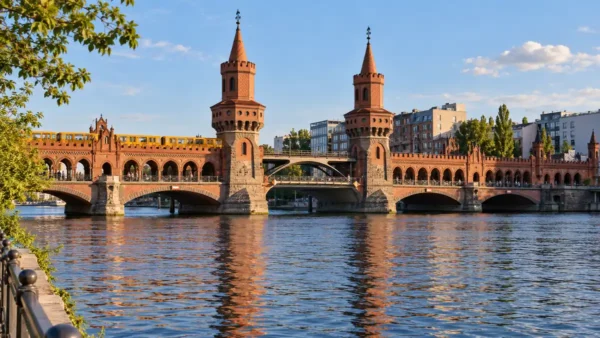
Choose Friedrichshain if the night means clubs and the RAW corridor and the budget is tight. Choose Kreuzberg if the night means bars, late dinners and the canal, and you want the better daytime base too. The two districts meet at the Oberbaumbrücke, so you can sleep in one and go out in the other. The real question is which one you want to walk home to.
Pick Friedrichshain when the plan is to be out late and the bed should cost as little as Berlin allows.
Charlottenburg and the quiet west: Savignyplatz, Kantstraße and the Kurfürstendamm
Charlottenburg is the calm, grown-up base in Berlin. Savignyplatz and Kantstraße give the Kiez feel, while the Kurfürstendamm and the Bikini Berlin and Zoologischer Garten end bring shopping and big-hotel comfort. It suits a slow trip, a return visit and anyone who prefers a residential evening to a scene.
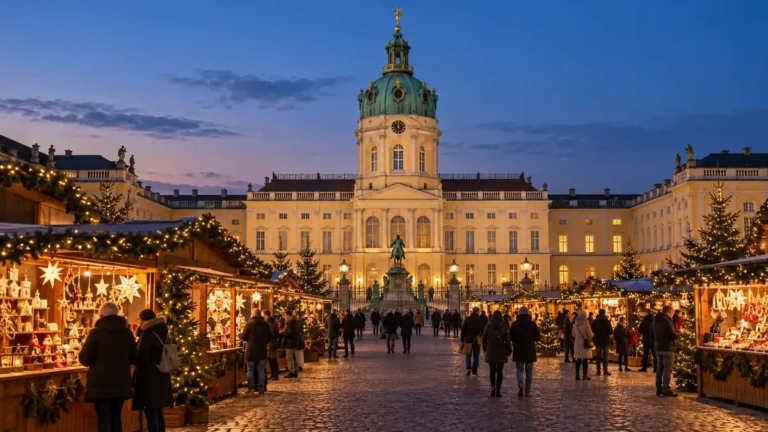
This is old West Berlin: bourgeois apartment blocks, restaurant streets and early nights. Schloss Charlottenburg, the Kaiser Wilhelm Memorial Church and KaDeWe are the local anchors. Zoologischer Garten (S-Bahn and U-Bahn) and Savignyplatz S-Bahn station connect the area. The eastern landmarks are a direct S-Bahn ride away, which is easy but not a walk.
The fit is clearest for a second visit, a longer stay, or a couple who want dinner and a quiet street. Prices sit in the upper range, home to several of the city’s grand hotels; Waldorf Astoria Berlin is the example.
The trade-off rules out two travelers. First-timers on a two-day trip who want the Mitte landmarks on foot will spend too much of it on trains. Nightlife-first travelers will find the evenings too early.
Neukölln, Schöneberg, Tiergarten and the other Berlin areas worth knowing
Six more areas are worth knowing, and none of them is the first-trip answer. Each one is right for one kind of traveler:
- Neukölln: bar-led and the cheapest area on this list; book in Kreuzkölln, along Weserstraße or in the Schillerkiez, since Hermannplatz can feel rough late. The Estrel, outside the ring, is the exception: a congress hotel for travelers with a reason to be there.
- Schöneberg: the centre of Berlin’s LGBTQ+ scene around Nollendorfplatz, with a calmer, food-led corner around Winterfeldtplatz.
- Tiergarten and Potsdamer Platz: business hotels in a central position, but the area is dead after dark.
- Hauptbahnhof area: right for an early train, wrong for a full stay (see below).
- Moabit: residential, well connected and cheaper, with nothing to do at night; the blocks around the station can feel rough late.
- Wedding: residential and cheaper, with good connections and quiet evenings, for travelers who only need a bed and a line into the centre.
Should you stay near Berlin Hauptbahnhof?
Stay near Berlin Hauptbahnhof only for a one-night stopover or an early train. The blocks around the station are new, quiet and short on restaurants. Friedrichstraße in Mitte is one S-Bahn stop away, so a Mitte base gives you nearly the same connection with a much better evening.
Where not to stay in Berlin: the corners that cost you sleep
No Berlin district is off-limits; the mistakes are about noise and the late walk home. The corners to skip for sleep are the Alexanderplatz square itself, the Kottbusser Tor and Görlitzer Park edge, the RAW-Gelände and Warschauer Straße corridor, Hermannplatz, the blocks around Moabit’s station, and anywhere outside the Ringbahn without a reason.
The Alexanderplatz square is a hub with no neighbourhood around it, and it empties late. The fix is Hackescher Markt, a short walk away, with the same central position.
Kottbusser Tor and the Görlitzer Park edge are where Kreuzberg’s nights are loudest and the late feel is roughest. Bergmannstraße, on the western side, keeps the district without the noise under the window.
The RAW-Gelände and Warschauer Straße corridor is Friedrichshain at full volume until morning. A street off Simon-Dach-Straße, a few blocks away, keeps the bars close and the bedroom quiet.
Hermannplatz in Neukölln and the blocks around Moabit’s station can both feel rough late at night. Kreuzkölln and Weserstraße are the better Neukölln addresses; in Moabit, a quieter residential street further from the station works better.
Outside the Ringbahn, distance is the cost: every day starts with a long ride. Before booking anywhere on this list, check the walk from the nearest station after dark.
Which Berlin area fits your trip: first-timers to slow travelers
Each of the eight trip types below has a clear home in Berlin, and for a first-timer that home is Mitte.
- First-timers: Mitte, Hackescher Markt side, because the landmarks are on foot and the stations are under the street.
- Nightlife: Friedrichshain’s Boxhagener Kiez for clubs, or eastern Kreuzberg for bars and the canal.
- Families: Prenzlauer Berg around Kollwitzplatz, where playgrounds and quiet streets come with every block.
- Couples: Prenzlauer Berg’s Helmholtzplatz for wine bars and calm nights, or Mitte’s Spandauer Vorstadt for evenings in the centre.
- Budget: Friedrichshain or Neukölln’s Kreuzkölln, where the same money buys more room than in Mitte.
- Solo: Friedrichshain or Kreuzberg, where the hostels and bars cluster and meeting people takes no planning.
- LGBTQ+: Schöneberg around Nollendorfplatz, the long-standing heart of the city’s queer scene.
- Slow or quiet trips: Charlottenburg around Savignyplatz, for restaurant evenings and residential calm.
Once the area is settled, the guide to planning a first trip to Berlin covers arrival, timing and the rest of the trip.
Scope and Sources
This page helps you pick a Berlin district, and the corner inside it, for your kind of trip, naming hotels only as examples of each area; sights, nightlife, transport, budgets and day plans live on the linked Berlin pages.
Written with AI assistance, these area picks were then gone over by Alex Perrut, working in tourism since 2015, for the Tripstou editorial team; our editorial process sets out how.
Official sources consulted: Berlin Senate Department for Finance, Berlin.de city portal.
Did this guide save you time or money? Tripstou is independent and reader-funded — if you'd like to give something back, you can support the site with a crypto contribution of any size.