Most first-timer trouble in Amsterdam comes from four mistakes: standing in a bike lane, riding a tram without checking in and out, treating the city’s tolerance of cannabis as permission to smoke anywhere, and treating the Red Light District as a photo stop. Avoid those and the rest is ordinary city sense. Cards work almost everywhere, pickpockets work the crowds around Central Station, and rain is possible in any season.
Whether you plan to visit a coffeeshop changes how much of the cannabis rules concern you. If you do, the sections on coffeeshops and public smoking decide where and how. If you don’t, read them anyway: the public ban covers the streets you will walk through. The situations below run in the order you meet them, from the kerb outside Central Station to what goes in your bag; where to stay, when to go and which museum to book each have their own page.
How We Checked These Rules
This page covers moving, paying and behaving on a first Amsterdam visit (bikes, trams, cash, coffeeshops, the Red Light District, safety, night-time conduct), not sights, itineraries, neighbourhoods, seasons or prices.
Alex Perrut, working in tourism since 2015, went over the coffeeshop and Red Light District rules and the tram check-in steps against the sources below for the Tripstou editorial team, after a draft written with AI assistance. How that works: our editorial process.
Official sources consulted: I amsterdam: rules and regulations, I amsterdam: sex and drugs rules, GOV.UK foreign travel advice, Business.gov.nl, Holland.com.
On This Page
How do you stay out of the way of Amsterdam’s cyclists?
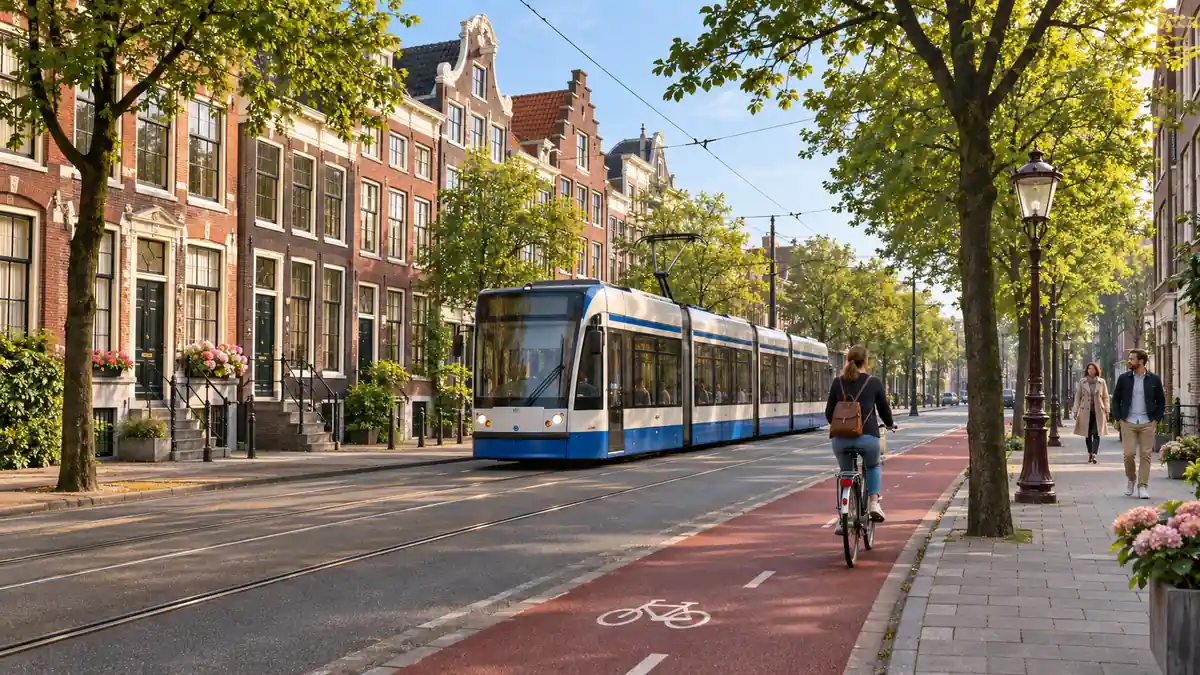
Treat every red-asphalt path and every lane painted with a bike symbol as a road. Never stand, walk or stop for a photo in it, look both ways for bikes and scooters before you step off the kerb, and cross briskly once you go.
Cycle traffic in central Amsterdam is dense and fast, and riders do not expect pedestrians in their lane. The UK government’s travel advice for the Netherlands warns visitors about exactly this: cycle paths are busy, and the people on them move quickly. Bikes are not the only thing to watch. Trams run through the same streets, often on tracks beside the bike lane, so a step back from one can put you in front of the other.
The hardest spots are the forecourt of Central Station and the length of Damrak. Both funnel arriving visitors, luggage and all, across heavy cycle routes. Stop on the pavement to check your map. Never in the lane.
- Don’t wait at a crossing on the cycle path itself; wait on the pavement.
- Don’t drift into a bike lane to pass a slow group on the pavement.
- Don’t step out because a rider seems far away: bikes close the gap quickly.
- Don’t park a rented bike, a suitcase or yourself on the path to take a photo.
A bell behind you is not a polite request. By the time a rider rings, they have usually decided not to brake, so step aside first and look around after.
Should you rent a bike as a tourist?
Rent a bike only if you already ride confidently in heavy traffic; otherwise walk and take trams. Amsterdam’s cycle paths are a commuter network, and locals ride them at commuter pace.
If you do rent, ride like a local. Use the cycle paths and keep off pavements and pedestrian shopping streets such as Kalverstraat. Put an arm out before you turn so the riders behind you know what you are doing. Switch on your lights after dark. Bike theft is common, so lock the frame to something fixed (a rack or a railing) every time you leave it, even for a moment.
Tap in, tap out: how trams, buses and the metro take payment
Hold a contactless bank card or phone to the reader when you board and again when you get off, on every GVB tram, bus and metro ride. Through OVpay that tap is your ticket, so you don’t need to buy anything before you travel.
Checking out matters as much as checking in. Forget the second tap and the system cannot tell where your journey ended, so you are charged more than the ride would have cost. Make the check-out tap a habit at every stop, including the last one of the night.
Use the same card or phone for both taps. A phone wallet and the plastic card behind it are read as two different cards, so tapping in with one and out with the other leaves both journeys open.
GVB runs the city’s trams, buses, metro and ferries. Trains, including the ones from Schiphol into the city, are run by NS, a separate operator, so check how NS takes payment before you land. For routes that mix the two, the 9292 journey planner covers every operator in one search.
Walk, take the free ferry, leave the car at home
The centre of Amsterdam is compact enough to walk, trams fill the gaps, and the free IJ ferries behind Central Station take you across the water to Amsterdam Noord. The Buiksloterweg ferry is the one most visitors use, and you board it on foot or with a bike.
Driving into the centre is the wrong choice for a city visit. The canal streets are narrow, many are one-way or closed to cars, and parking is scarce. Arrive by train, or leave a hire car outside the centre and switch to public transport.
Do you need cash in Amsterdam, and do you tip?
Cards and contactless payments work almost everywhere in Amsterdam, but carry a little cash for the exceptions. Tipping is not expected: rounding up or leaving a modest amount for good service is plenty.
The currency is the euro. Many shops and cafés are card-only, and a sign reading “alleen pin” at the till means exactly that: no cash at all. At the other end, some market stalls, public toilets and older small shops prefer cash, and some do not accept every foreign credit card. A debit card plus a few coins and small notes covers both cases.
A till in Amsterdam can turn down your cash just as readily as your card, which is why the safest wallet holds both.
Your accommodation bill carries one more line. The city’s tourist tax is added to the room rate, so check whether the price you booked already includes it.
A coffeeshop sells cannabis; a café sells coffee
The name is the trap: a coffeeshop is a licensed cannabis outlet, while a café or a brown bar is where you go for coffee and a drink. Amsterdam’s coffeeshops admit visitors aged 18 and over, and staff check ID at the door.
Cannabis is technically illegal in the Netherlands. The sale of small amounts in licensed coffeeshops is tolerated, and that tolerance comes with conditions: no sales to minors and no hard drugs on the premises. Staff can refuse entry to anyone.
Hard drugs are strictly illegal everywhere in the city. Never buy from street dealers, who approach visitors around the old centre: what they sell is often fake, and sometimes dangerous. Don’t mix alcohol and cannabis. If you are unsure about anything on the counter, ask the staff before you buy. That is all the consumption advice a first visit needs.
Where smoking cannabis is banned: the old centre, including the Red Light District
You can smoke cannabis inside the coffeeshop where you bought it, but not in public in Amsterdam’s old centre. The ban covers the Red Light District, Nieuwmarkt and Dam Square, applies to residents and visitors alike, and is enforced with on-the-spot fines.
Signs reading “No smoking cannabis in public” mark the zone. The rules around it are short:
- Inside a coffeeshop: allowed, for visitors aged 18 and over with ID.
- On the street in the old centre: banned, with on-the-spot fines.
- In a bar or club: most do not allow cannabis, even in their smoking areas.
- Drinking alcohol on the street: prohibited in most public places, especially in the centre.
- Hard drugs: illegal everywhere.
The tolerance stops at the coffeeshop door. Walk out onto Nieuwmarkt with a lit joint and a legal purchase becomes a fine.
How to behave in the Red Light District
Walking through De Wallen, the Red Light District, is allowed and ordinary. Photographing or filming the windows is not, and official guided tours of the district are not allowed. Go on your own, keep your phone in your pocket and keep your voice down.
Do
- Walk through as you would any other neighbourhood street.
- Keep moving and give the windows and the workers space.
- Stay quiet in the side streets, where people live above the windows.
Don’t
- Raise a phone or camera towards the windows, even for a street shot.
- Book or join a guided group tour of the district.
- Smoke cannabis on the street: the public ban covers De Wallen.
- Arrive drunk and loud with a group.
De Wallen is a residential neighbourhood first, with homes, shops and churches between the windows, and the rules exist to protect the people who live and work there. Weekend evenings get rowdy, and venues close earlier at weekends than many visitors expect. The same noise reaches the rooms above the streets, so a bed in De Wallen means late nights whether you go out or not. Weigh that before you book, using our guide to where to stay in Amsterdam.
Is Amsterdam safe? Pickpockets, fake police and canals
Amsterdam is safe from violent crime by big-city standards. The real risks for visitors are pickpockets in the Damrak, Dam Square and Central Station corridor and on crowded trams, scammers posing as police who ask to check your wallet, street dealers, and the canals after dark.
Pickpockets work where visitors are distracted: stepping off a train, boarding a tram, stopping to look up at a facade. Wear a cross-body bag zipped and in front of you, and keep nothing in your back pockets.
The fake-police scam targets visitors directly. Someone in plain clothes shows a badge and asks to inspect your wallet, cash or bank cards. A real officer has no reason to count your money, and the request itself is the giveaway.
If someone claiming to be police asks for your wallet or cards:
- Refuse to hand anything over.
- Walk into the nearest shop or busy café.
- Call 0900 8844, the Dutch police number for non-emergencies, to check whether the officer is genuine.
- Call 112 if you are threatened or in danger.
The canals are the risk people underestimate. Most canal edges have no railing, and people drown in Amsterdam’s canals every year. Don’t walk along the edge after drinking, and don’t stop at the waterside to urinate. Ignore street dealers entirely: their offer is illegal, and the product is often fake.
Locals expect quiet streets at night and nothing in the canals
The fastest way to be unwelcome in Amsterdam is noise after dark in the narrow canal streets. Keep groups quiet on the way home, never urinate in canals or doorways, and take empty bottles and cans back to the supermarket for the deposit instead of leaving them on a bridge or a step.
Sound carries in the canal belt. The streets are narrow, the houses sit close to the water, and people sleep with windows open above them. The city actively discourages visitors who come only to party, and its rules on noise, litter and public urination are enforced in the centre. A group that lowers its voice after midnight is treated as a guest. One that doesn’t is treated as a problem. Dutch directness works the same way in daytime: a resident who tells you plainly that you are blocking a doorway is not being rude, only clear. English is spoken almost everywhere, and a simple please and thank you in it goes a long way. For a quieter evening out, a brown bar suits the canal streets better than a bar crawl.
Book the big museums before you arrive
The Anne Frank House, the Van Gogh Museum and the Rijksmuseum sell timed entry slots online, and the Anne Frank House sells out far ahead. Book before you travel, or plan your visit without it.
A timed slot is a fixed appointment. Arrive on time, have the booking on your phone, and carry photo ID, because the name on the ticket may be checked. Which museums to choose, how to time the slots and whether a pass such as the I amsterdam City Card pays off are covered in our Amsterdam museums guide.
Tours and activities
Book skip-the-line tickets, day trips and local tours with free cancellation on most activities.
You can also browse everything on getyourguide.com.
Tripstou may earn a commission if you book through this link, at no extra cost to you.
What to pack for a city where it rains in every season
Pack layers and a waterproof jacket with a hood, because umbrellas lose to the wind here, plus shoes that handle wet cobbles and a quick step out of a bike lane, and a small cross-body bag.
Wind off the IJ makes a mild day feel colder by the water, winter days are short with flat grey light, and summer evenings are warm enough to sit out on a canal-side terrace. The same day can bring all of it, so plan for change, whatever the forecast says.
- A waterproof jacket with a hood
- A warm mid-layer, even in summer
- Comfortable shoes with grip for wet stone and cobbles
- A small cross-body bag that zips
- A contactless card or phone wallet for trams
- Photo ID for coffeeshops and museum bookings
Crowds are a matter of season more than weather, and the best time to visit Amsterdam depends on how much of them you can take.
The Rules in One Glance
- Treat red asphalt and any lane marked with a bike symbol as a road: wait on the pavement, look both ways before stepping off the kerb, and never stop in the lane for a photo.
- On GVB trams, buses and metro, tap the same contactless card or phone in when you board and out when you get off, or you pay more than the ride cost.
- Carry a debit card and a little cash, because some Amsterdam tills take cards only while some stalls and public toilets prefer coins.
- Amsterdam’s coffeeshops admit visitors aged 18 and over with ID, and cannabis bought there may be smoked inside but not on the streets of the old centre, where on-the-spot fines apply.
- You may walk through the Red Light District, but photographing or filming the windows is not allowed, and neither are official guided tours of the district.
- No genuine officer asks to count your cash, so refuse any “police” wallet check, call 0900 8844 to verify the officer and call 112 if you are in danger.
- Keep groups quiet in the canal streets at night and stay away from the unrailed canal edges after drinking.
Small Questions First-Timers Still Ask
What happens if you forget to check out of the tram or metro?
You are charged more than the ride would have cost, because without a check-out the system has no end point for your journey. The last ride of the night is when the second tap is easiest to forget, so make it part of stepping off, with the same card or phone you tapped in with.
Do people speak English in Amsterdam?
Yes. English is spoken almost everywhere a visitor goes, from shops and cafés to museums and trams, so you don’t need any Dutch. “Dank je wel” (thank you) is a welcome courtesy, and the one Dutch phrase worth recognising is “alleen pin” at a till, which means card only.
Can you drink the tap water in Amsterdam?
Yes. Amsterdam’s tap water is safe to drink, so refill a bottle at your accommodation instead of buying water.
Should you carry your passport or ID in Amsterdam?
Carry an official photo ID whenever you go out. Coffeeshops check it at the door to confirm you are 18 or over, and a museum may compare it with the name on a timed booking. For many visitors that document is the passport, so keep it zipped in a front pocket or a cross-body bag rather than a back pocket.
Keep Planning Amsterdam
- Amsterdam guide: the full planning picture, from orientation to how long to stay.
- Where to stay in Amsterdam: which area to base yourself in, and how to avoid De Wallen’s late-night noise.
- Amsterdam museums guide: timed tickets, slot timing and whether a pass is worth it.
- Best time to visit Amsterdam: crowds and season, so you know what to expect when.
Did this guide save you time or money? Tripstou is independent and reader-funded — if you'd like to give something back, you can support the site with a crypto contribution of any size.