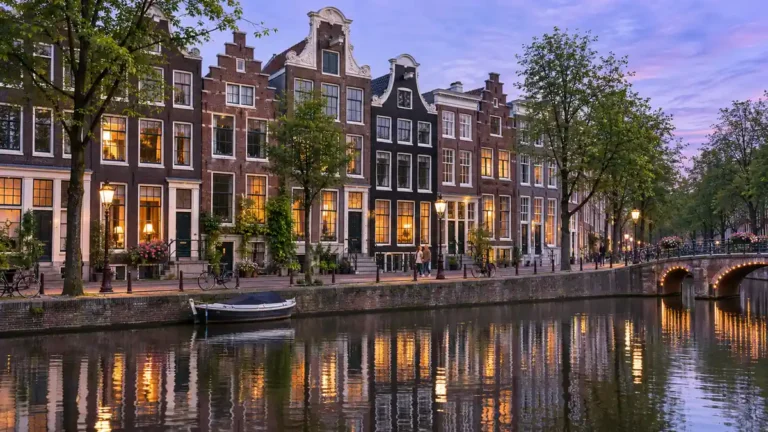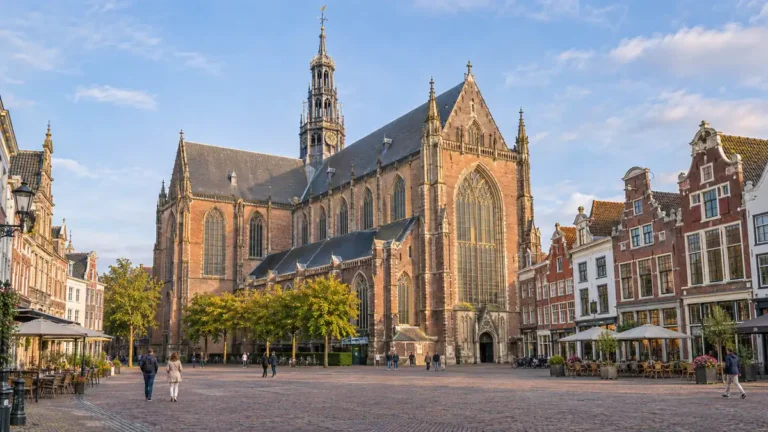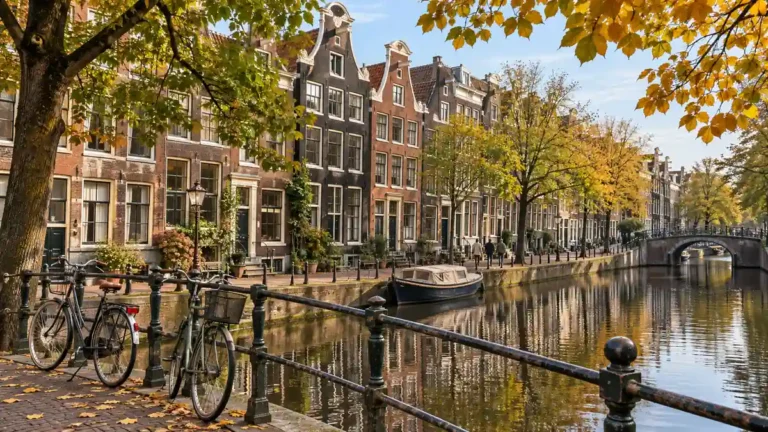
The foods to eat in Amsterdam are a short list: raw herring from a cart, bitterballen with a beer in a brown café, fries, kibbeling and a warm stroopwafel from a market stall, a slice of appeltaart, and one big sit-down meal of Indonesian rijsttafel or Surinamese roti. You find them by setting, not by restaurant. Each dish belongs to a cart, a stall, a café or a kitchen.
Season changes the list twice. Herring is a summer food at its best, while winter brings stamppot, snert and oliebollen. Cost follows the same logic: roti and market food are the cheap way to eat well, and rijsttafel is the splurge.
Bitterballen, Herring and Stroopwafels Come First
Bitterballen and raw herring are Amsterdam’s most famous foods, and the stroopwafel is its most famous sweet. A first visit should include all three. Add a paper cone of fries, rijsttafel for one evening and oliebollen if you come in winter, and you have eaten the city’s core.
| Dish | What it is | Where you eat it | Season |
|---|---|---|---|
| Bitterballen | Crisp-crumbed balls of soft meat ragout, dipped in mustard | Brown café, with a beer | All year |
| Haring | Raw brined herring with chopped onion and pickles | Herring cart or fish stall | Best in early summer |
| Frietjes | Thick fries in a paper cone, under a Dutch sauce combination | Snack bar or market stall | All year |
| Stroopwafel | Two thin waffles stuck together with caramel syrup | Market stall, warm off the iron | All year |
| Rijsttafel | Many small Indonesian dishes served around rice | Sit-down Indonesian restaurant | All year |
| Oliebollen | Fried dough balls under powdered sugar | Street stands | Winter, around New Year |
Several classics sit outside the table because each lives in one place. Kibbeling and kroketten are stall food, poffertjes and pannenkoeken are the sweet sit-down, roti is a Surinamese counter lunch, stamppot and snert are cold-weather café dishes, and aged Gouda belongs at the cheese counter. Each turns up below in the setting where you will actually eat it.
How to Eat Raw Herring in Amsterdam, and When It Is Best
Raw herring is bought from a herring cart or fish stall (a haringhandel) and eaten in one of two ways: held by the tail and lowered into the mouth with chopped onion and pickles, or as a broodje haring in a soft white roll. It is best in early summer, around June, when the new-season Hollandse Nieuwe arrives.
“Raw” here means brined, not sushi-raw. The fish is cured, so it tastes mild, soft and gently salty, with the onion doing most of the sharp work.
Hollandse Nieuwe is the name reserved for new-season herring. To carry it, the fish must reach a fat content of at least 16%. That fat is what makes the early-summer herring so soft it almost melts on the tongue.
Carts cluster where people walk: on market streets, on squares and beside canal bridges in the centre. Look for a small kiosk with a fish counter and a few standing customers; you order, pay and eat on the spot.
Start with the broodje haring if raw fish worries you. The bread and onion soften the first bite, and most people who like it in a roll try it by the tail the next day.
Street Food From the Stall: Fries, Kibbeling, Stroopwafels and Poffertjes
The cheap, standing-up Amsterdam meal is a paper cone of thick fries under a Dutch sauce combination, a tray of kibbeling with garlic mayonnaise, and a warm stroopwafel or a plate of poffertjes from a market stall. All four come from stalls and snack bars, and none needs a table.
Fries are called frietjes or patat, and the sauce is the point. Patatje oorlog (“war fries”) comes loaded with satay sauce, mayonnaise and raw onion. Patat speciaal swaps the satay for curry ketchup, with mayonnaise and onion again.
Kibbeling is battered, fried white fish, usually cod, served in chunks with a garlic or herb mayonnaise. Fish stalls and markets sell it, often from the same counter as the herring, which makes it the easy option for anyone who wants fish without the raw part.
A stroopwafel bought warm is a different food from the packet version. At a market stall the waffle is pressed on the iron in front of you, split and filled, and handed over soft enough to bend, with syrup still running. The packet biscuit you take home is crisp and dry by comparison, so buy from the stall where you can see the iron.
Poffertjes are tiny puffed pancakes served by the plateful with butter and powdered sugar. Pannenkoeken are their sit-down cousin: large, thin plate-sized pancakes, sweet or savoury, eaten at a table in a pancake house.
Kroketten are the larger, log-shaped relative of bitterballen, and Amsterdam sells them from walls of small hatches. You pay by coin or card, a little door unlocks, and you pull out a hot kroket. It is the city’s fastest snack.
Three sweets fill the shop shelf and travel well:
- Drop: Dutch liquorice, often salty, and an acquired taste worth one try.
- Ontbijtkoek: a dense, spiced breakfast loaf, sliced and buttered.
- Tompouce: a pastry slab of cream between puff layers, iced pink most of the year.
Brown Cafés: Bitterballen, Beer and the Kopstootje
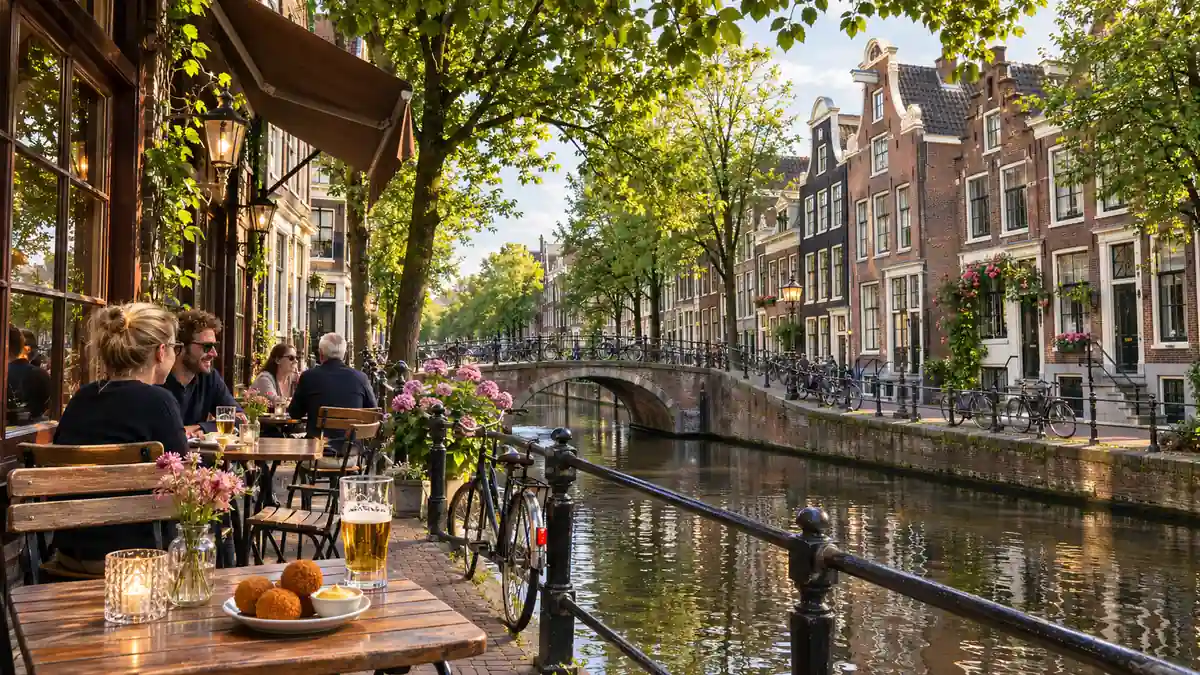
The classic Amsterdam evening is spent in a brown café, an old wood-panelled pub, with a plate of bitterballen and a beer. Bitterballen are crisp-crumbed balls of soft meat ragout that come hot from the fryer with a pot of mustard for dipping. The Dutch chaser is the kopstootje: a small glass of jenever served next to the beer.
Bruine cafés take their name from walls darkened over generations. They are concentrated along the canals of the Jordaan and in the streets around Spui, where you can walk from one to the next in a few minutes. Expect locals to stay for hours over two drinks and a snack.
Jenever is a juniper spirit and the ancestor of gin. It is drunk in proeflokalen, tasting rooms where the spirit is poured at the bar, and the oldest of them sit in the old centre. A kopstootje in a tasting room is the most Amsterdam drink you can order.
Local beer is easy to find, from Dutch lagers on tap in every café to small breweries across the city. The best-known landmark is a brewery under a windmill in the east of Amsterdam, where the beer comes with the sails turning overhead.
Dinner runs early, and bar snacks fill the later evening. That is when bitterballen are ordered most. Service is included in the bill, and rounding up is common.
Appeltaart: the brown café’s other order
Amsterdam appeltaart is a deep-dish apple pie with cinnamon and raisins, served with a heap of slagroom (whipped cream). The Jordaan cafés near the Noordermarkt are where people queue for it. Order it mid-afternoon with a coffee; by evening the café belongs to beer.
Rijsttafel and Roti: The Indonesian and Surinamese Kitchens You Should Not Skip
Amsterdam’s big sit-down meal is Indonesian rijsttafel, a spread of many small dishes around rice, and its cheap, filling lunch is Surinamese roti. Both are as much Amsterdam food as herring, and skipping them means missing half of how the city eats.
Both cuisines arrived through Dutch history overseas. Rijsttafel developed under Dutch colonial rule in Indonesia and is now more of an Amsterdam institution than an Indonesian one. Surinamese cooking came with migration around Suriname’s independence in the mid-1970s, and its kitchens are now part of everyday Amsterdam life.
Rijsttafel: how the meal works
Rijsttafel is a shared meal: a table of small dishes arrives at once, some spicy, some sweet, some fried, with rice at the centre, and everyone helps themselves. You order it for the whole table, so it works best with two or more people and an unhurried evening. It is the splurge meal of most trips. The long-standing Indonesian restaurants sit in the centre and around the canal ring.
Roti, pom and saoto: the Surinamese lunch
Surinamese roti is a soft flatbread served with curried chicken, potato and long beans, and it is one of the best-value meals in the city. Broodje pom is a sandwich filled with pom, a baked dish of chicken and grated root vegetable, and saoto is a fragrant chicken soup. Counter-service Surinamese places and takeaways are concentrated in De Pijp and Oost, where a roti lunch costs little and fills you until evening.
Make roti the lunch and rijsttafel the dinner on the same day, and you have eaten both kitchens without either meal crowding the other.
Albert Cuyp or Foodhallen: Which Market to Use, and on Which Day
Albert Cuyp Market in De Pijp is the open-air street market for stroopwafels, herring, kibbeling and fries, open Monday to Saturday. Foodhallen in Oud-West is the indoor food hall for a sit-down graze across many kitchens under one roof, open seven days a week, Sundays included. On a Sunday, Foodhallen is the one to use.
- Albert Cuyp Market (Albert Cuypstraat, De Pijp): about 260 stalls along one long street, which its operator calls Europe’s largest day market. Come here for the stall foods eaten standing up. It is closed on Sundays and public holidays.
- Foodhallen (De Hallen, Oud-West): 19 food stands inside a converted tram depot, with shared tables between them. It suits a group that cannot agree on one cuisine, and the Ten Katemarkt street market sits right beside De Hallen.
- Noordermarkt (Jordaan): the farmers’ market of the canal district, with cheese, bread and produce stalls, and the apple-pie cafés around its square.
- Dappermarkt (Oost): the everyday neighbourhood market of the east, multicultural and less touristed, with stalls that reflect who lives around it.
Albert Cuyp works best as a market morning, with breakfast from the stalls and lunch at a Surinamese counter in the streets around it. If you are building that morning into a wider sightseeing day, our guide to things to do in Amsterdam shows what sits around the markets.
Which Dutch Foods Change With the Season
Two foods are seasonal in a way that matters to a visitor: new-season herring belongs to early summer, and winter brings stamppot, snert and oliebollen. Almost everything else on this page, from bitterballen to rijsttafel, is eaten all year.
Summer is herring season. The Hollandse Nieuwe arrives around June, and that is when the herring is softest and the queue at the cart longest.
Winter is the season of stodge. Stamppot is mashed potato worked through with kale, sauerkraut or carrot and onion, with a sausage laid on top. Snert is a split-pea soup so thick a spoon stands in it, cooked with pork. Both are cold-weather café food, and both are hard to find on a menu in July.
Oliebollen are the sweet sign of winter. Fried dough balls dusted heavily with powdered sugar, they are sold from street stands mainly in the weeks around New Year and eaten hot from a paper bag.
Two smaller shifts follow the calendar. The pink tompouce turns orange around King’s Day, and spiced biscuits and chocolate fill the bakeries in the Sinterklaas season.
Gouda, Edam and Aged Dutch Cheese: Taste Them in the City
The Dutch cheese to try is aged (oude) Gouda: hard, crumbly and caramel-sweet, with crunchy crystals through it. Taste it next to young Gouda and Edam at the cheese shops and tasting rooms of the centre or at a market cheese stall, such as those at the Noordermarkt. You do not need to leave Amsterdam to eat it well.
The names come from towns. Gouda and Edam gave their names to the two famous cheeses, Alkmaar is known for its traditional cheese market, and Zaanse Schans is the windmill village where cheese making is shown to visitors. In the city, the useful move is to ask for a taste of the young, the mature and the old side by side; the difference in age is the whole lesson.
Where to Eat in Amsterdam, Neighbourhood by Neighbourhood
De Pijp is the best single neighbourhood for eating in Amsterdam, with Albert Cuyp Market and the city’s densest spread of Surinamese and multicultural kitchens. The Jordaan is for brown cafés, apple pie and the Noordermarkt, Oud-West for Foodhallen and Ten Katemarkt, and Oost for the Dappermarkt and Surinamese and Turkish food.
De Pijp is a morning and lunchtime neighbourhood. Walk Albert Cuyp for herring, fries and a warm stroopwafel, then sit down for roti in the side streets.
The Jordaan comes into its own in the afternoon and evening. Take appeltaart near the Noordermarkt mid-afternoon, then move to a canal-side brown café for bitterballen and a kopstootje.
Oud-West is the group dinner. Foodhallen gives everyone a different stand and one table, and it is the reliable choice on Sundays, when Albert Cuyp is closed.
Oost is for an unhurried local lunch: the Dappermarkt, then Surinamese or Turkish food in the streets around it, and the windmill brewery for a beer afterwards.
With only a short stay, pair one market morning with one rijsttafel evening; our two-day Amsterdam itinerary shows where both fit around the sights.
Two Quick Questions Before You Eat
Is raw herring in Amsterdam safe to eat?
Yes. Herring sold in the Netherlands must be frozen before it reaches the cart, as Dutch law requires, and it is then brined, so the “raw” fish you are handed has been both frozen and cured.
Is the tap water safe to drink in Amsterdam?
Yes, Amsterdam tap water is safe and good to drink. Ask for kraanwater in a café, and carry a bottle to refill as you walk between markets.
About This Food Guide
This page settles which Dutch and Amsterdam foods to eat and where and when each one is eaten; it is not a restaurant ranking, a price guide, a list of market hours or a day-trip plan.
Alex Perrut, working in tourism since 2015, went over the dishes and market days here for the Tripstou editorial team; the page was written with AI assistance, as our editorial process explains.
Official sources consulted: Albert Cuyp Market, Foodhallen Amsterdam, I amsterdam.
Plan the Rest of the Amsterdam Trip
- Amsterdam travel guide: the whole city in one planning page.
- Things to do in Amsterdam: the sights to put around a market morning.
- Two-day Amsterdam itinerary: where a rijsttafel evening and a market morning fit in two days.
Did this guide save you time or money? Tripstou is independent and reader-funded — if you'd like to give something back, you can support the site with a crypto contribution of any size.