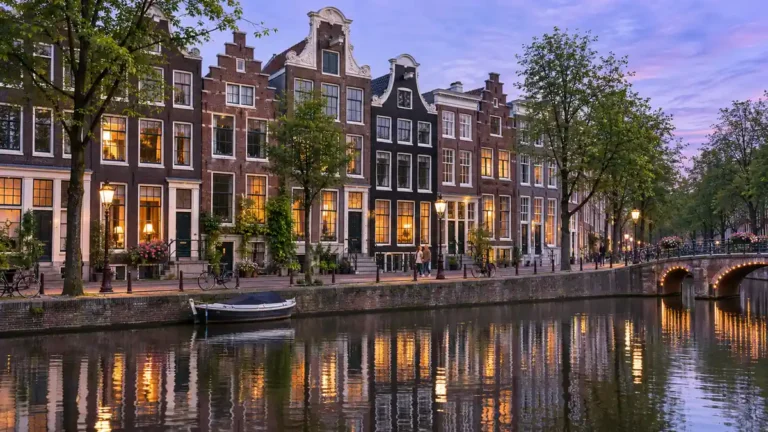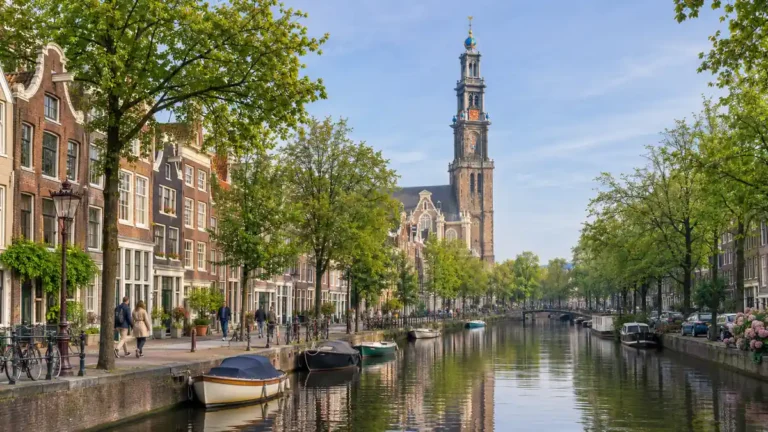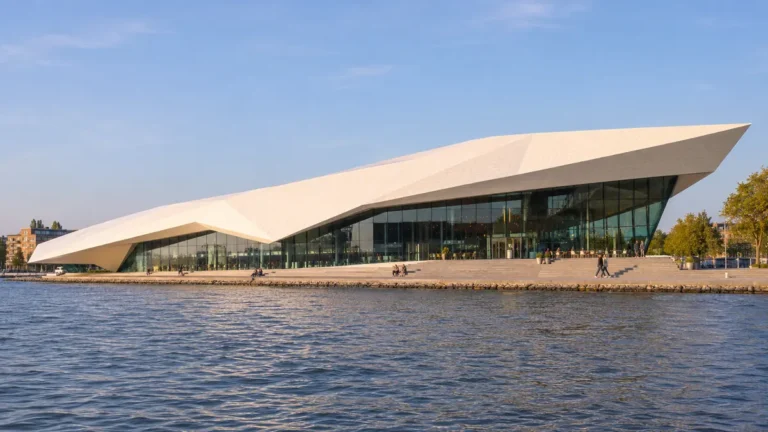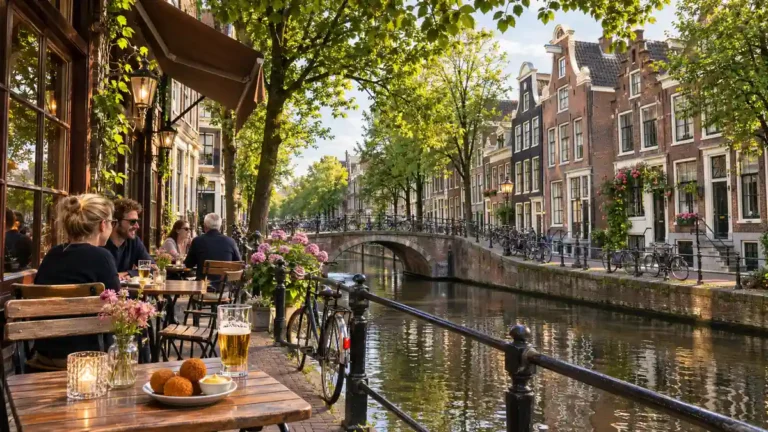
The day trips from Amsterdam that best repay a train ticket are Haarlem for a compact old town, Zaanse Schans for the nearest windmills, the Waterland villages of Volendam, Edam and Marken, and one big city: Rotterdam, or the Hague paired with Delft. Give Giethoorn or Kinderdijk a whole day if you go at all, and keep Keukenhof for spring. What separates them is effort. Haarlem and Zaanse Schans cost under half an hour from Centraal; Giethoorn costs around two hours each way.
Everything below is ordered by door-to-door time from Amsterdam Centraal, with one public-transport route per place and a straight call on whether a tour beats doing it yourself. Bruges, Maastricht, Texel and Groningen sit at the end, as the overnights they really are.
The Short Version
- Haarlem is the easiest first day trip for most visitors: a short direct train, an old centre a walk from the station, and half a day covers it.
- Zaanse Schans is the closest place to Amsterdam to see working windmills, while Kinderdijk is the bigger windmill site and costs a whole day by train and boat.
- For one big-city day, Rotterdam gives modern architecture and a working harbour, and the Hague with Delft gives the Mauritshuis in the morning and Vermeer’s town after lunch.
- Pair two places on the same line, such as Haarlem with Zaanse Schans or Rotterdam with Kinderdijk, and never try a third stop in one day.
- A guided day earns its price only where a bus or boat connection is the hard part: Giethoorn, Kinderdijk, the Waterland village combination and Keukenhof in season.
- Bruges, Maastricht, Texel and Groningen need a night away, and Antwerp is the one Belgian city that works as a long day from Amsterdam.
Which day trips from Amsterdam are worth it, and which to skip
Haarlem, Zaanse Schans, Utrecht, Rotterdam and the Hague with Delft all reward a day trip from Amsterdam on direct trains, with no planning beyond the departure board. Giethoorn, Kinderdijk and the Volendam–Edam–Marken circuit are worth it as well, but each hangs on a bus or boat connection, and that is where a guided day starts to earn its price. Bruges is the one to skip as a day trip: there is no direct train, and it takes 3–4 hours each way with changes.
The last connection, not the distance, sets how much of the day a trip costs. Giethoorn’s bus leg makes it about as long a haul as Antwerp, which sits across a border at the end of a fast train.
| Trip | Travel time each way | Route type | DIY or tour |
|---|---|---|---|
| Haarlem | Under 20 minutes | Direct train | DIY |
| Zaanse Schans | About 17 minutes, plus a 15-minute walk | Direct train | DIY |
| The Hague and Delft | About 50 minutes to an hour | Direct train | DIY |
| Rotterdam | About 40 minutes on the Intercity Direct | Direct train (supplement applies) | DIY |
| Giethoorn | Around two hours door to door | Train + local bus | Tour often easier |
| Kinderdijk | 1.5–2+ hours | Train + Waterbus boat | DIY or tour |
Pair two places on one line, never three. Haarlem with Zaanse Schans, the Hague with Delft, Rotterdam with Kinderdijk and Zaanse Schans with the Waterland villages all fit a day; a third stop turns the day into station time.
Day trips cover only the places within reach of Amsterdam. For the wider choice, including towns that deserve a night of their own, see the best places to visit in the Netherlands. With a single spare day and no appetite for trains, the things to do in Amsterdam will fill it without leaving the city.
Under half an hour from Centraal: Haarlem, Zaanse Schans and Utrecht
Haarlem, Zaanse Schans and Utrecht are the no-stress day trips from Amsterdam: direct trains, frequent departures, and nothing to book the night before. Each fills half a day, so you can decide over breakfast and still be back for dinner in the city.
Haarlem: the old town that takes an afternoon
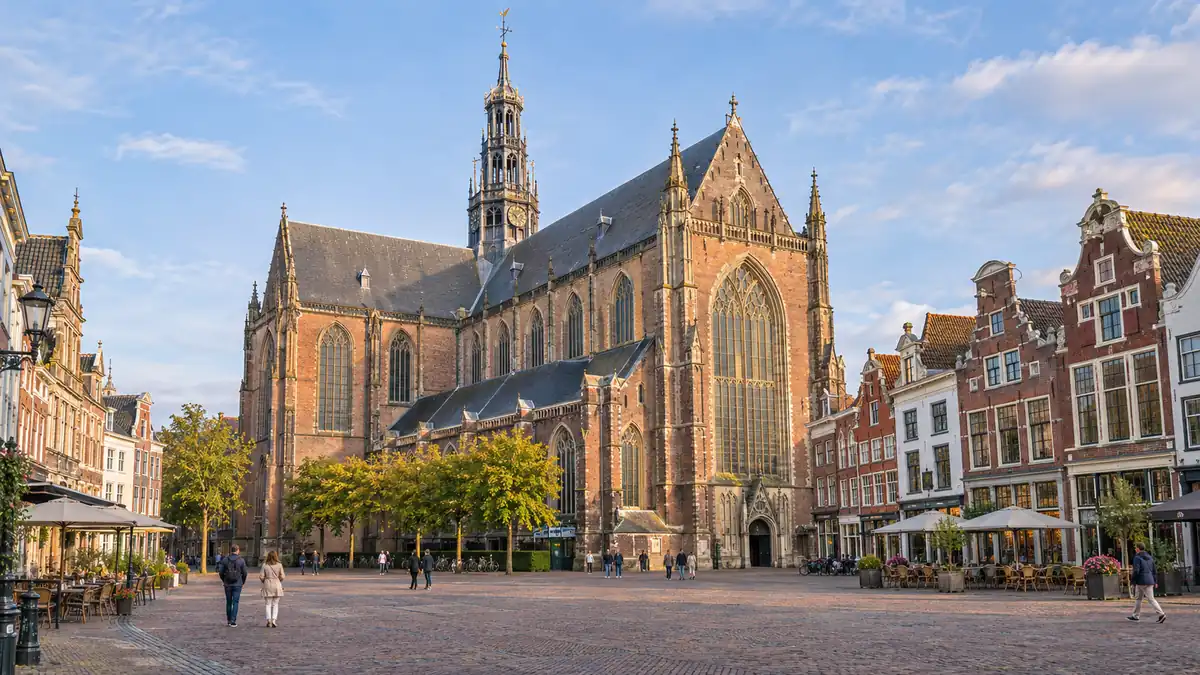
Haarlem is the easiest day trip from Amsterdam. A direct train takes under 20 minutes, and the old centre begins a short walk from the station. The Grote Kerk (St Bavo) dominates the main square, the Frans Hals Museum holds the Golden Age portraits, and De Adriaan gives the town a windmill of its own.
Half a day is enough. Haarlem pairs well with Zaanse Schans on the same day, and in spring it is the natural base for the Keukenhof and bulb-field area. It is the trip to take when you want a Dutch old town at walking pace and only have an afternoon.
Zaanse Schans: the closest windmills to Amsterdam
Zaanse Schans is the nearest place to Amsterdam to see working windmills. Kinderdijk is the bigger windmill site, but it takes 1.5–2+ hours each way by train and boat. Getting to Zaanse Schans is simple:
- Take the direct train from Amsterdam Centraal to Zaandijk Zaanse Schans, about 17 minutes.
- Walk roughly 15 minutes from the station to the windmills.
- Arrive early: the site is at its quietest before the tour coaches pull in.
The draw is the line of windmills along the water, plus the clog and craft workshops and the Zaans Museum. Doing it yourself is easy. A tour only makes sense when Zaanse Schans is the first stop of a day that continues to the Waterland villages (see the next section). For a first sight of windmills with almost no travel, nothing near Amsterdam beats it.
Utrecht: the Dom Tower and wharf-level canals
Utrecht is about half an hour from Amsterdam by Intercity, with trains running through the day. The Dom Tower is the climb, the Oudegracht is the canal with the wharf-level cellars right at the water, and the Centraal Museum and Museum Speelklok, with its mechanical music instruments, cover a rainy afternoon.
Utrecht alone is half a day. Add Castle De Haar outside the city and it becomes a full one. Pick Utrecht if Amsterdam’s canals left you wanting a student city with the same water and a slower pace.
Volendam, Edam and Marken: the Waterland villages by regional bus
Buses to the Waterland villages leave from the regional bus station behind Amsterdam Centraal, not from the train platforms. Volendam and Edam are on the bus network; Marken has no direct bus from Amsterdam and needs a change at Broek in Waterland or the seasonal boat from Volendam. Combining Zaanse Schans with the villages is the one day in this part of the country where a tour saves real time.
Each village earns its stop differently. Volendam is the harbour town with the waterfront promenade. Edam is the quieter cheese town with a compact centre. Marken, a former island, keeps its wooden houses. Broek in Waterland is the calm stop on the way, more village than attraction.
There are three ways to do it:
- Regional bus, DIY. A regional bus from behind Centraal reaches Volendam and Edam without a change. It suits a relaxed day in one or two villages at your own pace, with lunch where you choose.
- Bus plus boat, DIY. Ride the bus to Volendam, then take the seasonal boat across to Marken, or reach Marken by bus with a change at Broek in Waterland. It covers three places but asks you to time the connections yourself.
- Guided combination. A coach links Zaanse Schans, Volendam, Edam and Marken in half a day of driving. It suits anyone for whom all four in one go matters more than time in any of them.
All four in one day is possible on public transport, but only with an early start and no lingering, because Zaanse Schans sits on the train line while the villages sit on the bus network. That is the gap a coach closes, and you can book the village tour to close it.
Cycling is the other way into Waterland. Guided e-bike rides leave from the city into the countryside of windmills and a cheese farm, which turns the flat land between the villages into the point of the day.
Check which ticket covers the regional bus before you board. You can tap in with a bank card or buy a regional day ticket.
Tours and activities
Book skip-the-line tickets, day trips and local tours with free cancellation on most activities.
You can also browse everything on getyourguide.com.
Tripstou may earn a commission if you book through this link, at no extra cost to you.
About an hour away: Leiden, the Hague and Delft, Rotterdam and the cheese towns
The Hague paired with Delft and Rotterdam on its own are the two best uses of a full day an hour from Amsterdam. Leiden, Gouda, Alkmaar and Den Bosch are half-day stops you add to a train line, not destinations to build a day around.
The Hague and Delft in one day
The Hague and Delft fit one day because they sit a short train hop apart on the same line. The Intercity reaches the Hague in about 50 minutes to an hour, and Delft in about an hour.
Start in the Hague with the Mauritshuis and the Binnenhof, with Museum Mesdag for anyone who wants more painting. Spend the afternoon in Delft, the town of Vermeer and Delft Blue pottery, where the canals are small enough to walk end to end before the train home. Coach tours that string Rotterdam, Delft and the Hague into a single day exist, and you can reserve a guided day if a first look at all three counts for more than time inside any one.
This is the day for a museum lover: the Mauritshuis in the morning and Vermeer’s town in the afternoon tell one story.
Rotterdam: the Intercity Direct and the supplement
Rotterdam is about 40 minutes from Amsterdam on the Intercity Direct, and longer on a regular Intercity. The Intercity Direct carries a supplement between Schiphol and Rotterdam, so check your departure station in the NS app before you leave the hotel.
Rotterdam is the country’s modern counterpoint to Amsterdam. The Markthal, the Cube Houses, the Euromast and a harbour boat trip fill a day without a single gabled canal house. Rotterdam also pairs with Kinderdijk, since the Waterbus leaves from the city; that combination is set out under Kinderdijk below. Go here if you want architecture and a working harbour after days of canals.
Leiden, Gouda, Alkmaar and Den Bosch: the half-day add-ons
Leiden is 35–45 minutes from Amsterdam and the natural stop on the way to the Hague. It is a university town with museums, compact enough for a morning before you continue to the coast.
Gouda is under an hour away and is a cheese town first, with a pretty centre to walk around the cheese.
Alkmaar is about 35–40 minutes on an Intercity. Its traditional cheese market runs in season, and the Cheese Museum covers the rest of the year.
Den Bosch is about an hour away. St John’s Cathedral and a boat on the Binnendieze, the waterway that runs under the old town, are the reasons to go.
Giethoorn and Kinderdijk take the whole day, and a tour often earns its keep
Giethoorn and Kinderdijk are both worth a day trip from Amsterdam, and both cost a whole day: around two hours or more each way, with a change to a bus or a boat at the end. Neither pairs with anything else except Kinderdijk with Rotterdam. This is the tier where a guided day is a fair trade for the planning it removes.
Giethoorn by public transport, or on a tour
Giethoorn is worth the trip for its car-free canals, thatched farmhouses and an afternoon in a hired boat, but it is around two hours each way door to door. The village has no train station. Take the train to Steenwijk, direct or with a change at Zwolle, then the local bus from Steenwijk into the village.
The guided day solves the one awkward part. A tour from Amsterdam runs to Giethoorn and back in a single vehicle, with a canal cruise and a walk through the village built in, so there is no bus connection to time at Steenwijk. It is the simplest way to see Giethoorn on a short stay, especially for anyone uneasy steering a boat through narrow canals.
- Take a tour if you have one spare day, no wish to juggle a train-to-bus change, and want the boat trip arranged for you.
- Go by train if you want the quiet early or late hours, your own boat at your own pace, and a lower bill.
Midday on summer weekends is when the canals are busiest. Arriving early by train, before the day’s visitors build up, is the main advantage of doing it yourself.
Kinderdijk: train to Rotterdam, then the Waterbus
Kinderdijk is reached by train to Rotterdam and then the Waterbus boat, which takes 1.5–2+ hours each way, so allow a full day. The route has two legs:
- The Intercity Direct from Amsterdam to Rotterdam.
- The Waterbus from the Erasmusbrug area, up the river to Kinderdijk.
The reward is the UNESCO-listed line of windmills across the polder, the one windmill site near Amsterdam that out-scales Zaanse Schans. Since the boat leaves from Rotterdam, the pairing works naturally: a morning in Rotterdam and the boat after lunch, or Kinderdijk first and Rotterdam’s harbour in the evening light. Guided tours to Kinderdijk also exist and suit anyone who would sooner skip the two connections.
Choose Kinderdijk over Zaanse Schans when the windmills are the whole point of the day and you can spare all of it.
Keukenhof in spring: the one trip that depends on the calendar
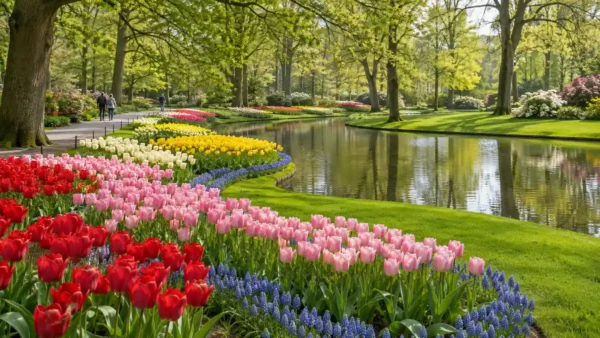
Keukenhof is a spring-only day trip: outside the season there is nothing to see at Lisse, and inside it the only real question is express bus or combination tour.
A seasonal express bus runs to the gardens from the Schiphol side and from the RAI side of Amsterdam. The gardens pair well with the bulb fields around them and with an afternoon in Haarlem or Leiden. Combination tours add Zaanse Schans or a windmill cruise to the gardens, and you can book the combined day for tulips and windmills on one coach. For the season’s dates, tickets and the bus options, see the Keukenhof guide.
Tour or train? When a guided day beats doing it yourself from Amsterdam
Doing it yourself wins for every direct-train city: Haarlem, Utrecht, Leiden, the Hague, Delft and Rotterdam. A tour wins when the trip depends on a bus or boat connection you cannot easily time (Giethoorn, Kinderdijk, the Waterland combination) or on a seasonal shuttle (Keukenhof).
Three questions settle it. How many connections does the trip need after the train? How much of the place is the journey itself, such as a canal cruise? And how many places are you trying to fit into one day? A trip that scores high on all three is a tour; a trip that scores zero is a train ticket.
Each choice has its price. On a tour you give up the quiet early hours and lunch of your choosing, because the coach arrives when the crowds do. On your own you take on a second connection and the planning the night before. The cost of a tour is mostly paid in the hours you cannot control, not in the ticket.
- A coach makes sense when the trip needs a bus or boat after the train, you have a single spare day, or you want three villages and a windmill site covered at once.
- The train makes sense when the place has a direct station, you want to arrive before the coaches, or you plan to stay past late afternoon.
Whichever way you go, stop at two places. Three in a day is the itinerary that looks efficient on paper and leaves you with photos from a car park.
Can you do Bruges in a day from Amsterdam? The trips that are really overnights
No: Bruges has no direct train from Amsterdam and takes 3–4 hours each way with changes, so it is a night away, not a day trip. Maastricht, Texel and Groningen fall into the same category. Antwerp is the one Belgian city that works as a day from Amsterdam.
Bruges, with its Belfry over the market square, deserves the evening after the day-trippers leave. A coach-tour version exists, but it is a long day on the motorway for a few hours on the ground.
- Antwerp is under 2 hours on the fastest trains, which makes it a feasible day, though a full one.
- Brussels takes 2–3 hours, enough for the Grand Place and little more; it is borderline as a day and better with a night.
- Maastricht is about two and a half hours away, in a south that feels like another country, and repays a night.
- Texel and Groningen are too far for a day.
If one of these is the trip you want, give it a night and treat it as the next leg of the journey.
Getting around for day trips: Intercity vs Sprinter, tapping in and the buses behind Centraal
Every route on this page runs on one habit: tap in and out with a bank card, or OVpay, on every train and bus. Take the Intercity on longer legs because the Sprinter stops everywhere, and remember that regional buses leave from behind Amsterdam Centraal, not from the tram stops in front.
- Intercity over Sprinter. Intercity trains skip the small stations; Sprinters call at all of them. On any leg beyond Haarlem the difference adds up.
- Mind the supplement. The Intercity Direct between Schiphol and Rotterdam carries a supplement on top of the normal fare.
- Tap in, tap out. A contactless bank card works through OVpay on trains and buses; the NS day return is the alternative for a single out-and-back journey.
- Buses go from the back. The regional bus station sits behind Centraal, away from the trams in front.
Check your departure station in the NS app before you leave the hotel. Where you base yourself decides which station is nearest, and the Amsterdam guide sets out the neighbourhoods and their stations.
Start early on any trip with a second connection, and keep to two places a day. A hire car is the exception worth one sentence: it makes sense only for Giethoorn combined with the countryside around it, where the bus is the weak link.
Train and bus tickets
Compare routes, schedules and prices across rail and bus operators in one search, with mobile tickets on your phone.
New to Omio? Code NEW10 takes 10% off your first booking — or APPNEW10 if you book inside the Omio app. Both apply to bookings up to €80.
Search routes and compare prices on Omio →
Tripstou may earn a commission if you book through this link, at no extra cost to you.
How We Checked These Routes
This page is a curated choice of day trips from Amsterdam, grouped by travel time from Centraal with one public-transport route for each; it is not a guide to any of the towns, not an itinerary and not a ticket-price page.
Written with AI assistance, then gone over route by route by Alex Perrut, working in tourism since 2015, for the Tripstou editorial team, following our editorial process.
Official sources consulted: I amsterdam, Rotterdam Partners, Holland.com.
Keep Planning Around Amsterdam
- Amsterdam guide: where to base yourself, and which station that puts nearest.
- Best places to visit in the Netherlands: the wider choice, including the places worth a night.
- Keukenhof guide: season dates, tickets and the express bus in detail.
- Things to do in Amsterdam: how to spend the spare day without leaving the city.
Did this guide save you time or money? Tripstou is independent and reader-funded — if you'd like to give something back, you can support the site with a crypto contribution of any size.