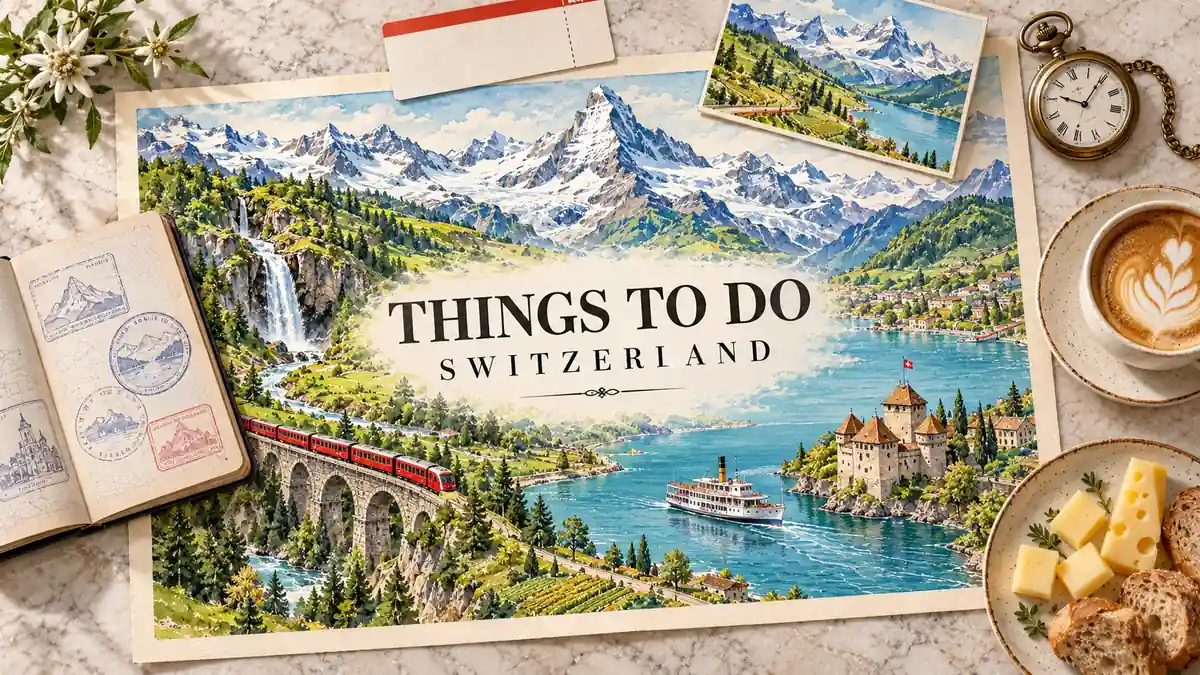
Switzerland’s icons look interchangeable from abroad. Several glacier summits promise the same Alpine panorama, the panoramic trains compete for the same window seat, and every lake seems to come with its own steamer and castle. All of them are expensive. A Swiss trip is won by choosing well, and collecting more of the same does not make it better.
This page groups the signature Swiss experiences by type: mountain excursions, scenic trains, lakes, valleys, old towns, food, and the extras (thermal baths and adrenaline days) that reward longer trips. Each pick names the base town it works from, notes whether it is a summer-season or year-round experience, and ends with one “Pick this if” line. A first-timer can shortlist the essentials in minutes, then decide which look-alikes to drop.
Quick Answer
A first Swiss trip works best built around one mountain excursion, one scenic train and one lake day. Choose the mountain by base and budget: Jungfraujoch for spectacle, Titlis or Pilatus from Lucerne for an easier, cheaper day. Add Lauterbrunnen’s waterfalls and a Gruyères fondue; thermal baths and adrenaline suit travelers with a week or more.
Trust Layer
Tripstou selection guide for travelers choosing between multiple places. Covers selection criteria, traveler fit, and trip value.
Produced with AI assistance and reviewed by Alex Perrut, working in tourism since 2015, for the Tripstou editorial team. See our editorial process for details.
Last factual review: October 2, 2026.
Official sources consulted: Switzerland Tourism, State Secretariat for Economic Affairs (SECO), Glacier Express.
Key Takeaways
- Jungfraujoch is the spectacle summit but the priciest and most weather-sensitive; Titlis and Pilatus from Lucerne give a cheaper, easier mountain day.
- Choose the Glacier Express if you want a full day aboard; the Bernina Express packs glaciers and the descent to Italy into half a day.
- A Lake Lucerne paddle steamer is the best half-day water trip because it doubles as transport to the Pilatus and Rigi lifts.
- When cloud covers the summits, switch to Lauterbrunnen’s waterfalls, Lavaux’s terraces or Bern’s old town instead of buying a fogged-in summit ticket.
- Budget-conscious travelers can skip Jungfraujoch: Schilthorn faces the same Eiger, Mönch and Jungfrau trio from across the Lauterbrunnen valley.
- Several icons run only in the summer season, including the Pilatus cogwheel railway and the Lake Lucerne paddle steamers, so check before booking.
Table of Contents
Which Swiss experiences should a first-timer build a trip around?
A first Swiss trip is built on one mountain day, one scenic train and one lake, chosen by base town. That combination covers the country’s range (glacier altitude, engineered rail scenery and the softer lakeshore) without paying for look-alike summits twice. Everything else on this page is seasoning you add once the core is fixed.
The sections below follow that logic. Mountains come first because they cost the most and decide your base. Trains and lakes follow, then the valley, city, food and extra days that fill the gaps between summit days.
Traveler type changes which groups deserve the most room:
- First-timers: one summit, one panoramic train and Lake Lucerne by paddle steamer cover the essentials.
- Families: Titlis, the lake steamers, Gruyères and the Lindt chocolate visit keep effort low and payoff high.
- Short trips: pick experiences that share one base, such as Lucerne or Interlaken, and skip the cross-country trains.
- Budget-conscious travelers: Pilatus or Schilthorn over Jungfraujoch, plus valleys, regional trains and a free Aare swim in Bern.
- Adrenaline seekers: paragliding over Interlaken, the Peak Walk at Glacier 3000 and winter sledding.
Weather decides more Swiss days than any plan does. Keep high-altitude days flexible, check the summit webcams on the morning itself, and buy the ticket only once the top is clear. A cloudy summit is an expensive view of fog.
This page covers what to do, not where to sleep. For choosing a base, see our guide to the best places to visit in Switzerland; for whole-trip planning, start with the Switzerland travel guide.
Which mountain excursion is worth the money?
Jungfraujoch is the spectacle pick, Titlis the easiest glacier day, and Pilatus the view-for-value pick. Jungfraujoch costs the most and depends hardest on clear weather. Titlis and Pilatus sit close to Lucerne and cost less, while Gornergrat is the one to choose when the Matterhorn is the point of the trip.
| Mountain | Base town | Best for | Trade-off |
|---|---|---|---|
| Jungfraujoch | Interlaken, Grindelwald or Lauterbrunnen | Glacier spectacle at the highest altitude | Priciest excursion and most weather-sensitive |
| Mount Titlis | Lucerne or Engelberg | Easy snow and glacier day for families | Busy summit, less wild than Jungfraujoch |
| Mount Pilatus | Lucerne, via Kriens or Alpnachstad | Lake views and the Golden Round Trip | Cogwheel railway runs in summer season only |
| Gornergrat | Zermatt, the car-free village | Close Matterhorn views without any hiking | Only practical if Zermatt is on the route |
| Schilthorn | Lauterbrunnen or Mürren | Eiger, Mönch and Jungfrau panorama, quieter | Views of the glacier, not onto it |
Jungfraujoch and Schilthorn look at the same peaks from opposite sides. Schilthorn puts the trio in your photograph; Jungfraujoch puts you inside the ice between them. Pay for Jungfraujoch only if standing on the glacier is the point.
Mountain excursions are where a rail pass can pay off or fall short, depending on which summits you pick. Our Swiss Travel Pass guide explains how to judge it.
Jungfraujoch
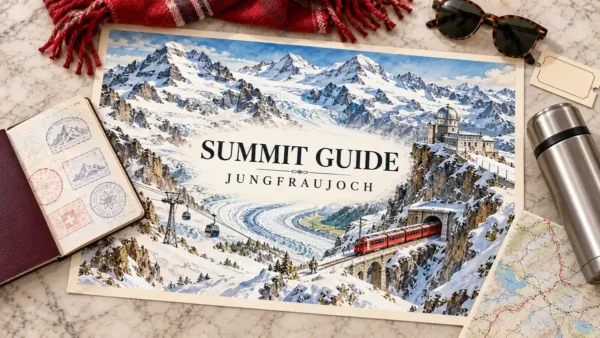
Jungfraujoch is the most dramatic altitude day in Switzerland: a high saddle between the Mönch and the Jungfrau, with the Aletsch Glacier stretching away below. Base in Interlaken, Grindelwald or Lauterbrunnen.
What sets it apart is scale. It is also the priciest of the Swiss mountain excursions and the most exposed to cloud, so a bad-weather visit wastes the biggest ticket of the trip. Tickets, access and timing are covered in our Jungfraujoch guide.
Pick this if: the glacier spectacle matters more than the budget and your dates can bend around the forecast.
Mount Titlis
Mount Titlis is the easiest glacier day from Lucerne. Cable cars climb from Engelberg, the last one with a rotating cabin, to a summit that keeps snow in every season. Base in Lucerne or Engelberg.
Titlis wins on convenience. The route is short and simple, and the snow play, glacier cave and cliff-top walkway keep children busy without a long high-altitude day. It is a natural pairing with the town picks in our guide to things to do in Lucerne.
Pick this if: you are travelling with children and want guaranteed snow without a full day of transfers.
Mount Pilatus
Mount Pilatus is the view-for-value pick, with Lake Lucerne spread directly beneath the summit. Base in Lucerne.
Its edge is the Golden Round Trip, which links a lake boat, the cogwheel railway up from Alpnachstad and the cable cars down toward Lucerne into one loop. The operator describes its line as “the steepest cogwheel railway in the world”. The cogwheel runs in the summer season only, so check the season before you book; the cable car side stays the year-round route up.
Pick this if: you want a lake-and-mountain loop in one outing and Lucerne is already your base.
Gornergrat
Gornergrat is the Matterhorn view without hiking. A cogwheel railway climbs from Zermatt to a ridge facing the peak and a ring of glaciers. Base in Zermatt.
No other excursion on this list puts a single famous mountain so squarely in the frame. Trains leave from the village centre, so the outing fits a morning, and the intermediate stations open walks for those who want them. Pair it with the rest of our things to do in Zermatt.
Pick this if: the Matterhorn is the image you came for and Zermatt is on your route.
Schilthorn
Schilthorn gives the Eiger, Mönch and Jungfrau panorama from the Lauterbrunnen side. Cable cars rise via the car-free village of Mürren to the revolving Piz Gloria summit station. Base in Lauterbrunnen or Mürren.
It is the quieter alternative to Jungfraujoch in the same region. The summit faces the famous trio across the valley, its James Bond history adds a light novelty layer, and Mürren itself rewards a stop on the way down.
Pick this if: you want the Jungfrau region’s big three peaks in view without paying for Jungfraujoch.
Tours and activities
Book skip-the-line tickets, day trips and local tours with free cancellation on most activities.
You can also browse everything on getyourguide.com.
Tripstou may earn a commission if you book through this link, at no extra cost to you.
Glacier Express, Bernina Express or GoldenPass: Which Scenic Train to Ride
Ride the Glacier Express if you have a full day, the Bernina Express for variety, and GoldenPass for lakes. The Glacier Express is an all-day Alpine crossing, the Bernina packs glaciers and the drop to Italy into a half-day ride, and GoldenPass suits travelers already moving between Lake Geneva and the Jungfrau region.
Glacier Express
The Glacier Express crosses the Alps between Zermatt and St. Moritz in about eight hours, over 291 bridges and through 91 tunnels. A seat reservation is required on top of the ticket.
No other Swiss train turns a transfer into the whole day. The panoramic carriages make the Rhine Gorge and the Oberalp Pass the main event, and meals are served at your seat. It suits travelers who enjoy slow travel and are crossing the country anyway.
Pick this if: the ride itself is the destination and you are happy to spend a full day seated.
Bernina Express
The Bernina Express runs the UNESCO-listed Albula and Bernina line over the Bernina Pass and down to Tirano in Italy, a half-day ride.
It packs the most variety into the least time. Spiral viaducts, glacier views near the pass and the descent into chestnut and palm country happen within a single morning. The circular Brusio viaduct is the image most travelers remember.
Pick this if: you want glaciers and palm trees in one trip and only have half a day for a train.
GoldenPass
GoldenPass links Montreux and Interlaken, trading high-Alpine drama for lakes and gentle pastoral landscapes.
It starts above Lake Geneva’s vineyards, crosses the Pays-d’Enhaut and the Gstaad area, and ends among the lakes of the Bernese Oberland. The scenery is softer than the other panoramic routes. It is the most useful of them, because it doubles as a real transfer between two major bases.
Pick this if: you are moving between Lake Geneva and the Jungfrau region and want the transfer to count.
Regular trains run the same lines for travelers who skip the reservation. On the Bernina line, regional trains cross the same viaducts, and their opening windows make them better for photographs than the sealed panoramic cars. Timetables and panoramic services vary through the year, so check the current season. For whether the Swiss Travel Pass covers panoramic trains and their reservations, see our pass guide.
Lakes and Boat Trips Worth a Half Day
Lake Lucerne by paddle steamer is the one boat trip every first-timer should take. Its historic fleet links the lakeshore villages to the Pilatus and Rigi lifts, so the cruise doubles as transport. Lake Geneva’s Château de Chillon and the Rhine Falls near Schaffhausen are the other water days worth routing for.
Lake Lucerne paddle steamers
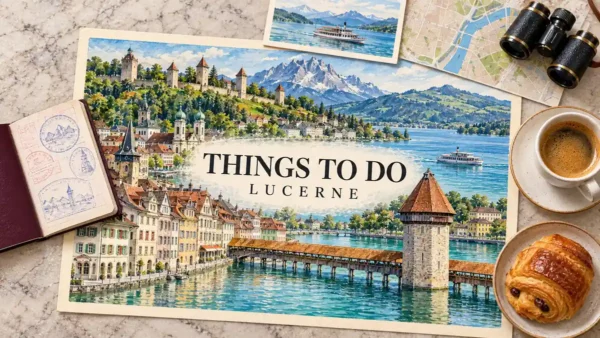
Lake Lucerne’s paddle steamers are the classic Swiss boat day, sailing from Lucerne’s waterfront between steep wooded shores. Base in Lucerne.
What makes them distinct is the connection to the mountains: Vitznau for Rigi and Alpnachstad for Pilatus are both steamer stops. The historic paddle fleet sails in the summer season, so check the season before you plan around it. Out by boat and back by mountain beats an out-and-back cruise.
Pick this if: you want the lake to carry you to a summit, so one day covers both.
Château de Chillon
Château de Chillon is a medieval castle on a rock in Lake Geneva, near Montreux. Base in Montreux or Geneva.
It is one of the most complete castle visits in Switzerland and among the easiest to reach, with lake views from its courtyards and towers. A lakeside path links it with Montreux on foot. It also pairs naturally with the city picks in our guide to things to do in Geneva.
Pick this if: you are on the Lake Geneva side and want history with your lake view.
Rhine Falls
The Rhine Falls near Schaffhausen are one of Europe’s largest waterfalls by volume. Base in Schaffhausen or Zurich.
Power is the draw. Viewing platforms reach right into the spray, and in season small boats run out to the rock in the middle of the falls. It is the easiest water experience to slot in from the north, and it works as a half day from the city covered in our Zurich guide.
Pick this if: you are arriving in Zurich and want a natural spectacle within easy reach.
Lauterbrunnen and the valleys beat the summits on a cloudy day
Lauterbrunnen’s waterfalls are the best cloudy-day fallback in the Swiss Alps. Low cloud that ruins a summit view barely touches a valley floor, so Staubbach and Trümmelbach still deliver. Lavaux’s vineyard terraces above Lake Geneva and the signature valley walks do the same job without any summit ticket.
Lauterbrunnen valley
Lauterbrunnen is a sheer-walled valley lined with waterfalls, with Staubbach falling right beside the village. Base in Lauterbrunnen or Interlaken.
Trümmelbach sets it apart: glacier meltwater thunders through a series of falls inside the mountain, reached by a tunnel lift. The valley floor works year-round, but Trümmelbach is seasonal, so check the season before you go. Rain improves the falls.
Pick this if: the summits are clouded in and you still want the Alps at full volume.
Lavaux vineyard terraces
Lavaux is a UNESCO-listed slope of vineyard terraces dropping to Lake Geneva between Lausanne and Vevey. Base in Montreux, Lausanne or Vevey.
It is the only experience on this page built around wine. Paths link the wine villages above the lake, so a walk from one cellar to the next makes an easy half day. Regional trains along the shore cover the return. The terraces stay beautiful under grey skies, when the lake turns silver.
Pick this if: you prefer a slow walk with a glass of local wine to another mountain lift.
Signature hikes
Switzerland’s signature hikes need no summit ticket beyond the lift to the trailhead. The panorama trail from Männlichen to Kleine Scheidegg faces the Eiger, Mönch and Jungfrau, and the Five Lakes Walk above Zermatt puts the Matterhorn in its waters.
Hiking deserves its own planning, and trail choice depends on fitness and season. Routes, effort and timing live in our guide to the best hikes in Switzerland; for picking a valley to stay in, see where to base in Switzerland.
Pick this if: you would trade a cable-car summit for an afternoon on your own feet.
Old Towns, River Swims and Culture Worth a Day
Bern’s old town and an Aare river swim are the one city day worth planning around. The UNESCO-listed arcades and Zytglogge clock tower fill a morning, and in summer locals float the river through town. Zurich, Lucerne and Geneva work best as city moments paired with mountain days, not as cities to tour exhaustively.
Bern rewards a slow day. Kilometres of covered arcades line the old town, the Zytglogge marks the hours with its moving figures, and the bear park sits across the river. In summer, locals walk upstream and let the Aare carry them back past the parliament. The current is strong. Swim only if you are confident in moving water, and learn the exit points before you jump in.
The free Aare float is what lifts Bern above the bigger cities for a first-timer. It turns a sightseeing day into the most local hour of the trip.
Lucerne’s Chapel Bridge and old town are best treated as the evening around your mountain days, since the city doubles as the natural base for Pilatus, Titlis and the lake. Our guide to things to do in Lucerne covers the town itself.
Zurich is usually the arrival city. Its lakefront promenade and old town fit an afternoon, and the Lindt chocolate visit in Kilchberg sits just along the shore.
Geneva earns its time at the lakefront, where the Jet d’Eau fountain is the city’s signature sight. It is the gateway to Chillon and Lavaux on the same lake.
Chocolate, Cheese and Fondue: The Food Experiences Worth Booking
Gruyères for fondue and Kilchberg for chocolate are the two food days worth planning. The Lindt Home of Chocolate sits on Lake Zurich’s shore near the city, and Gruyères pairs a hilltop castle village with a cheese dairy below it. Both run in any season, which makes them reliable fillers when mountain weather turns.
Lindt Home of Chocolate
The Lindt Home of Chocolate in Kilchberg, near Zurich, is the country’s showcase chocolate experience. Base in Zurich.
What sets it apart is the scale of the production story, from cocoa bean to bar, told through an interactive tour beside a giant chocolate fountain. Tastings come built in. Book ahead, because popular slots fill on weekends and rainy days. It slots into a Zurich half day with no change of base.
Pick this if: you land in Zurich with a free half day and a sweet tooth.
Gruyères
Gruyères is a car-free castle village above the cheese dairy that gives the cheese its name. Base on the Fribourg side or near Montreux.
The village combines a medieval main street, a castle and a show dairy where you watch the cheese being made, then fondue at a village restaurant. It works in any season and suits families. Maison Cailler, the chocolate factory in nearby Broc, can share the same day.
Pick this if: you want one food day that combines cheese, fondue and a castle.
Gruyères and Broc sit close enough that a single detour covers both cheese and chocolate. If you can only fit one food day into the trip, that pairing beats a Zurich chocolate stop on its own.
Thermal Baths and Adrenaline Days: Where to Slow Down or Speed Up
Thermal baths suit the week-long trip, and paragliding at Interlaken is the one adrenaline splurge worth it. Leukerbad and Vals turn a rest day into an experience after hard mountain days. Tandem flights over Interlaken’s lakes and the Peak Walk at Glacier 3000 add altitude thrills without another summit train.
Thermal baths
Leukerbad in Valais is one of the largest thermal resorts in the Alps, with outdoor pools facing sheer mountain walls. Vals in Graubünden is the architecture pick, with stone baths designed by Peter Zumthor.
Both work year-round and give tired legs a day off after summit days. They sit away from the main first-trip routes, so they reward longer trips and shoulder seasons most. Leukerbad suits groups and families; Vals suits travelers who want quiet.
Pick this if: you are travelling for more than a week or in shoulder season and need a recovery day.
Paragliding over Interlaken
Tandem paragliding over Interlaken is Switzerland’s signature adrenaline experience, floating between Lake Thun and Lake Brienz with the Jungfrau peaks in view.
No experience on this page needs less effort for the payoff. Flights launch from the slopes above town, and a pilot handles everything while you watch the lakes. They depend on wind and weather, so keep the booking flexible. Landing usually comes right in the town centre.
Pick this if: you want the lakes-and-peaks view without buying a summit ticket.
Peak Walk at Glacier 3000
The Peak Walk at Glacier 3000 is a suspension bridge strung between two summits, reached by cable car. Base in Les Diablerets or Gstaad.
It delivers the airiest view on this page, with the Matterhorn and Mont Blanc on the horizon in clear weather. Operating hours change with the season, so check the season before you go. In winter, sledding and tobogganing runs across the Alps take over as the easy adrenaline option.
Pick this if: heights excite you and you are staying in western Switzerland.
Frequently Asked Questions About Things to Do in Switzerland
Is the Glacier Express worth it?
The Glacier Express is worth it if the ride itself is your goal and you are crossing between Zermatt and St. Moritz anyway. Its panoramic carriages turn about eight hours of Alpine scenery into the day’s main event. Travelers short on time or money can cover the same route in stages on regular trains without a seat reservation.
What is Switzerland famous for?
Switzerland is famous for high Alpine peaks such as the Matterhorn and the Jungfrau, panoramic trains, glacier-fed lakes, chocolate and cheese. Visitors also know it for car-free mountain villages, medieval old towns like Bern and punctual public transport. For a first trip, each of those reputations maps onto one experience worth booking.
Can you see the Matterhorn without hiking?
Yes. The Gornergrat cogwheel railway climbs from Zermatt to a ridge facing the Matterhorn, so the classic view needs no walking at all. Cable cars on the Zermatt side reach other high viewpoints, and the peak is visible from parts of the village itself on clear days. Check the webcams first, because cloud often hides the peak.
What can you do in Switzerland in winter?
Winter in Switzerland centres on skiing, sledding runs and snow-covered summits such as Titlis, which keeps snow year-round. Panoramic trains, lake towns, thermal baths at Leukerbad or Vals and the food days in Gruyères and Kilchberg all work in the cold months. Summer-season icons, like the Pilatus cogwheel railway, are the ones to check first.
What are the most unique things to do in Switzerland?
The most unique Swiss experiences are the ones no other Alpine country quite copies. Float down the Aare through Bern with the locals, cross the Peak Walk between two summits at Glacier 3000, or hear Trümmelbach’s meltwater thunder inside a mountain. Lavaux’s terraces and the stone baths at Vals are quieter alternatives.
What are the best free things to do in Switzerland?
The best free Swiss experiences are outdoors and in the old towns. Floating the Aare through Bern in summer, watching Staubbach fall beside Lauterbrunnen village, walking Lavaux’s vineyard paths and strolling Bern’s arcades or Geneva’s lakefront cost nothing. Transport to reach them still costs money, so cluster free days around one base.
Related Guides
- Switzerland travel guide: the planning hub for the whole trip, from routes to logistics.
- Best places to visit in Switzerland: which towns and regions to base yourself in.
- Best hikes in Switzerland: trail picks with routes, effort and season.
- Jungfraujoch guide: tickets, access and timing for the highest excursion.
- Swiss Travel Pass: whether the pass pays off for your mountains and trains.
- Things to do in Lucerne: the town picks around Pilatus, Titlis and the lake.
- Things to do in Zermatt: Matterhorn views, Gornergrat and the car-free village.
- Things to do in Geneva: the lakefront city and its day trips along Lake Geneva.
Did this guide save you time or money? Tripstou is independent and reader-funded — if you'd like to give something back, you can support the site with a crypto contribution of any size.