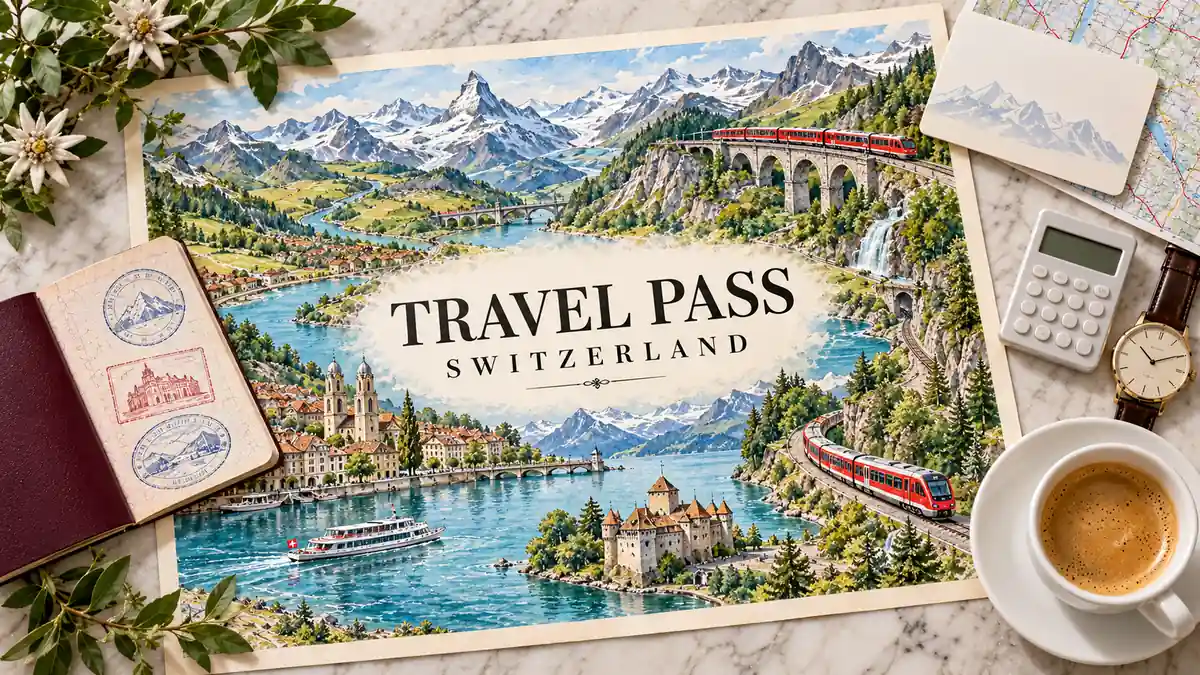
Your Swiss route is settled, the trains look fast and frequent, and the fares look steep. That is the moment the Swiss Travel Pass question starts to matter. Swiss rail is priced high enough that the ticket choice changes the cost of the whole trip, and the pass is not the automatic winner many travelers assume.
This guide resolves three things. First, whether the pass is worth buying for your trip. Second, whether the consecutive or the Flex version fits better. Third, when an alternative ticket beats both. It explains what the pass actually covers, what it only discounts, and how the main alternatives compare for different trip shapes. Prices are quoted in Swiss francs from the official Swiss rail and tourism sources, and only where they help the decision. Everything else is reasoning you can apply to your own route.
Quick Answer
The Swiss Travel Pass pays off on multi-base, train-heavy trips, not on one-base mountain stays. The variable is trip shape: travel days and base changes versus mountain excursions, which the pass mostly discounts. Buy it for a week or more of city-hopping; buy the Half Fare Card for mountain days from one or two bases.
Trust Layer
Tripstou planning guide for travelers resolving one travel decision. Covers the main variable, traveler context, and practical tradeoffs.
Produced with AI assistance and reviewed by Alex Perrut, working in tourism since 2015, for the Tripstou editorial team. See our editorial process for details.
Last factual review: October 2, 2026.
Official sources consulted: Switzerland Tourism, State Secretariat for Economic Affairs (SECO), Swiss Federal Railways (SBB).
Key Takeaways
- The Swiss Travel Pass pays off when you change base every few days and cover long distances, not when you stay in one place.
- Count long transfer days before trip length: a pass day earns its cost crossing the country, not on short regional hops.
- Only Rigi, Stanserhorn and Stoos are free; other mountain excursions are discounted by up to half, and panorama-train seat reservations cost extra.
- Choose the consecutive pass for back-to-back moving days, and Flex only when your trip includes genuine rest days with no transport.
- For one or two bases with several mountain trips, the Half Fare Card at CHF 150 a month usually beats the pass.
- Children aged 6 to 15 travel free with a paying parent on the Swiss Family Card, with either the pass or the Half Fare Card.
Table of Contents
Is the Swiss Travel Pass worth it for your trip?
The Swiss Travel Pass is worth it when you change base often and ride long distances most days. It is rarely worth it when you stay put. Mountains are the catch: beyond three included peaks, most summit trips are only discounted, so a mountain-heavy stay from one base gets less value.
Trip shape decides. Length matters far less than how often you move. Match your plan to the closest profile:
- City-hopper across three or more bases: buy the pass. Every long transfer is covered, and city transport in each base comes with it.
- One base with several mountain trips: buy the Half Fare Card. Mountain railways and cable cars are where the money goes, and the card cuts most of them by up to half.
- Short trip with a few fixed journeys: buy point-to-point tickets, ideally Supersaver fares, which are cheaper when booked ahead.
- One or two heavy travel days: buy a Saver Day Pass for those days and pay as you go for the rest.
- Car renter or single-region stay: the pass rarely pays. You ride the trains too little to cover its price.
- Family with children aged 6 to 15: decide by the adult logic. The Swiss Family Card works with both the pass and the Half Fare Card, so the children travel free either way.
Break-even comes from long transfers. A pass day earns its cost when you cross the country, not when you take a short regional hop and a lake boat. Zurich–Lucerne–Interlaken–Zermatt in eight days, with a base change every two days and long rides between them, is the classic pass trip. The same eight days spent entirely around Interlaken is not. The Switzerland itinerary by train shows how those bases connect.
Count your transfer days before you count your trip days. An eight-day pass with only two long transfers spends six days paying for short local rides that a Half Fare Card would have halved.
For the wider picture of regions and seasons before you settle the ticket, start with the Switzerland travel guide.
Train and bus tickets
Compare routes, schedules and prices across rail and bus operators in one search, with mobile tickets on your phone.
New to Omio? Code NEW10 takes 10% off your first booking — or APPNEW10 if you book inside the Omio app. Both apply to bookings up to €80.
Search routes and compare prices on Omio →
Tripstou may earn a commission if you book through this link, at no extra cost to you.
What does the Swiss Travel Pass include, and what is only discounted?
The pass covers train, bus and boat nationwide plus city transport, and most mountain tops are only discounted. Unlimited travel on the national network is the core of what you pay for. Three mountains are free, other mountain excursions are discounted by up to half, and panorama trains charge separately for seat reservations.
Read the free list literally. Anything not on it costs something.
Included at no extra cost:
- Trains, buses and boats across the national network
- Public transport in more than 90 towns and cities
- Panorama trains, excluding seat reservations and supplements
- Rigi, Stanserhorn and Stoos, the only three mountain excursions fully covered
- Free admission to more than 500 museums
Discounted, not covered:
- Other mountain excursions, at up to half off the regular fare
Not covered:
- Seat reservations and supplements on panorama trains such as the Glacier Express and the Bernina Express
Jungfraujoch, the summit most visitors ask about, is discounted and not covered. The Jungfraujoch guide handles the ticket and the timing.
On the big paid summits, the pass and the Half Fare Card give a similar discount. A mountain-heavy trip therefore pays the full pass price mainly for train coverage it may barely use.
Swiss Travel Pass or Swiss Travel Pass Flex: which version fits your trip?
Consecutive days suit back-to-back city-hopping; Flex suits slow travel with rest days in one place. The consecutive pass covers every day in a row from its first day, which rewards constant movement. Flex lets you pick travel days within one month, so you stop paying for days spent walking, hiking from your door or sitting by a lake.
Both versions come in 3, 4, 6, 8 and 15 days. The consecutive pass covers that many days in a row. Flex gives you the same number of travel days to use freely within one month, each activated on the day you travel.
Flex costs more per travel day than the consecutive pass of the same length. Freedom has a price. That premium only pays back when your trip has genuine rest days.
- Eight days, moving every two days: take the 8-day consecutive pass. Every day is a likely travel day, so the Flex premium buys nothing.
- Two weeks with five real travel days: take Flex 4 or Flex 6. Flex 6 covers every transfer with a spare day; Flex 4 works if one short hop goes on a single ticket.
- Three or four busy days on the move: take the consecutive pass. With no rest days in the plan, Flex adds cost and no benefit.
A rest day only counts as one if you take no transport at all. One lake boat or a bus to a trailhead needs either a Flex day or a separate ticket, so count those outings before choosing Flex 4 over Flex 6.
How much does the Swiss Travel Pass cost?
The adult second-class Swiss Travel Pass costs CHF 254 for 3 days and CHF 499 for 15 days. Both are official consecutive-pass prices. Longer passes cost far less per day, so the pass rewards long trips; first class, youth and family rates sit on top of or below that base.
Fifteen days cost less than twice the price of three. Length is the discount. A short pass is the expensive way to buy unlimited travel, which is why three-day trips so often come out ahead on single tickets.
First class starts from CHF 405. It buys space and quieter carriages, and most travelers do fine in second class.
Travelers under 25 pay 30% less than the adult price. Children aged 6 to 15 travel free with a paying parent on the Swiss Family Card, and children under 6 travel free without a ticket.
The fair test is the pass price against the Half Fare Card’s CHF 150 for one month plus half of every fare you expect to pay. If that sum comes in lower, the pass is the wrong buy.
Prices are published on the official SBB and MySwitzerland sites and do change, so confirm the figure on the day you buy. Transport is only one line of the trip budget; for accommodation, food and daily spend, see how much a Switzerland trip costs.
Which Swiss rail ticket wins: pass, Half Fare Card, Saver Day Pass or point-to-point?
The pass wins for constant movement, the Half Fare Card for mountain-heavy trips from few bases, singles for short stays. The Saver Day Pass fills the gap for one or two long travel days. Each product rewards a different trip shape, so the right choice follows from how often you move and how often you climb.
- Swiss Travel Pass: unlimited travel on consecutive or Flex days, with three free mountains and museum entry. Best for frequent base changes; the tradeoff is a high upfront price.
- Half Fare Card: one month of up to 50% off trains, buses, boats, panorama trains, mountain railways and cable cars. Best for a base-and-mountains trip; the tradeoff is paying something on every ride.
- Saver Day Pass: one day of unlimited train, bus and boat travel, priced by demand, half price with a Half Fare Card. Best for a single long day; mountain excursions are not included.
- Point-to-point and Supersaver tickets: single journeys bought per route, with Supersaver fares cheaper when booked ahead. Best for short trips; the tradeoff is the least flexibility.
| Ticket | Best for | What it covers | Price basis |
|---|---|---|---|
| Swiss Travel Pass | City-hoppers changing base every few days | Trains, buses, boats, city transport, three mountains, museums | From CHF 254, adult second class |
| Half Fare Card | Mountain-heavy trips from one or two bases | Up to 50% off transport, mountain railways, cable cars | CHF 150 for one month |
| Saver Day Pass | One or two long single travel days | Unlimited train, bus and boat for one day | Varies by demand, half price with Half Fare Card |
| Point-to-point tickets | Short trips with a few fixed journeys | One journey per ticket, including Supersaver fares | Priced per journey, cheaper when booked ahead |
Most trips fit one row. Some fit two, and that is where the best value hides.
A Half Fare Card plus one or two Saver Day Passes is the setup most pass comparisons skip. The card halves every mountain trip from a single base, and the Saver Day Pass, itself at half price with the card, covers the long arrival and departure days outright.
For a stay inside one region, regional passes such as the Jungfrau Travel Pass or the Berner Oberland Pass are a further option, worth comparing with the Half Fare Card before you commit.
Where to buy the Swiss Travel Pass and how to use it
Buy the Swiss Travel Pass online up to 11 months ahead as an e-ticket, and carry your passport or ID. Only residents outside Switzerland and Liechtenstein can buy it. On board, you show the pass and your ID at inspection; on panorama trains, seat reservations are booked separately.
Eligibility is about where you live. The pass is for people whose permanent residence is outside Switzerland and Liechtenstein, and residents of either country are not eligible.
The e-ticket works on a phone or as a printout. Conductors check it together with your passport or ID, so keep both within reach.
Flex days are activated on the day of travel, before you board. An unactivated day gives no cover.
Seat reservations on panorama trains such as the Glacier Express and the Bernina Express are booked and paid separately from the pass. Reserve them once your dates are fixed.
Boats, buses and city trams need no extra ticket on a valid pass day. You simply board.
For luggage, etiquette and the rest of the practical groundwork, the Switzerland travel tips come next.
Frequently Asked Questions
Do children travel free with the Swiss Travel Pass?
Yes, children aged 6 to 15 travel free when they hold the Swiss Family Card and ride with a parent who has a paid pass. Children under 6 travel free with no ticket. Travelers aged 16 to 24 pay the youth price, 30% below the adult fare. The family card also works with the Half Fare Card.
Is first class worth it on the Swiss Travel Pass?
For most travelers, no. First class starts from CHF 405 for three days against CHF 254 in second class, and it buys more space and quieter carriages, not better views or faster trains. It earns its premium mainly on long, busy routes in peak season, or for travelers carrying heavy luggage.
Do you need a seat reservation on the Glacier Express with the Swiss Travel Pass?
Yes. The pass covers the journey itself, but a seat reservation on the Glacier Express is required and paid separately, and the Bernina Express works the same way. Book the reservation once your travel date is fixed, because panorama cars on popular days fill early and the pass alone does not guarantee a seat.
Does the Swiss Travel Pass include museums?
Yes. The Swiss Travel Pass gives free admission to more than 500 museums across Switzerland, from major city collections to small regional ones. You show the pass at the museum entrance. For a city-hopping trip, the museum entries add real value on top of transport, though they rarely justify the pass on their own.
How do you activate a Swiss Travel Pass Flex day?
You activate each Flex day on the day you travel, before your first journey. That day then covers trains, buses, boats and city transport, exactly like the consecutive pass. Travel days can be spread freely across one month. Even a single boat trip or bus ride uses a full Flex day, so group short outings with longer travel days.
Does the Swiss Travel Pass cover the train from Zurich or Geneva airport?
Yes. Zurich and Geneva airports have their own railway stations on the national network, so a valid pass day covers the train into town and onward. Start a consecutive pass on arrival and that day counts as day one. On Flex, the airport ride uses a travel day, so pair it with a long first transfer.
Related Guides
- Switzerland travel guide: the country overview, with regions and seasons that shape where the pass fits.
- Switzerland itinerary by train: routes and base changes that decide whether a pass pays off.
- How much a Switzerland trip costs: the full budget beyond transport, from beds to meals.
- Jungfraujoch guide: ticket and timing for the summit the pass only discounts.
- Switzerland travel tips: the practical groundwork to sort once your tickets are bought.
Did this guide save you time or money? Tripstou is independent and reader-funded — if you'd like to give something back, you can support the site with a crypto contribution of any size.