Rhodes is large, so the tips that matter most are about time and place: see Lindos and the Old Town early or late, plan the island by area, and carry cash. Renting a car decides how much of the island you reach, since buses cover Rhodes Town, Faliraki and Lindos. Two days is the workable minimum and three or more is comfortable, ideally in May–June or September–October.
You have booked Rhodes, or nearly, and you want the first trip to go to plan. This page settles the decisions that shape it: how to split a large island into area days, whether to rent a car, how many days to give it, when to go against the heat and the crowds, how to time Lindos and the Old Town, what to carry in cash, what to pack, and which mistakes first-timers make.
One idea runs through all of it. Rhodes is a big island, and the walled Old Town is only one part of the trip. Timing matters more than any checklist: reach Lindos and the Old Town early or late, and the same streets feel like a different place. Each section gives a verdict first, then points to the deeper guide when you need it.
How This Page Was Put Together
This page resolves one question, how to set up a first trip to Rhodes so that timing, transport, cash and packing go to plan; it is not a guide to the island’s sights or a day-by-day itinerary, and it leaves fares, timetables and budgets to the transport and cost pages.
Our editorial process sets out how pages like this one are made: these first-trip tips were produced with AI assistance, then signed off by Alex Perrut, working in tourism since 2015, for the Tripstou editorial team.
Official sources consulted: Visit Greece, Greek Ministry of Tourism.
On This Page
Early or late is the only way to see Lindos and the Old Town without the coaches
Go before mid-morning or after the groups leave; both places empty out again by evening. Tour coaches and cruise excursions fill Lindos and the Old Town from mid-morning into the afternoon. Arriving early at Lindos also beats the heat on the climb, and the Old Town is at its best after dark.
Lindos rewards an early start above all. The path up to the acropolis is steep and exposed, and it is hardest in the midday sun. Set off early with water and shoes that grip. By late afternoon the day groups thin out and the village becomes pleasant again.
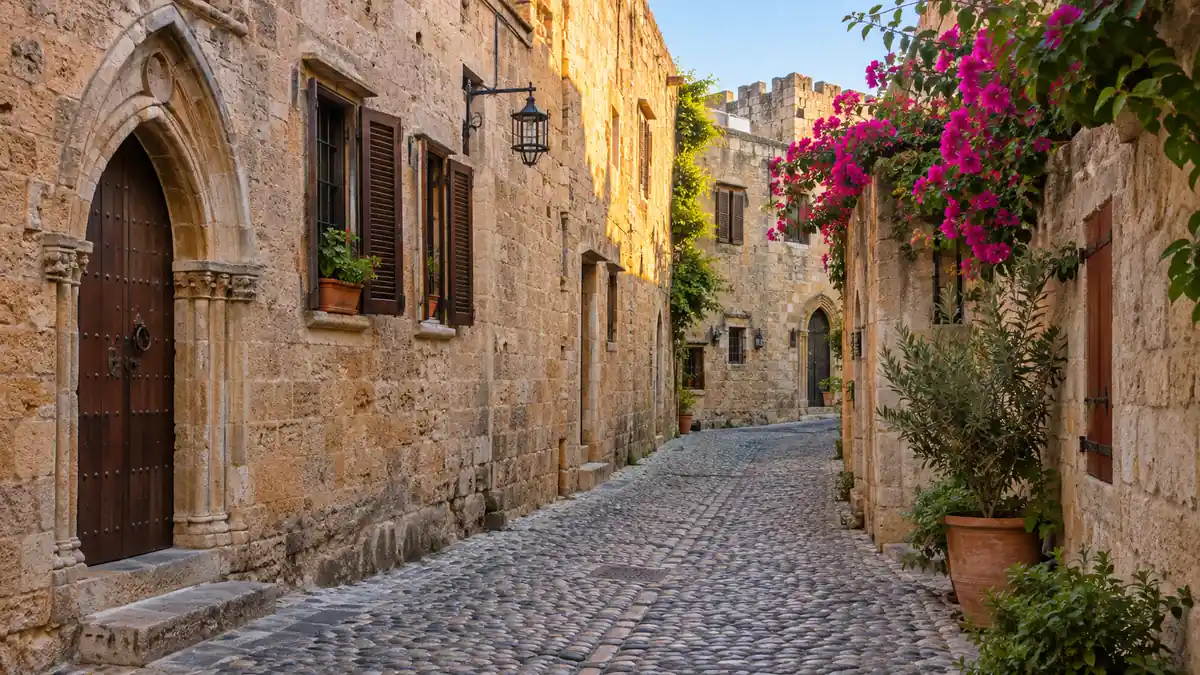
The Old Town follows a different clock. Rhodes Old Town is a UNESCO World Heritage site, and cruise calls are frequent in season. Passengers crowd its main streets through the middle of the day. Evenings are calmer. Port arrival lists published online show which days ships are due, so check them before fixing your Old Town day.
A cruise ship in port changes the Old Town more than the month does, so keep an evening free for the walls and lanes once passengers are back on board.
When to visit Rhodes to beat the heat and the crowds
Late spring and early autumn give the best balance of heat, crowds and open season. May–June and September–October bring warm days, open beach services and room to breathe at Lindos. July and August are the hottest and busiest months, which suits beach-only trips far better than sightseeing.
- May–June: warm, green and less crowded; the sea warms steadily through the period.
- July–August: peak heat and peak crowds. Book rooms and cars early, and walk up to Lindos in the first hours of the day.
- September–October: a warm sea and thinning crowds, the best all-round window for a first trip.
- Winter: quiet and mild, but many resort hotels and beach businesses close; plan around the Old Town.
Wind shapes the beach choice as much as the month does. The summer northerly makes the west coast noticeably windier, while the east coast stays more sheltered. Swimmers and families usually do better on the east side. Windsurfers head west.
In high summer the calm east coast is also the crowded one, and the wind is what keeps the west coast empty.
How big is Rhodes, and how should you plan by area?
Rhodes is far bigger than its Old Town, and each main area deserves its own day. The island runs roughly 80 km from north to south, so a first trip works best as area days: one for the Old Town, one for Lindos, and one for a beach or the west coast.
Think of the island as three separate outings, each with its own rhythm:
- Old Town day: the walled medieval centre, the harbour front and an evening meal inside the walls. It suits an arrival day or any day without a car.
- Lindos day: the white village, the climb to the acropolis and a swim in the bay below. Lindos is a full day out from Rhodes Town, about 1.5 to 2 hours each way by bus or roughly an hour by car.
- Beach or west-coast day: a resort beach on the sheltered east coast, or the emptier, windier west coast if you have wheels.
Seeing Rhodes in a single day fails on distance alone. Lindos eats most of a day once you add the ride, the climb and a swim. Squeezing the Old Town in as well means meeting both places at their busiest hour.
The Old Town and Lindos pull against each other on the clock — Lindos wants your early morning, the Old Town wants your evening — which is why they rarely share a day well. For what each part of the island holds, start with our Rhodes guide.
How many days do you need in Rhodes?
Two days covers the Old Town and Lindos; three or more is comfortable. Two days fits a short break or a stopover between ferries, with one day for each main place. A third day adds a beach, the west coast or a boat trip, and removes the rush that makes two-day visits tiring.
Each extra day buys something specific:
- Two days: the Old Town and Lindos, one each. It fits a short break or a ferry stopover, with no slack for beaches.
- Three days: adds a beach day or the west coast. This is the comfortable first-trip length for most travelers.
- Four days or more: room for a boat trip, a car day in the south and slow evenings. It fits beach holidays and anyone curious about the island beyond its two headline places.
Your base follows your trip style. Rhodes Town suits a car-free trip with the Old Town on foot; Lindos suits travelers after atmosphere; an east-coast resort suits a beach week. The tradeoffs by area are in where to stay in Rhodes.
Day-by-day plans live on their own pages. Follow the two-day Rhodes itinerary for a short visit, or the three-day Rhodes itinerary once you add a beach day.
Should you take a boat trip from Rhodes?
Yes, if you have three days or more. A day trip to Symi or a coastal cruise from Mandraki harbour is the simplest boat day for a first-timer. On a two-day visit, skip it. It takes a full day that the Old Town and Lindos need.
Tours and activities
Book skip-the-line tickets, day trips and local tours with free cancellation on most activities.
You can also browse everything on getyourguide.com.
Tripstou may earn a commission if you book through this link, at no extra cost to you.
Do you need a car in Rhodes?
You need a car in Rhodes only if you want the south and the west coast. A trip built on Rhodes Town, Lindos and the east-coast resorts works without one, because public buses link those places. The car buys reach and flexible timing; the tradeoff is tight parking around Lindos and Rhodes Town.
Two bus operators split the island. KTEL runs the east coast, including Lindos. RODA covers Rhodes Town and the west coast. Between them, a car-free first trip reaches every headline stop.
| Trip type | Car verdict | Why | Without a car |
|---|---|---|---|
| Old Town plus Lindos | No car; buses and walking are enough | Both places sit on regular bus routes | Bus to Lindos, walk the Old Town |
| East-coast beach stay | Optional, one hire day at most | The main resorts line the east-coast bus route | Buses to Lindos and Rhodes Town |
| South tip and west coast | Yes, hire a car for those days | Beaches and villages sit far apart | An organised day tour on fixed timing |
| Three or more mixed days | Hire for one or two days only | The car pays off on the far-flung days | Buses and walking on Old Town days |
If you plan to drive in July or August, the island’s busiest months, book the hire car well ahead. At beach car parks, leave nothing visible inside the car.
A short hire inside a longer stay usually beats a car for the whole trip, because the Old Town and Lindos days are exactly when a car becomes a parking problem. Routes, fares and timetables are in our Rhodes transport guide.
Cash or card in Rhodes, and how tipping works
Pay by card where you can, but keep small cash for kiosks, villages and some buses. Rhodes uses the euro, and cards are widely accepted in towns and resorts. Tipping is optional: rounding up or leaving a small amount for good service is the norm, with no fixed percentage expected.
Cash still does the work in a few places:
- Kiosks and small shops: water, snacks and small purchases are quicker in coins.
- Villages: small cafés and family businesses away from the resorts may prefer cash.
- Some buses: carry coins and small notes in case card payment is not available.
Tips stay small and informal. Round up a café bill or leave a few coins after a good meal. Nobody expects a set percentage.
A car-free trip needs more cash than a resort week, because bus rides and village stops are where coins still matter most.
Hotels also charge a climate resilience fee per room per night, paid at the property and scaled by hotel category and season. The amounts, along with daily budgets, are in what a Rhodes trip costs.
What to pack for Rhodes and how to stay connected
Pack for sun, cobbles and pebbles, plus a cover-up for churches and monasteries. Sun protection and a hat matter most in summer, grippy shoes handle the Old Town lanes and the Lindos climb, and water shoes help on pebble beaches. Carry something light that covers shoulders and knees at religious sites.
- Sun kit: high-factor sunscreen, sunglasses and a wide-brimmed hat.
- Walking shoes with grip: polished cobbles in the Old Town and the Lindos path turn slippery.
- Water shoes: many Rhodes beaches are pebble or shingle.
- A cover-up: a scarf or light shirt plus long trousers or a skirt for churches and monasteries.
- A light layer: for windy evenings on the west coast or a boat deck.
Mobile data earns its place here. It carries your maps through the Old Town maze, bus information on the move and ferry tickets if you head to Symi. For the right plan, see the best eSIM for Greece.
Country-wide habits — etiquette, a few words of Greek and how ferries work — sit in our Greece travel tips.
The Rhodes mistakes first-timers make
Most first-trip mistakes come from underestimating the island and mistiming Lindos. Visitors treat Rhodes as a one-day stop, reach Lindos at midday with the coaches, assume cards work everywhere, skip sun protection, or think the Old Town is the whole island. Each one has a simple fix.
- Treating Rhodes as a day stop: give it two days at least, and three if beaches matter.
- Reaching Lindos at midday: arrive early, or come back in the late afternoon.
- Relying on card everywhere: carry small notes and coins for kiosks, villages and buses.
- Underrating the sun: hat, sunscreen and water on every outing, above all on the Lindos climb.
- Never leaving the Old Town walls: give one day to the east-coast beaches or the west coast.
- Booking July or August late: secure rooms and hire cars well ahead of peak season.
Almost every item on that list is fixed by the clock or the calendar. None needs extra money.
Tap water and English in Rhodes
Can you drink the tap water in Rhodes?
Ask your accommodation about the tap supply where you stay, because local advice is the best guide. Many visitors and locals in Rhodes drink bottled water, which is sold widely in supermarkets and kiosks. On hot days, carry a bottle on every outing, above all on the Lindos climb.
Do people speak English in Rhodes?
Yes, English is widely spoken in hotels, restaurants, shops and tour businesses across Rhodes Town, Lindos and the resorts. Away from the resorts, a few Greek words are still appreciated and easy to learn. Kalimera (good morning) and efcharistó (thank you) are the two to learn first.
Did this guide save you time or money? Tripstou is independent and reader-funded — if you'd like to give something back, you can support the site with a crypto contribution of any size.