Greece rewards driving in two shapes and punishes it in most others. The mainland circuit out of Athens and the long drive across Crete are genuine road trips, where a car reaches ruins, gorges and mountain villages that buses serve badly. A handful of larger islands — Naxos, Paros, Milos, Rhodes, Corfu, Zakynthos — justify a rental for a few days each. Everywhere else, the car is dead weight. Santorini and Mykonos are the clearest examples: short distances, scarce parking and summer congestion that turns a rental into a daily problem. Central Athens is the same story with worse traffic.
This planner covers the routes worth driving, the stop order and night counts each one needs, the islands where a car pays and where it does not, and the mechanics that quietly decide the plan — ferries, one-way drops, tolls and what the roads actually feel like.
Quick Answer
A Greece road trip works best as a mainland circuit from Athens or a single end-to-end drive across Crete. The car earns its keep on the mainland and the large islands, while ferries beat driving across the small Cyclades. Rent per island where you need wheels, and skip the car entirely on Santorini and Mykonos.
Trust Layer
Tripstou itinerary guide for travelers planning a route. Covers pacing, stop count, stop order, base logic, and trip length.
Produced with AI assistance and reviewed by Alex Perrut, working in tourism since 2015, for the Tripstou editorial team. See our editorial process for details.
Last factual review: August 28, 2026.
Official sources consulted: Visit Greece, Greek Ministry of Tourism.
Key Takeaways
- Greece rewards driving in two shapes: the mainland circuit out of Athens, and one end-to-end drive across Crete.
- Skip the car on Santorini and Mykonos, where short distances and scarce parking make a rental a daily liability.
- Count inland stops against island ports on your shortlist: two or more inland stops and the car earns its cost.
- Renting a fresh car on each island beats dragging one across ferries, which requires written permission that some companies refuse outright.
- Budget seven to ten days for the mainland circuit and five to seven for Crete, before counting ferry days.
- Greek motorways are the easy part; the stress lives in old village centres, hill-town hotel access and city parking.
Table of Contents
Is a Greece Road Trip Worth It?
A Greece road trip is worth it on the mainland and big islands, rarely in the Cyclades. Driving unlocks the Peloponnese, Delphi, Meteora and Crete, where buses are slow and routes fragmented. For classic island hopping, ferries and your own feet do the job better, and cheaper.
The car serves travelers whose shortlist is full of places that are not towns: archaeological sites on empty headlands, gorge trailheads, monastery roads, beaches at the end of a dirt track. It burdens travelers whose shortlist is a run of island ports, because every one of those is walkable and every ferry adds a vehicle to the equation.
So count the shortlist. Two or more inland stops against a run of island ports, and the car pays for itself in reached destinations; fewer, and you have bought yourself a parking problem.
The tradeoff against organised day tours is real but narrow. Tours cover the headline sites from Athens without any driving stress, and they suit short trips well. They cannot give you a late afternoon in Nafplio or a morning drive over the Mani with nobody else on the road, which is the entire reason to drive. If you are still deciding what shape the whole trip takes, the wider Greece travel guide sets the context this page assumes.
The Greece Road Trip Routes Worth Driving
Three route shapes are worth driving in Greece: the mainland circuit from Athens, Crete end to end, and large islands. The mainland delivers antiquity and mountains in one loop. Crete is big enough to reward a full drive. The rest suit a rented car for two or three days, not a whole trip.
Each shape answers a different trip. Pick one and commit, because splitting a short trip between the mainland and an island road trip spends most of your time in transit.
- The mainland circuit — 7–10 days — antiquity, mountains and Meteora in one loop.
- The Peloponnese loop alone — 4–6 days — the short version, all ancient sites and coastline.
- Crete end to end — 5–7 days, 10 with the far east — gorges, mountain villages, the longest drivable island.
- A single drivable island — 2–4 nights with a car — Naxos, Paros, Milos, Rhodes, Corfu or Zakynthos, added to a ferry-based trip.
Northern Greece around Thessaloniki drives perfectly well, but it pulls a first Greek road trip away from the density of sites that makes the southern circuit worth the fuel.
The Mainland Circuit: Athens, the Peloponnese, Delphi and Meteora
The mainland circuit runs Athens to the Peloponnese loop, then north to Delphi and Meteora. It needs seven to ten days to work without rushing, and it is the one Greek route where a car beats every alternative. Legs are short — most Peloponnese hops run one to three hours.
Collect the car on your way out of the capital and drop it before you return. Central Athens is a bad place to hold a vehicle, and the city works better on foot and metro anyway; plan those days using the Athens city guide and treat the rental as a departure-day errand. Stop detail for the whole southern peninsula sits in the Peloponnese regional guide.
The Peloponnese loop
The established order is Corinth, Mycenae and Epidaurus, then Nafplio, then south to Monemvasia or the Mani, then west to Olympia. Legs are short enough that base-and-day-trip beats packing the car every morning.
- Nafplio — 2–3 nights — the natural base; Mycenae, Epidaurus and Corinth are all easy returns.
- Monemvasia or the Mani — 1–2 nights — the deep south, and the drive people remember.
- Olympia — 1 night — a site stop that breaks the westward run north.
The peninsula punishes ambitious base-hopping more than the distances suggest, because the roads curve and a 90-minute leg quietly eats a morning. Two bases work. Four does not.
North to Delphi and Meteora
From Olympia the route crosses north and climbs. Delphi is the standard overnight between the Peloponnese and Thessaly, and it breaks the drive at roughly the right point rather than forcing one long day behind the wheel.
- Delphi — 1 night — a stop, not a destination; it exists here to split the drive.
- Kalambaka or Kastraki — 2 nights — the base for the monasteries and the circuit’s turnaround point.
Two nights at the foot of the rocks is the difference between a photo stop and a visit, since the monastery road rewards being driven at two different times of day. Full visiting detail belongs to the Meteora guide. From there most travelers run the motorway back towards Athens in a single day.
Crete Is Greece’s Best Single-Island Road Trip
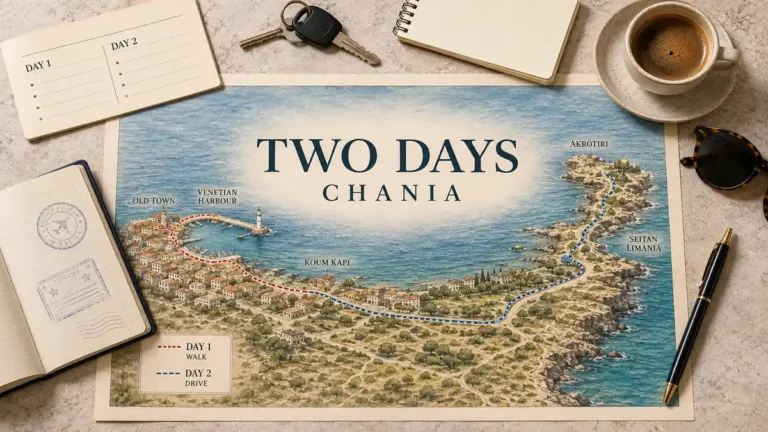
Crete is the only Greek island that justifies a road trip on its own. Start west in Chania and drive east: the west carries the island’s best scenery and the gentlest introduction to Cretan roads. Five to seven days covers the west and centre comfortably; ten gets you to the far east.
The shape is linear, not a loop. Pick up in the west, move steadily east, and drop off at the other end if the one-way charge is acceptable — otherwise plan the return motorway run as its own travel day. Regional context and site detail live in the Crete travel guide, and the western base itself is covered in the Chania guide.
- Chania — 2–3 nights — western base for the gorges and the west-coast beaches.
- Rethymno — 1–2 nights — the mid-island break that stops the drive becoming a single haul.
- Heraklion or the Lasithi side — 1–2 nights — the centre, Knossos and the road east.
- The far east — 2 nights — worth it only on a longer trip.
West-first is a judgement, not a rule: it front-loads the scenery while you are still enthusiastic about driving. Going east-first works if you fly into Heraklion and want the mountains as a finish.
The tradeoff is distance. Crete is long, the north coast road carries the fast traffic, and the southern mountain routes are slow, narrow and beautiful in that order. Choosing a southern crossing costs you an afternoon you probably budgeted for a beach.
Which Greek Islands Are Worth Renting a Car On?
A car pays off on Naxos, Paros, Milos, Rhodes, Corfu and Zakynthos. Skip it on Santorini and Mykonos, where distances are short, parking is scarce and high-season traffic turns a rental into a liability. The test is simple: islands with spread-out beaches and inland villages reward wheels; compact, congested ones do not.
| Island | Car worth it? | Why |
|---|---|---|
| Naxos, Paros and Milos | Yes, for two to four days | Inland villages and scattered beaches that buses reach slowly |
| Rhodes | Yes, for the south | The island is long and the best stretches sit far from town |
| Corfu and Zakynthos | Yes, for coastal access | Mountain roads and small bays with no useful bus service |
| Crete | Yes, for the whole stay | The one island that supports a full end-to-end road trip |
| Santorini | No, use transfers and buses | Short distances, scarce parking, heavy summer congestion on the caldera road |
| Mykonos | No, unless staying remotely | Compact island, expensive parking, town centre closed to traffic |
The Cyclades split cleanly on this question. Naxos has the strongest case, with a mountainous interior, working villages and a long southern beach strip. Paros is smaller but shaped the same way. Milos is arguably the clearest yes of the three, because its beaches ring a wide bay and several sit at the end of unsurfaced tracks.
Further out, size decides. Rhodes is long enough that the southern half is effectively off-limits without a car. Corfu and Zakynthos both hide their best coastline behind hill roads, and the wider Ionian Islands guide shows how those two fit the group.
The two clear refusals are Santorini and Mykonos. Both are small, both concentrate their visitors along a handful of roads, and both get slower through the high season rather than faster.
The verdict tracks where you sleep more than where you want to swim. Booking a room in the main port town of a small island usually kills the case for a car, because everything you gain in range you lose hunting for an overnight space.
Can You Take a Rental Car on a Ferry in Greece?
Yes, but only with written permission from the rental company. Policies vary widely, and some companies prohibit island-to-island moves outright. For most island combinations, renting a fresh car on each island is simpler than dragging one across the water. The exception is the mainland and its nearest islands.
Ask about ferries before you compare prices. A cheaper company that bans crossings is not cheaper for this trip, and permission granted at the desk on collection day is worth less than permission confirmed at booking.
Renting per island wins on three fronts at once: no car-deck ticket, no one-way or cross-border style restrictions, and no dead vehicle sitting on a ferry while you are up on deck. It also lets you match the car to the island — a small one for narrow village roads, nothing more.
Dragging one car makes sense on a continuous route: the mainland circuit, or the mainland plus one adjacent island where the crossing is short and you are staying long enough that a fresh rental would cost more in hassle than the car deck saves. Corfu and Zakynthos out of a Peloponnese trip are the usual candidates.
For a Cyclades trip built on ferries alone, the car question mostly disappears — the Cyclades island-hopping guide covers moving between islands without one.
What Driving in Greece Is Actually Like
Greek motorways are easy; old village centres and city traffic are where driving gets stressful. Greece drives on the right, motorway surfaces are good, and tolls are paid at fixed gates as you pass. The difficulty sits in the last kilometre — narrow lanes, steep hotel access and parking that disappears by evening.
Motorway driving is genuinely relaxed. Lanes are wide, signage is bilingual on the main corridors, and slower traffic drifting onto the hard shoulder to let you pass is normal local practice, not a hazard. Keep left-lane use to overtaking and the rhythm makes sense quickly.
Stress concentrates in three places. Old village centres were built for donkeys, not hire cars, and mirrors fold in for a reason. Hotel access on hill towns can involve a gradient and a turn you would not attempt twice. City parking, especially anywhere central in Athens or Heraklion, is the daily tax nobody plans for.
Local driving culture is assertive without being aggressive. Expect close following, confident overtaking and improvised parking, and drive predictably. Hesitant, over-cautious driving is what confuses everyone.
One practical thing to bring: a phone mount and a charging cable, because navigation runs the whole trip and village signage will not save you. The Greece packing list covers the rest.
How Many Days Does a Greece Road Trip Need?
Plan seven to ten days for the mainland circuit and five to seven for Crete. Adding one drivable island to the mainland loop pushes the trip to twelve to fourteen days once ferry days are counted. Under a week, drop the loop and drive one region only.
When time shrinks, the cuts follow a fixed order:
- Cut the far east of Crete first — it is the longest driving for the least density of stops.
- Cut Olympia next on the mainland, and run the Peloponnese as a Nafplio-based loop.
- Cut Meteora last, and only if you would otherwise be driving five hours in a day to reach it.
- Never cut a night from your main base to keep a distant stop — that trade always loses.
When time grows, additions come in this order: a second night in the Mani or Monemvasia, then a drivable island tacked on at the end, then the eastern half of Crete if that is your route.
Ferry days are travel days, not driving days. Count each crossing as half a day gone and the tidy plan you sketched loses one stop, which is better discovered now than at the port.
This page is about where to drive, not how to sequence a fixed trip length. For a day-by-day structure, the 7-day Greece itinerary, the 10-day Greece itinerary and the 14-day Greece itinerary take over from here.
Frequently Asked Questions
Do I need an international driving permit to drive in Greece?
It depends on your licence and, in practice, on your rental company. Non-EU drivers are frequently asked for one at the desk, particularly at island agencies, even where the legal requirement is unclear. An IDP is never valid on its own, so carry it alongside your home licence and confirm the policy when you book.
How do tolls work in Greece and how much do they cost?
Greek motorways use fixed toll gates: you pay a set price at each plaza you pass, not a ticket-and-distance system. Individual plazas commonly run about €2.50–€4, and crossing the country on the Athens–Thessaloniki corridor adds up to roughly €35–€40 for a car. Cash and cards are accepted at the gates.
Is it cheaper to rent one car or a separate car on each island?
A separate rental on each island is usually the cheaper option. Moving one car between islands adds costs the per-island approach avoids: the car-deck ticket, a possible one-way drop charge, and rental days you pay for while the vehicle sits on a ferry. It also removes the permission question.
How much is a one-way car rental drop-off fee in Greece?
Expect a substantial charge, commonly reported at around €200 or more, though it varies by company and by the distance between pick-up and drop-off points. Treat it as a real budget line, not a formality. Confirm the exact figure at booking, because it can outweigh the convenience it buys.
When is the best time of year for a Greece road trip?
Late spring and early autumn are the best driving windows. Roads are quieter, village centres and hill-town hotel access are less congested, and long midday hours in the car are more comfortable than at the height of summer. Winter drives well on the mainland but ferry schedules and mountain weather narrow the options.
Related Guides
- Greece travel guide — the wider planning context for a first trip.
- Peloponnese guide — stops, bases and sites along the mainland loop.
- Crete guide — the island behind Greece’s best single-island drive.
- Cyclades guide — island hopping by ferry, with or without a car.
- Meteora guide — the monasteries at the top of the mainland circuit.
- Greece packing list — what to bring for a driving trip.
Did this guide save you time or money? Tripstou is independent and reader-funded — if you'd like to give something back, you can support the site with a crypto contribution of any size.