
You have a tab open on a property labelled Triangle d’Or — or Grands Hommes, which is the same ground — and every description of the quarter says the same three things: elegant, prestigious, unbeatably central. None of them tell you what it is like to sleep there, and none of them state what the premium costs. The quarter sits inside Bordeaux’s pedestrian core, west of the quays.
This page does three things. It states what ground the label actually covers, briskly, so any listing can be placed on it. It then makes the finding that decides your address: the interior of the triangle is one place, so the question is not which part of it you book, but which corner you book near. And it states the honest trade — what the premium buys you, and what it costs.
Quick Answer
The Triangle d’Or works as a base: small, polished and central, with evenings a short walk beyond it. The interior is one place, so the corner decides: Comédie for the old-town lanes, Tourny for the river, Gambetta for the tram. Book near the corner your evenings point to; the quarter barely varies street to street.
Trust Layer
Tripstou stay guide for travelers choosing where to base. Covers area atmosphere, budget, convenience, noise, and traveler fit.
Produced with AI assistance and reviewed by Alex Perrut, working in tourism since 2015, for the Tripstou editorial team. See our editorial process for details.
Last factual review: August 9, 2026.
Official sources consulted: France.fr, Atout France.
Key Takeaways
- Anything inside the Allées de Tourny, the Cours de l’Intendance and the Cours Georges-Clemenceau is the quarter; anything beyond is a different address.
- The interior is one uniform place, so the address decision is which corner you book near, not which part.
- Comédie opens onto the old-town lanes, Tourny onto the river and the quays, and Gambetta onto the tram and the everyday city.
- The quarter’s quiet is commercial closure, not residential calm: shop frontage and cultural venues generate no late trade.
- Place des Grands-Hommes holds a covered food market at the centre, so provisions sit inside the quarter with no edge to cross.
- The premium buys a quiet room at the centre with every direction on foot; it costs you an evening at the door.
Table of Contents
The Triangle d’Or on a Booking Map
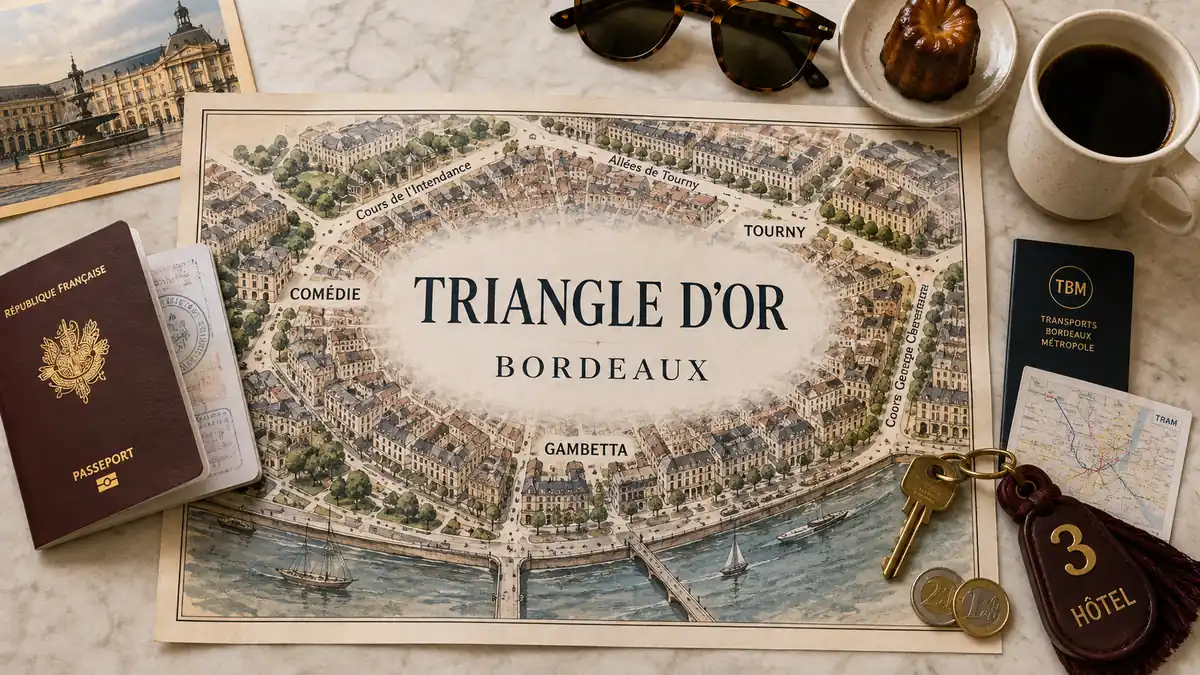
The Triangle d’Or is the small triangle enclosed by the Allées de Tourny, Cours de l’Intendance and Cours Georges-Clemenceau. Those three streets are the whole boundary. Anything inside them is the quarter; anything beyond them is a different address, whatever the listing calls it.
Among the quarters on Bordeaux’s stay shortlist, this is the one sitting at the centre of the pedestrian core, and how Bordeaux’s quarters compare as bases places it against the alternatives. The frame itself takes one pass:
- Allées de Tourny. Runs between Place Tourny and the Grand Théâtre corner, closing the quarter on its river side.
- Cours de l’Intendance. Begins at Place de la Comédie and ends at Place Gambetta, closing the quarter to the south.
- Cours Georges-Clemenceau. Links Place Gambetta back to Place Tourny and completes the shape.
Three squares mark the points. Place Tourny sits at the northern vertex. The Grand Théâtre on Place de la Comédie holds the south-eastern one — and since that building also houses the Opéra National de Bordeaux, two names on a map describe a single corner. Place Gambetta closes the west. Place des Grands-Hommes sits at the centre of the shape, and the city’s tourist office files this whole ground as the Grands Hommes district with “triangle d’or” as its nickname — so a listing using either name is describing the same streets.
The ground immediately outside matters as much as the frame itself. Beyond the Comédie corner the old-town lanes begin. On the Tourny side, Quinconces adjoins the triangle and the two read as one continuous elegant stretch toward the river. West of Place Gambetta the everyday city takes over. The shape is easy enough to draw once someone states it; what it implies for an address is the part nobody states.
Inside the Triangle, ‘Which Part’ Is the Wrong Question
The interior is small enough to cross on foot in minutes and uniform in register — one place, not zones. Its streets are a single mesh converging on one central square. No part of it feels meaningfully different from any other part, so choosing a part resolves nothing.
There is no length to travel here. Six streets run inward from the edges to Place des Grands-Hommes, the buildings hold the same register from one end of the mesh to the other, and a walk across the whole interior is over before it starts. Whatever a listing sits next to inside those three cours, the room stands in much the same relation to everything the quarter contains.
The corners are where the difference lives. Each one opens onto a different city — the old-town lanes, the river side, the everyday west — and those three are not interchangeable. Step out of the same quarter by a different vertex and you are somewhere else within a block.
The reason the corner carries so much weight is that the quarter does not entertain you in the evening. Street level here is shops, food traders and cultural venues, so almost everything you do after they close happens outside these three streets. Every one of those walks begins at a corner, and the corner you book near sets how short the walk out is — and how short the walk back is at the end of it.
Two listings with identical descriptions, one near Comédie and one near Gambetta, hand you the same room and a different evening. That is why placement here is decided by the vertex, not by the property.
The Three Corners: Comédie, Tourny and Gambetta
Each corner opens onto a different city: the old-town lanes, the river, and the everyday west. The interior you get is the same in all three cases. What changes is the ground you step onto when you leave, and how quickly your evening begins.
| Corner | Square at the vertex | Opens onto | The walk out and back |
|---|---|---|---|
| The Comédie corner (south-east) | Place de la Comédie, at the Grand Théâtre | Rue Sainte-Catherine and the old-town lanes beyond | Shortest walk out, shortest walk home afterwards |
| The Tourny corner (north) | Place Tourny, on the Allées de Tourny | The Quinconces side, the quays and the river | River is the next block; the lanes take longer |
| The Gambetta corner (west) | Place Gambetta, at the far western point | The everyday city west of the quarter | Tram reaches the quarter here; lanes are furthest |
The Comédie corner: where the old-town lanes begin
The Cours de l’Intendance begins at Place de la Comédie, at the opening of rue Sainte-Catherine, and ends at Place Gambetta. That junction is the exact point where the city’s main pedestrian shopping spine starts, and the old-town lanes open immediately beyond it. Booking near this corner puts the evening ground a couple of streets from the door, and it makes the walk back the shortest of the three. Book near this corner if the evenings are the point of the trip and you want the last stretch home to be brief. The Grand Théâtre stands at this vertex — the neighbour at the corner your walk out crosses anyway.
Best for: travelers whose evenings are the point of the trip and who want the shortest walk home from the lanes.
The Tourny corner: the river side
The Tourny corner opens onto the Quinconces side and the river. The river is the next block from here, and the walk north along the quays starts at this end of the quarter. Quinconces adjoins the triangle on this side, with the Allées de Tourny as the line between them, and the two read as one continuous elegant stretch. Book near this corner if your days run to the water and the open squares more than to the lanes.
Best for: travelers who want the quays and Quinconces on the doorstep and accept a longer walk to the old-town evening.
The Gambetta corner: the tram and the everyday city
Place Gambetta is the corner furthest from the lanes, and the one where the tram reaches the quarter. West of it the city turns everyday and non-visitor — streets that serve the people living on them. From here the walk to the old-town evening is the longest of the three corners and the walk to a tram is the shortest. That suits arriving with luggage, leaving early, or planning days outside the core; it works against a trip built on late walks home from the lanes.
Best for: travelers arriving with luggage or leaving early, who want the tram close and days built outside the core.
Read it as one decision. You are not choosing a part of the quarter — the inside is settled — you are choosing which edge your feet cross most often, and how long the return leg is once the shops behind you have shut. Pick the corner by the walk you make at the end of the day, not the one you make at the start: mornings here go in every direction, evenings only go one way.
What You Sleep Above: Shopfronts in Former Mansions
The quarter’s street level is retail and culture — shops and food trade in the ground floors of eighteenth-century mansions. That is what sits under most rooms here. It sets the rhythm of the street outside your window: busy through the day, emptying as the businesses close.
The three boundary cours are shopping arteries whose ground floors occupy former hôtels particuliers — private mansions, several of them protected. The Cours de l’Intendance is closed to car traffic and given over to pedestrians, with the tram along part of it; that status is specific to this edge and should not be assumed for the other two. Inward from the edges, the philosopher streets carry independent boutiques, restaurants and cafés toward the centre. Cultural frontage fills in the rest: the auditorium stands on the Cours Georges-Clemenceau, near the Grand Théâtre at the Comédie vertex.
The uniformity has an origin. The quarter was laid out in the eighteenth-century Tourny works, on ground previously occupied by convents, which is why the stock reads as continuous mansion rows with commercial ground floors instead of a patchwork of periods.
That building type converts into a short list of things to check before booking:
- What is under the room? Shop frontage on a pedestrian street is a daytime question, not a night one.
- Which side does it face? Courtyard-side rooms sit off the retail street entirely.
- Is there a lift? Upper floors in converted mansions were reached by stairs long before lifts existed.
Shopping as an activity, things to do, transport and getting your bearings on arrival all sit outside a stay decision; start from the Bordeaux city guide for those.
Hotels and places to stay
Compare hotels, apartments and stays for your dates in one search.
Search hotels and stays on hotels.com →
Tripstou may earn a commission if you book through this link, at no extra cost to you.
Is the Triangle d’Or Quiet in the Evening?
Yes — and the quiet is commercial closure, not residential calm: shop frontage generates no late trade. The streets empty because the businesses on them finish, not because people are asleep behind them. The mechanism matters, because it tells you exactly when the quarter goes quiet.
Street-level trade here is shops, food traders and cultural venues, and all three run on opening hours. Terrace and bar frontage is what keeps a street awake. Shop frontage does not. So the quiet arrives on a schedule you can predict: the shopping cours wind down, the philosopher streets follow, and the interior settles while the evening ground beyond the Comédie corner is still filling up.
What that means for the room is straightforward. You get a quiet street at the door and an evening that begins a short walk away. Performance nights are the exception, and they happen inside the quarter: the Grand Théâtre at the Comédie vertex and the auditorium on the Clemenceau edge both put people on these streets around a performance — neighbours at the corner, working to their own calendar.
A quarter that closes instead of sleeping has one practical consequence: the last stretch of your walk home is also the emptiest stretch of it, and it is the same walk whether you come back early or late.
What Place des Grands-Hommes Puts at Your Door
At the triangle’s centre, a circular place holds a covered food market in its rotunda, under a glass gallery. Six streets converge on it. For anyone sleeping nearby, that means provisions at the door and a working daytime rhythm at the middle of the quarter.
It reads as a ring with spokes. The circular plan is unusual in Bordeaux, which makes the place easy to find on a map, and the six streets running out of it carry the names of French philosophers — rue Montaigne, rue Montesquieu, rue Rousseau, rue Voltaire, rue Buffon and rue Diderot. They carry the independent boutiques, restaurants and cafés that fill the interior. The rotunda at the centre has held a covered food market under its glass-and-metal gallery since the mid-nineteenth century, with food traders on the lower level.
For a base, that is bread, cheese, fruit and prepared food inside the quarter, with no edge to cross to reach it. It also explains why the centre is not a fallback for the evening: this is a market square, not a terrace square, so the middle of the mesh keeps the same opening-hours rhythm as the edges around it. Provisions at the centre are what make the interior genuinely liveable for a stay — the quarter feeds you at the hours it is awake, and the rest of the day belongs to the corners.
What the Triangle d’Or Buys You — and What It Costs
The premium buys a quiet room at the centre; the cost is an evening that starts a walk away. Both halves are real, and no ranking page states the second one. Whether the trade is worth taking depends on how much of your day happens after the shops close.
What the address buys is structural. You are at the centre of the pedestrian core, so every direction is on foot and none of them is a project. The building stock is polished and the street level is orderly. And the room goes quiet when the shops do, on the schedule described above.
What it costs is equally structural. This is the highest-positioned quarter on the city’s stay shortlist. Its street level is a shopping district, so the frontage under your window sells things by day and shuts in the evening. And your evening ground sits outside the triangle, which means a walk out and a walk back on every night you go out.
What a Triangle d’Or address trades on is easy to name: retail ground floors on pedestrian shopping streets, eighteenth-century mansion stock, and a pin at the centre of the map. The trade is not negotiable by property. You can buy a better room here; you cannot buy a nearer evening, and moving one street inside the triangle changes nothing about either.
One practical clause before you commit: a car is a reason to check access before booking, because this is a pedestrian-street quarter and arrival is a question to settle in advance. And if you have read the corner model and still find yourself weighing this quarter against the old-town core, that is a genuine tie with a page of its own — Saint-Pierre or the Triangle d’Or resolves it properly.
Who the Triangle d’Or Suits — and Who Should Be Elsewhere in the Core
The Triangle d’Or suits readers who want the centre with the noise a few streets away, not at the door. It works against trips built around evenings that start where you sleep. Conditions decide this, and trip length is the sharpest of them. Traveler profiles matter less than the walk each condition implies.
Every direction is on foot from here, which sounds like it settles the question and does not. Trip length sharpens all of it. On a short stay you repeat the same walk out and back most evenings, and it always begins at the same vertex, so the corner decides your trip more than the quarter does. On a longer stay the balance shifts: more of your days use the quarter’s own street level — the market, the interior, the daytime rhythm — and the corner stops being the whole story. The evening-led condition is the honest one. If the trip is organised around what happens after the shops close, this quarter’s evenings happen beyond its edges, and no address inside the triangle changes that.
- First-timers. The Triangle d’Or is a strong first-visit base when you want the map centred and the noise a few streets off; a first visit built around evenings at the door points elsewhere in the core. The elaborated split lives in where first-timers should stay in Bordeaux.
- Couples. The register here is polish and a quiet centre — a street that goes silent at the door with the whole core reachable on foot from it. Weigh it in Bordeaux for couples.
- Families. Practically it works: central, calm at night, with a covered food market at the middle of the quarter for provisions. More options sit in Bordeaux for families, which covers the practical side across the city.
- Evening-led trips. Book the Comédie corner or accept the walk, because this quarter’s evenings happen beyond its edges either way. Bordeaux’s evening-led areas covers the wider picture.
- Budget-led trips. This is the shortlist’s high-positioned end and the interior is uniform, so there is no cheaper corner to retreat to inside the triangle. Start instead from staying in Bordeaux on a budget.
- Top-end trips. Mansion stock and a centre-of-the-map pin are what the upper end here trades on; whether that beats the city’s other options is a city-wide question. See Bordeaux’s high-end areas for that comparison.
- Property-level questions. This page resolves the corner and deliberately never the property, since the quarter’s reputation runs almost entirely through named inventory. For addresses, go to Bordeaux’s boutique hotels.
Frequently Asked Questions
Is Quinconces part of the Triangle d’Or?
No — Quinconces adjoins the triangle on its river side, with the Allées de Tourny as the line between them. The two read as one continuous elegant stretch, so a listing on the Quinconces side sits beyond the quarter’s edge without feeling like a different address.
Is Place Gambetta in the Triangle d’Or?
Place Gambetta is the triangle’s western vertex, so the square itself marks the quarter’s corner. Ground west of it lies outside the three cours and is filed as a separate neighbourhood, so a listing described as near Gambetta may sit beyond the quarter. Check the pin against the boundary streets.
Can you drive or park in the Triangle d’Or?
This is a pedestrian-street quarter, so arriving by car is a question to settle before booking. The Cours de l’Intendance is closed to car traffic and given over to pedestrians, and the interior streets are narrow. If you are driving, confirm access and arrival arrangements with the property first.
Is there a tram in the Triangle d’Or?
Yes — the tram runs along part of the Cours de l’Intendance and reaches the quarter at Place Gambetta. That southern edge is given over to pedestrians and the tram. Inside the core it is barely a variable, since every direction from here is on foot; it matters mainly for arrival and days outside the centre.
Is the Triangle d’Or a good base for a short trip?
Yes, provided the corner matches the trip. Short stays give the quarter’s own street level little chance to work — the market and the daytime rhythm reward longer visits — so the doorway carries the decision. With plans still open, the Comédie corner shortens the most walks.
Related Guides
- Where to stay in Bordeaux — the quarter shortlist this page zooms into.
- Bordeaux city guide — orientation, transport, shopping and the wine country beyond the city.
- Saint-Pierre or the Triangle d’Or — the tiebreaker against the old-town core.
- Where first-timers should stay in Bordeaux — the split this page leaves open on purpose.
- Bordeaux’s evening-led areas — for trips built around what happens after the shops close.
- Bordeaux’s boutique hotels — the property-level question this page routes out.
Did this guide save you time or money? Tripstou is independent and reader-funded — if you'd like to give something back, you can support the site with a crypto contribution of any size.