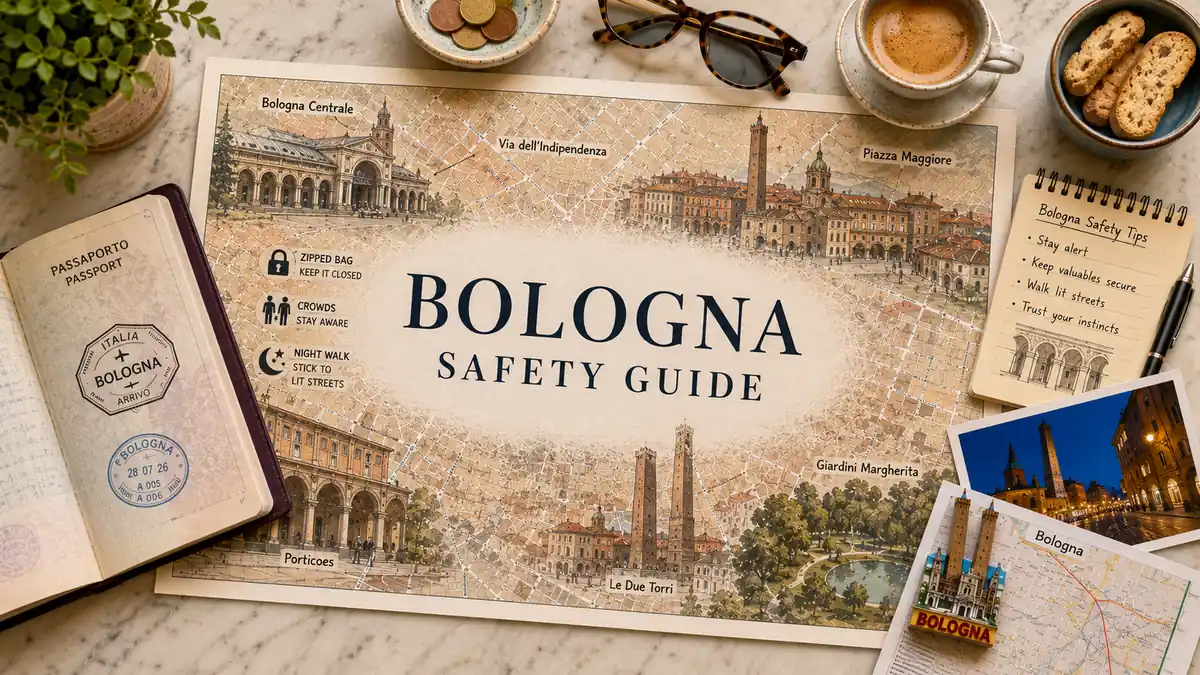
Bologna is one of the most comfortable Italian cities to walk, and one of the easiest to misjudge from photographs. The station district is scruffy, political graffiti covers shutters across the center, and the porticoes are worn by generations of students instead of polished for visitors. That surface reads as edge. The lived experience reads as a dense, busy, well-lit city where the realistic risk to a traveler is losing a wallet.
This guide answers the safety question outright, then gets specific. It covers why the city looks rougher than it is, what Bologna’s standing on the national crime index actually measures, which named spots change character after dark, where theft genuinely concentrates, the scam shapes that recur here, how the city reads for women traveling alone, and what to do if something happens. Almost all of it comes down to when you walk, not where.
Quick Answer
Bologna is a low-risk city for visitors, and pickpocketing is the realistic concern. The hour matters more than the neighborhood: the historic center stays comfortable late, while the station forecourt and Parco della Montagnola are worth skipping after dark. Keep bags closed at Bologna Centrale and in crowds, and walk lit central streets at night.
Trust Layer
Tripstou planning guide for travelers resolving one travel decision. Covers the main variable, traveler context, and practical tradeoffs.
Produced with AI assistance and reviewed by Alex Perrut, working in tourism since 2015, for the Tripstou editorial team. See our editorial process for details.
Last factual review: July 28, 2026.
Official sources consulted: italia.it, enit.it.
Key Takeaways
- Bologna is a low-risk city for visitors; opportunistic theft — pickpocketing and bag snatching — is the only common problem.
- The graffiti and the scruffy station district signal a working, student-heavy city, not a safety problem.
- The historic center stays lit and populated late; only the station forecourt, Montagnola and — for noise — Via del Pratello change after dark.
- Theft concentrates at Bologna Centrale and on crowded buses; a zipped bag worn in front removes most of the risk.
- Every scam that recurs here runs on distraction, so refusing to be rushed defeats the whole category at once.
- Bologna is one of Italy’s easier cities for solo travelers, including women, thanks to short distances and covered routes.
Table of Contents
Is Bologna safe for tourists?
Yes, Bologna is safe for tourists. Serious crime against visitors is rare, and the one common problem is opportunistic theft: pickpocketing and bag snatching in crowds. The center is dense, busy and easy to walk, and the overwhelming majority of visits here pass without any incident at all.
The risk profile follows the shape of the city. Bologna’s historic center is small enough to cross on foot, and its porticoes funnel people along the same covered, lit routes at all hours. One of Europe’s oldest and largest universities fills those streets with students who are still out long after the restaurant crowd has gone home. Crowds here are protection, not exposure.
Rank the risks honestly and the list gets short. Pickpocketing and bag theft come first by a wide margin, concentrated in a handful of predictable places. Everything after that — scams built on distraction, taxi overcharging, an inflated restaurant bill — costs money and dignity, not safety. Violent crime against visitors sits far enough down the list that planning a trip around it distorts the trip.
That makes Bologna an easy city for the travelers who worry most: first-timers in Italy, people arriving alone, families walking everywhere with children. The part of town that unsettles them on arrival is almost always the ground around Bologna Centrale, and that is the least representative corner of the city.
Is Bologna more dangerous than Rome, Florence or Naples?
No. Bologna sits in the same low-risk band as Italy’s other major visitor cities, with the same petty-theft pattern and less of the tourist-density pressure that makes Rome and Florence such productive ground for pickpockets. The comparison people arrive expecting — gritty industrial north versus polished Tuscany — does not survive contact with the streets. What Bologna has is fewer visitors packed around each famous sight, which means fewer crowds to work and fewer choreographed distraction routines aimed at foreigners. The difference is one of scale, not of kind.
Why does Bologna look rougher than it is?
Bologna’s rough edge is aesthetic, not a safety signal. The graffiti, the scruffy station district and the scuffed porticoes are the wear of a working, student-heavy city that people actually live in. Almost none of it correlates with risk to a visitor, and the streets that look most lived-in are often the busiest and most watched.
Bologna was never restored into an open-air museum. Florence and Venice manage their historic centers as exhibits; Bologna’s centro storico is where people go to work, study, argue and eat, and the buildings carry the marks of it. The porticoes are functional infrastructure, not ornament, and they get used like pavement because that is exactly what they are.
The graffiti is civic texture with a long political memory. Bologna has been a university city for centuries and a politically loud one for decades, and the tags, stencils and pasted posters on its shutters belong to a continuous public argument. Graffiti signals danger in cities where nobody is watching. Here the opposite applies: the most heavily tagged streets are usually the ones with the most students on them.
The station district supplies most of the bad first impression. Piazza Medaglie d’Oro and the streets immediately around Bologna Centrale are scruffier, louder and less cared-for than the center, and that is the first thing many arrivals see with a suitcase in hand. It is urban wear, not menace. For orientation, sightseeing and what the rest of the city actually looks like, our Bologna travel guide covers the ground this page deliberately leaves alone.
Why does Bologna rank high on Italy’s crime index?
Because the index counts reported offences against the resident population, and Bologna’s real population is far larger than the number of people registered as living there. Students, commuters and trade-fair visitors flood the city daily and appear in none of the denominators. A city that hosts many more people than it houses will always look worse per resident than it feels on the street.
The offence mix matters as much as the arithmetic. What drives the totals is theft — bags, phones, bicycles — reported diligently, because insurance claims require a police report. That is a different picture from violence against visitors, and a headline position does not separate the two. Read the index as a measure of reported property crime in a commuter city and it stops being alarming.
Is Bologna safe at night?
Yes, Bologna is safe at night in the historic center. The porticoes stay lit and populated well past dinner because a large student body keeps the center in use, and the walking routes between the main squares never really empty out. A few specific spots do thin out after dark, and they are worth knowing.
Choose the street, not the shortcut. The variable at night is how lit and how populated your route is, and in Bologna that is a street-by-street question, never a district question. Arriving late at Bologna Centrale, walk south on Via dell’Indipendenza: it is wide, well-lit and busy, and it delivers you into the center without a single quiet detour.
- Default to the porticoed main streets. They are covered, lit and still in use late, which is why locals walk them home by reflex.
- Skip the empty shortcut. A dark side lane that trims two minutes off the walk is the one decision worth reversing.
- Read the street, not the neighborhood. Quiet, unlit and unfamiliar is the combination that matters; the district name tells you very little.
- Book a licensed taxi or a ride app late. Use it for unfamiliar addresses, not for the walk between central squares.
Roadworks in the center periodically reroute pavements and change lighting, so a route that felt busy one evening can be boarded off the next; if that happens, take the wider street instead of the improvised gap.
Bologna’s after-dark comfort is borrowed from its students, so the center is at its liveliest in term time and noticeably thinner during university holidays. Same streets, smaller crowd, slightly more attention required on the walk home.
Is it safe to walk around Bologna alone?
Yes, walking around Bologna alone is safe in the center at essentially any hour. The variable is the liveliness of the street you are on, not the city you are in. Most solo travelers here walk everywhere, including back from dinner, and the porticoes make that feel ordinary because there is nearly always someone else under them. Apply the same street-reading habit late at night and there is nothing unusual to manage.
Which areas of Bologna need care after dark?
This is a night-only question, not a list of areas to avoid. No part of central Bologna is off-limits by day, and only three named spots genuinely change character after dark: the station forecourt, Parco della Montagnola and, in a different way, Via del Pratello. Everywhere else reads the same at both hours.
Verdicts below are behavioural, not ratings: each area is read only through how it feels to walk.
| Area | By day | After dark |
|---|---|---|
| Historic center (Piazza Maggiore, Santo Stefano) | Busy, covered and comfortable to walk throughout | Stays lit and populated well past dinner |
| Station forecourt and Piazza Medaglie d’Oro | Busy transit space, fine to cross and use | Thins out; less comfortable to linger in late |
| Parco della Montagnola | Pleasant, well-used green space in daylight | Empties and goes dark; walk around it |
| Bolognina | Ordinary district, routinely crossed without incident | Quieter and scruffier; not a late-night wander |
| Via del Pratello | Quiet lane of small bars and shops | Loud drinking street; noise, not crime |
Bolognina generates more anxious searching than anything else on that list, and it deserves a calm answer. It sits just north of the station, it is residential, and it is less polished than the center. People walk through it by day without a second thought. What changes after dark is the quiet — fewer people about, less light, less familiarity — which is a poor combination for a first-time wander at any address, here included.
Via del Pratello is on the list for the opposite reason. It is not a crime problem; it is a noise problem, and only if you want to sleep. Expect drinking, crowds and conversation spilling into the street late, which is a comfort question and nothing more.
The three flagged spots share one trait, and it is not crime: each empties, darkens or gets loud at exactly the hour the rest of the center is at its busiest. Read them as timing, not territory.
This page reads Bologna’s areas through a safety lens only. The booking decision runs on different variables, and where to stay in Bologna is where that gets resolved.
Is the area around Bologna train station safe?
Yes, the area around Bologna Centrale is safe and busy throughout the day. The forecourt and Piazza Medaglie d’Oro thin out late in the evening and attract people hanging around, and the station interior itself is the city’s main pickpocket ground at every hour. Neither of those makes the district dangerous. Arriving after dark, keep your bag closed inside the station and walk out along Via dell’Indipendenza instead of cutting through the quieter streets behind it.
Where pickpockets operate in Bologna — and how to avoid them
Pickpockets in Bologna concentrate at Bologna Centrale and on crowded city buses. Those two settings supply what thieves need: a press of bodies, luggage, and passengers whose attention is on doors, screens and departure boards. It is the one risk here that genuinely applies to most visitors, and it responds entirely to habit.
The map is short and specific. Bologna Centrale — concourse, platforms and the crush at the doors — comes first. Crowded buses on the busy central routes come second, particularly in the scrum at boarding. After that: Via Indipendenza and Via Rizzoli at peak shopping hours, Piazza Maggiore whenever an event draws a crowd, and the narrow market lanes of the Quadrilatero, where everyone slows down and looks up.
- Bag closed and in front. In any crush, a zipped crossbody worn across your chest removes the opportunity outright.
- Nothing in back pockets. A wallet or phone behind you is the easiest thing to lose on a packed bus.
- Phone off the café table. Terrace seating under the porticoes sits directly on busy pavement, so keep it in your hand or your pocket.
- Guard the boarding moment. The squeeze at a bus door and the shuffle onto a platform are where hands work; hold your bag through both.
- Split what you carry. Keep cards, cash and documents in more than one place so a single loss stays an inconvenience.
The porticoes work in your favor here. They keep foot traffic moving in predictable, overlooked lines, which is why almost nothing happens under them and almost everything happens at the station doors and on the bus steps. Thieves in Bologna work transitions, not landmarks.
What scams should you watch out for in Bologna?
Distraction is the pattern behind almost every scam in Bologna. Someone manufactures a moment of confusion — a question, a clipboard, a bumped shoulder — and your money moves while you are busy dealing with it. Refusing to be rushed defeats the whole category, whatever costume it happens to arrive in.
The shapes that recur here are few, and they repeat:
- Distraction teams near the station and busy squares. One person asks directions, drops something or presses close while another works your bag. Step back, create space, check your pockets.
- Fake charity or petition clipboards. A board is pushed at you for a signature, and while you read it, hands are elsewhere. Genuine collectors never need you to hold anything.
- Taxi overcharging on airport and station runs. Take marked, licensed taxis from the official rank or book through an app, and confirm how the fare will be calculated before you get in.
- Unpriced menus near the main square. A place with no written prices, or a plate quoted vaguely by weight, is building a bill you cannot argue with. That is fraud, not bad luck: read printed prices before you sit down.
- Unattended drinks on a night out. Standard nightlife hygiene applies here as anywhere — order at the bar, watch the pour, keep your glass with you.
That list is deliberately short. Each of these is a local costume on the same demand for your attention, and the costume is the only part that changes. Wider first-timer preparation, including the booking and restaurant traps that are irritating without being criminal, sits in our Bologna travel tips.
Is Bologna safe for solo female travellers?
Yes, and Bologna is one of Italy’s easier cities to travel alone in as a woman. The center is compact, young and populated late, walking distances are short, and the porticoes keep routes covered and overlooked. The caveats are the same night-time ones that apply to everyone here, not a separate set.
A large student population does most of the work. Term-time Bologna keeps its center in use late — people walking home, sitting out on the steps of Santo Stefano, filling the bars of the university quarter — which means a woman walking alone at night is rarely the only person on the street. Ambient occupancy beats any precaution you can carry.
The porticoes matter more than they sound like they should. They are covered, lit and continuous, so a late walk stays overlooked from windows and doorways for most of its length, with no dark gaps to duck between. Route choice remains the practical lever: the three night-only spots — the station forecourt, Montagnola and the noise of Pratello — are the same ones everyone else steps around.
Catcalling deserves an honest sentence and no more. Street comments happen in Italy, including here, and they read as a social annoyance, not a threat; a flat non-response ends nearly all of them. Late at night, book a licensed taxi or a ride app to an unfamiliar address instead of improvising a long walk, which is what a local woman would tell you to do.
That is the Bologna layer. The national picture — country-wide risk framing, the full scam catalogue, tap water, and the deeper solo-female-in-Italy detail — sits in our Italy safety guide.
Emergency numbers and what to do if you’re robbed
112 is the only emergency number you need in Bologna. It is the single European emergency line, it works throughout Italy, it is free from any phone, and one call reaches police, ambulance or fire. Save it before you arrive and use it for anything genuinely urgent, instead of searching for a local alternative.
If something is stolen, the useful steps are all things you control:
- Report the theft to the police. You need the report for any insurance or travel-cover claim, and claims are routinely refused without one.
- Cancel cards immediately. Do this before anything else if a wallet is gone; your bank’s app or emergency line is faster than any counter.
- Keep copies stored separately. A photo of your passport and a note of your card numbers, held somewhere other than your wallet, turns a crisis into paperwork.
- Do not chase anyone. Theft here is non-confrontational by design, and it only becomes dangerous if you turn it into a confrontation.
Bologna’s worst realistic day is an administrative one: a lost afternoon, some cancelled cards, a report to file. Preparing for that specific inconvenience is a far better use of your attention than preparing for danger this city rarely produces.
Travel medical insurance
SafetyWing Nomad Insurance provides travel medical coverage designed for travelers and digital nomads, with flexible Monthly and Annual plans.
Check Nomad Insurance coverage and current pricing →
New Nomad Insurance Essential members can get 8 weeks of electronic theft coverage free with reward code TRIPSTOU8.
Apply the reward before creating your SafetyWing account by looking for the pink camera icon on the Nomad Insurance page.
Tripstou may earn a commission if you purchase through this link, at no extra cost to you.
Frequently Asked Questions
Is Bologna safe for families with children?
Yes, Bologna suits families well. The historic center is compact and walkable, the porticoes keep walks covered in rain or sun, and distances between the main squares are short. The same theft caution applies — keep bags closed in crowds and at the station — and nothing else changes.
Is Bolognina safe?
Bolognina is safe to walk through, and people cross it by day without incident. It sits just north of the station and is less polished than the historic center, so after dark it feels quieter and scruffier. That makes it a poor choice for an unfamiliar late-night wander, not a district to avoid.
Is public transport in Bologna safe?
Yes, public transport in Bologna is safe, and nothing about riding a bus puts you at personal risk. Theft is the only concern: the boarding crush on busy central routes is where hands work, because bodies press together and attention drifts to doors and screens. Keep a zipped bag in front.
Is Via del Pratello safe at night?
Via del Pratello is safe at night — the problem there is noise, not crime. It is a narrow lane of small bars that fills with drinkers and conversation late, and the sound carries into the surrounding streets. Expect a loud walk through, and a loud night if you sleep nearby.
Is Bologna safe for students?
Yes, and students are part of why the center feels safe late. One of Europe’s oldest universities keeps the streets in use long after the restaurant crowd leaves, which raises ambient occupancy on the walk home. Standard nightlife hygiene applies: watch your drink, and keep your phone off the table.
Related Guides
- Bologna travel guide — orientation, sightseeing and how the city fits together.
- Where to stay in Bologna — area selection for the booking decision this page deliberately skips.
- Bologna travel tips — wider first-timer preparation, etiquette and booking traps.
- Italy safety — national risk framing, the full scam catalogue and solo-female depth.