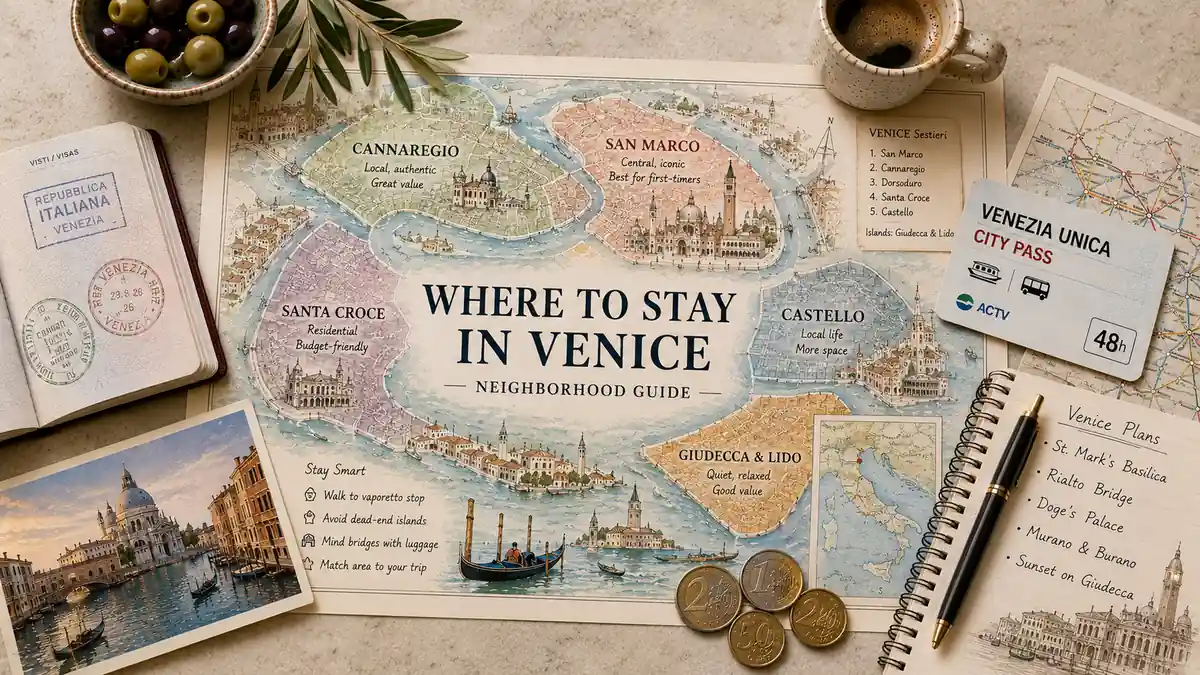
Venice is one small city split into six historic sestieri, and choosing where to stay is the decision that shapes your whole trip. The city is compact enough to cross on foot in under an hour, so the question is rarely how far one area is from another. It is which base fits how you travel — and how easily you reach a Grand Canal crossing or vaporetto stop from your door. A first-timer chasing the headline sights, a couple after quiet canals, and a budget traveler counting every euro each belong in a different sestiere. This guide maps all six areas, matches each to a traveler type, and gives you one simple rule for picking a base that works. No hotel lists, no sightseeing rundown — just where to sleep and why.
Quick Answer
San Marco is the best overall base in Venice for first-timers who want to walk to the main sights. It sits at the city’s center, which also makes it the busiest and most expensive place to sleep. For a quieter, more local, lower-cost stay close by, Cannaregio is the strongest alternative.
Trust Layer
Tripstou stay guide for travelers choosing where to base. Covers area atmosphere, budget, convenience, noise, and traveler fit.
Produced with AI assistance and reviewed by Alex Perrut, working in tourism since 2015, for the Tripstou editorial team. See our editorial process for details.
Last factual review: July 16, 2026.
Official sources consulted: italia.it, enit.it.
Key Takeaways
- San Marco suits first-timers who want the headline sights on foot, but it is Venice’s busiest and priciest base.
- Cannaregio delivers the best value and a quieter, local feel while keeping you close to the station and the center.
- Couples and art lovers do best in Dorsoduro, calmer than San Marco but still central and full of gallery atmosphere.
- Pick your base by its walk to a vaporetto stop or canal crossing, not by the neighborhood’s name.
- Booking on area name alone ignores the luggage-over-bridges reality that decides how effortless your Venice arrival actually feels.
Table of Contents
What are Venice’s six sestieri, and which suit a stay?
Venice has six sestieri — San Marco, San Polo, Santa Croce, Dorsoduro, Cannaregio, and Castello — arranged around the S-shaped Grand Canal. San Marco sits at the center; Cannaregio spreads north by the train station; Dorsoduro fills the southwest; Santa Croce forms the arrival edge; San Polo and Castello flank the middle.
The whole city is walkable end to end in well under an hour, so no sestiere is truly far from another. What changes between them is character, not distance: how central, how crowded, and how residential each one feels. Think of the map as a mood chart more than a distance chart — you are choosing an atmosphere and a level of foot traffic, not a commute. For broader city orientation before you narrow down a base, start with our complete Venice guide.
Canal-crossing access matters more than the neighborhood name
Choose a base by its walk to a vaporetto stop or canal crossing, not by the neighborhood’s name. Venice has only a handful of bridges over the Grand Canal, so a pretty address on the wrong side can add long detours to everywhere you go. Access beats label.
Two arrival points anchor the western edge: Santa Lucia train station in Cannaregio and Piazzale Roma in Santa Croce, where road transport and the People Mover stop. Basing near either cuts the first and last luggage haul of your trip, at the cost of a longer walk to St Mark’s and the central sights. A central base flips that math — you wake up in the heart of the city but carry your bags farther on arrival.
Venice has no cars, so every transfer between your door and a vaporetto stop happens on foot, over arched stone bridges with steps. A base one bridge closer to your vaporetto line saves more effort than one that is technically nearer in a straight line — the steps, not the metres, are what wear you down with a suitcase. Pick a base near the stops that serve what you will actually visit; our 2-day Venice itinerary shows what a first trip usually covers.
San Marco is the best base for first-time visitors
San Marco is the best base for first-timers who want St Mark’s, Rialto, and the main sights on foot. It occupies the geographic and tourist heart of Venice, so most landmark sights sit within a short walk. That central position is the whole appeal for a first visit.
The atmosphere is grand and unrelentingly busy. Day-trippers pour into St Mark’s Square from morning to evening, and the streets around it stay crowded far longer than in the outer sestieri. Early mornings and late evenings, once the day crowds thin, are when the area feels magical.
Convenience is unmatched: you can reach the headline sights on foot and step onto major vaporetto lines without a long walk. That access is exactly what a first-timer with limited days is paying for. On price, San Marco sits firmly at the high end — it is the most expensive sestiere to sleep in, and canal-view rooms command the steepest rates in the city.
For the full picture of the area, see our San Marco neighbourhood guide, and if this is your first trip, our first-time Venice stay guide goes deeper on picks. Torn between central buzz and a calmer alternative? Our San Marco vs Cannaregio comparison weighs it up. Best for: first-time visitors who value walkable sights over a calm, local feel.
Cannaregio is the top pick for a quieter, more local stay
Cannaregio is the best base for a quieter, more local stay near the train station. It stretches north from Santa Lucia station into residential lanes where Venetians actually live, yet keeps you within walking distance of the center. You trade some central buzz for calm and value.
The atmosphere is the most everyday-Venice of the main bases — wine bars full of locals, quieter canals, and the historic Jewish Ghetto at its core. Nights stay calm away from the few busier strips. It feels lived-in, not staged.
Convenience leans on the station: arriving and leaving is effortless, and vaporetto lines along the northern edge connect you to Rialto and San Marco with little walking. The trade-off is that the deepest, quietest lanes put you a fair walk from the main square. On price, Cannaregio sits at the budget-to-mid-range end for Venice, one of the better-value central sestieri.
Read our Cannaregio neighbourhood guide for street-level detail on which lanes stay quietest. Best for: travelers who want a quiet, local, better-value base with easy station access.
Dorsoduro is the strongest choice for couples and art lovers
Dorsoduro is the best base for couples and art lovers, calmer than San Marco but still central. It runs along Venice’s southwest edge, home to the Accademia and Peggy Guggenheim galleries and the lively Campo Santa Margherita. Atmosphere without the crush is the draw.
The atmosphere splits in two, which is part of its appeal. Around Campo Santa Margherita it is young and social, with a student-driven bar scene; along the Zattere promenade and the smaller canals it turns romantic and hushed. Couples can pick their block to match their mood.
Convenience is solid without being fully central: the Accademia bridge crosses straight toward San Marco, and vaporetto stops on the southern edge reach the station and the islands. On price, Dorsoduro runs mid-range to high-end, with canal-front and gallery-adjacent rooms at the top of the band and quieter interior lanes more moderate.
Choose your street here, not just the sestiere — a room by Campo Santa Margherita and one on the Zattere are a few minutes’ walk apart but deliver opposite evenings. Our Dorsoduro neighbourhood guide maps both sides, our Venice for couples stay guide covers romantic picks, and our San Marco vs Dorsoduro comparison weighs central buzz against calmer atmosphere. Best for: couples and art lovers who want character without San Marco’s density.
Best Venice area by traveler type
First-timers pick San Marco, couples Dorsoduro, and quiet-seekers Cannaregio — each area suits one clear traveler type. Venice rewards matching your base to how you travel, because the sestieri differ more in feel than in distance. Use the map below as a shortcut.
| Traveler type | Best base | Why it fits |
|---|---|---|
| First-time visitor | San Marco | Walkable to St Mark’s and Rialto |
| Couples | Dorsoduro | Romantic canals and gallery atmosphere |
| Families | Cannaregio | Quieter lanes and room to breathe |
| Budget travelers | Cannaregio | Best value among the central sestieri |
| Nightlife and atmosphere | Dorsoduro | Campo Santa Margherita bar scene |
| Luxury | San Marco | Grandest hotels and canal-view rooms |
Families and nightlife-focused travelers are the two types this map compresses most. Families usually do best in Cannaregio or Castello, where wider campos and calmer lanes give kids room and parents fewer bridges to haul strollers over — our Venice for families stay guide has the detail. For a lively evening base, Dorsoduro’s Campo Santa Margherita leads, and our Venice nightlife stay guide covers the rest. These are signposts; each traveler-type page carries the full pick logic.
Hotels and places to stay
Compare hotels, apartments and stays for your dates in one search.
Search hotels and stays on hotels.com →
Tripstou may earn a commission if you book through this link, at no extra cost to you.
Where to stay in Venice on a budget vs for luxury
Cannaregio and the outer fringes lean budget-friendly, while San Marco and canal-front Dorsoduro sit at the high end. Venice is an expensive city to sleep in overall, so the real choice is which trade-off you accept: location or value. Spend style should steer your sestiere.
On the budget end, Cannaregio and the quieter reaches of Castello and Santa Croce give you central-enough access at the lowest rates the historic city offers. Interior lanes away from the water always cost less than canal-front rooms in the same sestiere.
At the high end, San Marco commands the top rates, and canal-front Dorsoduro and the Grand Canal palazzo hotels follow close behind. You are paying for address and view more than for extra space.
Our budget Venice stay guide and luxury Venice stay guide break down each end, and our best luxury hotels in Venice roundup names the top-tier properties. A canal view moves a Venice room rate more than almost anything else you can change — dropping it, even one lane inland, is the fastest way to cut cost without leaving your chosen sestiere.
Other Venice areas worth knowing
San Polo, Santa Croce, and Castello are worth knowing but work best as secondary bases. Each has a clear niche instead of the all-round appeal of the three main bases, so most trips do better in San Marco, Cannaregio, or Dorsoduro. Still, each suits a specific traveler.
- San Polo sits central-west around the Rialto market, compact and lively by day. It suits travelers who want to be near Rialto and San Marco while paying a little less than the square itself.
- Santa Croce and Piazzale Roma form the arrival edge, next to the car terminal and bus links. This is the practical base for drivers, late arrivals, or anyone prioritising an easy entry over central atmosphere.
- Castello spreads east behind San Marco as the largest and most residential sestiere. Its quiet outer lanes suit families and repeat visitors who want local calm a short walk from the crowds.
Wherever you base, central Venice is a low-crime city where pickpocketing in the tourist crush is the main concern; our Venice safety guide covers the practicalities.
Frequently Asked Questions
Is it worth staying on the Venice islands (Giudecca or Lido) instead of the main city?
The Venice islands suit a calmer or repeat visit, not a first sightseeing trip. Giudecca and Lido are quieter and often cheaper, but every journey to the main sights depends on the vaporetto. If your days center on St Mark’s and Rialto, base in the central historic city instead.
Should I stay in Venice or in Mestre?
Stay in Venice itself if the historic atmosphere is the point of your trip. Mestre, on the mainland, is cheaper and better connected by car and train, but you lose the evenings and early mornings that make Venice special. Choose Mestre mainly to cut cost or for a very short stopover.
How many nights should I stay in Venice?
Two to three nights suit most first visits to Venice. That gives you two full days for St Mark’s, Rialto, and a slower wander through the quieter sestieri, plus time for one island or gallery. Add a night if you want day trips to Murano and Burano without rushing.
How far ahead should I book a place to stay in Venice?
Book your Venice accommodation two to three months ahead for spring and summer stays. The central sestieri and canal-view rooms sell out earliest, and Venice’s limited room supply pushes prices up as dates fill. For quieter winter visits, a few weeks’ notice is usually enough to find a good base.
Is a canal-view room worth the extra cost in Venice?
A canal view is worth it only if the setting matters more to you than the cost. It carries one of the steepest premiums in Venice, so a room a lane inland costs noticeably less for a similar space. Sightseeing-focused first-timers who are out all day rarely need one.
Is it better to stay in a hotel or an apartment in Venice?
Apartments suit longer stays and families wanting space, while hotels win for short visits and full service. In Venice, weigh access over size — check how many bridges stand between the door and the nearest vaporetto stop before booking either. That walk shapes daily life more than the room does.
Related Guides
Ready to go deeper? These guides take the next step from choosing an area to booking the right base.
- Complete Venice travel guide — the parent hub for planning your whole trip.
- San Marco neighbourhood guide — the central, first-timer base in full.
- Cannaregio neighbourhood guide — the quieter, more local alternative.
- Dorsoduro neighbourhood guide — the couples-and-art base explained.
- 2-day Venice itinerary — what your base should sit near.
- Best luxury hotels in Venice — the top-tier properties by area.
- Venice: San Marco Guide
- Venice: San Marco Guide