Three days is the right length for a first trip to Munich. Two days cover the city core: the Altstadt on foot, then the Englischer Garten and the museum quarter. The third day is what makes Neuschwanstein possible without cutting into the city days. Stay all three nights in one base, in or beside the Altstadt. Day 3 is the long one: about two hours each way by regional train plus a local bus, built around a timed guided-tour entry.
The order is deliberate. The Altstadt comes first because it is walkable and puts the city’s map in your head. Day 2 is split by geography, so you never cross town twice. The castle day goes last, once you know your way to the Hauptbahnhof.
Is three days enough for Munich?
Yes, and three is the sweet spot: two days clear the city’s main sights, and the third buys the Alpine castle day without rushing either of them. Two days are enough only if you skip any day trip.
Each extra day buys something specific. Two days give you the core: the old town loop and one green-and-museum day. Three days add one full day trip, and Neuschwanstein is the one most first-timers want. Four days let you add a second day trip or slow Day 2 down so the park and the galleries each get their own day.
The route suits first-time visitors who want the castle and the city in one short trip. Its cost is a single early, long day with about four hours on trains. If that sounds like a lost day, swap Day 3 for an in-city day (see the adaptation rules below) and keep the first two days exactly as written.
The 3-day Munich route at a glance
Day 1 walks the Altstadt, Day 2 covers the Englischer Garten and the Kunstareal, and Day 3 is Neuschwanstein by train, all from one base near the centre.
| Day | Area | Anchor stops | How you move |
|---|---|---|---|
| Day 1 | Altstadt (old town) | Marienplatz, Viktualienmarkt, Residenz | On foot |
| Day 2 | Englischer Garten and Kunstareal, north of the centre | Eisbach wave, Chinesischer Turm, Alte Pinakothek | U-Bahn + on foot |
| Day 3 | Hohenschwangau, near Füssen | Neuschwanstein, Marienbrücke, Alpsee | Regional train + bus, about 2 h each way |
Day 1: the Altstadt on foot, from Marienplatz to a beer-hall dinner
Day 1 is entirely walkable, and it goes first because it orients you: the whole loop sits inside the old town, and by evening you know where everything else on the route lies in relation to Marienplatz.
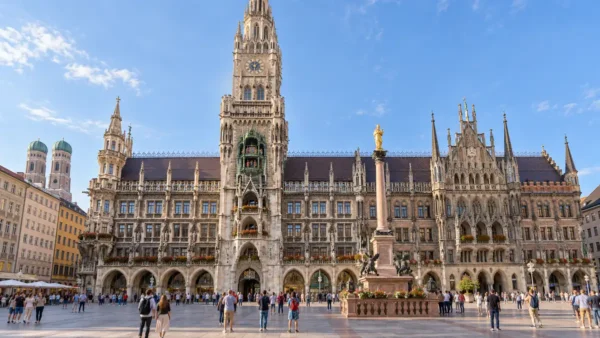
Start at Marienplatz, under the Neues Rathaus. Time your arrival for a Glockenspiel show if you like a fixed starting point; the show times are in the questions at the end. Then climb the Alter Peter tower next door. It comes early for a reason: from the top, the Frauenkirche towers, the Residenz roofs and, on a clear day, the Alps line up into the map you will walk for the rest of the day.
Viktualienmarkt is the lunch stop, a few minutes south of the square. The open-air market lets you eat standing or at the beer-garden tables and keeps the afternoon free. Walk back north to the Frauenkirche, whose twin domed towers mark the skyline, and if you want a local to thread the stories together, book a guided walk for this stretch of the loop.
The Residenz takes the afternoon. It was the seat of Bavaria’s rulers for centuries, and its rooms, courtyards and treasury fill as many hours as you give them, so it sits at the end of the walk, where nothing else has to fit after it. You pass the Feldherrnhalle on Odeonsplatz on the way in, worth a minute for its twentieth-century history.
Dinner closes the loop at a beer hall. The Hofbräuhaus is a short walk from the Residenz and is the one most visitors want to see once; Augustiner is the calmer choice if you would like to hear your table. Sight-by-sight detail, with hours and tickets, is in our guide to things to do in Munich.
Climb Alter Peter before lunch, not after. The tower view only works as orientation if you see it before you walk the streets below it, and every later stop on Day 1 is visible from the top.
Tours and activities
Book skip-the-line tickets, day trips and local tours with free cancellation on most activities.
You can also browse everything on getyourguide.com.
Tripstou may earn a commission if you book through this link, at no extra cost to you.
Day 2: Englischer Garten and the museum quarter, or Nymphenburg and Olympiapark
Day 2 is split by geography. The Englischer Garten and the Kunstareal sit next to each other north of the centre, so they share a day without a long ride between them. The palace-and-park variant is the swap for readers who would sooner spend the day outdoors than in galleries.
The main route: Englischer Garten in the morning, Kunstareal in the afternoon
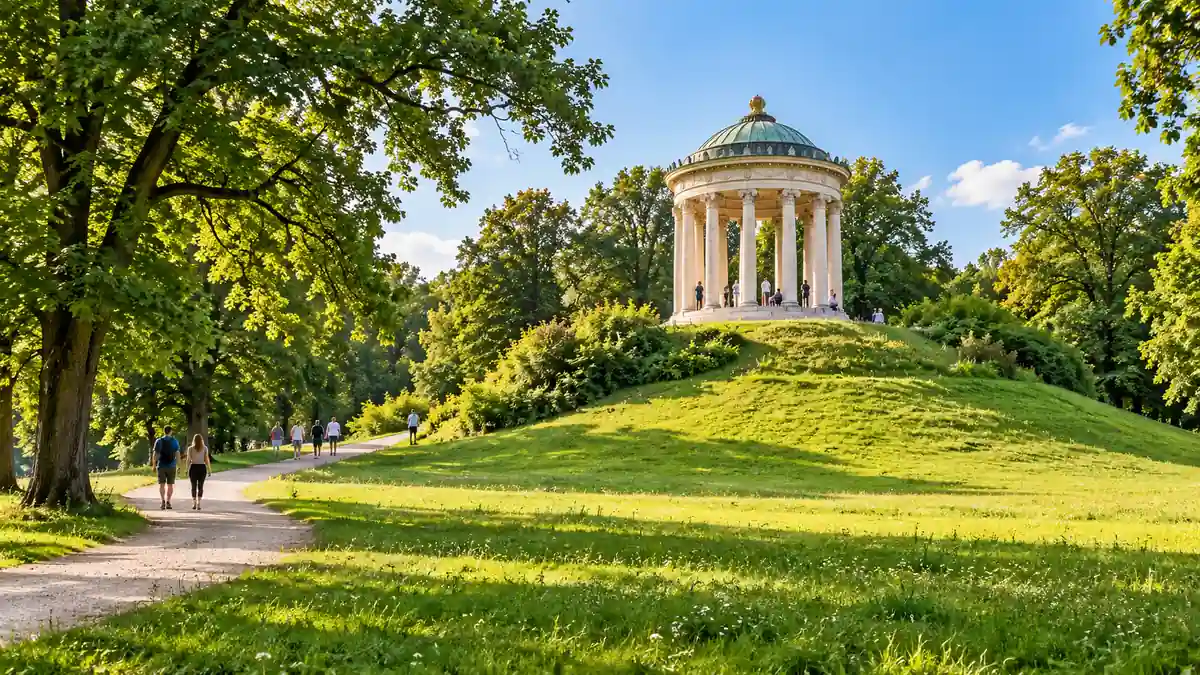
Enter the Englischer Garten at its southern tip, where surfers ride the standing Eisbach wave by the bridge. From there the park walk runs north past the Monopteros, the small hilltop temple with a view back over the old town, to the Chinesischer Turm beer garden for lunch.
The afternoon belongs to the Kunstareal, the museum quarter in Maxvorstadt. Pick one Pinakothek and do it properly; the Alte Pinakothek, with its old masters, is the usual first choice. Finish on Königsplatz, the colonnaded square at the quarter’s edge. A science-minded reader can swap the galleries for the Deutsches Museum on its island in the Isar and reserve an entry ticket for that afternoon instead. Munich’s museums do not all open every day, so check opening days before you fix which day is the museum day.
The variant: Nymphenburg Palace, Olympiapark and BMW Welt
These three chain together west and north of the centre: Nymphenburg Palace and its park in the morning, then across by tram and U-Bahn to Olympiapark and BMW Welt, which stand side by side. Families, outdoor-leaning travelers and second-time visitors pick this version. It costs you the galleries; the Hirschgarten beer garden, near the palace, is the lunch stop.
- Take the main route if paintings and a park walk are the day you came for.
- Take the variant if children, cars or open space matter more than old masters.
- Split them if you have four days: the main route on Day 2, the variant on Day 4.
Day 3: Neuschwanstein by train is a long day, and worth the early start
Book your Neuschwanstein ticket online in advance. The castle interiors are visited only on a guided tour with a fixed entry time, so the whole day is built backwards from that slot.
The clock runs like this. Regional trains leave Munich Hauptbahnhof for Füssen every hour, and the ride takes about two hours. Buses 73 and 78 leave from beside Füssen station for Hohenschwangau village. The official advice is to be in Hohenschwangau at least 1.5 to 2 hours before your admission time. Work back from the slot: tour time, minus that margin, minus the bus, minus about two hours of train gives you the departure from Munich.
The hours around the tour give the day its shape. Marienbrücke, the bridge above the gorge, gives the classic view of the castle; the Alpsee lake at the foot of the village is the slower hour. Then the bus back to Füssen and an evening train to Munich. If you would like someone else to handle the connections, book this day trip instead of going alone.
A limited number of same-day tickets go on sale from 08:00 at the Ticket Center in Hohenschwangau. Treat them as a fallback, never the plan.
Choose the tour slot first and the train second. The admission time, not the timetable, decides when you leave Munich, and an early slot means an early train from the Hauptbahnhof.
If the castle isn’t your day: Salzburg, Dachau Memorial or Linderhof
- Salzburg suits a reader who wants a second city: the fastest trains take about an hour and a half.
- Dachau Concentration Camp Memorial Site is a half-day of history: the S2 from the Hauptbahnhof takes about 25 minutes, then bus 726 to the “KZ-Gedenkstätte” stop.
- Linderhof or the Zugspitze give the Alps without the Neuschwanstein crowds.
Logistics and the full menu of options are compared in our guide to day trips from Munich.
Where to stay and how to get around for three days
Book one base for all three nights, in the Altstadt if budget allows and in Maxvorstadt if not. You walk Day 1, ride the U-Bahn for Day 2 and take the regional train from the Hauptbahnhof on Day 3.
The route never needs a hotel move, so one base is the simplest plan. The Hauptbahnhof is the Day 3 exit, which makes it worth staying within walking distance of the station or on a direct U-Bahn or S-Bahn line to it. An early train is easier with no change on the way.
The Altstadt is the first-timer pick. Day 1 starts at your door and the beer halls are a short walk home, but it is the priciest area in the city. The Platzl Hotel and the Louis Hotel are two examples on the Day 1 loop.
Maxvorstadt is the museum quarter: quieter, cheaper, and on the doorstep of the Day 2 galleries, with the Hauptbahnhof close by. You give up the evening stroll back from the old town and take a short ride instead.
Everything outside the old town runs on the U-Bahn and S-Bahn, which reach the Englischer Garten, the Kunstareal, Nymphenburg, Olympiapark and the main station without a car. Rail passes, money and entry rules apply to the whole country and are covered in our Germany travel guide.
Hotels and places to stay
Compare hotels, apartments and stays for your dates in one search.
Search hotels and stays on hotels.com →
Tripstou may earn a commission if you book through this link, at no extra cost to you.
Two days or four: what to cut first and what to add
With two days, cut Day 3 and keep Days 1 and 2 untouched. With four, add a second day trip or split Day 2 into its two halves. The city days carry the route; the day trip is the flexible part.
| Trip length | What you keep | What you cut or add | Day trips |
|---|---|---|---|
| 2 days | Day 1 Altstadt, Day 2 garden and museums | Cut Neuschwanstein | 0 |
| 3 days | All three days as written | Nothing | 1 |
| 4 days | All three days | Add Salzburg or Dachau, or the Nymphenburg variant as its own day | 1 or 2 |
Cut the castle before you cut a city day. A two-day trip that squeezes in Neuschwanstein leaves one rushed city day, and the Altstadt walk is what makes the rest of Munich easy to navigate.
Three days with no day trip
Without a day trip, the route stays in the city and Day 3 becomes the Nymphenburg, Olympiapark and BMW Welt variant, so the main Day 2 stays intact. A slower alternative is a full Deutsches Museum day, which gets the hours a single afternoon cannot give it. Either way the base and the first two days do not change.
How This Route Was Checked
This page plans one three-day Munich route: the order of the days, their pacing and the castle day. It is not a list of everything to see, a hotel roundup or a comparison of day trips.
Written with AI assistance and then checked by Alex Perrut, working in tourism since 2015, for the Tripstou editorial team, with the castle-day and train details read against the sources below. How we work is set out in our editorial process.
Official sources consulted: Hohenschwangau Ticket Center, City of Munich official portal, Dachau Concentration Camp Memorial Site.
Munich Itinerary Questions
What time does the Glockenspiel play at Marienplatz?
The Glockenspiel plays daily at 11:00 and 12:00, with a third show at 17:00 from March to October. On Day 1, the 11:00 show makes a natural start: watch it from the square, then climb Alter Peter before the walk down to Viktualienmarkt for lunch.
Does the itinerary change during Oktoberfest?
The order stays the same; what changes is the pressure on beds and tables. Oktoberfest fills Munich in late September, so book the base for all three nights as early as you can and expect fuller beer halls on the Day 1 dinner and busier U-Bahn and S-Bahn trains. Keep the castle day as planned: it takes you out of the city while the festival crowds stay in it.
Keep Planning Munich and Germany
- Things to do in Munich: the full sights list, with the depth this route skips.
- Day trips from Munich: every Day 3 option compared.
- Germany travel guide: country-level planning for the wider trip.
Did this guide save you time or money? Tripstou is independent and reader-funded — if you'd like to give something back, you can support the site with a crypto contribution of any size.