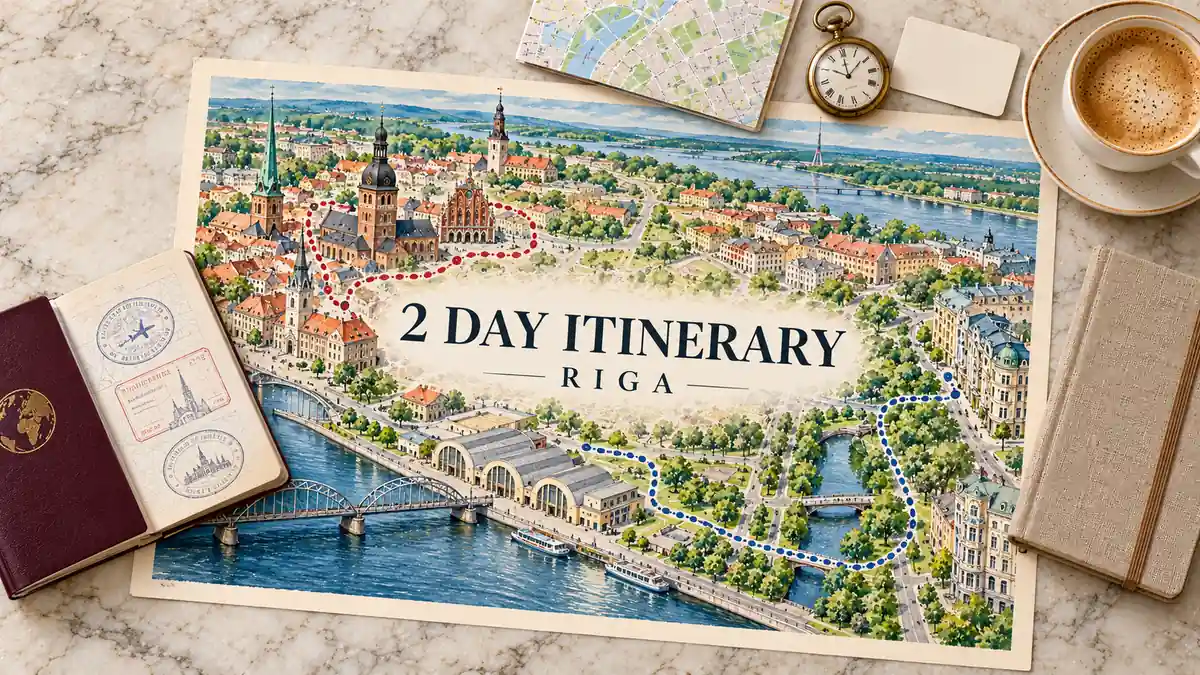
Two days in Riga is a classic weekend city break, and the real question is not what to see but in what order. This guide gives one fixed route from one base, walked almost entirely on foot: the Old Town on Day 1, then a single line on Day 2 from Central Market through the Moscow Suburb and past the Freedom Monument into the Art Nouveau quarter. Each block explains why it sits where it does, so no morning is spent retracing yesterday’s streets. The page also covers where to base yourself, how the airport bus sets the Day 1 start, what the route gives up, and how to shrink it to one day or stretch it to three. It does not list every sight, museum or day trip; those have their own guides. Read it as a sequence. Swap an anchor if you must, but keep the line intact.
Quick Answer
Two days covers Riga on foot from one base: Old Town first, then Central Market to the Art Nouveau quarter. Stop order is the key variable: the Old Town loop is compact, so Day 2 carries the longer walk. It suits first-time visitors wanting both districts; museum-heavy travelers should drop one museum or add a third day.
Trust Layer
Tripstou itinerary guide for travelers planning a route. Covers pacing, stop count, stop order, base logic, and trip length.
Produced with AI assistance and reviewed by Alex Perrut, working in tourism since 2015, for the Tripstou editorial team. See our editorial process for details.
Last factual review: September 29, 2026.
Official sources consulted: Latvia Travel, Latvian Ministry of Economics, Live Riga, Rīgas satiksme.
Key Takeaways
- Two days covers Riga’s Old Town, Central Market, Moscow Suburb and Art Nouveau quarter on foot, because all four sit side by side.
- Walk the Old Town as a loop on Day 1 and a single south-to-north line on Day 2, so no street is walked twice.
- Doing the Old Town first suits arrival day, since airport bus 22 stops at Grēcinieku iela, inside the Day 1 loop.
- Start Day 2 at Central Market in the morning, when the halls are liveliest, and finish on Alberta iela as the light fades.
- Museums are the price of seeing both districts: add at most one to Day 2, placed at the end of the line.
- With one day, cut the Art Nouveau quarter first; with a third day, add a day trip instead of more city walking.
Table of Contents
Is 2 Days Enough for Riga?
Two days covers Riga’s Old Town, Central Market and Art Nouveau quarter comfortably on foot. The three districts sit side by side, so one base serves the whole trip and no morning is lost to transport. The one condition: museum depth or a trip out of the city needs a third day.
Riga Old Town is a UNESCO World Heritage site, and its core is small. It fills an easy day at walking pace, with time for a tower view and a long dinner. Central Market sits beside the Old Town and the bus station. The Art Nouveau quarter starts just north-east of the Old Town, beyond the canal park, and is walkable from it.
The case for exactly two days is that Riga splits cleanly in two: the medieval core inside the old canal line, and the 19th- and early 20th-century city outside it. One day per half is the natural fit, and a third city day mostly repeats streets you have already walked.
Two days suits first-time visitors on a city break who want both halves in equal measure. It is tight for museum completists. Those travelers either give up one district or add a day. For the wider planning picture — best time to go, budget and getting around — see the Riga city guide.
The Recommended 2-Day Riga Route
The route is one loop on Day 1 and one straight line on Day 2. Both start at the Old Town’s edge. Day 1 circles the medieval core. Day 2 runs south to north, from Central Market through the Moscow Suburb and past the Freedom Monument into the Quiet Centre, so nothing is walked twice.
- Day 1: Old Town — the medieval core
- Day 2: Central Market, Moscow Suburb and Art Nouveau quarter — the 19th–20th-century city
The order follows the way the city grew. The Old Town is the medieval city inside the former fortifications. The market, the Moscow Suburb and the boulevards grew outside them, and the Art Nouveau streets came last. Walking them in that sequence reads Riga forward in time.
Putting the Old Town first works because the airport bus drops you at its edge. Day 1 can begin the moment your bags are down, while Day 2’s longer line gets a full, fresh morning. Reverse the days and the arrival afternoon is spent walking to the market.
Each day block below names two or three anchors only. That is deliberate. The full list of sights and museums lives in the guide to things to do in Riga.
Day 1: The Old Town Loop, From Bastion Hill to the Blackheads
Day 1 stays inside the Old Town, one loop from the canal park to the river without backtracking. It suits arrival day: the streets are compact, every stop is a few minutes apart, and the loop ends on the main square after dark. The order runs Bastion Hill, St Peter’s tower, Dome Square, then Town Hall Square.
You sleep at the same base both nights, so Day 1 is about orientation. Nothing needs booking. Every move is on foot.
Morning: Bastion Hill, Livu Square and St Peter’s tower
Bastion Hill is the right starting point because it sits on the Old Town’s eastern edge, beside the city canal, where most bases feed in. The park is a green prelude before the stone lanes. Livu Square, the Old Town’s open-air hub, is a few minutes on foot from there.
St Peter’s Church closes the morning. Take the lift to the viewing platform. Doing the tower first is the point: the view maps the whole afternoon — the cathedral spire, the river, the red roofs — before you walk it. Onward move: head west through the lanes to Dome Square.
Afternoon: Dome Square, the Three Brothers and the Swedish Gate
The afternoon sweeps the north-western half of the Old Town in one pass. Dome Square and Riga Cathedral come first, because they sit a short walk west of St Peter’s and you have just seen the spire from above. The Three Brothers, a row of medieval houses, are a few streets north.
The Swedish Gate, set into a surviving stretch of the old town wall, closes the sweep. This is the quietest corner of the loop. Onward move: drift back south through fresh lanes toward the river as the light drops.
Evening: Town Hall Square and the House of the Blackheads
Day 1 ends on Town Hall Square, facing the House of the Blackheads. Its ornate gabled facade is the image most visitors carry home from Riga, and the square is calmer once the day groups have gone. It is the arrival-day payoff.
Dinner is anywhere in the surrounding lanes, with the river embankment a step away. Ending here means your first night is spent on the city’s showpiece square. Onward move: a few minutes on foot back to a base in or beside the Old Town.
Day 2: Central Market to the Art Nouveau Quarter
Day 2 walks one line north from Central Market to Alberta iela, so the heavier day never doubles back. The market comes first because it is liveliest in the morning. The Moscow Suburb sits beside it, the canal park and Freedom Monument bridge the districts, and the Art Nouveau quarter is the finish.
Same base, second night, longer walk. If a museum is on your list, confirm its closing day before fixing which one lands on Day 2.
Morning: Central Market and the Moscow Suburb
Central Market is the right opener because it occupies former Zeppelin hangars beside the Old Town and the bus station, a short walk from any central base. Go early. The halls are fully stocked and working, and the Moscow Suburb begins directly behind them, with low wooden and brick streets unlike anything on Day 1.
The Ghetto and Holocaust Museum near the market is an optional stop. In the warmer months, the Academy of Sciences observation deck adds a second, higher view of the city. Onward move: eat lunch back at the market, then head north on foot toward the canal.
Midday: The canal park, Freedom Monument and Nativity Cathedral
The canal park is the bridge between the two halves of the day. Walk north along the city canal, through the green belt that traces the line of the old fortifications, to the Freedom Monument, the city’s central landmark. The Nativity Cathedral stands a short walk further on, inside Esplanāde park.
This block is transit with sights, which keeps it short. The cathedral’s gilded domes are best seen from outside on a tight day. Onward move: the Art Nouveau streets are a few minutes on foot to the north.
Afternoon and evening: Alberta iela and the Quiet Centre
Alberta iela is the showcase Art Nouveau street and the finish line of the trip. Facade after facade carries masks, figures and sculpted detail. The Riga Art Nouveau Centre at Alberta iela 12, a restored period apartment, is the optional museum here; the Corner House, the former KGB building, is the alternative for Soviet history.
Pick one, not both. The trip ends in the Quiet Centre as the light fades, with calmer streets than the Old Town. Onward move: walk back south along the boulevards, or take a tram or bus if your legs are done.
Where to Base Yourself for Two Days in Riga
Stay in or just beside the Old Town so both mornings begin on foot and no day needs transport. The Old Town gives atmosphere and puts Day 1 on your doorstep. The Quiet Centre edge, just north-east, gives calmer nights and a shorter walk home from the Day 2 finish.
First-time visitors on a short weekend usually do best inside the Old Town. Light sleepers should look at the boundary streets instead, since Old Town lanes can carry late noise at weekends. A base far from the centre saves little. It also breaks the walking logic that makes two days enough.
A base near the canal park splits the difference best: Bastion Hill is on your doorstep for Day 1, and Alberta iela is a short walk home when Day 2 ends. For area-by-area choices and hotels, see where to stay in Riga.
Hotels and places to stay
Compare hotels, apartments and stays for your dates in one search.
Search hotels and stays on hotels.com →
Tripstou may earn a commission if you book through this link, at no extra cost to you.
Getting From Riga Airport to the Old Town on Day 1
Bus 22 runs directly from Riga Airport to the Old Town edge, so Day 1 can start soon after landing. Get off at Grēcinieku iela for the Old Town or at Autoosta for the bus station and central railway station. A morning arrival leaves a full Day 1; an afternoon one shortens the loop.
The ride takes around 40 minutes depending on traffic. Tickets bought in advance cost about €1.50; buying from the driver costs about €1.81 and is card-only. Check the fare before you travel. Buses run frequently through the day, and the N22 night service runs hourly for late arrivals.
The Grēcinieku iela stop is why the Old Town comes first: the bus leaves you inside Day 1’s loop, so no arrival hour is spent getting into position. Land in the evening and the first night becomes the Town Hall Square block alone. Run the rest of the loop next morning. Day 2 then starts at the market after lunch, when the halls are quieter.
Museum Depth Is What You Trade for Seeing Both Districts
This route covers both districts by treating every museum as optional, and Day 2 is where that bill comes due. Day 1 absorbs one museum easily because the Old Town loop is short. Day 2 is the long walking day, and each museum you add pushes Alberta iela closer to dusk.
Three ways to handle it:
- Coverage: one museum on Day 1, none on Day 2. Suits first-time visitors; the tradeoff is seeing Day 2 from the street.
- Balanced: one museum at the end of Day 2, either the Art Nouveau Centre or the Corner House. Suits design or history interest; the midday block gets shorter.
- Depth: two or more museums. Suits history-focused travelers; drop the Moscow Suburb or add a third day.
Put the Day 2 museum at the end of the line. The Art Nouveau Centre and the Corner House both sit on the finish, so a late visit costs only the evening stroll, while a museum stop at the start eats the market morning. Confirm the closing day before fixing Day 2 order. It decides the whole sequence.
How to Adapt This Route With Fewer or More Days
With one day, keep the Old Town and a market morning; with three, add a day trip. The two-day route already covers central Riga’s three districts, so extra time buys a change of scenery. Less time costs the Art Nouveau quarter first, because it sits at the end of the line.
When time shrinks to one day:
- Cut the Art Nouveau quarter first: it is the furthest walk from the Old Town, and its facades need slow walking to pay off.
- Cut the Moscow Suburb next, but keep lunch at Central Market.
- Keep St Peter’s tower and Town Hall Square after dark; they carry the Old Town on their own.
When time grows to three days:
- Add one day trip first — Jurmala, Sigulda or Rundale — because central Riga is already covered.
- Add museum depth second, using the slack the third day frees on Day 2.
- Keep the same base; a day trip returns you to it each night.
| Trip length | What you cover | Walking load | Who it suits |
|---|---|---|---|
| 1 day | Old Town loop plus a Central Market lunch | Moderate, all inside a compact centre | Stopover visitors short on time |
| 2 days | Old Town, market, Moscow Suburb and Art Nouveau quarter | Heavier on Day 2’s south-to-north line | First-time visitors wanting both halves of Riga |
| 3 days | The two-day route plus one day trip | Two walking days and one transport day | Travelers wanting a change of scenery |
Rushed in an hour, Alberta iela is just a pretty street, which is why it is the first cut on a one-day visit. Transport and timing for each option are in the guide to day trips from Riga.
Tours and activities
Book skip-the-line tickets, day trips and local tours with free cancellation on most activities.
You can also browse everything on getyourguide.com.
Tripstou may earn a commission if you book through this link, at no extra cost to you.
Frequently Asked Questions
How many nights should you book for two days in Riga?
Book two nights if you land in the morning, because airport bus 22 puts you at the Old Town edge and Day 1 starts right away. An evening arrival shifts the Old Town loop into the next morning and pushes the market to the afternoon, so a third night keeps both full days intact.
Is Riga walkable, or do you need public transport?
Riga’s centre is walkable, and this whole route works on foot: the Old Town, Central Market, Moscow Suburb and Art Nouveau quarter sit next to each other. Public transport matters twice, for airport bus 22 on arrival and for an optional tram or bus back south when Day 2 ends on tired legs.
Is St Peter’s Church tower worth it on a two-day trip?
Yes, and it earns its place as the last stop of the Day 1 morning. A lift takes you to the viewing platform, and the view lays out the cathedral spire, the river and the red roofs you will walk that afternoon. Climbed early, it works as a map of the day; climbed late, it is only a view.
What can you do in Riga in the evening on a two-day trip?
Spend the first evening on Town Hall Square, facing the House of the Blackheads once the day groups have left, then eat in the surrounding lanes or walk the river embankment. The second evening belongs to the Quiet Centre, where the Art Nouveau facades of Alberta iela are calmer and the walk home runs along the boulevards.
Is the Riga canal cruise worth it on a two-day trip?
It is worth it on Day 1 if it is running, since the city canal runs past Bastion Hill, where the Old Town loop starts. Cruises are seasonal, so treat one as an add-on, not an anchor. On a tight day, it costs part of the morning, so the afternoon sweep past the Swedish Gate gets shorter.
Can you see Riga’s Art Nouveau quarter without a guide?
Yes. The Art Nouveau quarter is a street-level sight: the facades of Alberta iela and the surrounding Quiet Centre are on public streets, free to see at your own pace. A guide adds names and stories, not access. For an interior, the Riga Art Nouveau Centre at Alberta iela 12 shows a restored period apartment.
Related Guides
- Riga city guide — best time to go, budget, getting around and the wider planning picture.
- Things to do in Riga — the full list of sights and museums behind this route’s anchors.
- Day trips from Riga — how to use a third day on Jurmala, Sigulda or Rundale.
- Where to stay in Riga — area-by-area base choices and hotels for a two-day trip.
Did this guide save you time or money? Tripstou is independent and reader-funded — if you'd like to give something back, you can support the site with a crypto contribution of any size.