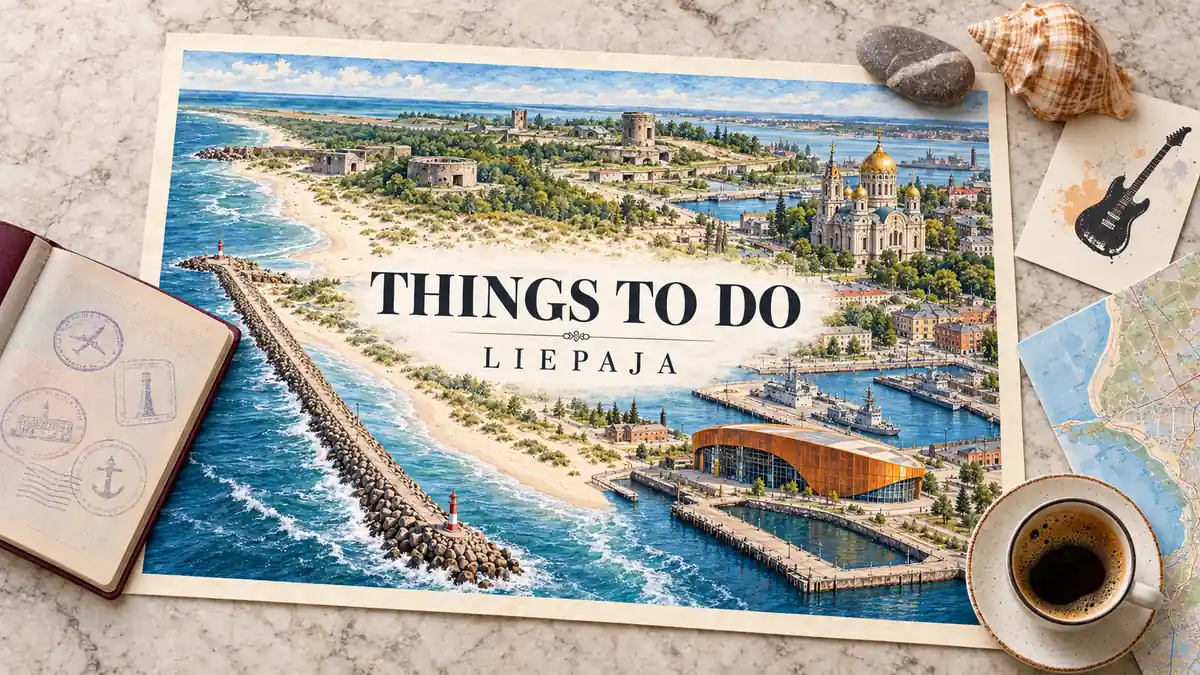
Liepāja is Latvia’s west-coast port city, a bit over 200 km from Riga, and the real question is whether it earns one day or two and what should fill them. The picks fall into three groups. Karosta, the former naval district in the north, holds the military prison, the Northern Forts and a tsarist-era naval cathedral. The centre holds the music identity: a concert hall, a cathedral organ and a working market. The coast holds a Blue Flag beach and the longest breakwater in Latvia.
Two hooks explain the city’s pull. Liepāja sees itself as Latvia’s music city, and its own slogan calls it the city where the wind is born. This page sorts the picks by the traveler each one suits, so you can build the visit around what fits and skip what does not.
Quick Answer
Karosta is the standout in Liepāja: the military prison, the Northern Forts and the naval cathedral. The centre (Great Amber, Holy Trinity’s organ, Peter’s Market) and the coast (Blue Flag beach, Northern Breakwater) fill a second day, making it a two-day city. Beach travelers should come in summer; history and music travelers get value year-round.
Trust Layer
Tripstou selection guide for travelers choosing between multiple places. Covers selection criteria, traveler fit, and trip value.
Produced with AI assistance and reviewed by Alex Perrut, working in tourism since 2015, for the Tripstou editorial team. See our editorial process for details.
Last factual review: September 29, 2026.
Official sources consulted: Latvia Travel, Latvian Ministry of Economics.
Key Takeaways
- Karosta is Liepāja’s strongest pick: the military prison, the Northern Forts and the naval cathedral sit in one district and fill half a day.
- Karosta Prison’s guided tour and overnight stay are deliberately confrontational, so families with young children and anyone uneasy with role-play should skip them.
- Music and culture travelers should build the visit around the centre, timing it to a Great Amber concert or an organ performance at Holy Trinity.
- The Blue Flag beach is a summer pick only, while the Northern Breakwater sunset walk works in every month when the sea is calm.
- At around three hours from Riga by bus or train, Liepāja needs an overnight; two days fit a concert, the prison night or the beach.
- For a beach-only day close to Riga, Jūrmala is the shorter trip; Liepāja pays off for travelers who want Karosta and music too.
Table of Contents
Karosta Is the Reason to Come to Liepāja
Karosta, the former closed naval district in the north of Liepāja, is the strongest reason to visit. It covers roughly the northern third of the city and was off-limits in Soviet times. Its three main sights (the military prison, the Northern Forts and the St. Nicholas Naval Cathedral) sit in one area and fill half a day.
Karosta looks rough. Soviet-era apartment blocks, some of them empty, stand beside the old naval buildings, and that faded edge is part of what you came to see. Travelers expecting a polished old town should know this before they go.
Order matters more here than the map suggests. Start with the prison, which gives the district its Soviet context, then the cathedral, and end at the forts on the shore, where the Northern Breakwater’s sunset is close enough to finish the day.
Karosta Prison
Karosta Prison is the headline sight, and Liepāja’s official tourism board describes it as the only military prison in Europe open to tourists. The visit is built around the building’s military past, and the guided formats lean hard into role-play.
- Guided tour: suits most visitors who want the story and the cells; the trade-off is a confrontational tone that some find uncomfortable.
- Overnight stay: suits travelers who want the full experience; the trade-off is a deliberately harsh night with no comfort on offer.
The intensity is the point. Families with young children and anyone uneasy with being shouted at should skip the immersive formats. Check karosta.lv for times.
Pick this if: dark tourism and Soviet history are the reason you came to Liepāja.
Northern Forts
The Northern Forts are coastal fortification ruins on the Karosta shore, and parts of them are slowly collapsing into the sea. Tilted concrete blocks lie on the beach while the waves work through what is left of the walls. The site feels raw and largely unfenced, which is both its appeal and its risk. Footing on wet concrete is poor. The wind off the Baltic is strong, so sturdy shoes and a windproof layer matter more here than anywhere else in the city. The breakwater sunset is close by, which makes the forts the natural last stop of a Karosta afternoon.
Pick this if: you want ruins and open seascape with little visitor infrastructure around them.
St. Nicholas Orthodox Naval Cathedral
St. Nicholas Orthodox Naval Cathedral is the tsarist-era church built for the naval base, and it stands out as the landmark among Karosta’s low blocks. Inside, the atmosphere is quiet and devotional, a sharp contrast with the prison in the same district. Treat it as a place of worship: modest dress and a quiet visit are the sensible default. A tower climb may be possible on some days. The cathedral is the gentlest of the three Karosta sights, which makes it the one to prioritise when time or appetite for the prison runs short.
Pick this if: architecture and atmosphere matter more to you than military history.
Tours and activities
Book skip-the-line tickets, day trips and local tours with free cancellation on most activities.
You can also browse everything on getyourguide.com.
Tripstou may earn a commission if you book through this link, at no extra cost to you.
The Centre: Art Nouveau, Music and Peter’s Market
Liepāja’s centre is where the music-city identity lives, and it fills a day without Karosta. A European Capital of Culture city, it packs a concert hall, a cathedral with a celebrated organ, a working market and a music heritage walk into a compact core. It suits culture travelers and anyone visiting outside beach season.
A historic tram line runs through the centre, and most picks here are within walking distance of each other. Art Nouveau facades line several streets between them.
The centre is the one part of Liepāja that does not depend on weather or season. On a wet or windy day, give it the whole schedule and move Karosta’s shoreline forts to the next dry spell.
Great Amber (Lielais Dzintars)
Great Amber (Lielais Dzintars) is the city’s concert hall and the home of the Liepāja Symphony Orchestra. Its modern building is the landmark of contemporary Liepāja, worth a look from outside even without a ticket. The real reason to plan around it is an evening performance. A concert turns a Liepāja visit into an overnight with a purpose. The trade-off is timing: the programme decides which night works, so check the schedule before you fix your dates.
Pick this if: a live concert is how you want to spend your evening in Liepāja.
Holy Trinity Cathedral
Holy Trinity Cathedral is the cathedral in the centre, and its draw is the organ, one of the largest historic mechanical organs in the world. The organ, not the building’s outside, is the reason to go, so the visit happens indoors. A tower climb may be possible, with views over the rooftops towards the sea. Hearing the organ played is the best version of the visit, so an organ recital or a service is worth seeking out over a silent walk-through.
Pick this if: organ music and church interiors rank high on your list.
Peter’s Market (Pētertirgus)
Peter’s Market (Pētertirgus) is Liepāja’s historic market, with an Art Nouveau pavilion at its heart. It is a working market. Locals shop there for everyday produce, and mornings are the liveliest time to walk through. It is also the easiest place to see what the city eats: Liepājas menciņi, the local cod dish, is Liepāja’s signature plate. The trade-off is scale. The market is a short stop of an hour or less, best paired with a walk through the rest of the centre.
Pick this if: local life and food interest you more than monuments.
Latvian Musicians’ Walk of Fame and the Music Scene
The Latvian Musicians’ Walk of Fame is an outdoor walk in the centre honouring Latvian musicians, and it is the most visible sign of Liepāja’s music-city identity. The walk itself takes minutes. Its value is context: Liepāja presents itself as Latvia’s music city, and its bars and venues are where that reputation plays out. Summer Sound, a summer festival, is the peak of the music calendar. It also fills the city, so plan around it deliberately.
Pick this if: you are timing your trip around live music.
The Coast: Blue Flag Beach, Seaside Park and the Northern Breakwater
Liepāja’s beach is wide, white-sanded and Blue Flag-rated, and it is a summer pick, not a year-round one. Seaside Park runs behind it, and the Northern Breakwater, the longest in Latvia, closes the day with a sunset walk. Outside summer, the wind decides whether the coast is bracing or simply cold.
The coast is the only group whose value swings with the calendar. Let it decide the month of your trip. If the beach is not your reason to come, the breakwater alone gives you the sea for an evening without building the visit around summer.
Seaside Park and the Beach
The beach at Liepāja is fine white sand backed by Seaside Park, a broad green belt of trees and paths between the town and the dunes. The Blue Flag beach also has accessibility features, worth checking in advance if anyone in your group relies on them. In summer this is the city’s living room. Out of season the beach empties and the wind takes over. Then the park becomes the better walk, sheltered by its trees while the open sand is exposed.
Pick this if: warm-weather beach time is the goal of your trip.
Northern Breakwater (Ziemeļu mols)
The Northern Breakwater (Ziemeļu mols) is the longest breakwater in Latvia, a stone pier running out into the Baltic on the northern side of the city. Walking it at sunset is the classic Liepāja evening, and it works in every season, which the beach does not. The trade-off is exposure. There is no shelter, the wind is strongest out here, and waves can break over the stones in rough weather. Treat it as a fair-weather walk and turn back when the sea is up.
Pick this if: you want an evening finish by the sea in any month.
Which Liepāja Picks Fit Which Traveler?
History travelers should build the trip around Karosta, music travelers around the centre, and summer travelers around the coast. The three groups serve different reasons for coming, so matching group to traveler matters more than seeing everything. Off-season visitors do best with Karosta, the centre and a breakwater walk.
- History and dark tourism: Karosta, anchored by the prison. Trade-off: the district’s rough edges and the prison’s intensity are the point, and not every traveler enjoys them.
- Music and culture: the centre, timed around a Great Amber concert or an organ performance at Holy Trinity. Trade-off: the evening programme sets your dates.
- Summer sun: the coast, with Seaside Park and the Blue Flag beach. Trade-off: outside summer the beach loses most of its value.
- Off-season: Karosta plus the centre, finished on the breakwater. Trade-off: wind and short days limit time outdoors.
Beach-only plans are the weak fit. For a seaside day close to Riga, Jūrmala is the shorter trip, and our guide to things to do in Jūrmala covers that resort. Liepāja is farther and wilder, built around Karosta and music, so it pays off for travelers who want more than sand.
One Day or Two: How Much Time Liepāja Needs
One full day covers Liepāja’s centre and a Karosta half-day. Two days is the right length if the beach or a concert matters. At around three hours each way by bus or train from Riga, Liepāja works as an overnight stop, and a same-day return leaves too little time.
- Half a day: Karosta only, with the prison, the cathedral and the forts. Fits travelers passing along the west coast with one fixed goal.
- One full day: Karosta in the morning, the centre and Peter’s Market in the afternoon, the breakwater at sunset. Fits a first visit with a night on either side.
- Two days: adds the beach in summer, a Great Amber concert or the prison overnight. Fits travelers who want the city’s pace as well as its sights.
The second day is where Liepāja repays the journey. The concert, the prison night and the beach each need an evening or a summer afternoon that a single day cannot hold. Book the bed first.
For country-wide transport, money and practical planning, see our Latvia guide.
Train and bus tickets
Compare routes, schedules and prices across rail and bus operators in one search, with mobile tickets on your phone.
New to Omio? Code NEW10 takes 10% off your first booking — or APPNEW10 if you book inside the Omio app. Both apply to bookings up to €80.
Search routes and compare prices on Omio →
Tripstou may earn a commission if you book through this link, at no extra cost to you.
Frequently Asked Questions
Is Liepāja worth visiting?
Yes, Liepāja is worth visiting for Karosta and its music identity. The former naval district, the concert hall and the cathedral organ reward history and culture travelers in any season. A beach-only trip outside summer is the weak case: the wind takes over and the sand empties, so the long journey buys little.
How many days do you need in Liepāja?
Two days is the right amount of time for most travelers in Liepāja. One full day covers Karosta and the centre at a steady pace. The second day is what makes room for an evening concert, a night in Karosta Prison or a summer afternoon on the beach, none of which fit around a single day’s sightseeing.
How do you get from Riga to Liepāja?
Buses and trains both run from Riga to Liepāja, taking around three hours for a bit over 200 km. That travel time is why Liepāja works best as an overnight stop: a same-day return leaves only a few hours on the ground, too little for Karosta and the centre together.
What food is Liepāja known for?
Liepājas menciņi, a local cod dish, is the plate most tied to Liepāja. Order it at least once: cod suits a port city on the open Baltic. For a wider look at what the city eats, walk through Peter’s Market in the morning, when the stalls of local produce are busiest.
Is Karosta worth visiting if you skip the prison?
Yes, Karosta still earns a few hours without the prison. The St. Nicholas Naval Cathedral and the Northern Forts carry the district on their own, and the faded Soviet-era streets between them are part of the experience. Travelers who dislike role-play lose the district’s headline sight but keep its architecture, its ruins and the sea.
When is the best time of year to visit Liepāja?
Summer is the best time to visit Liepāja if the beach is part of the plan. The Blue Flag sand and the seaside park earn their place in warm weather, and summer also brings the city’s music festival. For Karosta, the concert hall and the cathedral organ, any season works, but pack for strong wind.
Related Guides
- Latvia guide: country-wide planning, from money to getting around Latvia.
- Things to do in Jūrmala: the beach resort close to Riga, for a shorter seaside day.
Did this guide save you time or money? Tripstou is independent and reader-funded — if you'd like to give something back, you can support the site with a crypto contribution of any size.