
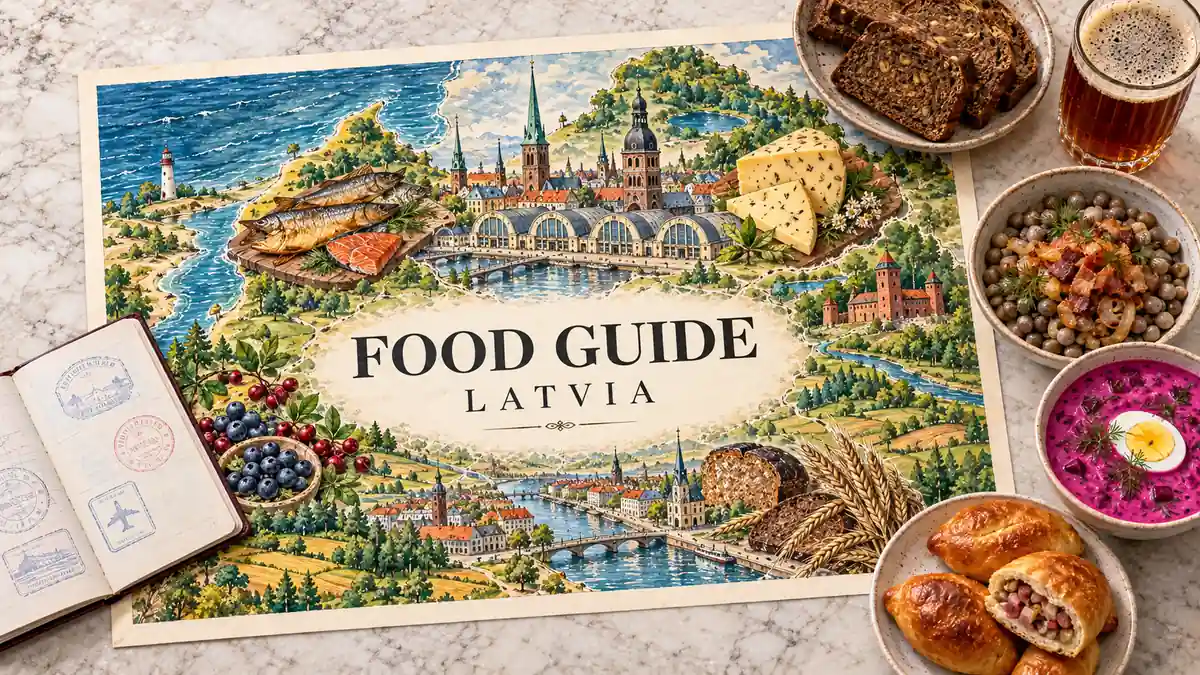
Menus in Latvia are built from rye, pork, dairy, potatoes and smoked Baltic fish, and many dish names give a first-time traveler no clue what arrives on the plate. This guide sorts Latvian food by the job each dish does: bread and staples, soups, mains, sweets and drinks. Each entry gives the Latvian name, a plain-English description and the place you are most likely to meet it.
Where you eat changes what you find. A market hall, a canteen lunch counter and a festive table show three different sides of the same cuisine, and Midsummer and Christmas each bring dishes you rarely see the rest of the year. The focus stays on what the food is and how to order it; restaurant prices and daily budgets are not part of this page.
Quick Answer
The essential Latvian tastes are rye bread, grey peas with bacon, smoked fish, cold beet soup and Riga Black Balsam. Setting changes the table: markets and canteens show everyday cooking, while Midsummer and Christmas bring Jāņu siers and festive grey peas. Start at Riga Central Market and a canteen lunch to sample widely.
Trust Layer
Tripstou planning guide for travelers resolving one travel decision. Covers the main variable, traveler context, and practical tradeoffs.
Produced with AI assistance and reviewed by Alex Perrut, working in tourism since 2015, for the Tripstou editorial team. See our editorial process for details.
Last factual review: September 29, 2026.
Official sources consulted: Latvia Travel, Latvian Ministry of Economics.
Key Takeaways
- Grey peas with bacon is Latvia’s national dish, best found on canteen counters in winter and on the Christmas table.
- Rupjmaize, the dense dark rye bread, comes with almost every meal, and its sweet-sour flavour returns in desserts and kvass.
- Riga Central Market is best for tasting cold foods like smoked fish and curd, while a canteen is the place for hot dishes.
- Your travel month shapes the menu more than your choice of venue: summer means cold beet soup and kvass, winter means peas and stews.
- Riga Black Balsam is a bitter 45% herbal liqueur, and a spoonful in coffee is a gentler first taste than a neat shot.
- Traditional Latvian cooking is meat-heavy, but vegetarians can eat well on rye bread, dairy, potato pancakes, cold beet soup and curd sweets.
Table of Contents
What is traditional Latvian food like?
Traditional Latvian food is hearty northern farm cooking built on rye bread, pork, dairy, potatoes and smoked fish. Barley, forest berries and mushrooms fill out the pantry, and smoking and pickling are the old ways of keeping food through long winters. Expect filling, lightly seasoned plates where sour, smoky and creamy flavours carry the dish.
The pantry follows the climate. A short growing season favours rye, barley, potatoes and cabbage, which all store well, while pork, curd cheese (biezpiens) and soured milk drinks such as kefir supply the protein. Forests add berries and mushrooms in the warmer months. The coast and the rivers supply fish, much of it smoked.
Seasoning is gentle. Dill, caraway, sour cream and bacon do most of the work, so travelers looking for chilli heat will find little of it. The table also shifts with the seasons: summer brings cold soups, fresh dill and new potatoes, late summer into autumn brings forest berries and mushrooms, and winter leans on peas, sauerkraut, pork and stews.
Everyday and festive food differ more in quantity than in ingredients. A weekday lunch is soup, a pork or potato main and rye bread; a festive table adds cheese, pīrāgi, smoked meats and more of everything. If food is one piece of a wider trip, the Latvia travel guide covers routes, timing and budget.
Sour is the flavour to calibrate for. Kefir, sorrel, sauerkraut and fermented rye run through the whole menu, so a first-timer who enjoys tang will like far more of Latvian cooking than one who does not.
Rupjmaize and the Staples Every Latvian Meal Starts With
Rupjmaize, the dense dark rye bread, is the staple you will meet at every Latvian table. It arrives with soup, beside mains and at breakfast, usually with butter, biezpiens curd, sour cream, pickles or smoked fish. Its slightly sweet-and-sour crumb sets the flavour baseline for the rest of the cuisine.
Rupjmaize is heavier and darker than most rye bread sold outside the Baltics. The crust is firm. Rye bread is part of the Latvian Culture Canon, and one scalded variety, salināta rudzu rupjmaize, is protected under the EU traditional-speciality scheme, which ties the name to a traditional method of making it.
The staples around it are simple and worth learning by name:
- Rupjmaize — dark rye bread — on every table, and sold whole in bakeries and at the market.
- Sklandrausis — a small open tart with a rye crust and a potato and carrot filling, also protected under the EU traditional-speciality scheme — bakeries and market stalls.
- Pīrāgi (speķrauši) — soft baked buns filled with chopped bacon and onion — bakery counters, cafés and festive tables.
- Biezpiens — fresh curd cheese — spread on bread and used in many sweets.
- Butter and sour cream — the default partners for bread, potatoes and soup; Rucava white butter even carries an EU-protected name.
Buy sklandrausis and pīrāgi from a bakery counter, not from a restaurant menu. They are hand-held bakery foods, and the bakery version is the everyday one Latvians actually eat.
Which Latvian soups should you try?
Cold beet soup, meatball soup and sorrel soup are the Latvian soups worth ordering first. Soup is a normal part of a Latvian lunch, so canteens and cafés almost always have one on. Cold beet soup is the summer signature; the other two appear through most of the year.
- Aukstā zupa — cold beet soup made with kefir or soured milk, beetroot, cucumber, dill and boiled egg, often served with hot potatoes on the side. Bright pink and sharp. A warm-weather dish.
- Frikadeļu zupa — a clear broth with small meatballs, potato, carrot and dill. Mild comfort food, found on canteen counters in every season.
- Skābeņu zupa — sorrel soup, sour and green, usually finished with egg and a spoon of sour cream. Most common in the warmer months.
Canteen lunch counters are the easiest place to try them, because soup is served by the bowl at the start of the line. Order soup with rye bread and you have eaten the most typical Latvian lunch there is.
Aukstā zupa divides first-timers by texture, not by taste. It is closer to a chilled, savoury kefir drink than to a hot borscht, so expect tang and crunch, not a warming stew.
What is the national dish of Latvia, and which mains follow it?
Grey peas with bacon (pelēkie zirņi ar speķi) is the dish Latvians call their national dish. The peas are cooked soft and topped with fried bacon and onion. It is eaten especially in winter and at Christmas, and it turns up on canteen counters through the colder months.
Pork dominates the everyday mains. Potatoes, cabbage and sour cream sit beside almost every plate. These are the dishes to recognise:
- Karbonāde — a breaded, pan-fried pork chop — the default main on canteen counters.
- Kotletes — minced meat patties, usually pork or mixed — served with potatoes and gravy.
- Štovēti kāposti — stewed cabbage, often soured — the usual side for pork.
- Kartupeļu pankūkas — potato pancakes of grated potato fried until crisp — served with sour cream.
- Bukstiņbiezputra — a thick barley and potato porridge — often topped with a bacon and onion sauce.
- Smoked fish plates — smoked Baltic fish with rye bread and potatoes — cafés, markets and home-style restaurants.
On a canteen counter the mains sit in trays behind glass. Pointing works as well as reading the label. Grey peas usually come from a deep tray with the bacon and onion spooned over at the end.
Grey peas look plain and taste far better than they look. The bacon and onion topping is the whole seasoning, so a plate served without it is not the national dish at its best.
Which Latvian desserts are worth saving room for?
Latvian desserts lean on rye bread and curd cheese instead of pastry, and maizes zupa is the one to try. This rye bread soup with dried fruit and whipped cream eats like a loose, fruity bread pudding. Layered rye crumb desserts and curd-based sweets complete the picture.
- Maizes zupa — rye bread cooked down with dried fruit and topped with whipped cream — cafés and canteens.
- Rupjmaizes kārtojums — layers of sweetened rye crumbs, whipped cream and berry jam — cafés and traditional restaurants.
- Biezpiens sweets — curd pancakes, curd cakes and chocolate-coated curd snack bars (biezpiena sieriņš) — cafés, supermarket fridges and the market dairy pavilion.
Both rye desserts taste of toasted bread, dark fruit and cream. Neither is very sweet. In summer and into autumn, forest berries such as bilberries and lingonberries turn up in jams, sauces and cakes.
The chocolate-coated curd bar is the easiest Latvian sweet to try. Every supermarket fridge stocks it, and it shows what biezpiens tastes like in one bite without a café stop.
What to Drink in Latvia: Black Balsam, Beer, Kvass and Kefir
Riga Black Balsam, a bitter herbal liqueur from a 1752 recipe, is the drink Latvia is known for. Beer is the everyday drink, kvass and kefir are the low- and no-alcohol staples, and sea buckthorn turns up in juices and teas. Between them they cover a bar, a canteen and a summer kiosk.
- Riga Black Balsam — dark, bitter and herbal; the original is 45% ABV, and a blackcurrant variant is softer and sweeter. It is drunk neat in small measures, stirred into coffee or hot drinks, or mixed into cocktails.
- Alus (beer) — the everyday drink with meals and at festivals. Pale lagers are the norm, and local breweries and craft bars are easy to find in Riga.
- Kvass — a fermented rye-bread drink with very low alcohol, slightly sweet and malty. It is most visible in summer, when kiosks sell it cold.
- Kefir — a soured milk drink taken with meals and used as the base of cold beet soup.
- Sea buckthorn (smiltsērkšķi) — a tart orange berry pressed into juices, teas and cordials.
Kvass is the drink that ties back to the bread. It tastes like liquid rye, and it is the gentlest way to try that flavour on a hot day.
Treat Black Balsam as a flavouring before you treat it as a shot. A spoonful in black coffee or hot blackcurrant juice shows the herbs without the bitterness landing all at once.
Where do you actually find these foods? Market, canteens and bakeries
Riga Central Market, canteen-style lunch counters and neighbourhood bakeries are where travelers meet everyday Latvian food. The market suits grazing across smoked fish, curd and bread, a canteen lets you taste several cooked dishes in one sitting, and a bakery covers pīrāgi and rye loaves.
Riga Central Market fills five pavilions, each given to one type of product. The pavilions were built in the 1920s from former airship hangars, and the market is part of the UNESCO-listed historic centre of Riga. It stands beside the central station and bus terminal. Food is organised by pavilion:
- Dairy — biezpiens, sour cream, farm cheeses and Jāņu siers around Midsummer.
- Fish — smoked and pickled Baltic fish, the market’s strongest tasting stop.
- Meat — smoked meats, bacon and sausages.
- Vegetables — pickles, sauerkraut, and berries and mushrooms in season.
- Gastronomy — ready-to-eat food you can buy and eat on the spot.
For opening hours, the night market and guided food tours, see the guide to visiting Riga Central Market and other things to do in Riga.
Canteens run on a simple system. Take a tray, point at what you want and the server plates it; you pay at the till at the end of the line. The self-service format lets you take small amounts of several dishes, which makes a canteen the fastest way to taste soup, a main and a dessert in one meal.
Bakeries are the place for pīrāgi, sklandrausis and whole rye loaves. Many also serve coffee. That makes them the natural breakfast stop.
Go to the market to taste and to the canteen to eat. The market is strongest on cold, ready foods such as smoked fish, curd and bread, while hot dishes like grey peas and karbonāde are easier to find on a canteen counter.
Tours and activities
Book skip-the-line tickets, day trips and local tours with free cancellation on most activities.
You can also browse everything on getyourguide.com.
Tripstou may earn a commission if you book through this link, at no extra cost to you.
What do Latvians eat at Midsummer and Christmas?
Midsummer brings Jāņu siers, the caraway cheese, and Christmas brings grey peas with bacon to the table. Midsummer (Jāņi) pairs the cheese with beer, while Christmas adds pork, sauerkraut and pīrāgi. Both tables are built from everyday ingredients, served in greater quantity and variety.
Jāņu siers is a mild fresh cheese flecked with caraway seeds and cut into wedges. It is protected under the EU traditional-speciality scheme. Look for it around Midsummer in the market dairy pavilion. The Christmas table is heavier: grey peas with bacon, roast or stewed pork, sauerkraut and bacon pīrāgi, often with rye desserts to finish.
Outside the two festivals, the seasons still shape what you find. Kvass is a summer drink, cold beet soup is a warm-weather dish, and forest berries and mushrooms reach the markets from late summer into autumn. Winter is the season for grey peas, sauerkraut and stews. If food is part of how you pick dates, weigh it alongside weather and daylight when planning your Latvia trip.
| Dish or drink | What it is | When or where you meet it |
|---|---|---|
| Rupjmaize | Dense dark rye bread with a sweet-sour crumb | Every meal, year-round, bakeries and markets |
| Grey peas with bacon | National dish of soft peas, bacon and onion | Winter, Christmas and canteen counters |
| Aukstā zupa | Cold pink beet soup made with kefir | Warm months, in canteens and cafés |
| Jāņu siers | Fresh caraway cheese for the Midsummer feast | Around Midsummer, in the market dairy pavilion |
| Kvass | Fermented rye-bread drink with very low alcohol | Summer kiosks, cafés and shops |
| Riga Black Balsam | Bitter herbal liqueur from a 1752 recipe | Bars and shops year-round, neat or mixed |
A summer trip trades grey peas for cold beet soup and kvass, and a winter trip does the reverse. The dishes you taste in Latvia say more about your travel month than about the places you choose to eat.
Frequently Asked Questions
Is Latvian food vegetarian-friendly?
Latvian food is meat-heavy, but a vegetarian can eat well with some care. Rye bread, curd cheese, potato pancakes, sklandrausis, cold beet soup and the rye and curd desserts are usually meat-free. Soups and stews often use meat stock and bacon, so ask before ordering, and pīrāgi are usually filled with bacon.
What does Riga Black Balsam taste like?
Riga Black Balsam tastes bitter, dark and strongly herbal, with a faint sweetness under the bitterness. The original is 45% ABV, so it hits hard when drunk neat. First-timers who find it too harsh can try the blackcurrant version, which is softer and fruitier, or taste it mixed into a hot drink.
What Latvian food can you bring home as a souvenir?
Riga Black Balsam is the classic food souvenir; pack the bottle in checked luggage. Dense rupjmaize rye bread keeps for several days, and sea buckthorn tea packs light. Smoked fish is the harder choice, since the smell carries and it keeps poorly without cooling. Check your home country’s rules on bringing in dairy and meat.
Do you tip in Latvian restaurants?
Tipping in Latvian restaurants is appreciated but never required. In sit-down restaurants and cafés with table service, many people round up the bill or leave around 5 to 10% when the service was good. Canteens and bakery counters are self-service, so nobody expects a tip there, and leaving nothing is not rude.
Is Latvian food similar to Estonian and Lithuanian food?
Latvian food shares a Baltic pantry with Estonia and Lithuania: rye bread, pork, potatoes, dairy and smoked fish appear across all three. The differences sit in the signature dishes. In Latvia, seek out the dishes it claims as its own: grey peas with bacon, sklandrausis, Jāņu siers and Riga Black Balsam.
Is it easy to eat gluten-free in Latvia?
Eating gluten-free in Latvia takes care, because rye and barley run through the menu. Rye bread, kvass, the rye desserts, sklandrausis, bukstiņbiezputra and breaded karbonāde are all off the list. Grey peas with bacon, smoked fish and boiled potatoes are safer picks, but ask whether soups or sauces are thickened with flour.
Related Guides
- Latvia travel guide — plan the rest of the trip: when to go, budget and route.
- Things to do in Riga — visit Riga Central Market as a sight and book a food tour.
Did this guide save you time or money? Tripstou is independent and reader-funded — if you'd like to give something back, you can support the site with a crypto contribution of any size.