
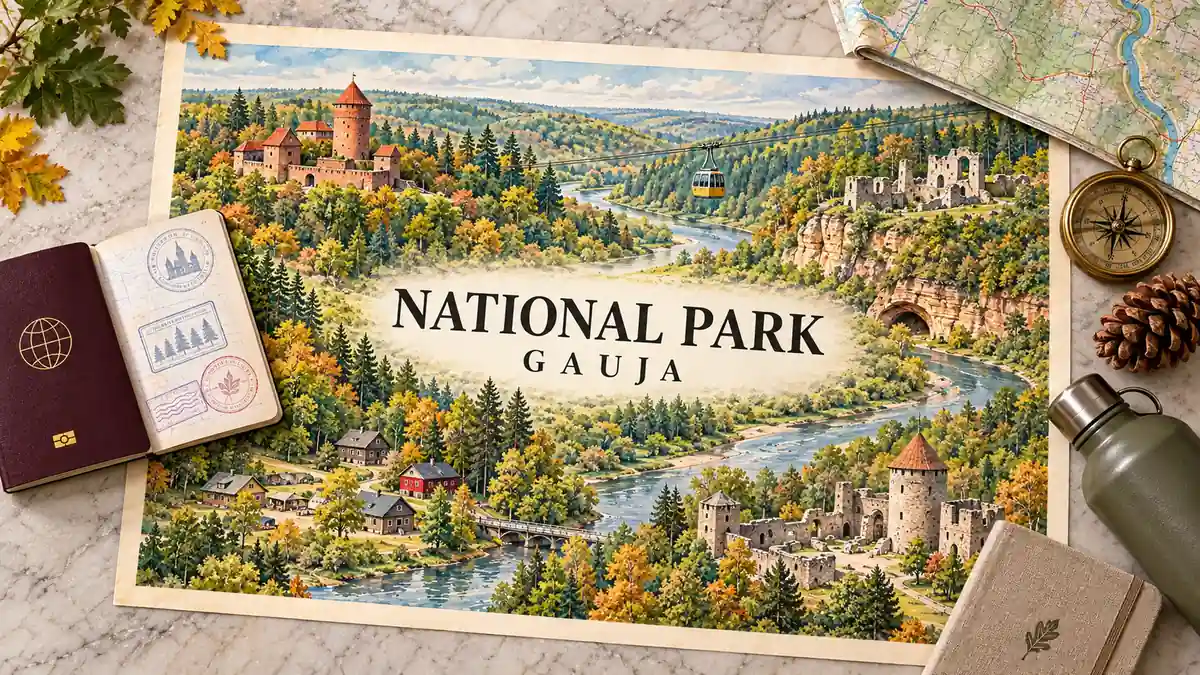
Most travelers meet Gauja National Park as “the Sigulda day trip from Riga”, and the real planning question is whether to stop there or push on to Līgatne and Cēsis. The park is a long, wooded river valley, and its highlights split into three parts: Sigulda with Turaida and Krimulda, the quieter Līgatne stretch, and the medieval town of Cēsis in the north. Sigulda works perfectly well without a car. The rest of the valley is easier with a car or with a night spent inside the park.
This guide resolves the decisions that shape the trip. It covers which part of the valley fits your interests, how many days to give it, whether to base in Sigulda or Cēsis, how to get there from Riga, and how to move between castles that sit on opposite sides of the river. It is a planner, not a sight list.
Quick Answer
Gauja National Park is Latvia’s oldest national park, a sandstone valley of castles and caves an hour from Riga. Sigulda alone is a car-free day trip; adding Līgatne and Cēsis means a night in the valley or a car. First-timers should base in Sigulda and go between May and October, with late-September foliage as the standout.
Trust Layer
Tripstou region guide for travelers planning a regional trip. Covers sub-areas, trip shape, base strategy, timing, and mobility tradeoffs.
Produced with AI assistance and reviewed by Alex Perrut, working in tourism since 2015, for the Tripstou editorial team. See our editorial process for details.
Last factual review: September 29, 2026.
Official sources consulted: Latvia Travel, Ministry of Economics of Latvia, Visit Sigulda, Turaida Museum Reserve.
Key Takeaways
- Sigulda is the easiest car-free part of the valley, because its castles, Turaida and Krimulda connect on foot, by bus 12 or by cable car.
- One day covers Sigulda and Turaida; a second day adds Līgatne’s trails or Cēsis, and covering both is tight without a car.
- Sigulda’s castles and Turaida sit on opposite sides of the valley, so plan the crossing by bridge, cable car or bus, not a straight walk.
- Walk the classic loop from Sigulda to Turaida and finish at Krimulda, so the cable car handles the last climb back across the valley.
- The Riga–Sigulda–Cēsis rail line reaches the main valley towns, but Līgatne’s trails and the outlying manors are where a car earns its place.
- Late September to mid-October is the standout window, when the wooded valley turns gold and red and crowds are lighter than on midsummer weekends.
Table of Contents
What Gauja National Park Is Known For
Gauja National Park is known for a sandstone river valley with medieval castles, cliffs and caves an hour from Riga. It is Latvia’s best-known nature trip because castles at Sigulda, Turaida and Cēsis and the Gūtmaņala grotto all sit along one valley that a single train line follows.
The park was established in 1973 as Latvia’s first national park, and it is still the oldest. It covers over 90,000 hectares. The valley section inside the park runs for about 95 km, cut through Devonian sandstone that the river has shaped into cliffs, outcrops and caves.
Gūtmaņala, also known as Gutmanis cave, is the most spacious grotto in the Baltics. It sits below Turaida on the valley floor and is the natural midpoint of the classic walk from Sigulda.
The towns are part of the park. Sigulda, Cēsis and Straupe lie inside its boundary, and so does Līgatne. Entry to the park itself is free; individual sites such as Turaida and the cable car are ticketed. Visitor centres at Gūtmaņala, at Zvārtes rock and at the Līgatne nature trails help with trail maps and local conditions.
Stepping off the train at Sigulda already puts you inside the park, so there is no gate to find and no entry fee to plan around; the only tickets you buy are for the individual castles and the cable car.
Gauja National Park’s Sub-Areas and What Each Offers
The park works as three sub-areas: Sigulda with Turaida and Krimulda, Līgatne, and Cēsis. Sigulda holds the castles, the cable car and the classic walk; Līgatne offers quiet trails and heritage; Cēsis pairs a medieval castle with an old town. Most first visits use only the Sigulda side.
The three sub-areas differ in pace as much as in sights. Sigulda is compact and busy. Līgatne is spread out and slow. Cēsis is a proper town with evenings of its own. The table sets them side by side before the profiles below.
| Sub-area | Character | Anchor sights | Base town | By train from Riga |
|---|---|---|---|---|
| Sigulda, Turaida and Krimulda | Castles, cliffs and the busiest walking paths | Sigulda castles, Gūtmaņala grotto, Turaida Museum Reserve | Sigulda, the park’s main gateway town | Yes, Sigulda station is on the line |
| Līgatne | Quiet sandstone banks and forest trails | Nature trails, paper-mill village, Soviet-era heritage | Sigulda or Cēsis; Līgatne is a small stop | Partly; the trails are easier by car |
| Cēsis | Medieval town with a slower evening pace | Cēsis castle and the compact old town | Cēsis, the best northern valley base | Yes, further along the same line |
Sigulda, Turaida and Krimulda
Sigulda is the gateway and the sub-area most visitors mean when they say Gauja. The town holds the medieval castle ruins and the New Castle beside them. Below, the river path leads to the Gūtmaņala grotto, and Turaida Museum Reserve stands about 5 km from Sigulda centre on the far bank. Krimulda faces Sigulda across the valley, linked by the cable car. Everything here connects on foot, by bus or by cable car, which is why it suits a day without a car.
Best for: a first, car-free day from Riga.
Līgatne
Līgatne is the quiet middle of the valley, known for sandstone banks and forest nature trails with their own visitor centre. The old paper-mill village and its Soviet-era heritage give it a character unlike the castle towns. A seasonal river ferry is part of the scenery here. Līgatne itself is a small stop, so most visitors base in Sigulda or Cēsis and come in for the day. The trails are spread out, and a car makes the most of them.
Best for: a quieter second day on foot among the cliffs.
Cēsis
Cēsis anchors the northern valley with a medieval castle and a compact old town that stays lively after the day-trippers leave. It is the natural base for exploring the upper Gauja, and it sits further along the same rail line as Sigulda. Cēsis deserves its own trip planning, so this guide keeps it at profile depth. For this page, the point is simple. Cēsis is where a Gauja trip becomes an overnight in a real town, with dinner and a walk after dark.
Best for: an overnight that trades day-trip crowds for a real town base.
How Many Days You Need in Gauja National Park
One full day is enough for Sigulda and Turaida; two days open Līgatne or Cēsis. Three days or more turn the valley into a base for longer trails and the river. A night in the valley is what changes the trip, because it removes the Riga round trip from each day.
- A day trip from Riga buys Sigulda’s castles, the Gūtmaņala grotto, Turaida and the cable car to Krimulda. It fits first-time visitors staying in Riga who want castles and forest in one outing. The tradeoff is pace: the walk is hilly, and there is no time left for Līgatne or Cēsis. Choosing Gauja over the other day trips from Riga is a separate decision from how to do it well.
- Two days with one night buys the Sigulda side plus either Līgatne’s trails or Cēsis’s castle and old town. It fits travelers who want the valley without rushing it. The cost is choosing one of the two; covering both in a second day is tight without a car.
- Three days or more buys the whole valley: Sigulda, Līgatne, Cēsis, longer trail sections and, in summer, time on the river. It fits walkers, paddlers and anyone treating Gauja as a destination in its own right. The limitation is logistics. Without a car, the rail line covers the towns, not the trailheads between them.
The second day is where the trip changes character. On day one you follow the crowd from Sigulda station to Turaida. On day two you choose between Līgatne’s empty paths and Cēsis’s town life, and that choice decides whether you need a car.
Sigulda or Cēsis: Where to Base Yourself?
Base in Sigulda for a first or car-free visit, in Cēsis for the northern valley and a town feel. Sigulda puts the castles, the cable car and the classic walk on your doorstep. Cēsis trades that for an old town with evenings of its own. Split the stay only on three days or more.
The honest recommendation for most first visits is Sigulda. The tradeoff is atmosphere: once the day-trippers leave, Sigulda is quieter as a town than Cēsis.
- Sigulda only suits first-timers and anyone without a car, since the main sights are walkable or a short bus ride away. Its tradeoff is that the northern valley needs a train trip out.
- Cēsis only suits travelers who want an old-town base and are happy to reach Sigulda by train for a day. Its tradeoff is distance from Turaida and the cable car.
- A split stay suits trips of three days or more that cover the whole valley. Its tradeoff is one more check-in, which only pays off with enough days.
Both towns rely on guesthouses, small hotels and rural stays in the surrounding countryside. Rural stays reward drivers. Travelers without a car should stay close to Sigulda or Cēsis station.
Pick the base by your second day, not your first: whoever plans Līgatne’s trails should sleep in Sigulda, and whoever plans Cēsis castle should sleep in Cēsis.
Hotels and places to stay
Compare hotels, apartments and stays for your dates in one search.
Search hotels and stays on hotels.com →
Tripstou may earn a commission if you book through this link, at no extra cost to you.
How to Get to Gauja National Park From Riga
Take the train from Riga to Sigulda, about an hour and roughly hourly, unless you plan the outlying trails. Cēsis sits further along the same line, under two hours from Riga. A car earns its place only when Līgatne’s trails and the scattered manors and viewpoints are on the plan.
By train from Riga
The train is the default way in. Sigulda lies about 53 km from Riga.
- Riga to Sigulda: Vivi trains take about an hour to just over an hour and run roughly hourly. This suits day-trippers and anyone basing in Sigulda.
- Riga to Cēsis: the same line continues to Cēsis in around 1.5 to 2 hours, with several trains a day. This suits travelers basing in the north; the tradeoff is fewer departures to plan around.
Fares are a few euros. Ticket options on the line change, so check Vivi’s app or website for the current fare structure before you travel.
By bus or car
- Bus: buses from Riga serve the valley towns and work as a fallback when a train time does not fit. The tradeoff is a less predictable ride than the rail line.
- Car: a car suits travelers covering Līgatne’s trails, outlying manors and viewpoints in one trip. The tradeoff is parking: the main sights get busy on summer weekends, and some car parks, Turaida’s among them, are paid.
For country-level transport, money and trip planning beyond the valley, see the Latvia travel guide.
A car buys you Līgatne and little else. Between Riga, Sigulda and Cēsis the train does the same job without parking.
Getting Around Without a Car: Sigulda, Turaida and Krimulda
Sigulda, Gūtmaņala, Turaida and Krimulda work without a car, using a valley walk plus the cable car or bus 12. The sights sit on two sides of the valley. From Sigulda station you walk to the castles, then cross to Turaida and Krimulda by bridge, cable car or bus, not in a straight line.
The classic valley walk
The classic walk runs from Sigulda’s castles down to the river, across the bridge, past the Gūtmaņala grotto and up to Turaida, about 5 km from Sigulda centre. It is hilly. Forest paths and wooden steps carry most of the route. The usual return goes via Krimulda, where the cable car takes you back across the valley to Sigulda. With stops at the castles and the grotto, plan at least half a day and wear shoes that cope with wet ground.
The cable car to Krimulda
The aerial cable car links Sigulda and Krimulda across the valley, departing every 20–30 minutes. It runs year-round with seasonal hours. Each ride is paid separately, so check the operator’s current price before you plan a loop around it. It saves the steep climb out of the valley at the end of the walk.
Bus 12, taxi and the train spine
Bus route 12 runs from Sigulda to the Turaida stop, and taxis wait on the station square for anyone who wants to skip the walk. Between towns, the Riga–Sigulda–Cēsis rail line does the heavy lifting. Līgatne is the piece a car solves, because its trails sit away from the line.
Walk the valley in the direction that ends with the cable car. Starting at Sigulda and finishing at Krimulda lets the cable car handle the last climb, while the reverse loop leaves the steepest stretch for tired legs.
When to Visit Gauja National Park
Visit between May and October, with late September to mid-October foliage as the standout window. That half of the year brings open trails, river trips and long days in summer. Winter works for a quiet castle visit, but short days and reduced activities cut what the valley offers.
- Summer suits paddlers and walkers who want long days and warm evenings. It is also the season for canoeing. The tradeoff is busier paths around Sigulda on weekends.
- Autumn suits photographers and walkers. The wooded valley turns gold and red against the sandstone, and crowds are lighter than on midsummer weekends. The tradeoff is cooler, wetter ground on the trails.
- Winter suits travelers who want the castles in snow and few people around. Days are short, many activities scale back, and the cable car keeps seasonal hours.
Autumn is Gauja’s signature season for a reason specific to this valley. The forest colour sits directly against the sandstone cliffs, so the Sigulda-to-Turaida walk looks its best exactly when the summer crowds have gone.
How to Spend Your Time: Trails, Castles and the River
Spend your time on the valley trails, the castles and caves, and in summer the river itself. Walkers fill a day on the sandstone paths; castle-focused visitors pair Sigulda, Turaida and Cēsis; paddlers need warm months and a cooperative river level. Most trips combine two of the three.
- Trails suit walkers who want forest and cliffs. The Sigulda–Turaida–Krimulda paths are the busiest; the Līgatne nature trails are the quieter alternative. The tradeoff is mud after rain and a car for the outlying routes.
- Castles and caves suit first-timers and history lovers. Sigulda’s castles, Turaida Museum Reserve and the Gūtmaņala grotto fit one day; Cēsis castle anchors the north. Sites are ticketed with seasonal hours.
- The river suits paddlers in summer. Canoe and boat hire operate in the warm months and depend on the river level. Short stretches fit a spare afternoon, while longer ones need a full day and transfers.
Sigulda also has adventure add-ons, including a bobsleigh track and bungee jumping, for travelers who want them. In Līgatne, the seasonal river ferry and the paper-mill village add a slower, heritage-led day away from the castle circuit.
Match the activity to the day length. A day trip has room for castles and one walk. A second day is what makes the river or Līgatne’s trails worth the effort.
Tours and activities
Book skip-the-line tickets, day trips and local tours with free cancellation on most activities.
You can also browse everything on getyourguide.com.
Tripstou may earn a commission if you book through this link, at no extra cost to you.
Who Gauja National Park Suits, and Who Should Skip It
Gauja suits first-time Latvia visitors and walkers who want castles and forest an hour from Riga. It rewards anyone happy with gentle valley scenery and short climbs. Travelers expecting alpine drama or a summit hike should skip it, because the park’s appeal is intimate sandstone and woodland, not big views.
For most visitors, Gauja is an add-on to a Riga stay. One day at Sigulda delivers the headline sights without changing hotels. Walkers and paddlers get more from treating it as a standalone base, with nights in Sigulda or Cēsis and time for Līgatne.
The limitations are honest ones. This is a valley, not a mountain range. Forest paths turn slippery in wet weather, and winter scales back the activities and daylight that make the park work.
Gauja is the easiest way to see Latvia’s countryside without leaving the rail line, which makes it the natural first nature trip for travelers who arrive in Riga without a car.
Frequently Asked Questions
Is one day enough for Gauja National Park?
Yes, one day is enough for the Sigulda side of Gauja National Park: the castles, the Gūtmaņala grotto, Turaida and the cable car to Krimulda. Take a morning train from Riga to leave a full day on foot. One day does not stretch to Līgatne or Cēsis, which need a second day.
Is Gauja National Park free to enter?
Yes, Gauja National Park has no entry fee and no gate; the towns of Sigulda, Cēsis and Līgatne sit inside it. What you pay for are individual sites: Turaida Museum Reserve and the Sigulda–Krimulda cable car are both ticketed. Prices change, so check each site’s official page before you go.
How do you get from Sigulda to Turaida Castle?
Walk, take bus 12 or take a taxi. Turaida is about 5 km from Sigulda centre across the valley. The walk drops to the river, passes the Gūtmaņala grotto and climbs to the castle on forest paths. Bus route 12 runs to the Turaida stop, and taxis wait on Sigulda’s station square for a quicker ride.
Can you canoe on the Gauja River?
Yes, canoeing and boat trips on the Gauja are a summer activity inside the park. Rentals operate in the warm months and depend on the river level, so confirm conditions with the operator before you plan around them. A short stretch fits a spare afternoon; longer sections take a full day and need a transfer back.
Is Gauja National Park worth visiting if you do not hike?
Yes. The main sights reward non-hikers: Sigulda’s castles, Turaida Museum Reserve, the cable car across the valley and the old town of Cēsis. Bus route 12 and taxis cut out the steepest walking between Sigulda and Turaida. Expect some slopes and steps anyway, because the castles sit on the valley rim.
Can you visit Gauja National Park in winter?
Yes, Gauja National Park stays open in winter, and the castles under snow draw few visitors. The Sigulda–Krimulda cable car runs year-round on shorter seasonal hours. Expect short days, icy forest steps and fewer activities, so plan a compact castle visit around Sigulda and Turaida instead of long trails or the river.
Related Guides
- Latvia travel guide: country-level planning, transport and money for the rest of your trip.
- Day trips from Riga: how Gauja compares with the other trips you can take out of the capital.
Did this guide save you time or money? Tripstou is independent and reader-funded — if you'd like to give something back, you can support the site with a crypto contribution of any size.