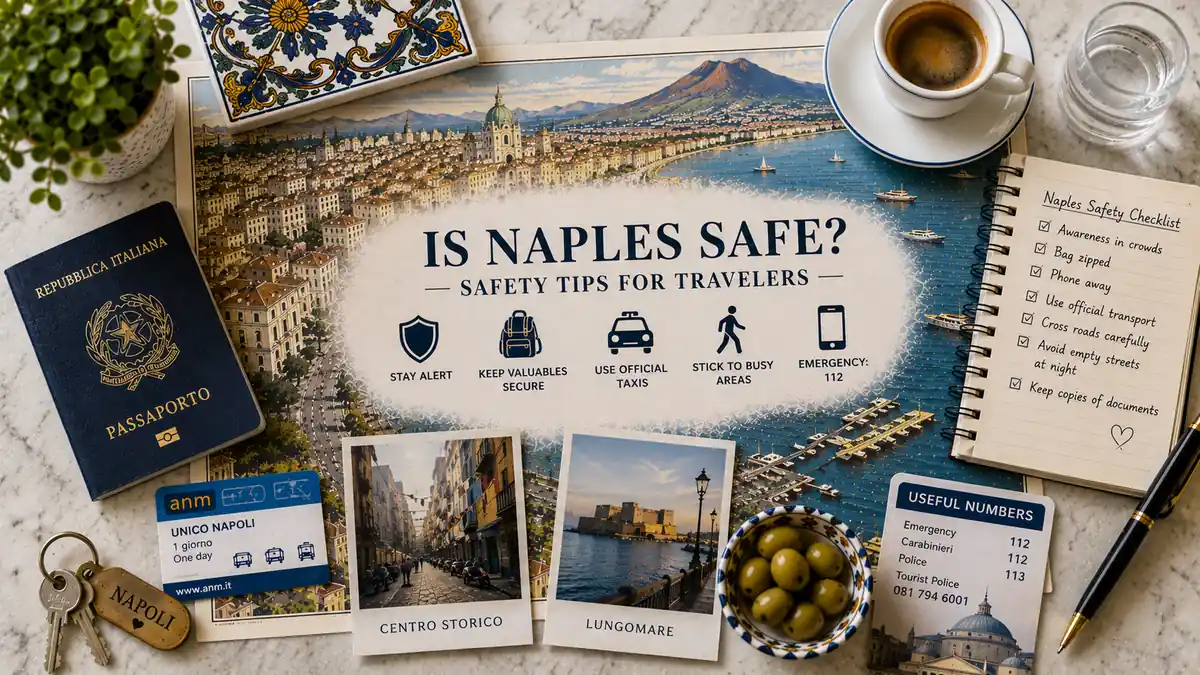
Naples has one of the roughest reputations in Western Europe, and most travelers arrive with the same question: is it deserved? This guide gives you a straight answer. It covers the actual risk profile — what threatens tourists and what does not — the areas worth caution versus the districts that are irrelevant to your trip, safety at night and for solo female travelers, the taxi and airport scams worth knowing about, pickpocket pressure on public transport, and the Camorra question that hangs over the city’s name. It closes with a short list of practical precautions that handle nearly all of it. No alarmism and no dismissal — just what the risks actually are, where they concentrate, and how to neutralize them before they find you.
Quick Answer
Naples is safe for tourists; petty theft, not violent crime, is the realistic risk. Location and alertness decide the rest — central areas are fine, while risk concentrates around the station, crowded transport, and empty late-night streets. Keep valuables secured, use official taxis or the Alibus, and move as you would in any big European city.
Trust Layer
Tripstou planning guide for travelers resolving one travel decision. Covers the main variable, traveler context, and practical tradeoffs.
Produced with AI assistance and reviewed by Alex Perrut, working in tourism since 2015, for the Tripstou editorial team. See our editorial process for details.
Last factual review: July 26, 2026.
Official sources consulted: Italia.it, ENIT.
Key Takeaways
- Naples is broadly safe for tourists; opportunistic petty theft, not violent crime, is the only realistic threat.
- Central districts and the seafront feel safe day and night, while the notorious outer districts sit far from any itinerary.
- Guard your bag and phone in crowds and on the Circumvesuviana, where the boarding crush is the real pickpocket moment.
- Avoid taxi scams by using official metered taxis, the fixed airport tariff, or the Alibus, agreeing the basis before moving.
- At night, stay on populated, lit streets and take a licensed taxi whenever the route home turns long or quiet.
- The Camorra targets local rackets, not visitors, so organized crime has no bearing on an ordinary Naples sightseeing trip.
Table of Contents
Is Naples Safe for Tourists?
Naples is broadly safe for tourists. Violent crime against visitors is rare, and the realistic risk is petty theft: pickpocketing and bag-snatching in crowded areas. Most trips pass without incident. The city asks for the same alertness as any large European port city, plus a little extra care with your phone and bag.
The reputation runs well behind the reality on the ground. The historic center, Via Toledo, and the Lungomare are densely walked from morning until late, and that constant foot traffic is itself a safety feature — you are almost never alone on a central street. Thieves here work crowds for unattended valuables; they do not confront people. For the country-wide picture, our guide to whether Italy is safe puts Naples in national context, and the full Naples travel guide covers the planning questions beyond safety.
Over-correction is the more common mistake in Naples: visitors who treat the city as hostile skip the street life that makes it worth visiting, then leave a phone in a back pocket anyway — the one habit that actually invites trouble.
Is Naples More Dangerous Than Rome or Milan?
No — for visitors, Naples carries a risk profile comparable to Rome and Milan. All three are big cities where pickpocketing dominates and tourist zones are the hunting ground. Rome’s packed metro and Milan’s station district generate the same warnings you will read about Naples; the difference is mostly reputation. Apply the same habits in all three and the risk levels out.
What Are the Main Safety Risks in Naples?
Pickpocketing and bag-snatching are the main safety risks in Naples. Scams — mostly around taxis and unofficial “helpers” — come second. Everything else, including violent crime, is marginal for visitors. The risks cluster exactly where tourists cluster: crowded shopping streets, packed transport, and the blocks around the central station.
Each risk has a specific shape, which makes each one specifically avoidable:
- Pickpocketing — works on crowds and distraction. Busy moments on Via Toledo, in the historic center’s narrow lanes, and on packed metro carriages are the classic settings. A zipped, front-worn bag defeats most of it.
- Bag-snatching — the scooter variant is the one to plan for. Walk with your bag on the building side of the pavement, strap across the body, and it stops being an easy target.
- Phone theft — a phone held loosely at the curb edge is the most exposed object you carry. Step back from the road to check maps or take calls.
- Scams — mostly transport-related: unofficial taxis, inflated “agreed” fares, and self-appointed helpers at the station. The taxi section below covers the full defense.
Which Areas of Naples Should You Avoid?
The districts behind Naples’ reputation — Scampia and Secondigliano — are outlying areas far from anything tourists visit. You will not stumble into them; reaching either takes a deliberate trip. In the center, the honest answer is caution by time of day — there are no true no-go zones on a normal itinerary.
The zones where visitors spend their time consistently feel safe and well-trafficked:
- Chiaia — polished, residential, full of bars and boutiques; comfortable at any hour.
- Vomero — the hilltop district, calm and local in character.
- Posillipo — quiet, affluent, and residential along the coast.
- Historic center and Via Toledo — chaotic and loud, but busy with people from morning until late.
- Lungomare — the seafront promenade, lively well into the evening.
The area around Napoli Centrale and Piazza Garibaldi deserves normal big-city vigilance — it is scruffy and pickpocket-prone, especially after dark, without being dangerous in the way the word implies. If the area question you are really asking is where to base yourself, our guide to where to stay in Naples handles that decision; this page only covers how areas feel.
The useful area question in Naples is not which districts to fear but which streets empty out after dark — the same historic-center alley can feel completely different at ten in the morning and one at night, and reading that shift matters more than any district label.
Is Naples Safe at Night?
Naples is safe at night in its lively central zones. The rule is simple: stay where people are. The Lungomare, Chiaia’s bar streets, and the main historic-center arteries stay populated well into the evening and feel fine; empty backstreets and the station area are where judgment kicks in.
Evening life concentrates in predictable places, which makes night planning easy. Aperitivo and dinner crowds keep Chiaia and the seafront busy late, and the historic center’s main lanes hum long after dark. Deserted shortcuts are the thing to skip. If a walk back to your accommodation crosses long, quiet stretches — or passes the station late at night — take a licensed taxi instead. The fare is a small price for removing the only genuinely uncomfortable variable. Trust the street-level signal: where locals are still eating and talking, you are fine.
Is Naples Safe for Solo Female Travelers?
Naples is safe for solo female travelers who apply standard big-city precautions. Harassment risk is comparable to Rome, Milan, or other major Italian cities — mostly unwanted attention rather than physical threat. Solo women visit routinely, and the city does not demand a special rulebook — just consistent judgment about streets, hours, and transport.
The practical framing is the same evening logic as the previous section, applied a little more strictly. Stay on populated streets after dark, favor licensed taxis for late returns, and choose busier carriages on the metro and Circumvesuviana. Unwanted attention, where it happens, responds best to firm, brief disengagement — no engagement, no apology, keep walking. Restaurant staff and hotel receptions are reliable allies if you ever want an escort called or a taxi arranged. None of this differs from what works in any major European city; Naples simply rewards doing it consistently.
How to Avoid Taxi and Airport Scams in Naples
Choosing the right vehicle is the whole defense against taxi scams in Naples. Use official white metered taxis, the fixed airport tariff, or the Alibus airport bus — and agree the basis, meter or fixed rate, before the car moves. Touts offering rides inside the terminal or station are the ones to refuse.
The behaviors that close off every common variant:
- Board only at official taxi ranks — never with a driver who approaches you inside arrivals or on the station concourse.
- Before moving, confirm the deal out loud: meter running, or the fixed airport tariff by name. A driver who refuses both is a driver to leave.
- Treat any invented surcharge announced mid-ride as a dispute to settle calmly at the destination, ideally with the tariff card the taxi is required to display.
- The Alibus is the simplest fallback: a flat-fare official bus between the airport, the station, and the port — no negotiation involved.
Train and bus tickets
Compare routes, schedules and prices across rail and bus operators in one search, with mobile tickets on your phone.
Search routes and compare prices on Omio →
Tripstou may earn a commission if you book through this link, at no extra cost to you.
Staying Safe on Public Transport and the Circumvesuviana
Public transport in Naples is safe to use; the realistic risk is pickpocketing in crowds. Pressure peaks on the Circumvesuviana toward Pompeii and Sorrento, where packed carriages full of distracted day-trippers create ideal working conditions. Bag position and boarding awareness solve most of the problem.
The vigilance habits that matter:
- Wear your bag in front, zipped, with a hand resting on it in any crush.
- Keep your phone put away while boarding and at busy platforms — the distracted-scrolling stance is the profile thieves select for.
- Stand clear of artificial bottlenecks at the doors; a group crowding you at boarding is a cue to step back and wait.
- Nothing of value in outer pockets, ever, on this line.
Most Circumvesuviana theft happens in the boarding crush at Garibaldi and the Pompei Scavi platform — the door scrum gives cover and an instant exit, so guard the moment you step on more carefully than the ride itself.
Is the Camorra a Danger to Tourists?
No — the Camorra is not a danger to tourists. Organized crime in Naples operates in spheres a visitor never touches: local territory, rackets, and business interests. Tourists are not targets, and no ordinary sightseeing itinerary intersects with that world. The name looms larger than the risk.
What the Camorra does affect is the city’s reputation — it is a large part of why “is Naples safe” gets asked at all. Its activity is concentrated in local economic life and in districts far from the visitor core, and it has no stake in street crime against tourists, which brings police attention without profit.
Your actual exposure as a visitor rounds to zero. The risks worth your attention in Naples are the ones covered above: a crowded carriage, an unzipped bag, an unofficial taxi.
How to Stay Safe in Naples: Practical Precautions
A handful of habits removes almost all realistic risk in Naples. The threats are opportunistic: they favor the distracted, the flashy, and the visibly lost. Arrive alert but relaxed, build these behaviors into your first day, and the city quickly feels like what it is — busy, loud, and fundamentally welcoming.
The full precaution set, condensed from everything above:
- Secure your valuables. Zipped cross-body bag worn in front, nothing in back pockets, and no more cash or cards than the day needs.
- Practice phone discipline. Step away from the curb to check maps, and keep the phone out of sight while boarding transport.
- Blend in. Leave conspicuous jewelry at home, walk with purpose, and duck into a doorway or café to reorient instead of consulting a map mid-pavement.
- Ride transport alert. Bag in front on the metro and the Circumvesuviana, extra attention in the boarding crush, distance from door-crowding groups.
- Apply night judgment. Populated, lit streets after dark; a licensed taxi whenever the route home turns long, quiet, or passes the station late.
That is the entire safety workload for Naples — five habits, none of which cost you any of the city. For the non-safety side of getting Naples right — etiquette, ordering, timing, day-trip logistics — see our Naples travel tips.
Travel medical insurance
SafetyWing Nomad Insurance provides travel medical coverage designed for travelers and digital nomads, with flexible Monthly and Annual plans.
Check Nomad Insurance coverage and current pricing →
New Nomad Insurance Essential members can get 8 weeks of electronic theft coverage free with reward code TRIPSTOU8.
Apply the reward before creating your SafetyWing account by looking for the pink camera icon on the Nomad Insurance page.
Tripstou may earn a commission if you purchase through this link, at no extra cost to you.
Frequently Asked Questions
Is the area around Napoli Centrale (Garibaldi) safe?
Yes, with normal big-city vigilance. The Napoli Centrale and Piazza Garibaldi area is scruffy and pickpocket-prone but not genuinely dangerous, especially after dark. Keep your bag zipped and phone away, ignore anyone offering unofficial rides or help, and it functions like any busy European transport hub.
Is it safe to walk around Naples during the day?
Yes, walking around Naples by day is safe and one of the city’s pleasures. The historic center, Via Toledo, and the Lungomare stay busy and well-trafficked, which deters anything beyond opportunistic theft. Keep valuables secured in crowds, and you can explore on foot freely and comfortably.
How dangerous is the traffic and crossing the road in Naples?
Naples traffic is chaotic, and crossing the road is the everyday hazard most visitors underestimate. Scooters weave constantly and rarely stop unprompted. Cross decisively at a steady pace once you commit, make eye contact with drivers, and follow locals across busy junctions instead of hesitating mid-street, which confuses traffic.
What should you do if you get pickpocketed in Naples?
If you get pickpocketed in Naples, report it promptly to the police to obtain a report for insurance and any card claims. Cancel stolen cards immediately, and note that the central station and tourist police can help. Most theft is non-confrontational, so prioritize documentation over pursuit and keep yourself safe.
Is Naples safe for families with children?
Yes, Naples is safe for families with children who apply the same petty-theft precautions as anywhere. The main considerations are crowds and chaotic traffic, so keep children close on busy streets and at transport crossings. Families visit routinely for the food, waterfront, and nearby Pompeii, and the city is welcoming to them.
Is it safe to use ATMs and carry cash in Naples?
Yes, using ATMs and carrying cash in Naples is safe with basic care. Choose ATMs inside banks or busy, well-lit spots, shield your PIN, and avoid withdrawing large sums at once. Carry only the day’s cash, split cards between bags, and keep nothing valuable in outer or back pockets.
Related Guides
- Naples travel guide — plan the wider trip: sights, timing, and logistics.
- Where to stay in Naples — choose your base by neighborhood and traveler type.
- Is Italy safe? — the country-wide safety picture beyond Naples.
- Naples travel tips — the non-safety essentials: etiquette, food, and practicalities.