Two days in Milan is tight, but it works if you sequence the city instead of chasing a checklist. The center is compact, and most of the marquee sights cluster within walking distance, which is exactly what makes a weekend feasible. The trick is grouping stops by neighborhood so you never cross the city twice. This plan does that: Day 1 stays in the historic core around the Duomo, and Day 2 shifts to the Navigli canals, Brera, and the modern Porta Nuova district. One thing needs locking in before you arrive — the Last Supper, which sells out far ahead and derails plans made on the day. Everything below is a single, walkable route with clear morning, afternoon, and evening blocks, plus rules for trimming or extending it if your schedule changes.
Quick Answer
Two days is enough for Milan’s core sights, though not for day trips. Spend Day 1 in the historic center around the Duomo, then Day 2 on the Navigli canals, Brera, and modern Milan. The route is largely walkable with short metro hops. It suits first-time and weekend visitors.
Trust Layer
Tripstou itinerary guide for travelers planning a route. Covers pacing, stop count, stop order, base logic, and trip length.
Produced with AI assistance and reviewed by Alex Perrut, working in tourism since 2015, for the Tripstou editorial team. See our editorial process for details.
Last factual review: July 17, 2026.
Official sources consulted: Italia.it, ENIT.
Key Takeaways
- Split the trip geographically: spend Day 1 in the historic center around the Duomo, then Day 2 across Navigli, Brera, and modern Milan.
- Two days covers Milan’s headline sights at a comfortable pace, but leaves no room for lake or outlet day trips.
- Book the Last Supper before anything else; it sells out weeks to months ahead and sets the shape of Day 2.
- Walk almost everything on Day 1; save the metro for two longer Day 2 hops to the Navigli and Porta Nuova.
- Short on time? Cut the modern district first and protect Day 1’s historic core; with more, add a third day.
Table of Contents
Is 2 Days Enough to See Milan?
Two days is enough for Milan’s essential core, but not for day trips or deep museum time. A weekend covers the Duomo, the Galleria, Sforza Castle, the Navigli, and Brera at a comfortable pace when you group them by area. It skips the lakes, outlet runs, and second-tier sights.
A weekend forces priorities, and the right ones are geographic. Keep Day 1 inside the historic ring and Day 2 on the canal-to-modern axis, and you see the headline Milan without doubling back. What you give up is depth — one museum in passing, not three, and a rooftop view rather than a slow half-day at each church. That is the honest trade of a two-day trip.
The constraint on a Milan weekend is rarely distance. It is the Last Supper’s fixed timed entry, which pins one half-day to a slot you do not choose — plan the rest of the route around whatever time you get.
Your 2-Day Milan Route at a Glance
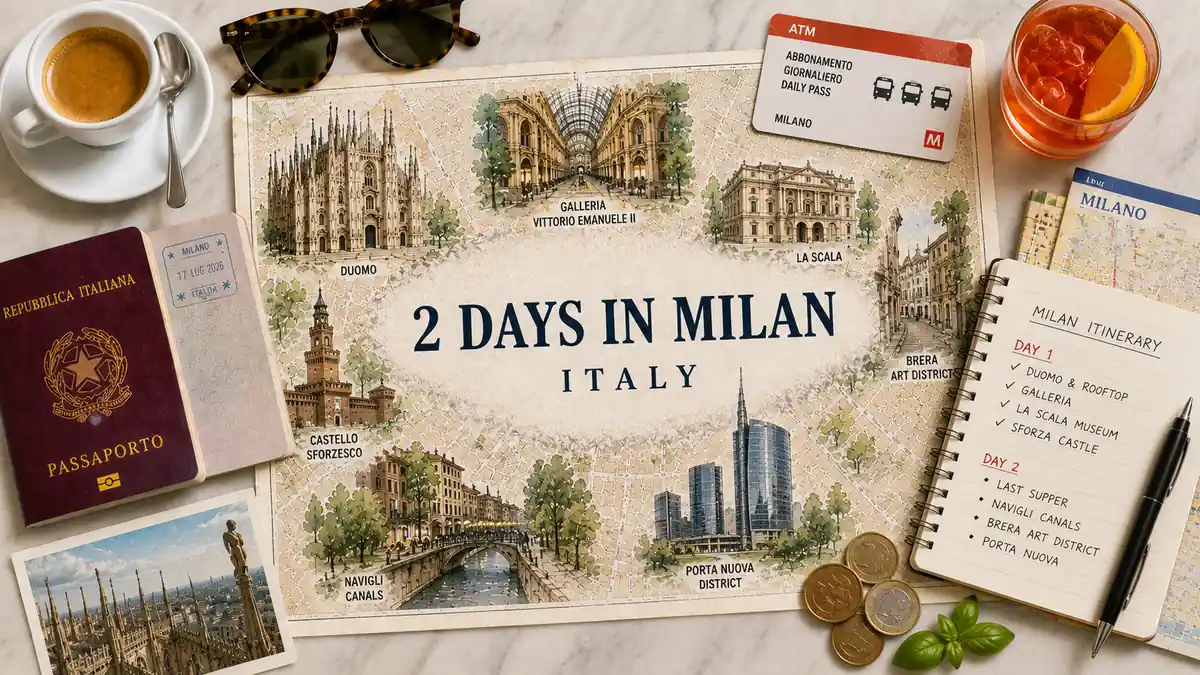
Start in the historic center, then move to Navigli, Brera, and modern Milan on Day 2. The order is geographic, not arbitrary: Day 1 keeps you inside a walkable ring of landmarks, and Day 2 links the canals to the modern north. Grouping this way avoids backtracking across the city.
- Day 1 AM: Duomo & rooftop — the historic heart.
- Day 1 PM: Galleria & La Scala — arcades and opera house.
- Day 1 Evening: Sforza Castle & Parco Sempione — sunset by the park.
- Day 2 AM: The Last Supper & Navigli — the mural, then the canals.
- Day 2 PM: Brera — galleries and cobbled lanes.
- Day 2 Evening: Porta Nuova & Gae Aulenti — modern Milan and aperitivo.
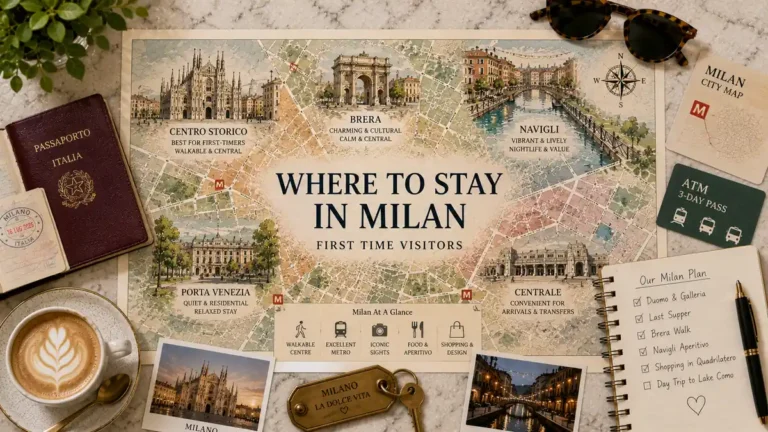
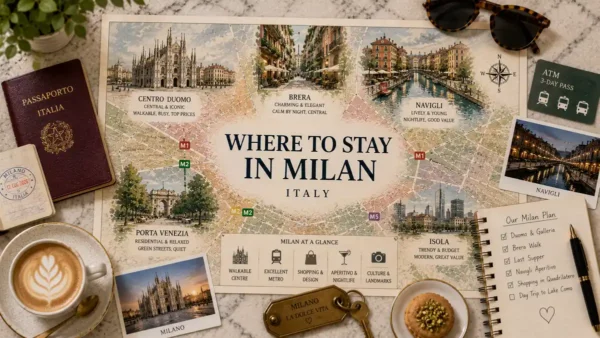
The order works because Milan’s must-sees fall into two natural clusters. Day 1 is the medieval-to-19th-century core; Day 2 is the canals, the art quarter, and the glass-tower north. Walking one cluster per day keeps transit minimal and leaves evenings free. For the full menu of sights beyond this route, see our guide to things to do in Milan. If you are still choosing a base, our where to stay in Milan breakdown covers which district keeps this route shortest.
Day 1: Duomo, Galleria, La Scala and Sforza Castle
Spend Day 1 in the compact historic center, starting at the Duomo. Everything on this day sits within a short walk, so you lose almost no time to transport. The rhythm runs from the cathedral and its rooftop in the morning, to the Galleria and La Scala midday, then Sforza Castle and Parco Sempione at golden hour.
Day 1 barely needs a map. Each stop is a short walk from the last, so the day flows on foot from the cathedral outward.
- Morning — Duomo: Begin at the Duomo early to beat the crowds. The rooftop terraces are the reason to arrive first thing; access is ticketed, so check current options before you queue.
- Afternoon — Galleria & La Scala: Step next door into the Galleria Vittorio Emanuele II, then reach Teatro alla Scala a few minutes on foot. Both sit inside the same square-and-arcade cluster.
- Evening — Sforza Castle & Parco Sempione: Walk up to Sforza Castle and drift into Parco Sempione behind it for sunset. The courtyards are easy to wander, and the park is a natural place to slow down.
Day 2: Navigli, Brera and Modern Milan
Day 2 trades the old center for the Navigli canals, Brera, and modern Milan. Morning belongs to the Last Supper and the waterways on the city’s western and southern edge. The afternoon winds through Brera’s galleries and lanes, and the evening ends among the skyscrapers of Porta Nuova and Gae Aulenti.
Day 2 covers more ground, so a couple of metro hops replace the all-walking rhythm of Day 1.
- Morning — The Last Supper & Navigli: Start with your booked Last Supper slot at Santa Maria delle Grazie, then head down to the Navigli canals for a late-morning stroll along the water.
- Afternoon — Brera: Cross to Brera for its cobbled lanes and the Pinacoteca. This is the afternoon to wander rather than tick boxes.
- Evening — Porta Nuova & Gae Aulenti: Finish among the skyscrapers of Porta Nuova and the Gae Aulenti square, a good spot for an aperitivo before dinner.
What to Pre-Book Before Your Trip
Book the Last Supper well ahead; tickets sell out far in advance. It is the one Milan sight where showing up on the day almost never works, because entry runs in small timed groups. Everything else on this route can be booked closer in, though advance tickets shorten the queue at the Duomo.
Lock the Last Supper first, then work down. A realistic pre-booking list for a short trip:
- The Last Supper: release windows open weeks to months ahead and sell out fast — this is the non-negotiable one.
- Duomo rooftop: advance tickets cut the queue, though same-day entry is usually possible.
- Anything time-sensitive you care about: a special exhibition or a La Scala performance.
For how ticket costs add up across a weekend, see our Milan trip cost guide. Miss the Last Supper window and there is no walk-up fix — unlike the Duomo rooftop, you cannot talk your way into a sold-out slot on the day, so this booking sets the shape of your Day 2.
Tours and activities
Book skip-the-line tickets, day trips and local tours with free cancellation on most activities.
You can also browse everything on getyourguide.com.
Tripstou may earn a commission if you book through this link, at no extra cost to you.
Is Milan Walkable, or Do You Need the Metro?
Most of Milan’s core is walkable, with the metro for a few longer jumps. Day 1 needs almost no transport, since the center’s landmarks sit within a tight ring. The metro earns its keep on Day 2, linking the historic center to the Navigli and out to the modern northern district.
On foot, Day 1 is effortless; the metro only matters when the route stretches. The hops worth riding for are the run from the center to the Navigli and the jump north to Porta Nuova — both are longer than they look on a map. Everything inside the historic core stays quicker on foot. For ticket types, lines, and how the transport network fits together, see our Milan guide.
On a two-day trip the metro saves your legs on just two legs — the canal run and the modern-district hop. A longer travel pass rarely pays off for a weekend this walkable.
How to Adapt This Route with Less or More Time
With less time, cut Day 2’s modern district first; with more, add a day trip. A single-day version keeps the historic core and drops the canals and Porta Nuova. A third day is best spent on Brera’s museums or a lake or outlet excursion, not on cramming more into the first two.
Adapt by cutting or adding whole blocks, and keep the single-route shape intact.
Cut first, if you have under two days:
- Drop Day 2’s modern district (Porta Nuova); it is the most skippable block.
- Then trim the Navigli to a quick evening stroll instead of a full morning.
Add first, if you have more:
- Add a third day for Brera’s museums or a day trip to the lakes or an outlet.
- Fold Milan into a longer national loop.
Protect Day 1 above all — the historic core is what makes the trip feel like Milan, so cut it last. For a fuller longer-stay plan, see our 3 days in Milan itinerary. To slot Milan into a broader route, our Italy itinerary shows where it fits.
Frequently Asked Questions
Can you see the Last Supper without booking ahead?
Almost never. The Last Supper admits small timed groups at Santa Maria delle Grazie, and slots sell out weeks to months in advance. Walk-up tickets are rare and unreliable, so treat this as the one Milan sight you must reserve before you arrive.
Is Milan worth visiting for 2 days?
Yes, comfortably. Milan rewards a weekend with a dense, walkable core, world-class art, and a stylish aperitivo scene, so you rarely feel shortchanged. It suits first-time visitors and anyone pairing the city with a wider Italy trip. Only day-trip seekers will wish for more time.
What’s the best time of year for a short Milan trip?
Spring and early autumn are the easiest, with mild weather for walking the open-air route and lighter crowds than midsummer. Milan stays a year-round city break thanks to its indoor sights, though August is quieter as locals leave and some businesses close. Weekends around major fashion or design events fill up fast.
Do you need to rent a car for a Milan weekend?
No. A car is a liability in central Milan, where limited-traffic zones, paid parking, and a walkable core make driving pointless for a two-day visit. The metro, trams, and your own feet cover everything on this route, and airport trains handle arrivals. Save the car only for onward day trips.
Is the Duomo rooftop worth it on a short trip?
Yes, if you go early. The rooftop terraces put you among the cathedral’s spires and statues with wide views over the city, and they are the reason to make the Duomo your first morning stop. Access is ticketed and queues build fast, so book ahead or arrive at opening.
How early should you start each day on a 2-day Milan itinerary?
Aim to start by mid-morning at the latest, and earlier on Day 1. Opening the Duomo and its rooftop first beats the queues and heat, and Day 2 hinges on whatever Last Supper slot you booked. Early starts leave evenings free for aperitivo without cramming the daylight hours.
Related Guides
Keep planning your Milan weekend with these guides:
- Zoom out to the full city overview in our Milan guide.
- Pick the right base with where to stay in Milan.
- Budget the trip with our Milan trip cost guide.
- Add a day using our 3 days in Milan itinerary.
- Browse the full sight list in things to do in Milan.
- Fit Milan into a bigger route with our Italy itinerary.
Did this guide save you time or money? Tripstou is independent and reader-funded — if you'd like to give something back, you can support the site with a crypto contribution of any size.