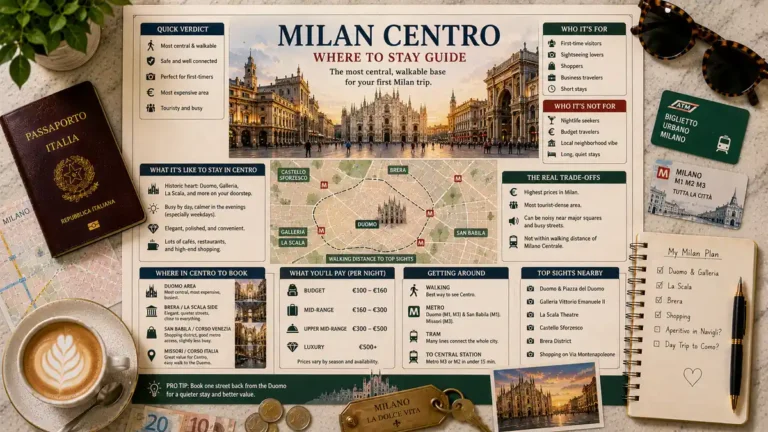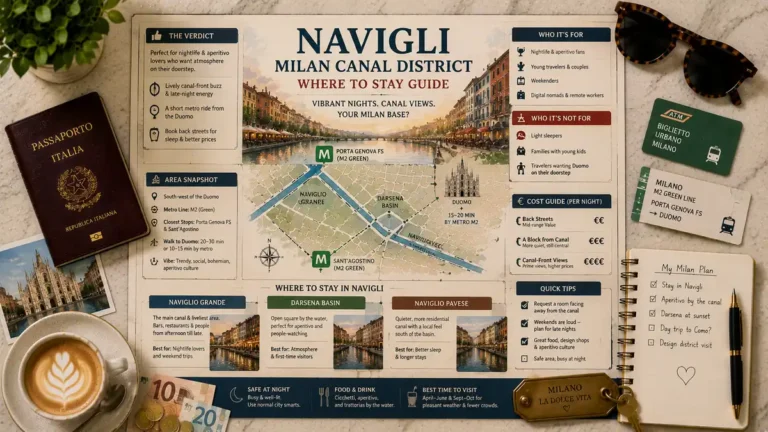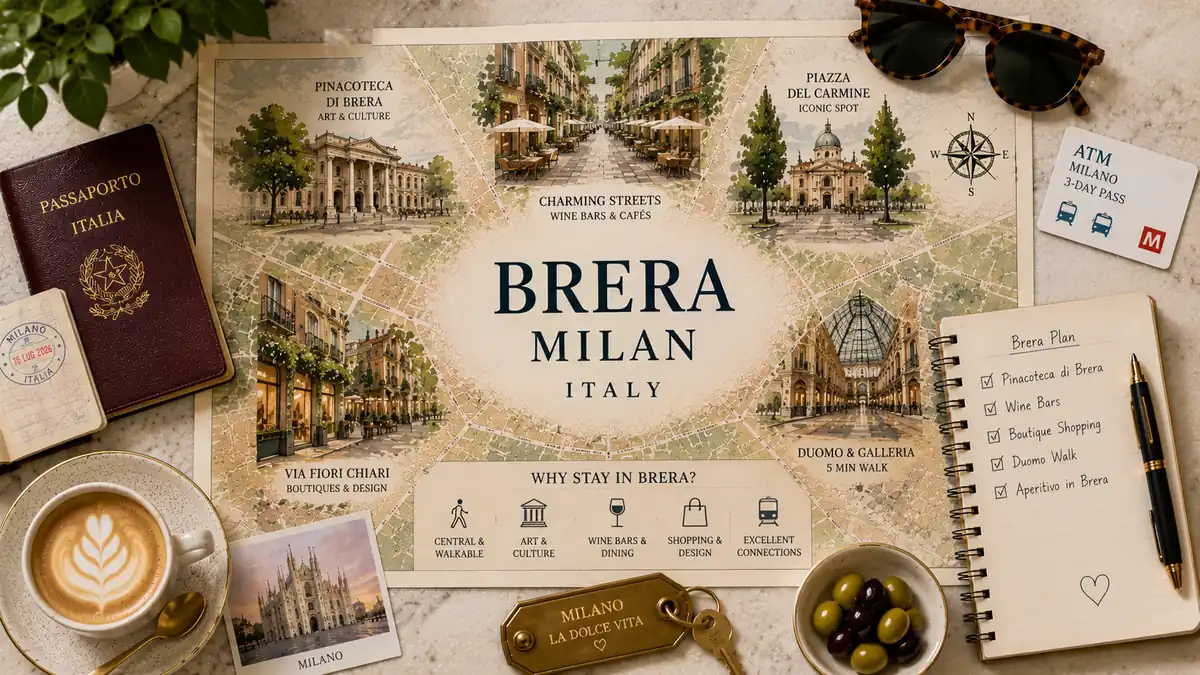
You’re close to booking a Milan trip and Brera keeps coming up as the neighbourhood to stay in — elegant, central, and endlessly photogenic. The question is whether it’s the right base for you, or whether its reputation is doing the heavy lifting. Brera is Milan’s art quarter: a pocket of cobblestone lanes, galleries, and wine bars wrapped around the Pinacoteca di Brera, just north of the Duomo. It’s one of the city’s most desirable places to sleep, and one of its most expensive. That tension — genuine central charm on one side, a real price premium on the other — is what this guide resolves. Below you’ll find a straight verdict on whether Brera fits your trip, an honest feel for staying here day to day, where it sits, what it costs in relative terms, and exactly who should book elsewhere.
Quick Answer
Yes — Brera is one of Milan’s most desirable central bases, upmarket and walkable, ideal for art-and-design lovers. The main tradeoff is cost — it ranks among the priciest areas — and evenings near the bars run lively. It suits couples and first-timers wanting central character; budget and party-first travelers should look at Navigli or cheaper zones.
Trust Layer
Tripstou stay guide for travelers choosing where to base. Covers area atmosphere, budget, convenience, noise, and traveler fit.
Produced with AI assistance and reviewed by Alex Perrut, working in tourism since 2015, for the Tripstou editorial team. See our editorial process for details.
Last factual review: July 16, 2026.
Official sources consulted: Italia.it, ENIT.
Key Takeaways
- Brera is one of Milan’s most desirable central bases, best for travelers who prize art-district charm and walkability over savings.
- The biggest tradeoff is cost — Brera sits firmly at the high end of Milan’s stay spectrum, with few budget rooms.
- Couples, first-timers, and design or culture lovers fit Brera best; families and budget travelers usually get more value elsewhere.
- You can walk from Brera to the Duomo, La Scala, and the fashion streets in minutes, rarely needing the metro.
- Evenings around the wine bars run lively but refined — expect a buzzy, wine-led scene, not club-driven noise or total silence.
- Your travel dates move the bill more than the address — Fashion Week and the Salone furniture fair spike rates citywide.
Table of Contents
Is Brera a good area to stay in Milan?
Yes, Brera is one of Milan’s best central bases for travelers who value charm and walkability. The neighbourhood pairs a genuine art-district atmosphere with a location minutes from the Duomo on foot. The main caveat is cost — Brera consistently ranks among the priciest areas in the city to book a room.
Brera earns its reputation on atmosphere. The streets are the draw: art galleries, independent boutiques, and pavement wine bars packed into a compact, low-rise grid that most of central Milan lost to traffic. That is why the location premium tends to pay off here — you spend far more waking hours in the neighbourhood itself than in your hotel room, so the streets you’re paying for are the ones you actually use. For a full picture of how Brera stacks up against every other district, the master area picker for where to stay in Milan sets the wider context. If your decision is specifically Brera against the historic core, the dedicated Centro versus Brera comparison settles that head-to-head. This guide stays focused on Brera on its own terms.
What Brera feels like as a place to stay
Brera feels like an upmarket-bohemian art village dropped into the middle of Milan. Cobblestone lanes, ivy-draped facades, gallery windows, and candlelit wine bars set a slower, more romantic tone than the business-like streets around the Duomo. It reads polished but characterful — expensive, yet genuinely atmospheric rather than sterile.
By day the district runs on quiet luxury: window-shopping, long lunches, and the low hum of an art-school crowd. Evenings shift up a gear. The wine bars and restaurants fill, tables spill onto the cobbles, and the lanes stay busy late — charming if you want life outside your door, less so if you need silence by ten. If that polish sounds more refined than you want — say you’d trade galleries for canal-side bars and a scruffier, younger buzz — the Centro versus Navigli comparison points to the alternative vibe.
What there is to do in Brera
Brera’s appeal as a base is that its daily life happens on your doorstep. The Pinacoteca di Brera, one of Italy’s great art collections, anchors the district alongside the Brera Academy, which keeps a creative, student-adjacent energy in the streets. Boutiques, design showrooms, and small galleries fill the lanes between long lunches and evening aperitivo. Once a month, the Brera antiques market takes over the neighbourhood. None of this is a sightseeing checklist. It is the texture you walk through every day as a guest — the real reason people pay to sleep here.
Where Brera sits in Milan and how central it feels
Brera sits directly north of the Duomo, squarely inside Milan’s historic centre. La Scala opera house and the Galleria Vittorio Emanuele are a short walk south, and the Via Montenapoleone fashion district borders it to the east. On foot, Brera feels central — you can reach the city’s headline sights in minutes without touching the metro.
This puts you inside the ring most first visitors want to be in, with the main landmarks clustered a short stroll away. The everyday result is simple. You wake up in the middle of the action instead of commuting into it, which is a large part of what the premium buys. For how Brera fits into the wider city and its neighbourhoods, the broader Milan city guide fills in the context this stay profile deliberately leaves out.
Positions are approximate walking relationships; check a live map before you set out.
| Landmark or district | Direction from Brera | Getting there on foot |
|---|---|---|
| Duomo and the Galleria | Just to the south | A short, easy walk |
| La Scala opera house | On Brera’s southern edge | Only a few minutes away |
| Via Montenapoleone fashion streets | Along the eastern border | A short, level stroll |
| Sforza Castle and the park | A little to the west | A comfortable, pleasant walk |
Getting around from Brera
You can walk to most of central Milan’s headline sights from Brera, which is the district’s biggest practical advantage. For everything further out, three metro lines are close by: M1 (red), M2 (green), and M3 (yellow) all have stations within easy reach around the neighbourhood’s edges. Trams and buses fill the gaps.
For a stay, this means you rarely need transport for the core sightseeing days. The Duomo, La Scala, the Galleria, and the fashion streets are all on foot. When you do venture out — to the trade-fair grounds, the outer districts, or the airports’ rail links — the metro is a short walk away.
- M1 (red) — links the historic centre with the east and west of the city.
- M2 (green) — runs toward the main railway stations and the southern canals.
- M3 (yellow) — connects the centre south to north through the station belt.
What it costs to stay in Brera
Brera is one of Milan’s most expensive areas to stay, sitting firmly at the high end of the city’s spectrum. Budget rooms are scarce here; the neighbourhood skews toward mid-range and high-end stays, boutique properties, and design hotels. Rates climb further during major events, so timing matters as much as the address.
Think in spend styles rather than nightly figures:
- Budget — thin on the ground in Brera; hostels and cheap rooms cluster in other districts.
- Mid-range — available, but priced at the top of the mid band for the location.
- High-end — Brera’s core strength, where boutique and design hotels concentrate.
Your dates can move the bill more than your neighbourhood does. Booking Brera on an ordinary week can undercut a cheaper district during Fashion Week or the Salone del Mobile furniture fair, when citywide demand spikes and rates jump across the board. If you’re chasing named top-end properties, the roundup of luxury hotels in Milan and the luxury stay guide handle specific picks. If the premium is the dealbreaker, the budget stay guide points to cheaper bases that still keep you connected.
Hotels and places to stay
Compare hotels, apartments and stays for your dates in one search.
Search hotels and stays on hotels.com →
Tripstou may earn a commission if you book through this link, at no extra cost to you.
Who should stay in Brera — and who should look elsewhere
Brera suits travelers who want central character and refinement over budget savings or late-night energy. It’s a natural fit for couples, first-time visitors, and design or culture lovers who plan to spend on location. Families, budget travelers, and nightlife-first visitors are usually better served by other Milan areas.
- Couples: yes — the romantic, walkable streets make Brera one of the strongest choices; the couples’ stay guide confirms the fit.
- First-time visitors: yes — central location and easy walking to the sights suit a first trip; see the first-timer stay guide.
- Design and culture lovers: yes — galleries, boutiques, and the Pinacoteca make this their home turf.
- Luxury travelers: yes — the density of boutique hotels rewards a top-end budget.
- Families: often elsewhere — more space and value sit in quieter, cheaper areas; weigh the options in the families’ stay guide.
- Budget travelers: look elsewhere — Brera rarely delivers a value booking.
- Nightlife-first: mixed — evenings are lively but wine-bar refined, not club-driven; the nightlife stay guide points to better bases.
Brera’s charm is exactly what works against families. The narrow, boutique-lined lanes that couples love tend to mean smaller rooms, few apartments, and little green space, which is why the fit flips by traveler type more than by budget alone.
Pros and cons of staying in Brera
Brera’s pros are its central location, walkability, and art-district atmosphere; the cons are high prices and lively, noisy evenings. For most travelers who can absorb the cost, the charm and convenience outweigh the drawbacks. The decision comes down to how much you value character over value-for-money.
The pros:
- Central position with the Duomo, La Scala, and the shopping district all on foot.
- Rare, genuinely atmospheric streets — galleries, boutiques, and cobblestone lanes.
- Excellent walkability, so you rarely depend on transport for sightseeing.
- Strong dining and wine-bar culture right outside the door.
The cons:
- Among the most expensive areas in Milan to book a room.
- Evenings can be lively and noisy near the busiest bar-lined lanes.
- Limited budget options and little space for families.
- Popularity means crowds along the main streets in peak season.
Frequently Asked Questions
Is Brera safe at night, and is it noisy?
Brera is one of Milan’s more reassuring central districts after dark, well-lit and busy with diners, not trouble. The real issue is noise, not danger: the wine-bar lanes stay lively late, with tables spilling onto the cobbles. Light sleepers should request a room set back from the busiest streets.
How far is Brera from the Duomo?
Brera sits just north of the Duomo, an easy walk of only a few minutes through the historic centre. You reach the cathedral, the Galleria Vittorio Emanuele, and La Scala on foot without needing the metro. That proximity is a core reason the neighbourhood commands its price premium as a base.
Is Brera walkable to Milan’s main sights?
Yes, Brera is highly walkable to Milan’s headline sights, which is a large part of its appeal as a base. The Duomo, La Scala, the Galleria, and the Via Montenapoleone fashion streets all sit within a short stroll. You only need the metro for outer districts, the fair grounds, or airport rail links.
Is Brera worth the higher price to stay in?
For travelers who value atmosphere and a central location, Brera usually justifies its premium; for value-hunters, it rarely does. The price buys walkable proximity to the sights and a genuinely characterful setting, not extra space or amenities. If saving money outranks charm, a cheaper, well-connected district will serve you better.
Do you need a car when staying in Brera?
No, a car is more hindrance than help in Brera, where narrow, partly pedestrianised lanes and scarce, costly parking work against driving. The walkable centre and nearby M1, M2, and M3 metro lines cover almost every trip. Skip the rental unless day-trips beyond Milan are central to your plans.
When is the Brera antiques market held?
The Brera antiques market takes over the neighbourhood roughly once a month, filling the lanes with vintage stalls and browsers. As a guest, it is worth knowing your dates: the market brings extra crowds and buzz to the streets on those days. It reinforces the district’s creative, browse-as-you-go character.
Related Guides
Ready to lock in your Milan base? These guides take the decision the next step.
- Where to stay in Milan — the master area picker for every neighbourhood.
- Milan city guide — the wider context for planning your trip.
- Centro versus Brera — the direct head-to-head against the historic core.
- Centro versus Navigli — a livelier, canal-side alternative compared.
- Best areas for couples — where romance and walkability line up.
- Luxury stay guide — top-end bases and what you get for the spend.
Did this guide save you time or money? Tripstou is independent and reader-funded — if you'd like to give something back, you can support the site with a crypto contribution of any size.