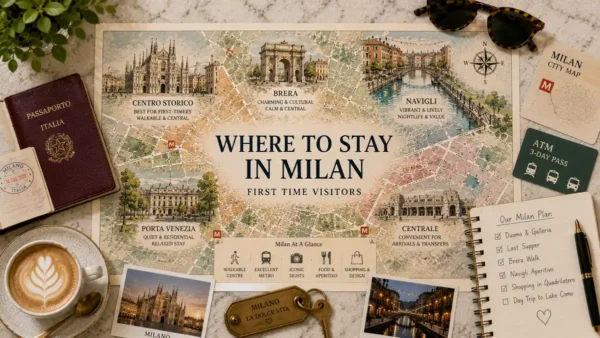
You’ve settled on Milan, and now the real question is where to sleep — and Centro, the historic core around the Duomo, is almost certainly the first name you’re weighing. It is the postcard Milan: the cathedral, the Galleria, La Scala, all within a short walk. But a base has to earn its keep on convenience, cost, and comfort, not just on views. This guide gives you a straight verdict on whether Centro deserves your booking, the trade-offs nobody mentions until check-in, and where within the district to actually book. If Centro turns out to be the wrong fit, you’ll know exactly which direction to look instead. Start with the quick verdict below.
Quick Answer
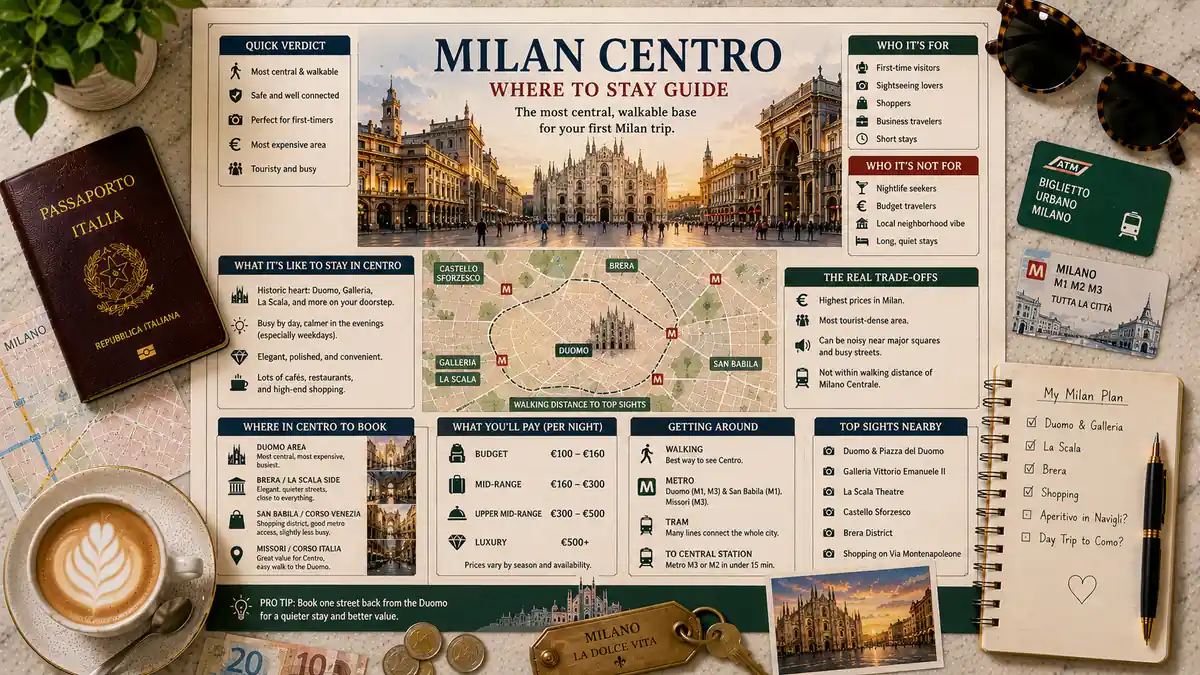
Centro is Milan’s most central, most walkable base and the safe default for first-time visitors. The trade-off is real: it is the city’s priciest and most tourist-dense area. Choose it for short sightseeing trips and a first Milan visit; travelers chasing nightlife or better value should base further out.
Trust Layer
Tripstou stay guide for travelers choosing where to base. Covers area atmosphere, budget, convenience, noise, and traveler fit.
Produced with AI assistance and reviewed by Alex Perrut, working in tourism since 2015, for the Tripstou editorial team. See our editorial process for details.
Last factual review: July 16, 2026.
Official sources consulted: italia.it, enit.it.
Key Takeaways
- Centro is Milan’s most central, most walkable base and the safe default for first-time visitors focused on landmarks.
- The single biggest trade-off is price: Centro charges the city’s top rates because you pay for location above the room.
- Nearly every major sight sits within walking distance, so short sightseeing trips lose almost no time to transit.
- Milano Centrale is a short metro ride away, not walking distance, so plan a quick transfer on arrival.
- Skip Centro if your priority is nightlife, budget, or local neighborhood feel — better-value areas sit further out.
- Booking one street back from the Duomo cuts noise and cost without lengthening your morning walk to the sights.
Table of Contents
Is Centro the right base for your Milan trip?
Yes — Centro is the right base for most first-time Milan trips. It puts you inside the historic core, within walking distance of the Duomo, the Galleria, and La Scala, with the city’s densest metro access. The caveat: you pay the most and share the streets with the most tourists.
The logic is location. From a Centro room you can see the cathedral, catch a tram, and reach every major museum without ever planning a commute. That matters most on a short trip, where an hour lost to transit is a real slice of your stay. For a first visit built around Milan’s landmarks, no other area gets you there faster.
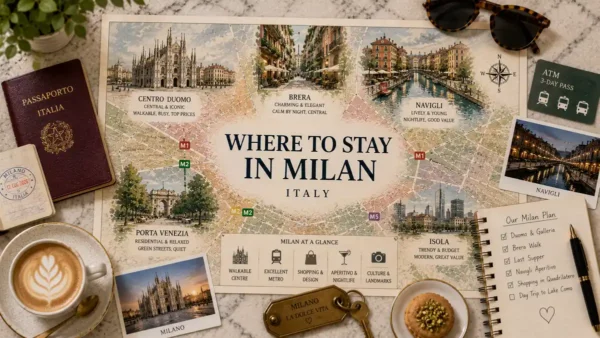
Centro is the hub that the rest of Milan’s neighborhoods are measured against — so if you’re still mapping the whole city, start with the full picture of staying in Milan and how each district compares. For context on what those landmarks and neighborhoods actually contain, the wider Milan guide fills in the orientation this stay page deliberately skips.
One thing seasoned Milan visitors know: Centro’s payoff is highest for two or three nights and shrinks the longer you stay, because a week here means paying peak rates for convenience you stop using once you slow down and explore beyond the core.
What staying in Centro Storico actually feels like
Staying in Centro Storico feels grand, busy, and permanently switched on. You wake up steps from the Duomo, walk marble arcades to dinner, and never wait long for a tram or metro. Days are landmark-dense and social; evenings stay lively around the cathedral square, never quiet or residential.
The texture is unmistakably central. Mornings bring commuters and camera-toting visitors across the same piazza; boutiques and historic cafés line the routes between sights. It is polished and monumental — beautiful, but rarely calm.
Don’t expect a neighborhood feel. Centro is where Milan performs, not where it relaxes at home, so you trade corner-trattoria intimacy for constant motion and world-famous scenery on your doorstep. Light sleepers and slow-travel types feel that intensity most; sightseers barely notice it because they’re out in it all day.
The real trade-offs of staying in central Milan
Centro trades money and calm for time and convenience. You buy walkability, landmark access, and the best transport links in Milan — and pay for it with the highest room rates, the thickest crowds, and street noise that runs late. For a short, sightseeing-led trip, that trade usually pays off.
Weigh it honestly against what you actually want from the stay. The upside is concrete: everything within walking distance, effortless transit, and safety in numbers late at night. The downside is just as concrete — premium pricing, foot traffic that never fully clears, and a soundscape of trams, delivery vans, and nightlife.
The noise, not the price, is what catches most Centro guests off guard: a Duomo-facing room can still carry trams and street chatter well past midnight, so ask for a courtyard-side or upper-floor room if you sleep light. That single request fixes the most common complaint.
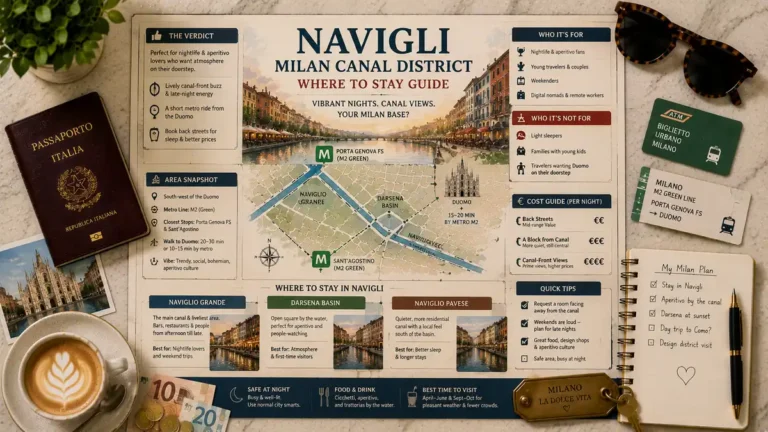
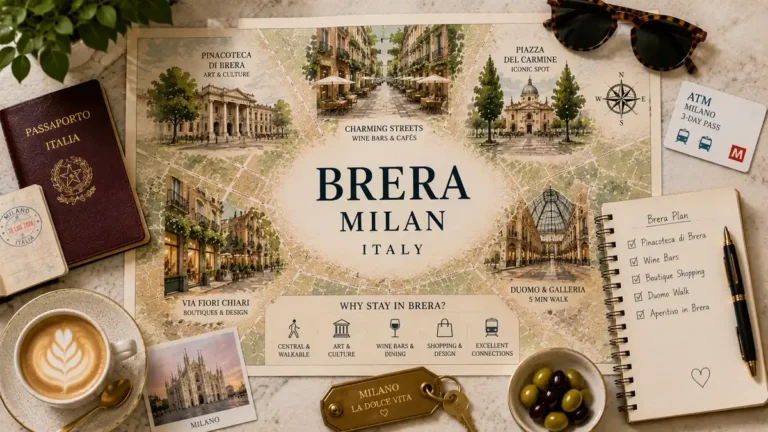
If the balance is tipping the wrong way and you’re weighing an alternative, two comparisons do the heavy lifting: Centro versus Navigli for atmosphere and nightlife, and Centro versus Brera for a more elegant, lower-key central feel.
Is Centro too touristy and crowded to enjoy?
Centro is touristy but rarely too touristy to enjoy, provided you plan around the peaks. The area around the Duomo and Galleria stays busy through the day, yet the crowds thin quickly on side streets and in the early morning and evening. Basing here means you can step out before the day-trippers arrive.
The genuine crush is seasonal, not constant. During major fashion and design weeks the center fills, hotels sell out, and prices spike; outside those windows the density is manageable and part of the appeal. If your dates overlap a big event, book early and expect company at the landmarks.
Who should stay in Centro — and who should look elsewhere
Centro suits first-timers and short-stay sightseers best, and value or nightlife travelers least. If your priority is seeing Milan’s landmarks on foot with minimal transit, it is the obvious base. If it is budget, local atmosphere, or late-night energy, another neighborhood serves you better.
Match yourself to the clearest fit below, then follow the link for a booking-level breakdown of that traveler type:
- Best for first-timers: you want the landmarks on your doorstep and zero transit learning curve — Centro is the default. See where first-timers should stay.
- Best for couples on a landmark-and-dinner trip: you’ll trade quiet for a walk-everywhere romantic core. Compare it against calmer picks in stays for couples.
- Workable for families who prioritize walkability: short legs to sights help, but space and noise are the catch. Weigh it in stays for families.
- Skip it if you’re here for nightlife: Centro quiets after dinner, and the bars cluster elsewhere. Base near the scene in stays for nightlife.
- Skip it if you’re watching the budget: you pay a location premium for every room. Stretch your money in budget stays.
- Consider it if you want luxury with a landmark view: the top-tier addresses cluster here. Browse luxury stays.
Where exactly in Centro to book your stay
Centro splits into two booking zones: right on the Duomo or on the quieter fringe streets around it. The cathedral core maximizes walk-out convenience but concentrates noise and price. The fringe — toward Cordusio, Missori, or the edge nearest Cadorna — keeps you central while trading a few minutes for calm.
Pick the sub-zone that matches how you’ll use the room:
- Best for maximum walk-out convenience: the cathedral core, right around Piazza del Duomo and the Galleria — you step out into the landmarks, at the highest price and noise.
- Best for central-but-calmer nights: the fringe streets toward Cordusio and Missori — still a short walk to everything, with quieter evenings and slightly gentler rates.
- Best for easy onward transit: the western edge near Cadorna — handy for the Malpensa Express and Castello Sforzesco while staying inside the walkable core.
Booking one street back from Piazza del Duomo often costs less and sleeps quieter without adding a single metro stop to your morning walk to the sights. It is the easiest upgrade most guests overlook.
Hotels and places to stay
Compare hotels, apartments and stays for your dates in one search.
Search hotels and stays on hotels.com →
Tripstou may earn a commission if you book through this link, at no extra cost to you.
What you’ll pay to stay in Centro
Centro sits at the top of Milan’s lodging market. Expect to pay more here than in almost any other neighborhood for the same room quality, because you are buying location above all. Prices climb further during fashion and design weeks, when central rooms sell out first and rates peak.
Think in spend styles rather than fixed figures, since rates swing hard by season and event calendar:
- Budget: options exist but are limited — expect compact rooms, guesthouses, or fringe-street addresses, and accept that even the low end here runs above the citywide floor.
- Mid-range: the sweet spot for most Centro stays — comfortable three- and four-star hotels a short walk from the Duomo, priced for the location rather than lavish rooms.
- High-end: Centro’s specialty — grand historic hotels and design-led five-stars with cathedral or Galleria views, at Milan’s top rates.
In Centro you pay a premium for the address before the room, so a three-star by the Duomo can cost what a four-star fetches further out — judge value on location, not stars alone. For an actual shortlist of top-tier addresses, see the luxury hotels in Milan.
Frequently Asked Questions
Is Centro Milan safe at night?
Yes, Centro is one of Milan’s safest areas after dark. The Duomo district stays busy and well-lit late into the evening, with steady foot traffic and a visible presence around the main squares. Take normal big-city precautions against pickpockets in crowds, especially near the cathedral and busy transport hubs.
How far is Centro from Milano Centrale station?
Centro sits a short metro ride from Milano Centrale, not walking distance. The station connects to the Duomo area directly by metro in well under half an hour, so arriving by train is easy despite the gap. Plan on a quick metro hop instead of walking with luggage between the two.
Can you walk everywhere from Centro Milan?
Yes, you can reach most of Milan’s headline sights on foot from Centro. The Duomo, Galleria, La Scala, and Castello Sforzesco all sit within an easy walk, which is Centro’s main selling point. For the Navigli canals or farther neighborhoods, hop on the dense metro and tram network.
What is the difference between Centro and Centro Storico in Milan?
In practice, Centro and Centro Storico describe the same central area around the Duomo. Centro Storico is the historic core — the cathedral, Galleria, and La Scala — while Centro is used loosely for that whole central zone. When booking a stay, treat the two names as interchangeable.
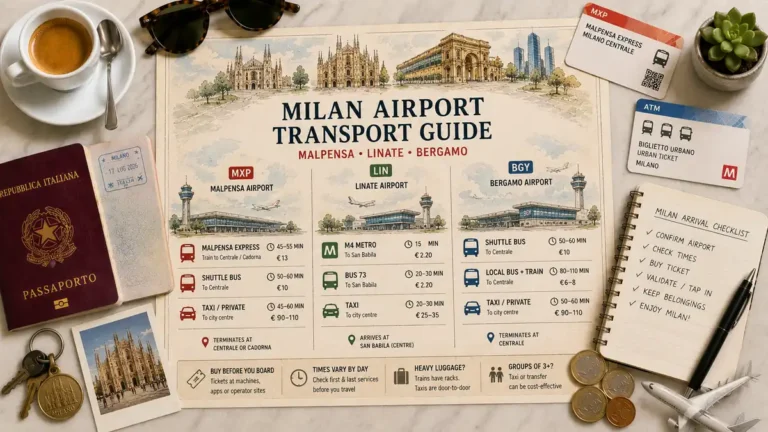
Does Centro Milan connect easily to the airports?
Yes, Centro connects to all three Milan airports without much hassle. Cadorna, on Centro’s western edge, runs the direct Malpensa Express train, while Linate and Bergamo link in by metro and shuttle bus. Basing centrally keeps airport transfers simple whichever airport you fly into.
Related Guides
Keep planning your Milan base with these next steps:
- Where to stay in Milan — the full neighborhood shortlist and how every area compares.
- Centro vs Navigli — central convenience against canal-side nightlife and atmosphere.
- Centro vs Brera — the landmark core against Milan’s most elegant central district.
- Where to stay for a first Milan trip — the safest base picks for a debut visit.
- Luxury hotels in Milan — a shortlist of the city’s top-tier addresses.
- Milan travel guide — the wider orientation to sights, transport, and neighborhoods.
Did this guide save you time or money? Tripstou is independent and reader-funded — if you'd like to give something back, you can support the site with a crypto contribution of any size.