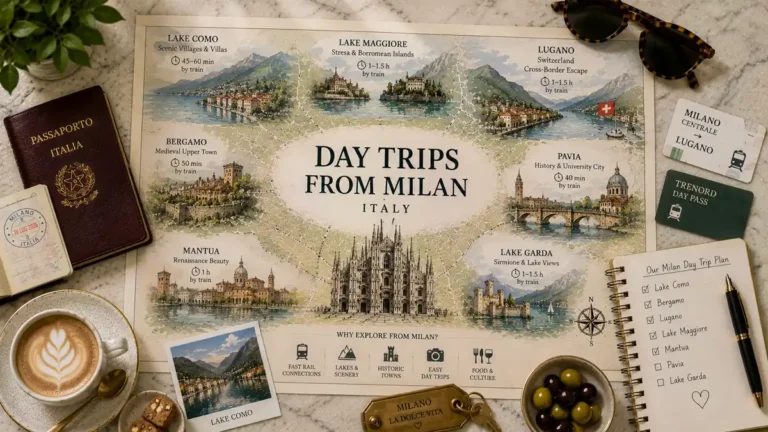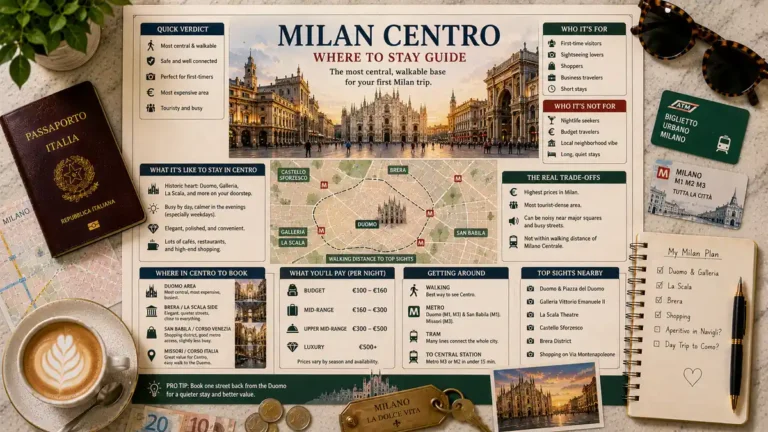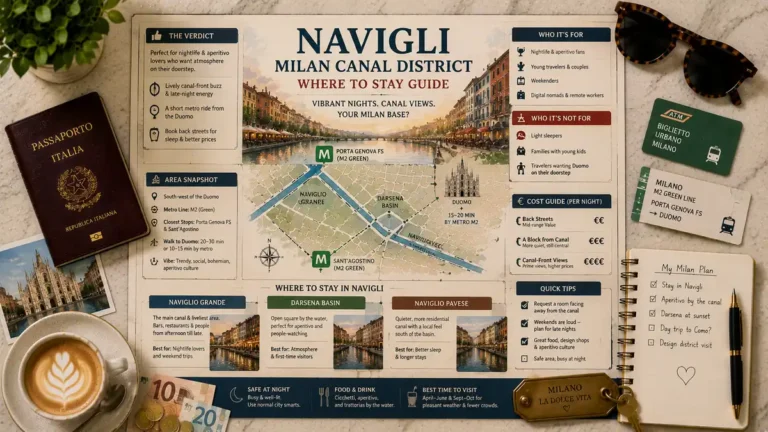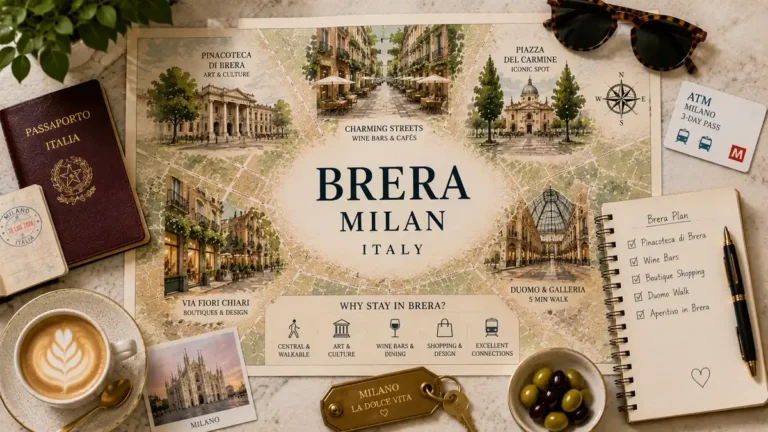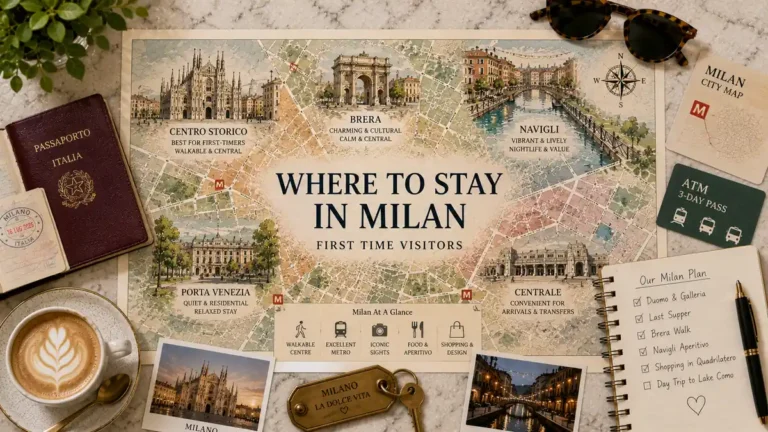
Milan’s headline sights sit closer together than almost any other big Italian city, yet first-time visitors routinely zigzag across the centre and burn their third day on indecision. This itinerary fixes both problems. It runs the city in an order that never doubles back — historic centre first, the art-and-castle loop second, the day trip last — and it gives a straight answer to the question every 3-day Milan plan runs into: Lake Como, or more Milan? You will also find the one piece of admin that cannot wait: booking the Last Supper, which sells out long before most people start planning their days. Everything else on this route is flexible. Follow the three days as written, or use the adaptation rules at the end to stretch or shrink the plan without rebuilding it.
Quick Answer
Spend Day 1 in Milan’s historic centre, Day 2 on the Last Supper and Brera, Day 3 at Lake Como. Day 3 swaps to a slower city day — fashion quarter, galleries, aperitivo — if you’d rather stay in Milan. Book the Last Supper as soon as your dates are fixed; the route suits first-timers on foot.
Trust Layer
Tripstou itinerary guide for travelers planning a route. Covers pacing, stop count, stop order, base logic, and trip length.
Produced with AI assistance and reviewed by Alex Perrut, working in tourism since 2015, for the Tripstou editorial team. See our editorial process for details.
Last factual review: July 24, 2026.
Official sources consulted: Italia.it, ENIT.
Key Takeaways
- Structure Milan as two city days plus one day trip; two full days cover the compact centre without rushing.
- Run the days centre-first, art-and-castle loop second, day trip last, so no day ever crosses the city twice.
- Spend Day 3 on a Lake Como day trip; switch to a slower Milan day only for bad weather or low energy.
- Book the Last Supper the moment your dates are fixed; it is the one reservation that can sink Day 2.
- Three days is enough for Milan’s core plus one day trip, but not for deep museums or a second excursion.
Table of Contents
Your 3-Day Milan Route at a Glance
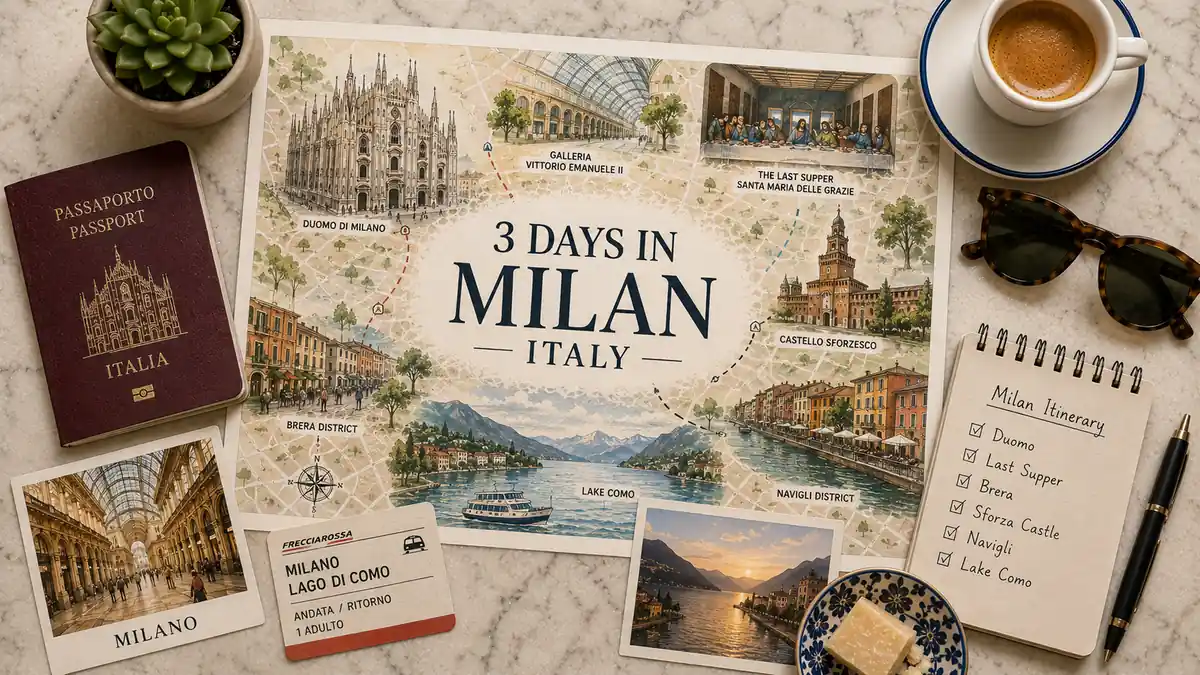
Two city days plus one day trip is the right 3-day Milan shape. Day 1 covers the historic centre and ends on the Navigli, Day 2 handles the pre-booked Last Supper with Brera and the castle, and Day 3 goes to Lake Como — or slows down in the city.
- Day 1: Duomo, Galleria Vittorio Emanuele II, historic centre, Navigli evening — the walkable classic core
- Day 2: The Last Supper, Brera, Castello Sforzesco — the pre-booked art loop
- Day 3: Lake Como day trip (or a slower Milan day) — the reward day out
The two city days do all the sightseeing work, which frees Day 3 to be a reward instead of a mop-up. Sleep central for all three nights — a single base is what makes the walking route work, and where to stay in Milan covers the areas. For everything around the route — arrival, getting around, timing — start with the full Milan travel guide.
How This Order Avoids Backtracking
The order works because each day owns one compact zone. Day 1 stays inside the historic core, where the Duomo, the Galleria, and the surrounding streets sit within minutes of each other on foot. Day 2 moves one ring outward — Santa Maria delle Grazie, Brera, and the castle form a loose arc west and north of the centre that walks as a single loop. Day 3 leaves town entirely. Nothing repeats, and no day asks you to cross the city twice.
Milan rewards sequencing over transport tactics: the sights cluster so tightly that a sensible order saves more time than any metro strategy could.
Day 1: The Duomo, Historic Centre, and a Navigli Evening
Day 1 covers the Duomo, the Galleria Vittorio Emanuele II, and the historic core, ending on the Navigli. The centre comes first because it anchors your mental map of Milan — every later day builds outward from it. It is also the day that tolerates a slow start best.
- Morning: Piazza del Duomo and the cathedral, rooftop included
- Afternoon: Galleria Vittorio Emanuele II and the streets of the historic core
- Evening: aperitivo along the Navigli canals
Go to the Duomo first and go early. The piazza is at its calmest before mid-morning, and the rooftop is the day’s one timed element — book a slot ahead or be in line when it opens. From the roof you can read the whole city, with the Alps on the horizon on a clear day, which makes it the best orientation stop Milan has.
The Galleria Vittorio Emanuele II opens directly onto the piazza, so the afternoon takes care of itself: the arcade, the surrounding streets, a long lunch. Resist adding museums here. Day 1’s job is orientation and atmosphere, not collections — the route deliberately saves its ticketed culture for Day 2.
In the evening, head south-west to the Navigli. The canals run on aperitivo hours: arrive before sunset, pick a canalside bar, and let the evening stretch. You close Day 1 with the centre mapped in your head — exactly what Day 2’s outer loop builds on.
Day 2: The Last Supper, Brera, and Sforza Castle
Day 2 pivots around a pre-booked Last Supper slot at Santa Maria delle Grazie. From there the day flows through the Brera district and its Pinacoteca to Castello Sforzesco and Parco Sempione. It is the only day on the route a missed booking can sink, so build it first.
- The Last Supper at Santa Maria delle Grazie — the fixed, timed anchor
- Brera and the Pinacoteca di Brera — the flexible middle of the day
- Castello Sforzesco and Parco Sempione — the open-air finish
The booking is the whole game. Last Supper entries are limited, timed, and sell out well before most travelers start planning, so reserve the moment your dates are fixed — treat it like booking the flight, not like buying a museum ticket. If no slots exist for your dates, rebuild the day around Brera and the castle and let the painting go; hoping for returned tickets wastes a Milan morning.
Build the day backwards from your entry time: a morning slot pushes Brera into the afternoon, while an afternoon slot flips the loop so you start at the castle.
Brera is the buffer. The district absorbs however much time the day gives it — the Pinacoteca for a focused visit (check its opening days before you commit a morning to it), then the streets around it, which are Milan at its most walkable. Finish at Castello Sforzesco and walk out through Parco Sempione as the light drops. By evening you have seen Milan’s heaviest hitters, and Day 3 is completely free.
Tours and activities
Book skip-the-line tickets, day trips and local tours with free cancellation on most activities.
You can also browse everything on getyourguide.com.
Tripstou may earn a commission if you book through this link, at no extra cost to you.
Day 3: Lake Como Day Trip or a Slower Milan Day?
For most first-time visitors, spend Day 3 on a Lake Como day trip. The lake sits about 50 km north of Milan, a short train ride away, and delivers a scenery change no third city day can match. Stay in Milan instead if the weather is poor or your energy is gone.
Should You Do the Lake Como Day Trip?
Yes — if this is your first Milan trip, the forecast is decent, and you can handle an early start. Trains from central Milan reach both Como and Varenna, and boats link the mid-lake towns, so the logistics stay simple. No other day trip from Milan returns this much scenery for this little effort.
- Go if it’s your first visit, the sky is clear, and you’re happy leaving early.
- Skip if museums are your priority, the forecast is grim, or two city days have emptied the tank.
The tradeoff is honest: Como is a full out-and-back day. You will spend a chunk of it in transit, and you give up whatever a third Milan day would have added. Pick one leg of the lake and stay there — Como town for the shortest travel day, or the Varenna–Bellagio pairing for the postcard views. Trying to cover all three towns turns the day into a timetable exercise instead of a lake day.
The Slower Milan Alternative
The slower day trades scenery for texture. Spend the morning in the Quadrilatero della Moda — Milan’s fashion quarter works as a walking route even if you buy nothing — then give the afternoon to whichever galleries or neighbourhoods the first two days made you curious about. No timed entries, no train, no plan that can fail. End with a long aperitivo in the district you liked most.
Treat it as a route day, not a checklist day. If you want raw material to choose from, the full list of things to do in Milan has it.
Train and bus tickets
Compare routes, schedules and prices across rail and bus operators in one search, with mobile tickets on your phone.
New to Omio? Code NEW10 takes 10% off your first booking — or APPNEW10 if you book inside the Omio app. Both apply to bookings up to €80.
Search routes and compare prices on Omio →
Tripstou may earn a commission if you book through this link, at no extra cost to you.
Is 3 Days Enough Time in Milan?
Yes — 3 days is enough for Milan’s core sights plus one day trip, without rushing. The city’s headline sights cluster inside a compact, walkable centre, so two full days cover them comfortably. What three days cannot buy is depth: long museum sessions or a second day trip.
Three days covers the Duomo and the historic core, the Last Supper, Brera, the castle, and a full Lake Como day — with evenings left for the Navigli and aperitivo. That is the complete first-visit core. What it cannot cover: serious museum depth, more than one day trip, or an overnight on the lake. Those need a fourth day or a return visit.
First-time visitors are the ideal fit for this plan. Art-focused travelers should either take Day 3’s slower city option — it exists for exactly this case — or plan four days from the start. For what three days here realistically costs, see the Milan trip cost guide.
How to Adapt This Route with More or Fewer Days
With 2 days, cut the Lake Como trip first; with 4 or more, add depth, not stops. The two city days are the route’s fixed core, and they survive almost any compression. Extra time buys slower museums or an overnight on the lake, never a rebuilt itinerary.
- Cut first: the Day 3 day trip. With only two days you are following our 2 days in Milan route — a purpose-built plan, not a compressed version of this one.
- Add first: depth. A fourth day buys an unhurried Pinacoteca morning, a proper Quadrilatero wander, or upgrades the Como day trip into an overnight on the lake.
What extra days should never buy is churn — more zones per day, a second day trip squeezed against the first, a hotel change. The route’s value is its order, and the order survives stretching far better than stuffing. If Milan is one stop in a longer trip, treat these three days as a self-contained block and plan the rest with the full Italy itinerary.
Frequently Asked Questions
Do you need to book the Last Supper in advance?
Yes, book the Last Supper as far ahead as your dates allow. Entries at Santa Maria delle Grazie are timed and strictly limited, and they sell out well before most travelers start planning. Reserve the moment your trip is confirmed; do not rely on returned tickets appearing later.
How many days do you need in Milan?
Two to three days suits most first-time visitors. Two days cover Milan’s core sights at a brisk pace, while a third day adds breathing room and a Lake Como day trip. Beyond three days, you are adding museum depth or extra excursions rather than covering essentials.
What are the best day trips from Milan besides Lake Como?
Bergamo, Lake Maggiore, and Turin are the strongest alternatives. Bergamo’s walled upper town makes a compact half-day escape, Lake Maggiore trades Como’s crowds for quieter island gardens, and Turin offers a grand, café-lined city break. Each works as an out-and-back day by train from central Milan.
When is the best time to visit Milan?
Spring and early autumn are the best times to visit Milan. Mild weather makes the walkable centre and a Lake Como day trip most rewarding, and the crowds sit below summer peaks. Summer turns hot and humid, while winter is cooler and grey but quieter for indoor sights and galleries.
Can you visit Lake Como from Milan without a car?
Yes, Lake Como works easily without a car. Direct trains from central Milan reach both Como and Varenna in a short ride, and passenger ferries connect the lakeside towns from there. Driving brings parking hassle for little gain, so most day-trippers rely entirely on the train-and-boat combination.
Is Milan walkable enough to see in three days on foot?
Yes, Milan’s core is highly walkable, which is what makes this route work. The Duomo, Galleria, Brera, and the castle sit within a compact centre you can cross on foot in minutes. You will only need transport for the Navigli evening and the Lake Como day trip on Day 3.
Related Guides
- Milan travel guide — arrival, getting around, and every planning decision beyond this route
- Where to stay in Milan — pick the base that keeps this route walkable
- Things to do in Milan — the fuller attraction set beyond these three days
- Milan trip cost — what a trip like this realistically runs
- 2 days in Milan — the shorter route when Day 3 disappears
- Italy itinerary — fold Milan into a longer route
Did this guide save you time or money? Tripstou is independent and reader-funded — if you'd like to give something back, you can support the site with a crypto contribution of any size.