Choosing where to stay in Milan comes down to three levers: how central you want to be, how lively the streets should feel after dark, and how much you’re willing to pay. The city’s neighborhoods separate cleanly along those lines, so the right base depends more on your trip type than on any single “best” area. First-timers, couples, and night owls each have an obvious home here. This guide maps the main areas — Centro/Duomo, Brera, and Navigli, plus a couple of strong runners-up — against the trips they suit, states a clear first-timer default, then routes you to deeper neighborhood pages when you’re ready to book. Read it as a fast area pick, not a hotel list.
Quick Answer
Centro/Duomo is the best overall base for first-time visitors — central, walkable, and superbly connected. The core tradeoff is simple: central areas cost more and stay busy, while quieter, cheaper bases sit further from the Duomo. For nightlife and a younger, canal-side crowd, choose Navigli instead — livelier but less central.
Trust Layer
Tripstou stay guide for travelers choosing where to base. Covers area atmosphere, budget, convenience, noise, and traveler fit.
Produced with AI assistance and reviewed by Alex Perrut, working in tourism since 2015, for the Tripstou editorial team. See our editorial process for details.
Last factual review: July 17, 2026.
Official sources consulted: italia.it, enit.it.
Key Takeaways
- Centro/Duomo is the safest default for a first Milan trip, putting the Duomo, Galleria, and three metro lines on your doorstep.
- The central premium buys walkability and busy streets; step a few metro stops out and you gain quiet plus lower rates.
- Match the area to the trip: Brera for couples, Navigli for nightlife, Porta Venezia for families, Isola for budget.
- Peripheral, metro-connected areas are consistently the cheapest bases, while Centro/Duomo carries the highest rates and Navigli lands mid-range.
- The common mistake is over-paying to sleep central when a quieter room ten minutes out barely changes your sightseeing day.
Table of Contents
The main areas to stay in Milan, compared
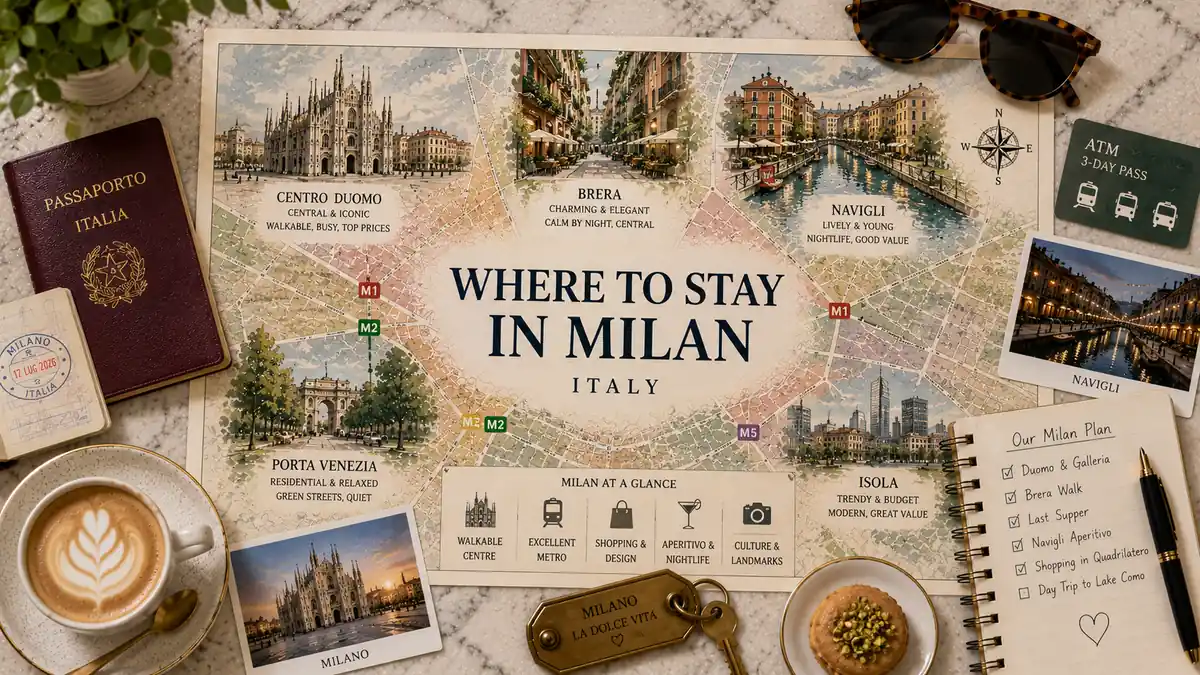
Milan’s three headline areas split by trip type: Centro for first-timers, Brera for quiet-central calm, and Navigli for nightlife. Porta Venezia and Isola round out the shortlist for specific travelers. Each area trades centrality against price and noise, so the table below maps them at a glance before the sections go deeper.
| Area | Best for | Vibe | Relative price | Proximity to Duomo |
|---|---|---|---|---|
| Centro / Duomo | First-time visitors | Historic, grand, always busy | High-end | Right at the core, walk everywhere |
| Brera | Couples, design lovers | Arty, calm, boutique-lined | Mid-range to high-end | A short walk north of the centre |
| Navigli | Nightlife, younger crowds | Canal-side, buzzy after dark | Mid-range | Short metro ride south of the centre |
| Porta Venezia | Relaxed and longer stays | Leafy, residential, easygoing | Mid-range | A few metro stops east |
| Isola | Modern-Milan, budget-minded | Design-forward, local-feeling | Budget to mid-range | Near Garibaldi, one metro hop |
Treat this table as the shortlist, not the verdict — each area rewards a different priority. The sections below expand every entry with the atmosphere, convenience, and relative price that decide the call. For how these areas fit into a wider trip, the broader Milan travel guide covers planning beyond the stay decision.
Centro (Duomo): the best base for first-time visitors
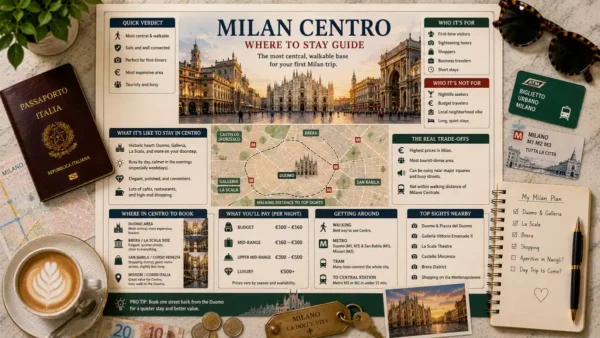
Centro/Duomo is the best base for first-time visitors, putting Milan’s landmarks and transport within walking distance. You wake up beside the Duomo, the Galleria, and La Scala, with metro lines fanning out to everything else. The tradeoff is real: this is the priciest, busiest part of the city.
The atmosphere is grand and monumental, the streets busy from morning until late. Convenience is the true draw — most first-visit sights sit within a walk, and three metro lines meet under the Duomo, so you rarely need a plan B. Expect high-end pricing across most hotels; you pay a premium for the address and the walkability. If it’s your first Milan trip and you value zero transit friction over a quiet night, base here. For the full breakdown see the Centro neighborhood guide, and the first-time stay guide goes deeper on booking your first base.
The Duomo premium buys walkability, not nightlife — Milan’s late scene runs south along the Navigli canals, so paying to sleep at the centre won’t put you closer to it.
Best for: first-timers who want everything on foot.
Brera: quieter, central and stylish
Brera suits couples and design-minded travelers who want a central base with a calmer, more stylish feel. Just north of the Duomo, it swaps the crowds for cobbled lanes, galleries, and boutique-lined streets. You stay within walking reach of the centre while giving up some of the buzz for quiet.
The atmosphere is romantic and unhurried, with art studios, wine bars, and independent shops setting the tone. Convenience stays high — the Duomo is a walk away and the metro is close — but the mood is softer than the tourist core. Pricing runs mid-range to high-end, reflecting the address and the polish. Couples and travelers who want central without the noise get the best of both. For the full picture see the Brera neighborhood guide, and the couples stay guide covers this fit in more detail.
Best for: couples wanting a stylish, central base without the crowds.
Navigli: nightlife, canals and a younger crowd
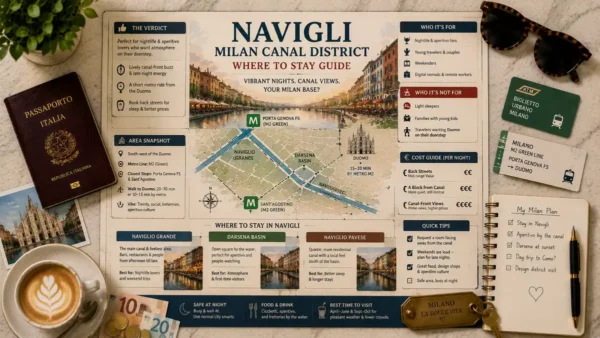
Navigli suits nightlife-focused and younger travelers who want canal-side bars and a lively after-dark scene. Built around Milan’s old canals, it fills nightly with aperitivo crowds, music, and restaurants. The tradeoff is noise and distance: it sits further from the Duomo and stays loud well past midnight.
By day the canals are relaxed and photogenic; by night the whole quarter turns into Milan’s drinking and dining hub. Convenience is decent — a short metro ride reaches the centre — but you’re trading walk-everywhere access for atmosphere. Pricing lands mid-range, generally friendlier than the Duomo. Light sleepers should book a room set back from the water. If bars and buzz outrank a quiet night, this is your base. See the Navigli neighborhood guide for depth, the nightlife stay guide for going-out logistics, and the Centro vs Navigli comparison if you’re torn between the two.
Best for: nightlife-first and younger travelers who want the party at their doorstep.
Other areas worth knowing: Porta Venezia and Isola
Porta Venezia and Isola are solid secondary bases that missed the main list only on centrality. Porta Venezia is leafy, relaxed, and well-connected, a favorite for longer or repeat stays. Isola, beside the Garibaldi skyscrapers, feels modern and local — good value with a design-forward edge and easy metro access.
Both reward travelers who value neighborhood feel over a Duomo-doorstep address. Porta Venezia’s calm, residential streets and nearby parks make it comfortable for families balancing sightseeing with downtime — the families stay guide covers that fit in detail. Isola works for a shorter, style-led stay when budget matters and you’re happy to ride the metro in. Neither replaces the big three for a first visit, but both make sense once you know Milan or want a quieter, cheaper corner.
Do you need to stay near the Duomo?
No — you don’t need to stay near the Duomo, because Milan’s metro makes quieter bases just as usable. The network is fast and dense, linking outer neighborhoods to the centre in minutes. Staying central buys walkability and saves transit time; staying out buys quiet and lower prices.
Milan is genuinely walkable in the historic core, but you’ll lean on the metro from almost any base, central or not. The real question is which tradeoff fits your trip:
- Stay central if you’re on a short, first-time trip and want to walk to the major sights.
- Stay out if you’d happily trade a short metro ride for a calmer, cheaper room.
A metro-connected room a few stops out often beats a central one for the same money — you lose about ten minutes each way and gain a much quieter night, which matters most on a two-day Milan trip when you’re out sightseeing anyway. To see how the call plays out between two central options, the Centro vs Brera comparison breaks it down. For confidence in picking a zone, the Milan safety guide covers which areas feel comfortable, and the 2-day Milan itinerary shows how little your base location matters once you’re moving.
Which area is cheapest, and is staying central worth it?
The cheapest stays sit outside the centre — peripheral, metro-connected areas beat Centro on price every time. Centro/Duomo carries the highest rates, Brera runs mid-range to high-end, and Navigli and Isola land more affordable. Whether the central premium is worth it depends on your trip length and priorities.
The premium pays off on a short first trip, when saved walking time outweighs the higher nightly rate and every hour counts. On longer stays it rarely does — a metro-connected base cuts the cost while barely touching your day. That price gap is the whole argument: a room two stops from the centre can run well below a central rate, and the saving often covers an extra night in the city. For the cheapest workable areas, the budget stay guide maps them out; at the other end, the luxury stay guide and our roundup of Milan’s luxury hotels cover the high-end options.
Best areas by traveler type
Here’s the fastest way to pick: match your traveler type to one Milan area and book. Each profile below points to the area that fits best, with the reason in a single clause. Use it as a shortcut when you don’t want to read every section above.
- First-timers: Centro/Duomo — everything walkable, transport on the doorstep.
- Couples: Brera — central but calm, stylish and romantic.
- Families: Porta Venezia — leafy, residential, easy to slow down in.
- Nightlife and younger travelers: Navigli — canal-side bars and late energy.
- Budget travelers: Isola or peripheral metro areas — lower rates, quick rides in.
- Luxury travelers: Centro or Brera — top hotels beside the landmarks.
Hotels and places to stay
Compare hotels, apartments and stays for your dates in one search.
Search hotels and stays on hotels.com →
Tripstou may earn a commission if you book through this link, at no extra cost to you.
Frequently Asked Questions
Is it safe to stay in Milan, and which areas should I avoid?
Milan is generally safe to stay in, including Centro, Brera, and Navigli. The main concern is pickpocketing around crowded transport hubs and tourist sights, not violent crime. The blocks immediately around Centrale station feel rougher at night, so book a room a little away from it.
Where should I stay in Milan without a car?
Stay anywhere central or metro-connected — Milan is designed for car-free travel. Centro/Duomo, Brera, and Navigli all sit on or beside metro lines, and the historic core is walkable. A car is a liability here thanks to limited parking and the central congestion-charge zone, so skip it entirely.
How many nights do you need in Milan?
Two nights suit most first visits, enough to cover the Duomo, the Galleria, and one or two museums without rushing. Add a third night if you want a day trip to Lake Como or extra time for shopping and aperitivo. One night works only for a quick stopover.
Where should I stay in Milan near the train station (Centrale)?
Base near Centrale only if you have early trains or a short stopover, since the area is convenient but charmless. The station sits on metro lines M2 and M3, so you can reach the Duomo in minutes. For a first proper visit, a central base like Centro or Brera feels far nicer.
Which Milan area is quietest for a good night’s sleep?
Porta Venezia and Brera are the quietest central-ish bases, with leafy, residential streets that calm down after dark. Avoid the Navigli waterfront if you’re a light sleeper, as canal-side bars run loud past midnight. Anywhere a couple of metro stops out of the centre also trades buzz for silence.
Is staying near a metro station essential in Milan?
Not essential, but it makes any base far more useful, especially outside the walkable core. Milan’s metro is fast and dense, so a room within a few minutes of a stop lets you reach the Duomo quickly from cheaper outer areas. In the historic centre, walking often replaces the metro entirely.
Related Guides
Plan your next step with these connected guides:
- Milan travel guide — broader city planning beyond the stay decision.
- Centro neighborhood guide — full detail on Milan’s historic core.
- Navigli neighborhood guide — the canal-side nightlife district in depth.
- First-time stay guide — booking your first Milan base.
- Luxury hotels in Milan — the actual high-end properties.
- 2-day Milan itinerary — pacing a short trip.
- Milan safety guide — which areas feel comfortable.
Did this guide save you time or money? Tripstou is independent and reader-funded — if you'd like to give something back, you can support the site with a crypto contribution of any size.