Three days gives you enough time for Florence’s Renaissance core, but only if you order it well. The historic centre packs the Duomo, the Uffizi, David, and the Oltrarno into a space you can cross on foot in twenty minutes, so the real planning problem is sequence, not distance. Cluster the wrong sights on the wrong day and you spend the trip doubling back across the Arno and queuing at the busiest hour. This plan groups each day by geography and by booking reality: museum mornings, walking afternoons, and evenings that end at a bridge or a hilltop view. It is built for first-timers who want a full but unrushed trip, with a clear recommendation for the third day and a Tuscan day-trip alternative if you would rather leave the city.
Quick Answer
Three days is enough to see Florence’s Renaissance core at a walkable pace. Spend Day 1 on the historic centre and the Uffizi, Day 2 on David, the dome climb, and the Oltrarno, then use Day 3 to go deeper in the city or take a Tuscan day trip. Book Uffizi and Accademia tickets ahead.
Trust Layer
Tripstou itinerary guide for travelers planning a route. Covers pacing, stop count, stop order, base logic, and trip length.
Produced with AI assistance and reviewed by Alex Perrut, working in tourism since 2015, for the Tripstou editorial team. See our editorial process for details.
Last factual review: July 15, 2026.
Official sources consulted: italia.it, enit.it.
Key Takeaways
- Three days comfortably covers Florence’s Renaissance core at an unrushed pace, leaving the third day free for depth or a Tuscan escape.
- Group each day by geography — north-bank core, then David and the Oltrarno — so you walk the plan without backtracking across the Arno.
- Pre-book official Uffizi and Accademia tickets before you arrive; both sell out and skipping the queue reshapes your whole day.
- Day 3 is a fork: stay for city depth and Piazzale Michelangelo at sunset, or leave for a Tuscan hill-town day trip.
- Almost the entire route is walkable, with Piazzale Michelangelo the only real climb and day trips the only time you need transport.
- The extra day over a two-day trip is what turns a highlights sprint into a proper, sit-down-for-lunch Florence visit.
Table of Contents
Is Three Days in Florence Enough?
Yes, three days is enough to see Florence’s Renaissance core at an unrushed pace. The centre is compact and walkable, so you can cover the landmark sights in two days and keep the third for depth or a Tuscan day trip. First-timers rarely feel short on time with three full days.
Two days is enough to tick the headline sights, but it is a sprint. You reach David and the Uffizi and little else, and evenings get eaten by queues you could have avoided. The third day is what turns a highlights dash into an actual trip. It buys you the dome climb, a proper crossing into the Oltrarno, and time to sit down for lunch instead of eating on the move. If you only have 48 hours, the tighter 2-day Florence itinerary shows what to cut and what to keep.
The third day is where Florence stops feeling like a checklist. Days one and two are largely fixed by the must-see sights; the third is the only one you can spend on a single neighbourhood, a museum you loved enough to revisit, or a hill town an hour away. That freedom is the payoff a two-day trip never delivers.
Your 3-Day Florence Itinerary at a Glance
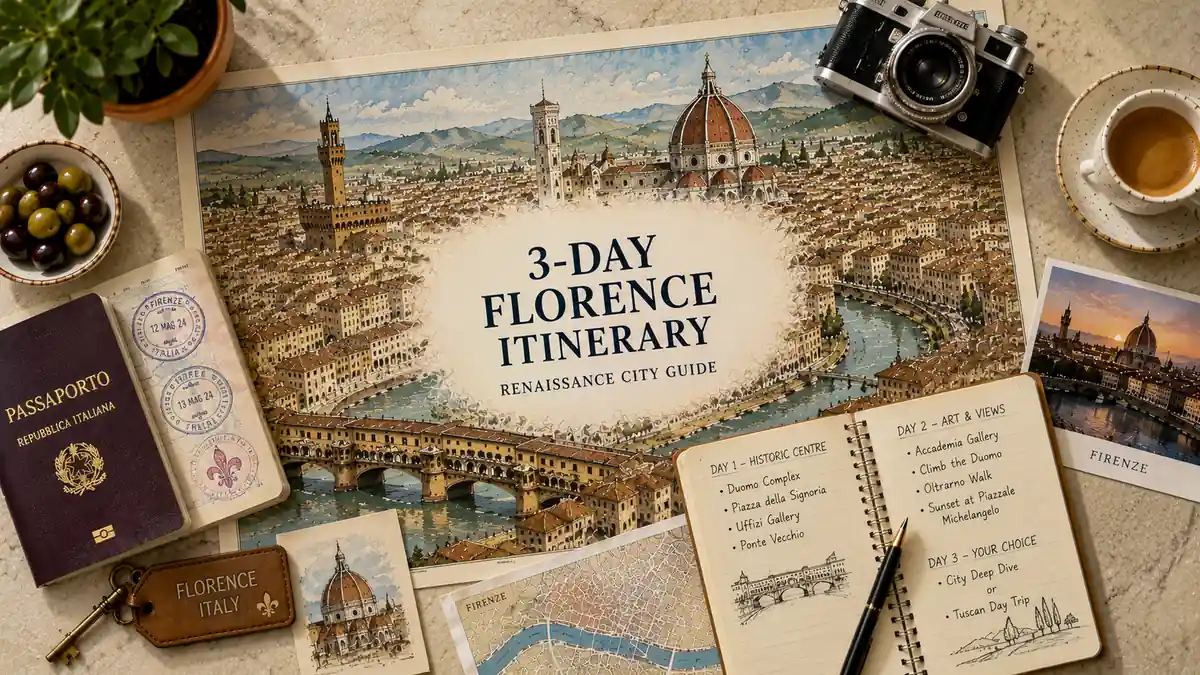
The recommended shape is three geographically grouped days that minimise backtracking. Day 1 covers the Renaissance core around the Duomo and Uffizi, Day 2 takes in David, the dome climb, and the Oltrarno across the Arno, and Day 3 goes deeper in the city or heads out to Tuscany. Each day ends near where the next one starts.
Here is the route at a glance, one line per day:
- Day 1 — Renaissance core: Duomo, Piazza della Signoria, Uffizi, Ponte Vecchio
- Day 2 — David and the Oltrarno: Accademia, dome climb, San Lorenzo, Pitti and Boboli
- Day 3 — depth or a day trip: Medici sights and Piazzale Michelangelo, or a Tuscan escape
The order is deliberate. Day 1 keeps you inside a tight city-centre loop on the north bank so you learn the ground before crossing the river. Day 2 pushes west and then south over the Arno, ending in the Oltrarno where you are already positioned for a sunset viewpoint. This grouping is what keeps the plan walkable and stops you crossing the same bridge four times. For the wider city context this plan sits inside, see the full Florence guide; if you want the complete menu of sights to swap in, the things to do in Florence guide lists them all. This itinerary selects and sequences a first-timer core rather than cataloguing everything.
Day 1: The Renaissance Core
Day 1 covers the dense Renaissance heart of Florence in a single walkable loop. You start at the Duomo exterior, move through Piazza della Signoria and Palazzo Vecchio, spend the middle of the day in the Uffizi, and end on the Ponte Vecchio at dusk. Everything sits within a few minutes’ walk on the north bank.
Open with the Duomo and Brunelleschi’s dome from the outside; save the climb itself for Day 2 when you have a timed slot. From the cathedral it is a short walk south to Piazza della Signoria, the open-air sculpture gallery outside Palazzo Vecchio, where you get your first read on the city’s civic centre.
Give the Uffizi the core of the day. Book an official timed entry in advance and aim for a morning or late-afternoon slot to dodge the worst crowds; treat any prices and opening hours as things to verify before you go, since they shift by season. Two to three hours inside is a realistic first-timer visit without museum fatigue.
End at the Ponte Vecchio. It is a two-minute walk from the Uffizi, it looks best in the low evening light, and it drops you at the river ready to cross into the Oltrarno the next day. If you want a longer catalogue of what else sits on this loop, the things to do in Florence guide covers the overflow.
Day 2: David, the Duomo Climb, and the Oltrarno
Day 2 pairs Florence’s two biggest climbs and its most atmospheric quarter. You start at the Accademia for David, take your timed dome climb mid-morning, break for lunch near San Lorenzo and Mercato Centrale, then cross the Arno into the Oltrarno for Pitti Palace, the Boboli Gardens, and quieter streets. The route runs west to south.
See David first, at opening. The Accademia is small, it fills fast, and an advance official ticket saves you the longest queue in the city. Thirty to sixty minutes is enough for most first-timers; the museum is compact and David is the reason you came.
Climb the dome on a pre-booked slot. Dome access uses a timed reservation that sells out, so lock it in when you buy your tickets and treat the exact rules as something to confirm officially. From the top you get the view that makes sense of the whole centre you walked yesterday. Break afterwards at Mercato Centrale for a fast, good-value lunch.
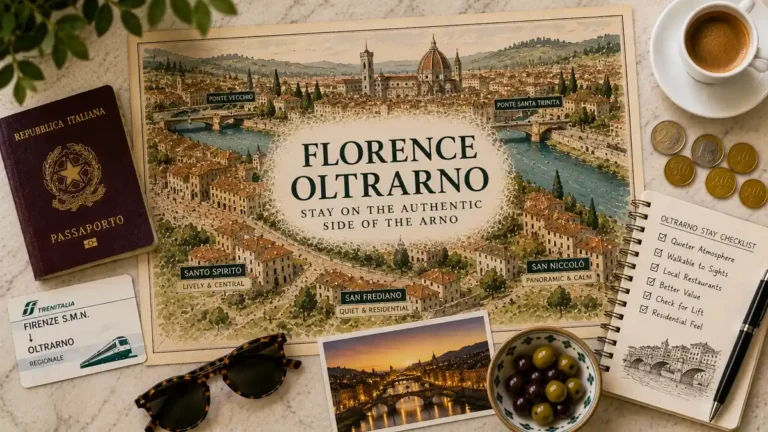
Cross into the Oltrarno for the afternoon. Pitti Palace and the Boboli Gardens anchor the south bank, and the surrounding artisan streets are where the day slows down. Staying central makes this crossing effortless on foot, which is exactly why base location matters for this plan.
Day 3: Stay in Florence or Take a Day Trip?
Stay in the city on Day 3 if this is your first visit. Use it for the depth the first two days skip — the Medici chapels, a museum worth a second look, and Piazzale Michelangelo for the classic sunset panorama across the Arno. Take a Tuscan day trip only if you have already covered the core.
The default is city depth because Florence still has more first-timer weight than any single hill town can match on a tight schedule. A third day inside the walls lets you revisit the Uffizi highlights, wander the Oltrarno properly, and finish at Piazzale Michelangelo as the light drops — a short climb or bus ride for the best free view in the city.
The day trip only wins once the city no longer needs you. If your dome climb is unbooked or you have not crossed into the Oltrarno yet, spend Day 3 in Florence. Swap to Tuscany when the core is genuinely done and a countryside change would refresh the trip more than a fourth museum. The next section covers which day trip suits which traveller.
Best Day Trips from Florence for a 3-Day Trip
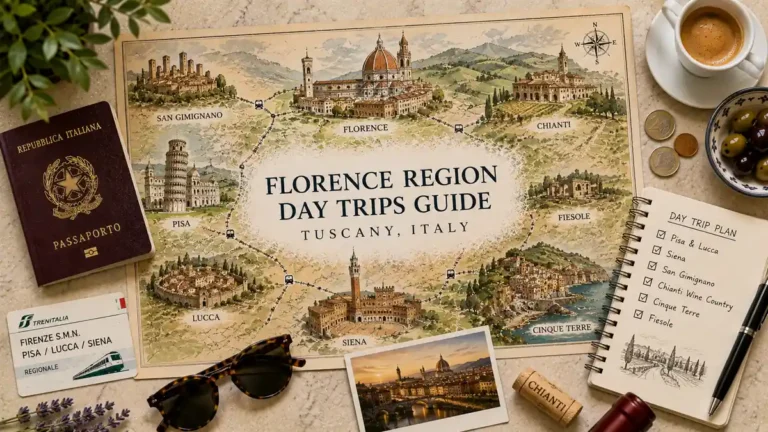
The strongest day trips from Florence trade a little travel effort for a very different landscape. Siena and San Gimignano deliver the classic Tuscan hill-town pairing, Chianti sells slow wine-country scenery, Lucca offers walled-city calm, Pisa is the quick tower stop, and Bologna adds a food-city contrast. Pick by the mood you want, not by distance alone.
The table below sorts the main options by who they suit and rough travel effort. Times and fares shift by season and service, so confirm current schedules before you commit — and if day-trip costs matter to your budget, the Florence trip cost guide breaks down the spending side.
| Day trip | Who it suits | Travel effort | What you get |
|---|---|---|---|
| Siena and San Gimignano | First-timers wanting classic Tuscany | Moderate, easiest by guided tour | Two iconic hill towns in one day |
| Chianti wine country | Couples and slow-travel fans | Moderate, best with a tour or car | Vineyard scenery and tastings |
| Lucca | Travellers wanting a calm walled town | Low, direct train | Bike-able ramparts and quiet lanes |
| Pisa | Anyone set on the leaning tower | Low, short direct train | The famous tower and cathedral square |
| Bologna | Food-focused travellers | Low, fast train | A university city built around eating |
Pisa is the shortest trip but the thinnest payoff. Most people photograph the tower within an hour and then wish they had given the day to Siena or Lucca. If your third day is precious, weight it toward the hill towns or a food city rather than the quickest tick on the list.
Tours and activities
Book skip-the-line tickets, day trips and local tours with free cancellation on most activities.
You can also browse everything on getyourguide.com.
Tripstou may earn a commission if you book through this link, at no extra cost to you.
Can You Walk the Whole Florence Itinerary?
Yes, you can walk almost the entire plan. Florence’s historic centre is compact and flat, and this itinerary is grouped by geography specifically so each day flows on foot with no wasted crossings. The only exceptions are Piazzale Michelangelo, which needs a short climb or bus, and any day trip out of the city.
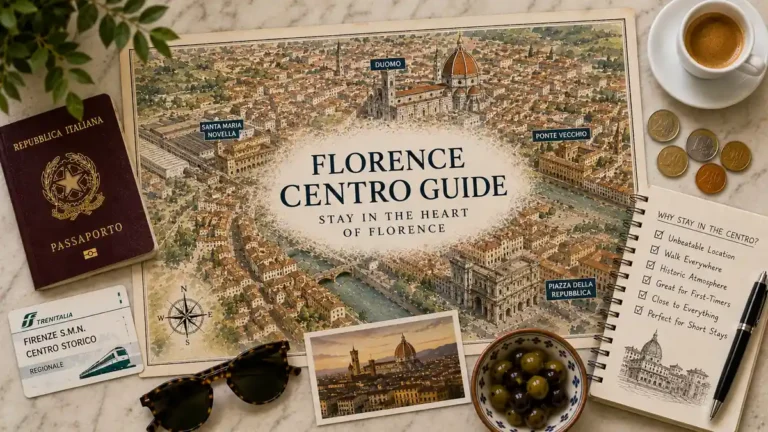
Most of the core sights sit within a fifteen-to-twenty-minute walk of each other, and the daily loops are built to end near the next morning’s start. The one uphill stretch is Piazzale Michelangelo on Day 3 — reachable on foot up a stepped path or by a short local bus if you would rather save your legs for the view. To keep the whole plan this walkable, base yourself centrally; the Florence where to stay guide covers which neighbourhoods put you inside the loop.
How to Adapt This Itinerary for More or Fewer Days
Adapt the plan by trimming from the outside in or adding from the third day out. With only two days, cut the Day 3 depth and the day trip and keep the fixed core of David, the Uffizi, and the dome. With four days or more, keep three days intact and add a Tuscan day trip or onward Italy leg.
Cutting to two days means dropping the softer, optional pieces first: Piazzale Michelangelo, the Medici chapels, and any day trip. Protect the non-negotiable core — the Uffizi, David, and the dome climb — and compress the Oltrarno into a shorter afternoon. The dedicated 2-day Florence itinerary already sequences this tighter version for you.
Adding a fourth day is where the day trip earns its place: leave Florence’s core untouched across Days 1 to 3 and use the extra day for Tuscany or a longer route through the country. To extend beyond the city, the Italy itinerary guide connects Florence into a multi-city trip.
Drop the day trip before you drop anything inside the walls. On a tight schedule Florence’s core rewards depth more than a rushed hill town does, so the countryside is the first thing to go when days shrink and the last thing to add when they grow. Keep one recommended route and flex it — do not run two itineraries in parallel.
Frequently Asked Questions
Do you need to book Uffizi and Accademia tickets in advance?
Yes, book official Uffizi and Accademia tickets before you arrive. Both are Florence’s busiest museums and walk-up queues can swallow hours, especially in peak season. Reserve a timed entry directly through the official ticketing site as early as you can, and treat exact prices and booking fees as things to confirm before you go.
What is the best time of year to visit Florence?
Spring and autumn are the best times to visit Florence. The shoulder months bring mild walking weather and thinner crowds than the July–August peak, when heat and queues both spike. Winter is quietest and cheapest but cooler, while high summer suits travellers who pre-book everything and start their sightseeing early.
How many days do you need in Florence?
Most first-timers need three days in Florence to see the Renaissance core without rushing. One day only skims the Duomo and a single museum, two days cover the essentials at a sprint, three days add breathing room and a viewpoint, and four or more open up a Tuscan day trip.
Can you visit the Uffizi and Accademia on the same day?
You can, but it makes for a heavy museum day. This plan deliberately splits them — the Uffizi on Day 1 and the Accademia on Day 2 — so neither feels rushed and you avoid back-to-back gallery fatigue. If you must combine them, book a morning Accademia slot and an afternoon Uffizi slot.
Do you need to climb the Duomo dome, and should you pre-book it?
You do not have to climb the dome, but the panorama over Florence rewards those who can manage the stairs. There is no lift and the ascent is steep and narrow, so skip it if stairs or tight spaces are a problem. Access uses a timed reservation that sells out, so pre-book it.
Is Florence a good base for day trips in Tuscany?
Yes, Florence is one of the best bases for exploring Tuscany. It sits on major rail lines and is a hub for guided tours, putting Siena, Lucca, Pisa, and the Chianti hills within an easy day’s reach. On a three-day trip, though, save day trips for a fourth day so the city comes first.
Related Guides
- Florence Guide — the full city hub for planning your whole trip.
- 2-Day Florence Itinerary — the shorter plan when you only have two days.
- Things to Do in Florence — the complete menu of sights to swap in.
- Where to Stay in Florence — the best central bases for walking this route.
- Florence Trip Cost — budget, tickets, and day-trip spending.
- Italy Itinerary — extend beyond Florence across the country.
Did this guide save you time or money? Tripstou is independent and reader-funded — if you'd like to give something back, you can support the site with a crypto contribution of any size.