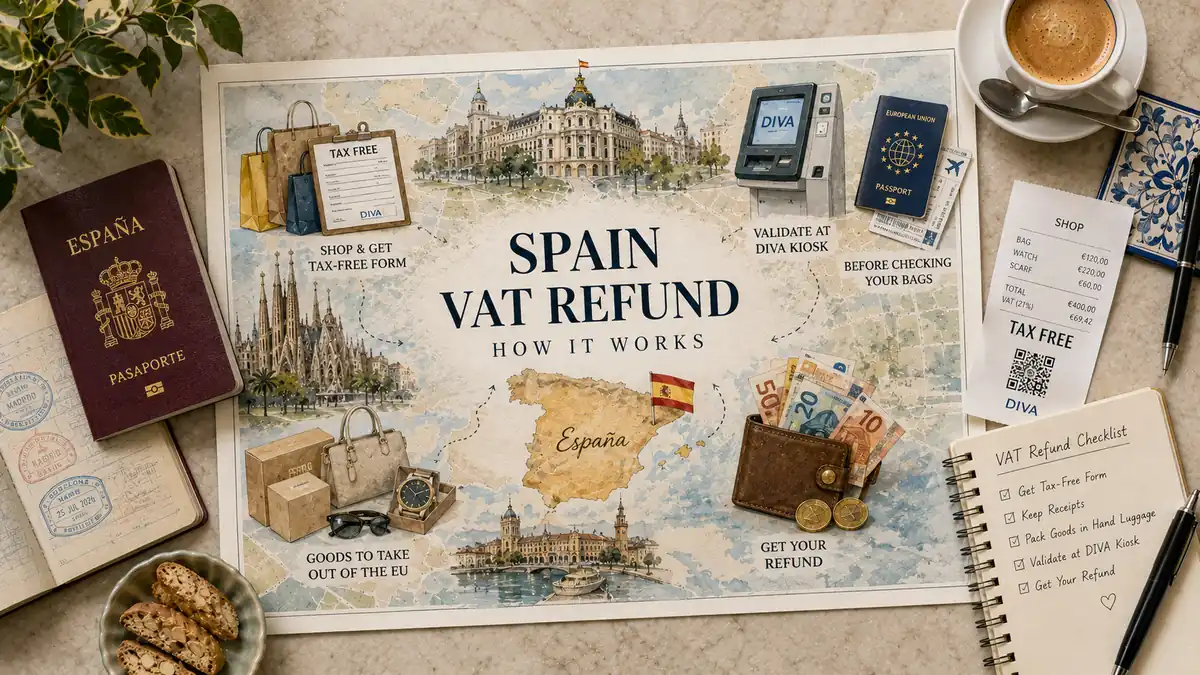
Non-EU residents can reclaim Spanish VAT on goods they carry home, and the process is more mechanical than most guides make it sound: get a tax-free form when you pay, validate it electronically at the airport, collect the money. Two corrections matter before you start. First, Spain has no minimum purchase amount — the €90 threshold still quoted across the web was abolished, and any qualifying purchase can be claimed. Second, the 21% VAT rate is a headline, not a payout: after operator commissions and surcharges, most travelers net roughly 12–15.7% of the purchase price. This guide covers who qualifies, how the in-store step and the DIVA kiosk work, what you actually get back, how Global Blue and Planet fit in, how long refunds take, and what changes when Spain is not your last stop in the EU.
Quick Answer
Non-EU residents reclaim Spanish VAT by getting a tax-free form in-store and validating it at an airport DIVA kiosk. There is no minimum purchase, but the amount you net depends on whether the shop refunds you directly or an operator takes a commission. Validate before checking your bags — customs may ask to see the goods.
Trust Layer
Tripstou planning guide for travelers resolving one travel decision. Covers the main variable, traveler context, and practical tradeoffs.
Produced with AI assistance and reviewed by Alex Perrut, working in tourism since 2015, for the Tripstou editorial team. See our editorial process for details.
Last factual review: July 25, 2026.
Official sources consulted: spain.info, tourspain.es.
Key Takeaways
- Spain scrapped its minimum purchase amount, so even a small souvenir qualifies for a VAT refund if you follow the process.
- Only non-EU tax residents can claim, and only on goods — hotels, meals, and transport never qualify.
- Validate your tax-free forms at a DIVA kiosk before checking your bags, since customs may ask to see the goods.
- Expect roughly 12–15.7% of the price back, not the full 21%, once operator commissions and surcharges are deducted.
- Shop-direct refunds skip operator commission and return more of the VAT, so ask at the till before defaulting to a desk.
- Goods must leave the EU within three months, and on multi-country trips you validate at your final EU exit point.
Table of Contents
Who Can Claim a VAT Refund in Spain?
Only travelers whose tax residence is outside the EU can claim a Spanish VAT refund, and only on goods. Purchases must be for personal use or gifts and leave the EU with you. Services — hotels, meals, car hire — never qualify, regardless of where you live.
Tax residence is the test, not nationality or visa status. A traveler who lives and pays taxes outside the EU qualifies even on a short visa-free visit; an EU resident does not, whatever passport they hold. Your passport, shown at the till, is the standard proof. Whether you can enter Spain in the first place is a separate question — the Spain visa requirements guide covers entry rules.
Can UK Tourists Claim a VAT Refund After Brexit?
Yes. UK residents count as non-EU residents and can claim Spanish VAT refunds on goods they take home. The process is identical: tax-free form at the shop, DIVA validation at the airport, then collection. A UK passport showing UK residence is normally all the proof the shop needs.
There Is No Minimum Purchase Amount in Spain
Spain has no minimum purchase amount for a VAT refund — any qualifying purchase can be claimed. Guides quoting a €90 or €90.16 threshold are outdated; that rule was abolished. A €10 souvenir is as claimable as a €1,000 handbag, provided you follow the same form-and-validation process.
The myth persists because the threshold was once real, and commercial tax-free guides copied each other long after the rule changed. Spain scrapped it. Any shop that refuses a tax-free form because the purchase is “too small” is applying its own policy, not Spanish law.
The rule’s real value shows in mid-size purchases — clothes, shoes, gifts — that the old threshold would have excluded. On very small tickets, an operator’s commission can shrink the refund to less than the airport queue is worth, so consolidating purchases in fewer shops usually beats claiming every tiny receipt.
How to Get the Tax-Free Form in the Shop
Ask the shop for a tax-free (DIVA) form at the till and show your passport when paying. The shop issues an electronic form linked to your purchase, which you later validate at the airport. Without this form there is no refund — you cannot create one after leaving the store.
The in-store step takes a minute when you know the sequence:
- Check for tax-free signage — Global Blue, Planet, or a generic “Tax Free” sticker. Not every shop participates.
- Show your passport at checkout and ask for the tax-free form before the transaction closes.
- Confirm your name and passport details on the form match your documents exactly.
- Keep the receipt together with the form — you will need both at the airport.
Department stores and chains handle this daily; small independents may not offer it at all. Ask anyway. If tax-free shopping is one stop in a longer trip, the Spain travel guide covers the rest of the planning.
How Does DIVA Validation Work at the Airport?
Scan each tax-free form’s barcode at a DIVA kiosk in the airport before you leave the EU. DIVA is Spain’s mandatory electronic validation system — it replaced the manual customs stamp. A green screen means the form is validated and you can proceed to collect your refund.
Kiosks sit in the check-in areas of Spain’s major international airports, including Madrid Barajas (Terminals 1 and 4) and Barcelona El Prat (Terminals 1 and 2). Follow the tax-free or VAT refund signage on the day — positions change. A red screen means the form needs a manual check at the customs desk; the FAQ covers what to bring.
Do You Validate DIVA Before or After Checking Your Bags?
Before. Validate while your luggage is still with you, because customs can ask to see the goods during a manual check. A validated form with no goods to show is the one situation that reliably kills a refund. Three habits prevent it:
- Validate at the kiosk before you drop checked bags — or keep refundable goods in your carry-on.
- Have forms, receipts, passport, and boarding pass together in one place.
- Build in extra time — kiosks and customs desks queue at peak departure hours.
How Much VAT Do You Actually Get Back?
Expect roughly 12–15.7% of the purchase price back — not the full 21% VAT rate. Refund operators deduct commission before paying you, and cash or currency conversion can trim the amount further. The 21% figure is what the shop charged, not what reaches your pocket.
The gap is structural. Operators run the desks, apps, and payment rails, and they fund all of it from a slice of your refund. Choosing cash at the airport usually adds a surcharge on top; taking the refund in a non-euro currency adds a conversion margin. Each convenience costs a little more of the 21%.
Shop-direct refunds are the exception worth chasing: a retailer that refunds you itself skips the operator’s commission and returns more of the VAT for identical paperwork — asking at the till costs nothing. Treat whatever arrives as a bonus, not money already spent; the Spain travel budget guide is the place for overall trip-cost planning.
Spending money abroad
A Wise account converts your money at the mid-market exchange rate and shows every fee upfront, with a card you can spend in the local currency.
Check Wise’s rates and fees for your currency →
Tripstou may earn a commission if you sign up through this link, at no extra cost to you.
Global Blue vs Planet: How to Choose
You rarely choose between Global Blue and Planet — the shop’s affiliation decides which operator handles your form. Both work identically under Spain’s DIVA system. Your real decision is the refund method: immediate cash at an airport desk, a slower card refund, or a shop-direct refund where offered.
Frame it as speed against yield:
- Shop-direct refund — the largest payout, since no operator commission applies, but only some retailers offer it and the money follows later.
- Operator cash desk — money in hand before boarding, at the cost of commission plus a cash surcharge.
- Operator card refund — no cash surcharge and no desk queue, but you wait days to weeks for the credit.
For a large single purchase, the card refund’s better rate usually justifies the wait. For a handful of small forms at the end of a trip, the cash desk’s simplicity can win even at a worse rate.
How Long Does a Spain VAT Refund Take?
Cash refunds at an airport desk are immediate; card or bank-transfer refunds take days to weeks. Shop-direct refunds can take up to around 15 days after your form is validated. The fastest method — cash — is usually also the one with the highest surcharges.
Card refunds land on the card used for the purchase or the one registered on the form, so check the details before you fly. Keep a photo of every validated form. If a refund never arrives, contact the operator — or the shop, for direct refunds — quoting the form reference; the validated DIVA record is your proof the export was completed.
What If Spain Is Not Your Last EU Stop?
Validate your Spanish tax-free forms at your final EU exit point, even if that airport is outside Spain. The rule follows the EU border, not the country of purchase. Flying Madrid to Paris to New York means validation happens in Paris — Spain’s kiosks cannot close out your claim.
The same applies in reverse: purchases made elsewhere in the EU get validated in Spain when Spain is your last stop before home. At a non-Spanish exit, local kiosks may not read a Spanish DIVA form, which sends you to the staffed customs desk instead — budget extra airport time for the queue. Keep the goods accessible there too. The three-month export window still applies wherever you exit; the FAQ covers the deadline in detail.
Frequently Asked Questions
Can You Get a VAT Refund on Hotels or Restaurants in Spain?
No. Spain’s VAT refund applies only to physical goods you carry out of the EU, never to services. Hotel stays, restaurant meals, car hire, tours, and transport are all excluded, regardless of your residence. Only tangible purchases like clothing, electronics, or gifts can be claimed through the tax-free process.
Does the VAT Refund Work in the Canary Islands?
No. The Canary Islands, Ceuta, and Melilla sit outside Spain’s mainland VAT system — they use IGIC and IPSI taxes instead. Purchases made there do not qualify for the standard tax-free VAT refund covered here. The DIVA process applies to goods bought under mainland Spain’s 21% VAT rate.
How Long Do You Have to Take the Goods Out of the EU?
Three months. Goods must leave the EU within three months of the purchase date for the VAT refund to remain valid. If you validate your DIVA form after that window closes, the claim fails. Keep the purchase date in mind when planning a long trip through several countries.
What Happens If the DIVA Kiosk Screen Turns Red?
A red screen means the kiosk cannot validate your form automatically, so head to the customs office for a manual check. Bring the goods, receipts, tax-free forms, passport, and boarding pass. An officer verifies the export and validates the form by hand, letting you then collect your refund as normal.
Do the Goods Need to Be Unused to Claim the Refund?
Yes, in principle. Tax-free goods are meant to be exported unused, so carry them in original packaging and keep them accessible for inspection. Customs can ask to see the items during a manual check, and visibly used or consumed goods can put the refund at risk. Treat them as sealed until you land.
Related Guides
- Spain travel guide — the full Spain hub: where to go, how to get around, and how a shopping stop fits the wider trip.
- Spain travel budget — what a trip to Spain really costs by style and season, so the refund stays a bonus, not a plan.
- Spain visa requirements — who needs a visa to enter Spain and what border officers expect on arrival.
Did this guide save you time or money? Tripstou is independent and reader-funded — if you'd like to give something back, you can support the site with a crypto contribution of any size.