The best first trip to Bulgaria uses Sofia as the base, adds Rila Monastery and Plovdiv as the two strongest add-ons, and spends one night away in Veliko Tarnovo. The season changes the answer for some travelers: the Black Sea coast is a summer trip of its own, and Bansko is the pick for a winter ski week.
The picks below cover the places and things to do in Bulgaria that suit first-time visitors arriving in Sofia. They are grouped by the kind of trip they suit (the core route, the mountains, the coast and the places beyond the classic route), so you can take the group that matches your trip and skip the rest.
On This Page
Is Bulgaria Worth Visiting, and Where Should You Start?
Bulgaria is worth visiting for travelers who want medieval monasteries, Roman and Revival-era old towns, high mountains and a summer coast inside one compact country. Start in Sofia, then add Rila Monastery, Plovdiv and Veliko Tarnovo.
That combination wins because its four parts do not overlap. Sofia is a working capital with layers from every era. Rila Monastery is a painted monastery deep in the mountains. Plovdiv is a lived-in old town built over Roman ruins, and Veliko Tarnovo is a medieval capital on its hilltop. Few first trips get that much range from so little ground.
The route does not suit a pure beach holiday or a ski week; both have their own sections further down. After the core picks, the page moves to the mountains, then the coast, then the places that reward a second trip or one particular interest.
Where a First Trip Goes: Sofia, Plovdiv, Veliko Tarnovo and Rila Monastery
These four make the core of a first trip. Sofia is the base, Rila Monastery and Plovdiv are the add-ons from it, and Veliko Tarnovo is the one place worth a night away.
Sofia or Plovdiv is not really a choice. Sofia is the bigger city and the practical base; Plovdiv is the more atmospheric old town. A first trip takes both.
Sofia
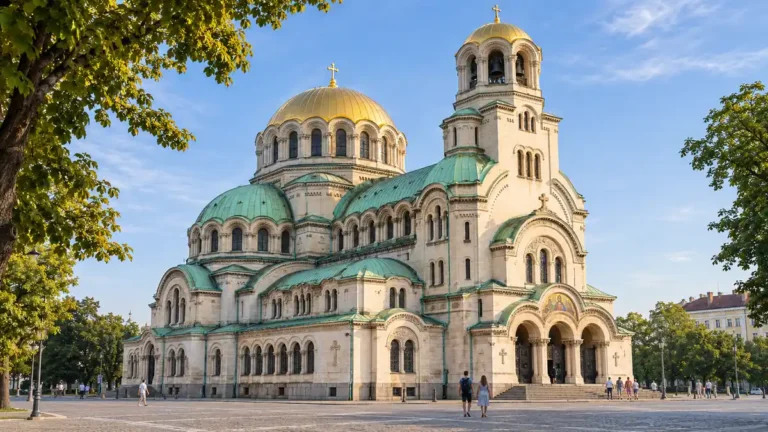
Sofia is the base because flights land here and the add-ons reach out from it. Its historic centre packs the Roman remains of Serdika, Orthodox churches and the gold-domed Alexander Nevsky Cathedral into a few walkable streets. Communist-era buildings sit right beside them, so a single walk covers most of the city’s story. Vitosha Boulevard is the main street for cafés and evenings, and Vitosha mountain rises on the city’s doorstep for a half-day outdoors. The Sofia travel guide covers the city sight by sight.
Plovdiv
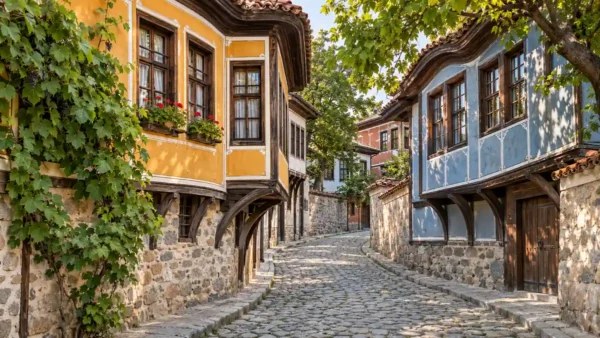
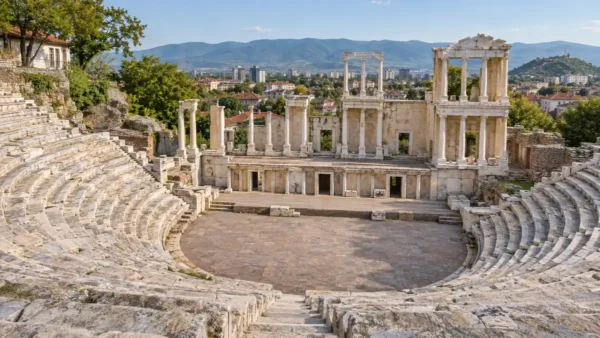
Plovdiv is worth the trip from Sofia: its Old Town is a lived-in quarter of Revival-era houses set over Roman ruins, with the Ancient Theatre at its heart and the cafés of Kapana a few streets below. It is the most atmospheric town on the core route, and the one where travelers who like to wander get the most. Whether it works as a day trip or deserves a night is settled on the page about things to do in Plovdiv; without a car, you can also book a guided day trip from Sofia.
Veliko Tarnovo
Veliko Tarnovo is the best overnight from Sofia. It was the capital of medieval Bulgaria, and the town still looks the part: houses stacked up the slopes of a river gorge, with Tsarevets Fortress on the hill opposite.
Tsarevets is worth it. The walls run around the whole hilltop, and the walk up to the patriarchal church at the summit gives the best view of the town and the river below. The standard ticket costs €7.67.
The night is the point. Veliko Tarnovo sits too far from Sofia for a comfortable day trip, and one night lets you see the fortress at a slower pace and the old town in the evening. Of the four core picks, it gives the most to anyone drawn to medieval history on a grand scale.
Rila Monastery
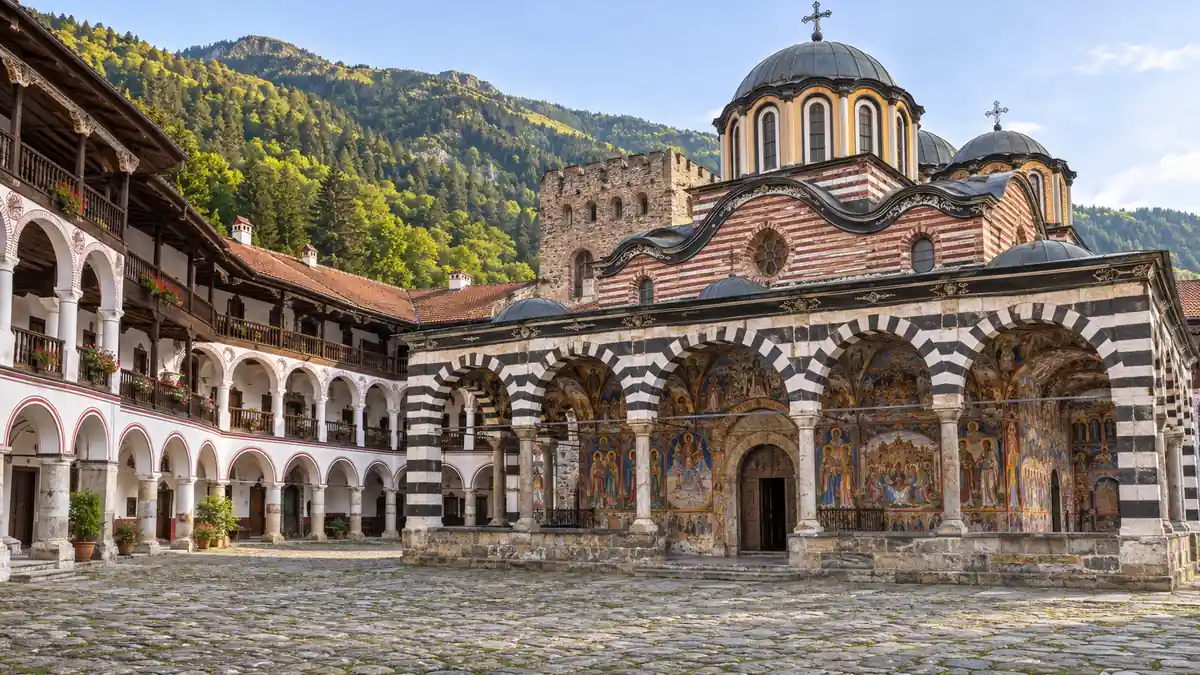
Rila Monastery is the country’s best-known monastery and a UNESCO-listed site, set in a mountain valley of the Rila range. Striped arcades and a church covered in frescoes fill the courtyard, with forested peaks rising on every side.
It is a classic day trip from Sofia. Travelers without a car can reserve a guided day trip from the capital, while drivers can pair the monastery with a walk in the valley.
The combined ticket for all the museum exhibits costs €12 and is sold only at the monastery; single museums start from €2.50. Pick Rila if you want one image of Orthodox Bulgaria to take home.
Tours and activities
Book skip-the-line tickets, day trips and local tours with free cancellation on most activities.
You can also browse everything on getyourguide.com.
Tripstou may earn a commission if you book through this link, at no extra cost to you.
Bulgaria’s Mountains Are for Summer Hikes and Winter Skiing
Bulgaria’s mountains split by season. The Seven Rila Lakes and the Rhodopes are warm-season picks, and Bansko is the winter one. None of them is a casual add-on to a city trip: each needs a full day at least.
The Seven Rila Lakes
The Seven Rila Lakes are a mountain hike for fit walkers: a chain of glacial lakes stepped one above the other in the Rila range. A chairlift climbs from the Panichishte side up to the Rila Lakes hut, and the walk starts there.
The full circuit is a summer and early-autumn outing. Outside that window the high trails are under snow. The lift runs on a seasonal timetable.
The chairlift sells adult and reduced fares, and children under 5 ride free.
| Ticket holder | One-way | Return |
|---|---|---|
| Adult | €13 | €20 |
| Child aged 5 to 12, pensioner or disabled traveler | €7 | €10 |
| Child under 5 | Free | Free |
The lift saves the climb to the hut, not the walk itself: the lakes circuit still starts at the top, on foot, at altitude. Walkers who prefer a guide and a set start can book a guided hike from Sofia.
Bansko and the Ski Resorts
Bansko is Bulgaria’s biggest and best-known ski resort, set under the Pirin mountains; Pirin National Park is UNESCO-listed. Borovets and Pamporovo are the other two main resorts. Skiing here is a winter trip of its own, built around the resort, and it does not mix with the Sofia-led culture route.
The Rhodopes
The Rhodopes are the south’s mountains of gorges, caves and villages, with Trigrad Gorge and the Devil’s Throat cave as the best-known stops. They suit slow travelers with a car who already have a second trip in mind.
Which Black Sea Town in Bulgaria Suits You?
Sozopol suits a quieter old-town beach base, Nessebar is the pick for its UNESCO-listed old town, and Varna is a city with a beach. The coast is a summer trip of its own, not an add-on to Sofia.
The resorts are built for summer, and prices and crowds peak in July and August. That peak is where the coast changes a budget most; the breakdown of how much a trip to Bulgaria costs shows what to expect.
Nessebar
Nessebar is a UNESCO-listed old town of medieval churches on a small peninsula joined to the mainland. It is the most striking town on the coast and the most crowded in summer. Go for the churches and the setting, and expect company.
Sozopol
Sozopol is the quieter old-town beach base: wooden houses on a headland, with beaches on either side. It suits couples and families who want a beach and an evening stroll without resort nightlife.
Varna and Burgas
Varna is a city with a beach, and its Sea Garden park runs along the shore. Choose it for restaurants, museums and city life alongside the sea, with the palace and botanical gardens at Balchik and the resort of Golden Sands to the north. Burgas is a working city between the sea and its lakes, more a gateway to the southern coast than a destination.
Is Sunny Beach Worth It?
Sunny Beach is worth it only if a resort holiday is the goal. It is a package resort built for nightlife and all-inclusive stays, with little culture of its own. Anyone after old towns and character does better in Sozopol or Nessebar.
Beyond the Classic Route: Buzludzha, the Rose Valley and Small Towns
These are second-trip or special-interest picks. Each one rewards a particular kind of traveler and costs a detour, so choose the one or two that match your interests instead of trying to collect them all.
Can You Go Inside Buzludzha?
No: the interior of Buzludzha is closed to visitors, and the monument is seen from outside. Even from the outside, it is the most dramatic communist-era monument in the country, a concrete saucer on a mountain ridge near Shipka.
Photographers and history fans get the most from it. There is no public transport to the site, so you need a car or a tour from Sofia or Plovdiv. In winter, snow can close the mountain road. A summer event is held at the site.
The Rose Valley and Kazanlak
The Rose Valley is Bulgaria’s rose-oil country, with Kazanlak as its town and the UNESCO-listed Thracian Tomb of Kazanlak as its historic sight. It is best in late spring, when the roses bloom and the harvest is under way. Outside that season it suits travelers drawn to the Thracian past more than to the flowers.
Koprivshtitsa
Koprivshtitsa is a preserved Revival-era village of painted houses and cobbled lanes in the hills. Come here for Bulgarian village life at its most intact; Tryavna is the smaller alternative in the same spirit.
Melnik
Melnik is Bulgaria’s smallest town, at the foot of the Pirin mountains in the far southwest. Wine is the draw, along with the Melnik Earth Pyramids, sand formations that tower over the town, and Rozhen Monastery close by. Wine lovers heading south should not drive past it.
Belogradchik
Belogradchik is a fortress built into the rock formations around it, in the remote far northwest. The rocks are the reason to go, and the fortress walls run straight into them. It fits travelers with spare days and a car, because it sits well away from every other pick on this page.
Prohodna and Devetashka Caves
Prohodna and Devetashka are two large caves in northern Bulgaria, Prohodna known for the two eye-shaped openings in its roof. Both make sense as one stop off the road for anyone already driving across the north.
What Food Should You Try in Bulgaria?
Start with shopska salad and banitsa, and try rakia and Bulgarian wine. The food is a reason to slow down in any of the places above, not a destination of its own.
- Shopska salad: tomato, cucumber and pepper under grated white cheese, the national starter.
- Tarator: a cold yoghurt and cucumber soup with walnuts, made for hot days.
- Banitsa: filo pastry, often filled with cheese.
- Kavarma: a slow-cooked meat stew.
- Sirene po shopski: cheese and egg baked in a clay pot.
- Rakia: the fruit brandy that opens a meal.
- Bulgarian wine: Melnik is the name to look for.
Inland Bulgaria and the Coast Rarely Fit One Short Trip
The main tradeoff is culture and cities inland against the summer coast. On a short trip, pick one: the coast sits at the far end of the country from Sofia and works as a trip of its own.
Every pick attaches to a Sofia-based route in one of three ways: a day trip, a night away or a separate trip. The coast and the ski resorts belong in the last group.
| Place | What it adds | How it fits |
|---|---|---|
| Rila Monastery | A painted monastery in the mountains | Day trip from Sofia |
| Plovdiv | A Roman and Revival-era old town | Day trip or a night |
| Veliko Tarnovo | The medieval capital and Tsarevets | A night away |
| Seven Rila Lakes | A high mountain hike | A full day in summer or early autumn |
| Black Sea coast | Beaches and old seaside towns | A separate summer trip |
| Bansko | The country’s main ski resort | A separate winter trip |
Adding the coast to a week inland usually costs the Veliko Tarnovo night, which is the part of the route a first trip can least spare. When to go, how long to stay and how to move between the picks are decided in the Bulgaria travel guide.
When to Skip the Classic Route, and What to Pick Instead
The Sofia-led route is the wrong choice when the trip has a single purpose. A beach holiday, a ski week, a hiking trip or a focus on communist-era history each has a better starting point.
- A summer beach holiday: base yourself in Sozopol or Nessebar for old towns by the sea; Sunny Beach makes sense only when the resort itself is the holiday.
- A winter ski week: go straight to Bansko and treat Sofia as the arrival city, not the trip.
- A hiking trip: the Seven Rila Lakes, the Pirin mountains and the Rhodopes give more trail time than any city base.
- Communist-era history: pair Sofia’s monuments and buildings with Buzludzha, accepting that the saucer is viewed from the outside only.
Common Questions About Visiting Bulgaria
Which places in Bulgaria are UNESCO World Heritage sites?
Bulgaria’s UNESCO World Heritage sites are Boyana Church, the Madara Rider, the Thracian Tomb of Kazanlak, the Rock-Hewn Churches of Ivanovo, Rila Monastery, the Ancient City of Nessebar, Srebarna Nature Reserve, Pirin National Park and the Thracian Tomb of Sveshtari; the country also holds a share of the transnational site of ancient beech forests. Rila Monastery, Nessebar, Pirin National Park around Bansko and the Kazanlak tomb are all on this shortlist, and Boyana Church is in Sofia.
What is there to do in Bulgaria in winter?
Winter in Bulgaria is ski season: Bansko is the biggest resort, and Borovets and Pamporovo are the other two main ones. Sofia, Plovdiv and Veliko Tarnovo carry a culture trip through the cold months. The Seven Rila Lakes circuit and the coast are warm-season picks, and snow can close the road to Buzludzha.
Can you visit the Seven Rila Lakes without a tour?
Yes. The lakes circuit is a self-guided walk that starts at the top of the chairlift, and the lift sells its own tickets, €13 one-way or €20 return for an adult. A guided hike adds a guide and a set start; the walk itself asks for fitness and the summer or early-autumn window, not a tour.
How This Shortlist Was Chosen
This page is a shortlist of Bulgarian places for a first trip, picked and grouped by the kind of trip each one suits and by how it attaches to a route from Sofia. It is not a planning guide to the country, a day-by-day itinerary or a price list.
This shortlist was drafted with AI assistance. Alex Perrut, working in tourism since 2015, checked the picks, the ticket prices and the chairlift fares against the sources below for the Tripstou editorial team, as our editorial process describes.
Official sources consulted: Rila Lakes chairlift, Rila Monastery, Veliko Tarnovo Regional History Museum, Buzludzha Project Foundation.
Did this guide save you time or money? Tripstou is independent and reader-funded — if you'd like to give something back, you can support the site with a crypto contribution of any size.