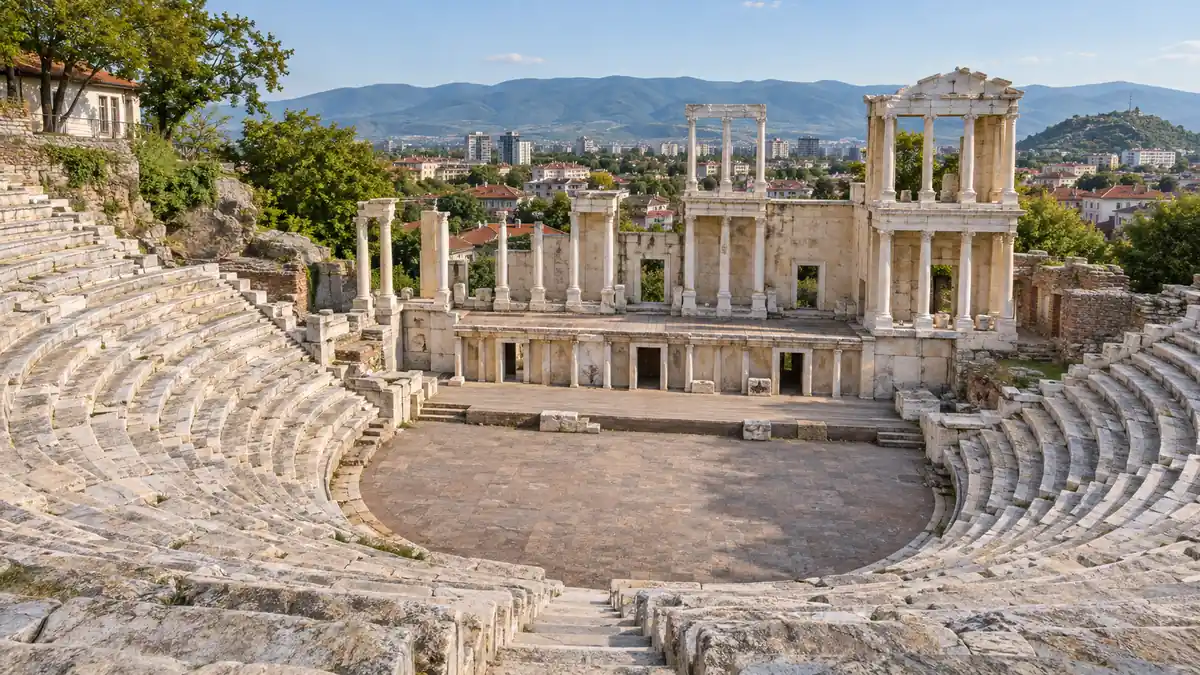
The things most worth your time in Plovdiv are the Ancient Theatre and the Old Town with its painted Revival houses, followed by the Roman Stadium on Main Street and an evening in Kapana. The picks are made for a first visit, usually arriving from Sofia. A day trip covers the Roman sites and an Old Town walk. One night adds Kapana after dark, a hill at sunset and the trip south. If evenings and food matter more to you than museums, build the visit around Kapana and treat the houses as a bonus.
The sights fall into three groups. The Roman city (theatre, stadium, mosaics) comes first, then the Old Town on its hills, then Kapana and Main Street for eating and drinking. After those come the ticket choice, the trip to Bachkovo Monastery and Asen’s Fortress, and the call between a day and a night.
Is Plovdiv Worth Visiting, and What Should You See First?
Plovdiv is worth visiting because it has something no other Bulgarian city puts on open view: a Roman theatre and a Roman stadium inside a working city centre, below a hilltop Old Town of painted Revival houses. See the Roman layer first. It is what makes Plovdiv different, and the Ancient Theatre is the one site to pay for if you only pay for one.
- The Ancient Theatre: Roman stone tiers on the Old Town hill, facing the modern city, for the first-timer who wants Roman Plovdiv at its most complete.
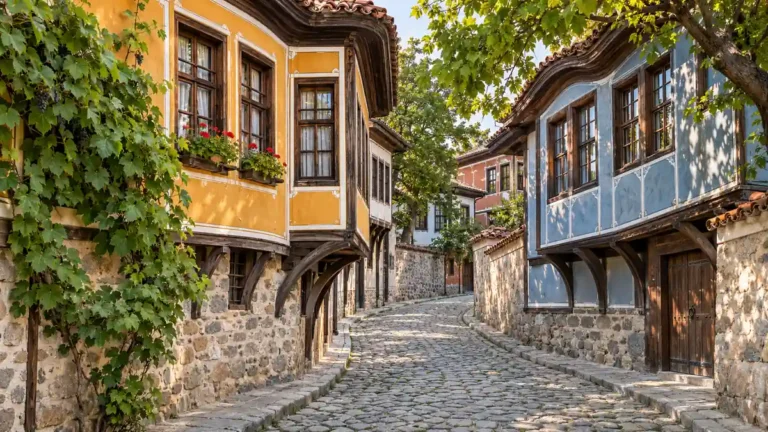
- The Old Town and its Revival houses: cobbled lanes, painted facades and one or two house interiors, for travelers who like architecture and want to walk while they look.
- The Roman Stadium on Main Street: a curved Roman end sitting below the pavement of the shopping street. It costs nothing and fits between any two other stops.
- Kapana: the craft-street quarter below the Old Town, easy-going by day and busiest after dark, which makes it the part of Plovdiv an overnight stay pays off in.
The order follows what only Plovdiv has. Roman ruins in the street are the thing you cannot see elsewhere in the country. The Revival houses are the second pillar, a whole hillside of merchant mansions kept as a district. Kapana belongs to the evening because it comes alive once the sites close. To see how Plovdiv fits into a longer trip, the guide to the best places to visit in Bulgaria puts it alongside the country’s other stops.
When to change the order
Short on money or time? Start on Main Street. The open-air section of the Roman Stadium is free, and walking the street past it and Dzhumaya Mosque shows you the Roman layer without buying a ticket. Add the Old Town lanes on foot and you have seen Plovdiv’s two signature layers for nothing.
Travelers who would choose a long dinner over a fifth museum should plan the visit around Kapana. Arrive in the afternoon, see the theatre, then give the evening to the bars and craft streets. With a car and half a day to spare, Bachkovo Monastery and Asen’s Fortress are a better use of the time than another Revival house. By the third house interior, the rooms start to look alike.
Plovdiv’s Roman City: the Theatre, the Stadium and the Mosaics
The Roman layer is the reason to come, and the Ancient Theatre leads it. The Roman Stadium is partly free and seen in passing. The Bishop’s Basilica mosaics suit a slower visit with time for detail.
The Ancient Theatre
The Ancient Theatre of Philippopolis is the centrepiece of Roman Plovdiv and the first stop on any visit. Its tiers of seating climb the slope of the Old Town hill, so the stage looks out over the modern city below. That view, with Roman stone in front and apartment blocks behind, sums up Plovdiv better than any other spot.
The theatre is not only a ruin. It still hosts performances in the warm season, and an evening show there is a strong reason to stay the night. If you want the history explained on the spot, reserve a guided walk through the Old Town that takes in the theatre. Entry is a standard single-site ticket, covered in the ticket section below.
The Roman Stadium on Main Street
The open-air section of the Roman Stadium is free: its curved end sits below street level in the middle of Main Street, and you look down into it from the pavement. No other Roman site in Plovdiv blends into daily life the same way. Shoppers walk past it without breaking stride.
A 3D projection hall at the stadium is ticketed and brings the full building back to life on screen. For the visitor with an hour and no ticket budget, the stadium is the stop: a pause on the steps above it, then on to the mosque next door.
The Bishop’s Basilica mosaics
The Bishop’s Basilica is the place to see Plovdiv’s mosaics. It is a large early Christian church known for its floor mosaics, and of all the ancient sites it repays slow looking most. Travelers who care more about detail than scale often rate it above the theatre.
It sits outside the combined ticket and has its own, higher-priced entry (figure in the ticket section). Plan it as a separate stop, not a quick add-on.
The rest of Roman Plovdiv: Forum, Eastern Gate and Small Basilica
The Roman Forum, the Eastern Gate and the Small Basilica round out the Roman city. They are smaller pieces you will pass, or can add once the main three are done. The Regional Archaeological Museum holds finds from the ancient city, which helps if the ruins have made you curious about what stood there.
Tours and activities
Book skip-the-line tickets, day trips and local tours with free cancellation on most activities.
You can also browse everything on getyourguide.com.
Tripstou may earn a commission if you book through this link, at no extra cost to you.
The Old Town: Revival Houses, Hills and Sunset Views
The Old Town is a walk first and a museum second. Go for the lanes and the painted facades, step inside one or two houses, and finish on Nebet Tepe for the view. Most of the pleasure is free and outdoors; the ticketed interiors add depth but do not replace the walk.
Walking the Old Town: Hisar Kapia and the cobbled lanes
The Old Town sits on the hills above the centre, and the classic way into it is on foot through Hisar Kapia, its old stone gate. Past the gate, the lanes run between overhanging upper floors and coloured walls. The Church of St Constantine and Helena stands in the same quarter.
The cobbles are large, uneven and steep in places. Wear shoes with grip and expect to climb slowly. Guided day trips from Sofia are built around these same lanes, with a guide pointing out the gates, churches and houses on one loop, a good fit if you would like the Old Town explained in one visit.
Balabanov, Hindliyan and the other Revival houses
Balabanov House and Hindliyan House are the two Revival houses to go inside. Balabanov is the one for interiors, with restored, furnished rooms. Hindliyan shows the architecture of a wealthy merchant home at its fullest, painted walls included. Seeing both gives you the Old Town’s domestic side without repeating yourself.
The other houses are worth a look from outside, and inside if you hold the combined ticket:
- Nedkovich House: another furnished merchant home, for a third interior.
- Stambolyan House: a further Revival house on the combined-ticket circuit.
- Klianti House: worth a look for its decorated walls.
- Pharmacy Museum Hippocrates: an old pharmacy kept as a museum, a short stop.
The Regional Ethnographic Museum fills an Old Town Revival mansion with the region’s crafts, costumes and household objects. It answers the question the houses leave open: how ordinary people lived here, beyond what the mansions were built to show. The combined ticket for the houses is explained in the ticket section, along with the days each house closes.
Nebet Tepe and the other hills at sunset
Nebet Tepe is the sunset pick, at the very top of the Old Town above the lanes. Its ruins look across the whole city and the plain beyond. Sahat Tepe, with its clock tower, gives a second view over the centre. Bunardzhik Hill, crowned by the Alyosha Monument, is the third.
Sunset on Nebet Tepe is an overnight visitor’s reward. In the long days of the warm season, the sun goes down after most day-trippers have headed back to Sofia. That alone is a fair reason to stay.
Which Plovdiv Ticket Should You Buy?
Buy single tickets for one or two sites and the combined ticket from three sites up. Three single tickets at €3.58 come to €10.74, the same price as the combined ticket that covers up to five. The Bishop’s Basilica always needs its own ticket, and the open-air section of the Roman Stadium costs nothing.
| Ticket | Adult price | What it covers | Who should buy it |
|---|---|---|---|
| Open-air Roman Stadium | Free | The curved section below Main Street | Everyone passing on Main Street |
| Single site | €3.58 | One Ancient Plovdiv site, the Ancient Theatre included (not the Bishop’s Basilica) | Visitors seeing one or two sites |
| Combined ticket | €10.74 | Up to 5 Old Town sites of your choice (not the Small Basilica or the Bishop’s Basilica) | Anyone going inside three sites or more |
| Bishop’s Basilica | €7.57 | The basilica and its mosaics | Mosaic lovers with time to spare |
| Roman Stadium 3D hall | €3.68 | The projection hall at the stadium | First-timers who want the stadium shown complete |
The Ancient Theatre, the Roman Stadium, the Revival houses, the Bishop’s Basilica, the Small Basilica and the Pharmacy Museum Hippocrates are all run by the Ancient Plovdiv Municipal Institute. Tickets are also sold online through the institute’s shop, and larger multi-site passes are sold too. The combined ticket pays off fastest on the theatre plus two houses: at three sites it already matches the single-ticket total, so the fourth and fifth come free.
When the sites are open
The Ancient Theatre and the Roman Stadium open every day. From November to March the hours are 09:00–17:30, and from April to October 09:30–18:00. Both pause for 30 minutes at lunch; at the theatre that is 12:30–13:00.
The Revival houses keep the same seasonal hours, each with a short lunch pause, but not the same days. Balabanov and Hindliyan open Tuesday to Sunday. Nedkovich and Stambolyan open Monday to Saturday. Most house museums close one day a week and every site pauses for lunch, so on a Monday, plan on Nedkovich and Stambolyan for the interiors, not Balabanov and Hindliyan.
Kapana, Main Street and Where to Eat in Plovdiv
Kapana is where the day in Plovdiv ends. It is a small grid of craft streets, bars and painted walls tucked between the Old Town slope and Main Street, and it is the best argument for staying the night. Main Street leads into it, and the places to eat below sit close by.
Kapana: craft streets, street art and bars
Kapana is Plovdiv’s creative quarter, a tight knot of short streets lined with workshops, small galleries, cafés and bars. Murals and street art cover many of its walls, so the walk itself is the attraction during the day. After dark the terraces fill and the quarter becomes the city’s evening centre.
Kapana suits the visitor who would pick atmosphere over another museum. Give it an evening, not a quick pass at lunch: the streets are at their best once the bars open.
Main Street, Dzhumaya Mosque and Tsar Simeon Garden
Main Street (Knyaz Alexander I) is Plovdiv’s pedestrian spine, running past the Roman Stadium and Dzhumaya Mosque towards the centre. The mosque is the city’s Ottoman landmark, standing on the square beside the stadium. Next to it, a Turkish coffee and pastry shop is the classic stop for a cup and something sweet.
Further along, the bronze statue of Milyo, a local character, sits on the street for photos. At the far end, Tsar Simeon Garden and its Singing Fountains make the evening stroll.
Where to eat and drink in Plovdiv
These four cover a meal, a beer, a coffee and a sweet stop:
- Pavaj: a Kapana restaurant for a sit-down dinner of Bulgarian dishes.
- Cat & Mouse: a craft beer bar in Kapana, for the evening drink.
- Central Perk: a café for a coffee break between sites.
- The Turkish coffee and pastry shop by Dzhumaya Mosque: strong coffee and pastries on Main Street.
Order a shopska salad of tomato, cucumber and white cheese, and cold tarator soup of yoghurt and cucumber in summer. Rakia, the fruit brandy, is the local drink to try once.
Bachkovo Monastery and Asen’s Fortress: the Half-Day Trip South
With half a day to spare, Bachkovo Monastery and Asen’s Fortress are the trip to take from Plovdiv. Both lie a short drive south of the city beyond Asenovgrad, and they are usually seen together, by car or on a tour.
The pair works because the two sites are so different. Bachkovo is a working monastery in the hills, with churches to step inside. Asen’s Fortress is a medieval stronghold on a rocky height. One gives you a monastery interior, the other a hilltop ruin, and both are a change from the city’s Roman stone and Revival houses.
The trip suits the overnight visitor and anyone with a car. Day-trippers from Sofia on the bus should skip it: it eats the half-day they need for the theatre and the Old Town. The other out-of-town options are the Starosel Thracian temple and the wineries of the Thracian Valley.
Is a Day Trip from Sofia Enough, or Should You Stay a Night?
A day trip from Sofia is enough for the Ancient Theatre, the Roman Stadium, Main Street and an Old Town walk. Stay one night if Kapana after dark, a hill at sunset or the trip to Bachkovo matter to you. Anyone who can spare the night should take it: Plovdiv’s evenings are half of what it offers.
- A day from Sofia covers the Ancient Theatre, the free stadium section, Main Street and Dzhumaya Mosque, the Old Town lanes and one Revival house.
- A night adds sunset on Nebet Tepe, dinner and drinks in Kapana, the Singing Fountains, a second house or the Bishop’s Basilica, and a morning for Bachkovo and Asen’s Fortress.
A guided trip is the easy route if you want one day and no planning. A day trip from Sofia that covers the Roman ruins, the Old Town and the pedestrian street handles the transport too; book this day trip if you would sooner skip the bus.
Getting from Sofia to Plovdiv
Direct buses link Sofia and Plovdiv roughly every hour through the day, take about 2 hours 20 minutes, and cost around €11. Some services end at Plovdiv’s Yug (South) bus station. Trains also run between the two cities. If you are basing yourself in the capital, the Sofia travel guide covers the city at the other end of the ride.
Where the Old Town and Kapana sit
Everything in town on this list is reached on foot. The Old Town covers three hills above the centre: Nebet Tepe, Taksim Tepe and Dzhambaz Tepe. Kapana is the flat lower grid between the Old Town slope and Main Street. Main Street runs past the stadium and the mosque to the centre, so a visit moves downhill from the theatre to the bars on foot. For the rest of the country, from currency to getting around, the Bulgaria travel guide picks up where Plovdiv ends.
Train and bus tickets
Compare routes, schedules and prices across rail and bus operators in one search, with mobile tickets on your phone.
New to Omio? Code NEW10 takes 10% off your first booking — or APPNEW10 if you book inside the Omio app. Both apply to bookings up to €80.
Search routes and compare prices on Omio →
Tripstou may earn a commission if you book through this link, at no extra cost to you.
How This Plovdiv List Was Chosen
This page is a curated pick of Plovdiv’s sights and one short trip south, chosen for a first visit of a day or a night on what only Plovdiv offers: the Roman layer, the Revival houses and Kapana. It is not a full Plovdiv city guide, a day-by-day itinerary or a list of places across Bulgaria.
The ticket figures, opening hours and bus details were checked against the sources below by Alex Perrut, working in tourism since 2015, for the Tripstou editorial team. The page was drafted with AI assistance, and our editorial process sets out the steps.
Official sources consulted: Ancient Plovdiv Municipal Institute, Sofia Central Bus Station.
Plovdiv Questions Travelers Still Ask
What are the free things to do in Plovdiv?
The open-air section of the Roman Stadium on Main Street is free, and most of Plovdiv’s appeal is outdoors and costs nothing to see. Walk Main Street past Dzhumaya Mosque, enter the Old Town through Hisar Kapia and take in the Revival facades from the lanes, then wander Kapana for its street art. Sunset on Nebet Tepe and an evening by the Singing Fountains in Tsar Simeon Garden round out the outdoor side of the city.
Is there a free walking tour in Plovdiv?
Yes. A free walking tour runs from the city centre on a tip basis: there is no ticket, and you pay the guide what you think the walk was worth at the end. It is the cheapest way to have the city explained, and it leaves your budget for the theatre ticket.
Is it better to stay in Plovdiv Old Town or Kapana?
Stay in the Old Town for quiet nights among the Revival houses, or in Kapana and the streets by Main Street to have restaurants and bars at the door. The Old Town’s cobbles are steep and uneven, which matters when you arrive with a suitcase. Kapana and Main Street sit on flat ground, so after a late dinner there is no climb back uphill.
Did this guide save you time or money? Tripstou is independent and reader-funded — if you'd like to give something back, you can support the site with a crypto contribution of any size.