Whether you need a visa for Bulgaria depends on your passport. EU, EEA and Swiss citizens need none. Holders of US, UK, Canadian, Australian and many other passports need no visa for a short stay. Travelers from countries such as India, China, Türkiye, South Africa and the Philippines need a short-stay Schengen visa before they travel.
Bulgaria is inside the Schengen area, so its entry rules are the Schengen rules: a short stay means up to 90 days in any 180 across the whole area, not in Bulgaria alone. If your passport is visa-exempt, two checks settle the trip. Look at your passport’s issue and expiry dates, and count every Schengen day on the itinerary, not just the Bulgarian ones.
On This Page
Do you need a visa for Bulgaria?
You need a visa for Bulgaria only if your nationality is on the visa-required list. Passports fall into four groups: EU, EEA and Swiss citizens, who need no visa at all; visa-exempt nationals, who need none for a short stay; a group exempt only when they carry a biometric passport; and nationals who must get a Schengen visa before travel.
| Passport group | Visa for a short stay? | What you need instead |
|---|---|---|
| EU, EEA and Swiss citizens | No, for any length of stay | Passport or national identity card |
| Visa-exempt (e.g. US, UK, Canada) | No, up to 90 days in any 180 | Valid passport; biometric registration at the border |
| Exempt with a biometric passport (e.g. Serbia, Ukraine, Georgia) | No, if the passport is biometric | Biometric passport; same 90-day limit |
| Visa required (e.g. India, China, South Africa) | Yes | Short-stay (type C) Schengen visa issued before travel |
Bulgaria’s foreign ministry publishes the full list for ordinary passports. These are examples from it, not the complete table:
- No visa: the USA, the United Kingdom, Canada, Australia, New Zealand, Japan, the Republic of Korea, Israel, Singapore, Malaysia, Taiwan, Hong Kong, Macao, the UAE, Brazil, Mexico, Argentina, Chile, Colombia, Peru and Uruguay, plus all EU, EEA and Swiss citizens.
- No visa with a biometric passport: biometric passports from Albania, Bosnia and Herzegovina, Georgia, Kosovo, North Macedonia, Moldova, Montenegro, Serbia and Ukraine.
- Visa required: citizens of India, mainland China, the Philippines, Indonesia, Thailand, Vietnam, South Africa, Nigeria, Egypt, Morocco, Pakistan, Russia, Belarus, Kazakhstan, Saudi Arabia, Qatar, Kuwait, Türkiye, Ecuador and Bolivia.
Do US and UK citizens need a visa for Bulgaria?
US and UK citizens do not need a visa for a short stay in Bulgaria. Canadian and Australian passports are the same case. What these travelers still need is a passport that meets the Schengen issue and expiry dates, a running count of Schengen days across the whole trip, and a few minutes at the border on arrival, where non-EU visitors are registered biometrically. The passport figures and the registration process each have their own section further down this page.
Is Bulgaria in the Schengen area?
Yes. Bulgaria is a full member of the Schengen area, as well as an EU member that uses the euro, so the Schengen entry rules apply at its airports, seaports and land borders.
Status: Bulgaria has applied the Schengen rules in full since 31 March 2024, and checks at its land borders with other Schengen countries ended on 1 January 2025.
Membership works in both directions for visa holders. A valid uniform Schengen visa issued by any Schengen country covers a trip to Bulgaria, and a visa issued by Bulgaria covers the whole area. Days spent in Bulgaria count exactly like days in France or Greece.
How long can you stay in Bulgaria without a visa?
Visa-exempt visitors may stay up to 90 days in any rolling 180-day period across the Schengen area as a whole, not per country. Every day in Bulgaria counts towards that allowance, whether you arrive by air, by land or by sea.
A worked example shows how it adds up. Spend 30 days in Greece, then cross into Bulgaria: you have 60 days left, not a fresh 90. The same holds for a week in Romania after Bulgaria, or a flight on to Italy.
The window rolls. On any day of your stay, look back 180 days and add up every day you spent anywhere in the Schengen area. That total must stay at 90 or under. A long summer in Greece can leave little room for an autumn week in Sofia.
For a multi-country trip, map the Schengen days first and the sights second. Once the dates fit, the rest of a trip to Bulgaria is ordinary planning.
Passport validity and what border officers can ask for
Your passport must have been issued less than 10 years before the day you arrive, and it must stay valid for at least 3 months after the day you plan to leave the Schengen area. Both conditions apply together: a passport inside its expiry date but issued 10 years ago fails the first one.
Border officers may also ask you to show:
- a return or onward ticket;
- proof of accommodation for the stay;
- enough money to cover the trip.
Cash of EUR 10,000 or more must be declared when you enter or leave. On the way out, visitors who live outside the EU can claim back the VAT on eligible purchases; the steps are in the guide to the VAT refund in Bulgaria.
ETIAS and EES: what applies when you enter Bulgaria
Only one of the two EU border systems is in use. The Entry/Exit System registers non-EU travelers at Bulgaria’s external borders; ETIAS does not operate, so there is nothing to apply for or pay before a trip.
How does EES registration work at the Bulgarian border?
The Entry/Exit System registers non-EU travellers biometrically at the border and is fully operational across the Schengen area. It applies to every non-EU traveler crossing a Schengen external border and replaces the stamping of passports. There is no pre-registration: it happens at the border itself.
On a trip to Bulgaria, registration takes place on arrival from outside Schengen at Sofia Airport and the other international airports, and at the land crossings with Serbia, North Macedonia and Türkiye. What comes after the arrival hall is covered in the Sofia travel guide.
Does Bulgaria require ETIAS?
ETIAS is a pre-travel authorisation for visa-exempt nationals that is not yet in operation; the European Union will announce the start date several months before launch. Once it runs, it costs EUR 20, stays valid for up to three years or until the passport expires, and covers entry to 30 European countries, Bulgaria among them.
Because ETIAS collects no applications, a website selling one is not official.
How to apply for a Schengen visa for Bulgaria
You apply for one short-stay (type C) Schengen visa at the consulate of the country where you will spend the most time. When that country is Bulgaria, the application goes to a Bulgarian embassy or consulate or to its visa application centre. Bulgaria issues no online visa and no visa on arrival.
On a multi-country trip, the longest stay decides. Ten nights in Bulgaria and four in Greece means a Bulgarian application; with equal stays, apply to the first Schengen country you enter. In several countries VFS Global handles applications for Bulgaria, and the visa centre adds its own service charge. A visa already issued by another Schengen country needs no second application, as the Schengen section above explains.
| Item | Figure | Applies to |
|---|---|---|
| Visa fee, adult | EUR 90 | Adult applicants |
| Visa fee, child | EUR 45 | Children aged 6–12 |
| Earliest application | 6 months before travel | All applicants |
| Latest application | 15 days before travel | All applicants |
| Normal processing | 15 days | Most applications |
| Processing with extra checks | Up to 45 days | Files that need further review |
What documents does a Bulgaria visa application need?
The core file is a passport that meets the Schengen dates and has at least two blank pages, travel medical insurance, and proof that you can pay for the stay. Bulgarian consulates set a minimum for both the insurance and the money.
- Passport: at least 2 blank pages, issued less than 10 years before arrival and valid at least 3 months after you leave the Schengen area.
- Travel medical insurance: minimum cover of EUR 30,000 from an insurer licensed in the EU, covering emergency care, hospital treatment and repatriation for the whole stay.
- Means of subsistence: Bulgarian consulates ask for at least EUR 50 per day and at least EUR 500 in total, or prepaid tourist services; add EUR 100 when you enter with your own vehicle.
- Travel and stay: a return or onward ticket and proof of accommodation.
The consulate or visa centre handling your file publishes its own full checklist, and that list is the one to follow.
Crossing Bulgaria’s land borders: which ones leave Schengen
Greece and Romania are Schengen neighbours, so crossing into them is an internal move, although border guards may still check passports. Serbia, North Macedonia and Türkiye lie outside Schengen and the EU, so crossing to them means leaving the Schengen area.
Leaving has three consequences on the Schengen side. Non-EU travelers get an EES record at the crossing. The day you exit stops your Schengen count, and re-entry resumes it. A single-entry visa is used up the moment you cross out. A trip to Thessaloniki or Bucharest raises none of these points; a side trip to Belgrade, Ohrid or Istanbul raises all three. Keep the passport on you even at the Greek and Romanian crossings.
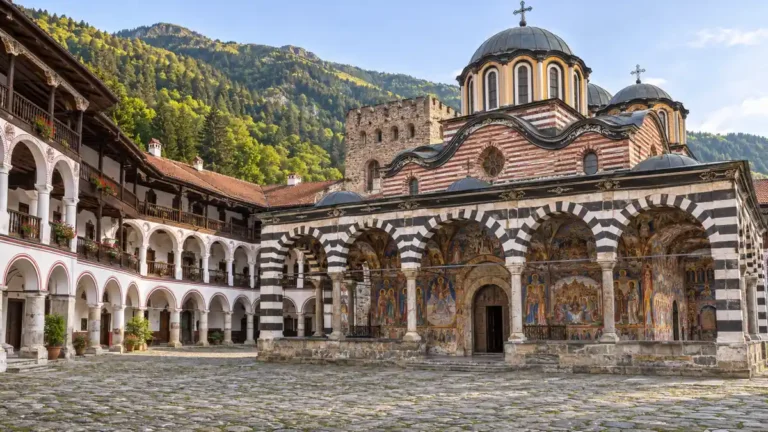
Day trips inside Bulgaria involve no border at all. A day out from Sofia to Rila Monastery and Boyana Church never leaves the country, so it needs no extra paperwork, although every day of it still counts towards the 90.
Can you do a day trip from Sofia to Skopje on a Schengen visa?
A day trip from Sofia to Skopje leaves the Schengen area, so returning to Bulgaria needs a visa valid for a second or multiple entry. A single-entry visa ends when you cross out, and it cannot bring you back the same evening. Check the number of entries printed on the visa before you book this day trip. Visa-exempt travelers re-enter under the same 90/180 allowance, with an EES record at the crossing both ways.
Tours and activities
Book skip-the-line tickets, day trips and local tours with free cancellation on most activities.
You can also browse everything on getyourguide.com.
Tripstou may earn a commission if you book through this link, at no extra cost to you.
More Questions About Entering Bulgaria
How can you stay in Bulgaria longer than 90 days?
A stay of more than 90 days needs a Bulgarian national long-stay (type D) visa, obtained before you travel. A short stay cannot be stretched into a longer one by leaving the Schengen area and coming back, because the count on any day still looks back over the previous 180 days.
What happens if you overstay in Bulgaria?
Overstaying can lead to a ban from the Schengen countries for up to 3 years. The Entry/Exit System records the day you leave and detects an overstay automatically, so plan the exit date inside the 90-day allowance from the start.
Can Turkish citizens transit Bulgaria with a Schengen visa?
Yes. A valid uniform Schengen visa covers Bulgaria whatever the passport, Turkish ones included. Bulgaria’s foreign ministry also lets holders of ordinary Turkish passports with a valid Schengen or EU visa or residence permit cross Bulgaria without a Bulgarian visa for up to five days, on the way to or from the country that issued it.
About This Entry Guide and Its Sources
This page answers one planning question: whether your passport needs a visa for a short stay in Bulgaria, and what entering under the Schengen rules involves. It is not a Bulgaria travel guide, a residence or work-visa guide, or a guide to entering neighbouring countries.
The page was written with AI assistance, and Alex Perrut, working in tourism since 2015, checked its entry rules for the Tripstou editorial team; our editorial process describes each step.
Official sources consulted: European Commission visa guidance, Bulgarian Ministry of Foreign Affairs, Embassy of Bulgaria in Washington, UK Foreign Office travel advice and European Union Travel to Europe portal.
Did this guide save you time or money? Tripstou is independent and reader-funded — if you'd like to give something back, you can support the site with a crypto contribution of any size.