Bologna answers the transport question faster than most Italian cities: for the length of a normal visit, your feet do the job. The historic centre is compact and flat, the porticoes keep the main routes covered, and the places you came to see sit close together. That is the head answer, and it holds for most people.
What trips visitors up is everything around that answer. Bologna’s bus fares are higher than much of what is published online still claims, and the rules for using a ticket are stricter than they look. The centre is also a restricted-traffic zone with camera enforcement, so arriving by car is the one decision that can turn a good trip into a bill months later.
This guide covers the walk-first verdict and when to break it, what a ticket costs, how to buy and validate one, and why you should keep a car outside the walls.
Quick Answer
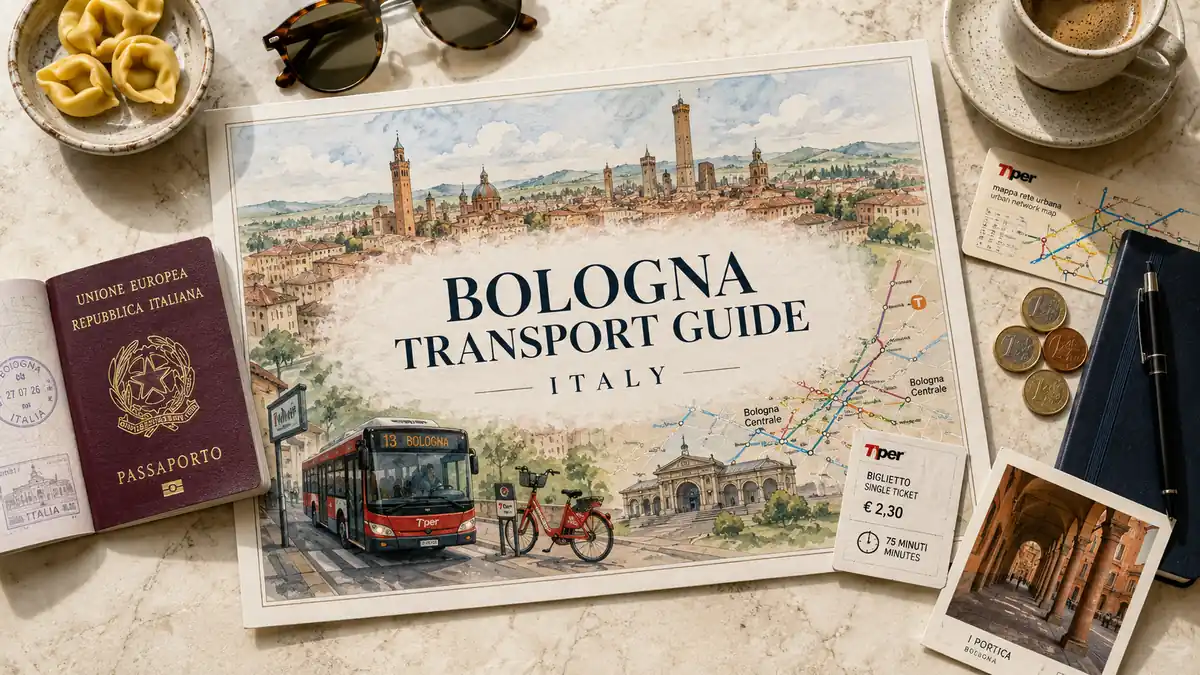
Bologna’s historic centre is compact and porticoed, so most visitors walk everywhere and never buy a ticket. You need a bus mainly for the Fiera district, hill destinations, heavy luggage, or late nights; a single ticket costs €2.30 and lasts 75 minutes. Tap a contactless card, validate immediately, and do not drive into the ZTL.
Trust Layer
Tripstou planning guide for travelers resolving one travel decision. Covers the main variable, traveler context, and practical tradeoffs.
Produced with AI assistance and reviewed by Alex Perrut, working in tourism since 2015, for the Tripstou editorial team. See our editorial process for details.
Last factual review: July 27, 2026.
Official sources consulted: Italia.it, ENIT.
Key Takeaways
- Plan to walk: Bologna’s centre is compact, flat and porticoed, so most short-stay visitors never buy a bus ticket.
- Budget for a bus only for the Fiera, hill destinations, luggage days and late nights — not for daily sightseeing.
- One validated single ticket buys 75 minutes across any route, so a short there-and-back errand often costs a single fare.
- Tap the same contactless bank card every ride and the daily and weekly caps replace any pass you would otherwise buy.
- Validate the moment you board, because an unvalidated ticket counts as no ticket and inspectors accept no explanation.
- Leave the car outside the walls: the historic centre is a camera-enforced ZTL and the penalty reaches you months later.
Table of Contents
Can you get around Bologna on foot?
Yes — Bologna’s historic centre is small enough to walk end to end. The core is flat, the streets are dense, and the porticoes cover most main routes, so rain and midday heat rarely push you onto a bus. Most short-stay visitors never buy a ticket at all.
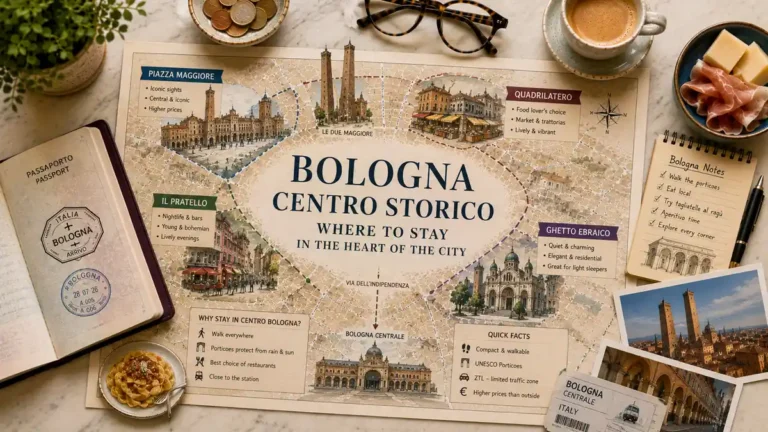
The geography does the work. Piazza Maggiore sits at the middle of a walled centre that you can cross in the time it takes to finish a coffee, and the main station, the university quarter and the market streets all fall inside that circle. Arriving travellers routinely walk in from Bologna Centrale with a wheeled bag. Cobbles and the odd step are the only real friction.
The porticoes are why the verdict survives bad weather. Covered walkways run along most of the streets you will use, which turns a rainy afternoon into a non-event and keeps August walking in shade — something that is simply not available in most Italian city centres, where a downpour pushes everyone into a taxi. Weather is not a reason to change your transport plan here.
Walking well suits almost everyone, with two honest exceptions: limited mobility, and a base outside the walls. If you want the wider picture of the city before you plan movement, our Bologna travel guide sets the context, and a compact centre is exactly what makes a tight schedule like 2 days in Bologna realistic without a single bus fare.
When you actually need a bus in Bologna
You need a bus mainly for the Fiera, the hills, luggage, or late nights. Those are the trips where distance, gradient or timing beats walking. Everything inside the ring of former city gates stays comfortably on foot, which is why most visitors use transport a few times across a whole trip, not daily.
The genuine cases are short to list:
- The Fiera district — the exhibition quarter sits north-east of the centre, too far to walk with a conference badge and a deadline.
- The hills and outlying sights — anything on the slopes south of the centre involves a climb that a bus removes.
- Arrival and departure days — heavy bags plus cobbles is the classic case for buying a ticket instead of suffering.
- Bad weather beyond the porticoes — coverage is excellent inside the core and thins out past it.
- Late nights — when the walk home is long and service is thinner than during the day.
Arriving from the airport is its own question with its own mechanics, and it is covered separately in our guide to getting from Bologna airport to the centre. Onward journeys leave from Bologna Centrale, one of the best-connected stations in the country and a natural hub if you are travelling Italy by train. Your own bus dependency is decided before you arrive, by where you sleep — staying outside the walls converts walking trips into paid ones twice a day, which is worth weighing when you choose where to stay in Bologna.
Which buses visitors actually use
Visitors use a handful of connections, not the network. In practice that means the link between the station and the centre when you are carrying bags, the services out to the Fiera during trade fairs, and the routes climbing towards the hills and the sanctuary above the city. Everything else is a commuter network you will never touch.
Do not memorise line numbers before you travel. Tram construction has forced diversions and moved stops in parts of the city, so a route number printed in an old guide can be accurate and still leave you standing at a stop that no longer exists. Read the destination on the front of the bus, confirm the stop in the operator’s app on the day, and treat any number you saw online as a starting point.
How much does a bus ticket in Bologna cost?
A single Bologna bus ticket costs €2.30 and lasts 75 minutes. That window runs from the moment you validate, covers any route in the urban area, and lets you change lines as often as you need inside it. Buying on board with cash costs more than buying in advance.
| Ticket type | Price | Validity | Best for |
|---|---|---|---|
| Single urban ticket | €2.30 bought before boarding | 75 minutes from validation, any route | Occasional hops during a short stay |
| Single bought on board | €2.50 in cash from the driver | 75 minutes from validation, any route | Emergencies when nothing else is open |
| CityPass carnet of 10 | €19.00 total, €1.90 per journey | 75 minutes per validated journey | Couples and families sharing one carnet |
| Daily ticket | €9.00 for the whole day | 24 hours from the first validation | Rare days of near-constant bus use |
| Contactless tap-to-pay caps | €9.00 per day, €25.00 per week | Applied automatically across seven days | Anyone tapping the same bank card |
Two details matter more than the numbers themselves. The 75-minute window is generous enough that a there-and-back errand often fits inside one fare, and the ticket is not tied to a single line, so a change of bus midway costs nothing extra. Resident products — annual passes, subsidised student cards and the local travel cards — are not designed for visitors and are not worth investigating.
Single, carnet or daily: which one to buy
Buy nothing in advance unless you know you will ride. One or two journeys a day is single-ticket territory, and the moment two people are travelling together, a shared carnet quietly beats singles because several travellers can validate from the same one. That sharing rule is the reason the carnet outperforms the daily ticket for most couples.
The daily ticket has been largely designed out of the decision by the contactless cap. If you tap the same bank card all day, the system stops charging once your spend reaches the daily ceiling, which means you get the daily-ticket outcome without predicting your day in advance. The people who should still buy a daily ticket deliberately are those paying cash. Everyone else should just tap and let the arithmetic happen.
Where do you buy a bus ticket in Bologna?
Tap a contactless card on board, or buy ahead at a tabacchi, machine or app. Contactless is the simplest option for visitors because it needs no shop, no cash and no local account. Paper and app tickets still matter when your card is not accepted or your phone battery dies.
The channels available to a visitor:
- Contactless bank card on board — tap the reader as you get on, with no ticket to buy first.
- The Roger app — the regional transport app, which sells and activates tickets from your phone.
- Tper points — the operator’s own sales offices for anything the app cannot solve.
- Tabacchi and authorised resellers — the traditional route, marked by the black-and-white “T” sign.
- Automatic machines — including Bologna Centrale and the Autostazione, useful on arrival.
The tabacchi habit is worth keeping even in a contactless city. Shops close on Sundays and holidays, and a small one may be out of carnets, so buying your paper tickets when you happen to pass an open one beats hunting for a shop with a bus already arriving. If you plan to tap, carry a backup — a second card, or an app ticket bought before you leave the hotel.
Paying by contactless card
Contactless cards work directly on board: tap the validator as you board and you are ticketed for the same 75-minute window as a paper single. There is no registration, no local app account, and no need to work out how many journeys you will make.
The caps in the table above do the arithmetic for you across a day and across a week. Use the same physical card every time — the cap tracks the card, not the person. And tap each traveller separately: one tap covers one passenger, so a couple taps twice.
How do you validate a ticket, and what happens if you don’t?
Validate as soon as you board — an unvalidated ticket counts as travelling without one. The 75-minute window starts at validation, not at purchase, so a ticket bought yesterday is worthless until it is stamped. Inspectors board without warning and check the stamp, so the habit matters more than the price.
The mechanics take a few seconds:
- Board and go straight to the nearest validator, before you look for a seat.
- Insert a paper ticket or carnet ride into the machine until it stamps the time.
- Hold a contactless card or app code against the reader and wait for the confirmation.
- Keep the ticket or card with you for the whole journey, not just until you sit down.
The stamp is the ticket. Italian transport treats validation, not purchase, as the moment your fare begins, and that is what catches out visitors from cities where buying is enough — travelling without the stamp costs far more than the fare ever would. Build the habit on your first ride and it costs you nothing for the rest of the trip.
Can you drive into Bologna’s city centre?
No — Bologna’s historic centre is a camera-enforced ZTL and a car is a liability. Access is restricted to authorised vehicles from 07:00 to 20:00 every day, and the cameras read plates automatically. Even with a permit, parking inside the walls is scarce and the centre is walkable anyway.
The rules a visiting driver needs:
- The restricted zone covers the historic centre inside the line of the old walls.
- Enforcement is automatic — there is no barrier and no one waves you through.
- Hotels inside the zone can usually register a guest’s plate; ask before you arrive, not after.
- Park outside the zone and walk or ride in, which is what residents without a permit do.
The penalty arrives long after you have gone home, forwarded by the rental company with its own administration charge attached. Most drivers only learn about the wrong turn months later, when arguing about it is hopeless. Satnav will happily route you through the centre. Treating the ZTL boundary as the end of your drive, and the car as something you park once and leave, removes the whole problem.
T-Days and the “T” streets
Via Rizzoli, via Indipendenza and via Ugo Bassi form the “T” at the heart of the centre, and they function as pedestrian space. On weekends and public holidays the T is closed to traffic entirely — the T-Days scheme — and the streets fill with people walking down the middle of the road.
Permits do not help during T-Days. Access that works midweek is suspended, which catches out drivers with hotel authorisation who assume their registration covers every day. If you are collecting or returning a rental car, do it away from the T and check the day’s closures locally before you set off.
Bikes, scooters and taxis: the situational options
Shared bikes and scooters are situational in Bologna — walking usually wins in the centre. A flat, compact core means two wheels save little time, and the porticoes are pedestrian space, so the gain only appears on longer cross-city hops. Taxis earn their place with luggage, late nights or mobility needs.
Shared bikes and e-scooters are available through the usual app-based operators and are unlocked and paid for by the minute. They make sense for a cross-city trip that is too far to walk and too awkward for a bus. They make much less sense inside the walls, where you will spend as long parking legally as you saved riding.
One local rule is non-negotiable: the porticoes are footways, not cycle lanes. Riding under them is unwelcome and unsafe on busy stretches, so plan bike and scooter trips along open streets. A taxi is the honest answer on arrival and departure days, and the only answer once the buses thin out.
Is the Bologna tram open yet?
No — the tram is still under construction, so plan around the works, not the line. Building sites for the Linea Rossa affect streets, stops and bus routes in parts of the city, and diversions change as the work moves. Check the stop on the day instead of trusting an old map.
For a visitor staying in the centre, the practical impact is minor — some detours on foot and a moved bus stop — but anyone relying on a specific bus route should confirm it locally before travelling.
Frequently Asked Questions
What is the fine for riding a Bologna bus without a ticket?
Riding without a validated ticket costs far more than the fare itself. Inspectors board unannounced, check every stamp, and treat an unvalidated ticket exactly like no ticket. There is no discretion for good faith, and a receipt from the tabacchi will not save you.
Are there night buses in Bologna?
Yes, Bologna runs a limited late-night service after the daytime network winds down, but it is thinner and less frequent than daytime routes. Check the operator’s app for the night departures serving your stop on the evening you need them, and treat a taxi as the reliable fallback.
How do you get a taxi in Bologna?
Find a taxi at a rank or book one by phone or app — street hailing is not how it works here. Ranks sit outside Bologna Centrale and at the main squares, and demand spikes on wet evenings and during trade fairs, so book ahead when timing matters.
Where do you park if you drive to Bologna?
Park outside the ZTL and walk or ride in — that is what residents without a permit do. Car parks and street parking sit around the ring road and the former gates, a short walk from the centre. If your hotel is inside the zone, ask it to register your plate before you arrive.
Does Bologna have a metro or underground?
No, Bologna has no metro or underground railway. The urban network is buses, run by the regional operator, with a tram line still under construction and not yet in service. For a visitor that changes little: the historic centre is walkable end to end and buses cover everything beyond it.
Can two people share a CityPass carnet in Bologna?
Yes, a CityPass carnet can cover several travellers on the same trip. Each passenger validates once per journey, and every validation uses one of the ten rides, so two people travelling together consume two. That makes a shared carnet cheaper than two singles from the first ride onward.
Related Guides
- Bologna travel guide — the full orientation to the city, from neighbourhoods to what the centre is actually like.
- Getting from Bologna airport to the centre — the arrival question this page deliberately leaves alone, resolved in detail.
- Where to stay in Bologna — how base choice changes your walking radius and your transport bill.
- 2 days in Bologna — what a compact, walkable centre lets you fit into a short stay.
- Travelling Italy by train — using Bologna Centrale as the hub for onward journeys across the country.
Did this guide save you time or money? Tripstou is independent and reader-funded — if you'd like to give something back, you can support the site with a crypto contribution of any size.