Bologna is chosen, and now the sums look wrong. The historic centre prices itself for a city that fills up whenever the trade fairs are on, and every cheap room you find seems to sit beside the station, across the railway, or somewhere outside the walls. The worry underneath is always the same: does cheap here mean far, loud, or rough? It does not have to mean any of them. Bologna is small, arcaded and walkable in a way that makes a budget base far less of a compromise than in Rome or Milan — but only if you pick the right one. This guide names the best budget area outright, says what it costs you in comfort and quiet, gives a straight verdict on the station side and Bolognina, and sets out the calmer alternatives for anyone who cannot sleep through a student quarter.
Quick Answer
Zona Universitaria is the best budget base in Bologna, suiting solo travelers, students and anyone wanting cheap but walkable. You trade student-quarter noise and less postcard charm for centre-adjacent walking distance at budget rates. Take the Bologna Centrale side for the lowest rates in a plainer setting, or Porta Saragozza for quiet.
Trust Layer
Tripstou stay guide for travelers choosing where to base. Covers area atmosphere, budget, convenience, noise, and traveler fit.
Produced with AI assistance and reviewed by Alex Perrut, working in tourism since 2015, for the Tripstou editorial team. See our editorial process for details.
Last factual review: July 27, 2026.
Official sources consulted: italia.it, enit.it.
Key Takeaways
- Zona Universitaria is the cheapest base in Bologna that still walks to the centre, suiting solo travelers and students.
- The trade-off for that saving is term-time street noise and a plainer setting, not distance from the sights.
- The Bologna Centrale side and southern Bolognina are worth it for late arrivals and early trains, less so for slow trips.
- Porta Saragozza buys quiet at below-centre rates, the best-value trade in a city that charges most for a central address.
- Stay length decides the accommodation type: cheapest bed for one or two nights, apartment once you pass four or five.
- Centro Storico and Santo Stefano should leave a budget shortlist early, because both charge for the address above all else.
Table of Contents
Zona Universitaria is the best budget base in Bologna
Zona Universitaria is the best budget base in Bologna for anyone who wants cheap and still walkable. The streets around Via Zamboni sit against the historic centre at student-quarter prices, so you save on the room without buying transport or a long walk into the city. It suits solo travelers and students above all.
The atmosphere is unpolished and lived-in. Via Zamboni and the lanes off it belong to the university: cheap canteens and bakeries, noticeboards, bicycles, people who live here all year. Nothing is staged for visitors. That is a large part of why the rooms cost less, and also why some travelers take one look and book elsewhere.
Everything is walkable from here, which is the whole argument for the area. Piazza Maggiore, the Due Torri and the old market lanes are a short arcaded walk away, so a cheap base never turns into a daily commute. You will not need transport for an ordinary day in the city.
Price positioning is budget, and clearly under what the centro streets ask for a comparable room. Hostels, small guesthouses and rented rooms concentrate here because a permanent student market keeps the bottom of the range competitive.
The honest cost is noise and a plainer setting. Term-time evenings get loud around the busier squares, and you will not get the postcard view a centro window buys. Both are budget trade-offs, not defects — you are choosing to spend the difference on the rest of the trip.
For the quarter’s full character beyond the budget question — daytime feel, food, what living there is actually like — read the full Zona Universitaria area guide. If your real decision is this quarter against the old core, the centro versus Zona Universitaria comparison settles it head to head.
- Best for: solo travelers and students who want the cheapest base that is still walkable to the centre.
Ask which way the room faces before you book here. The quarter’s noise is street-level and concentrated on a few squares, so an internal or courtyard room in the cheap area routinely sleeps better than a street-facing room in an expensive one.
Is it worth staying near Bologna Centrale or in Bolognina?
Yes, with conditions. The station strip and southern Bolognina are the cheapest realistic beds in Bologna and stay walkable to the centre. What you pay for the saving is a plainer, busier setting with little of the old city’s atmosphere on your doorstep. It suits short, logistics-led stays best.
Bologna Centrale is the city’s main rail station, immediately north of the historic centre, and Via dell’Indipendenza runs straight from it down to Piazza Maggiore. Bolognina begins on the far side of the tracks. The southern edge of Bolognina, closest to the station, is the part that still functions as a base; the further north you go, the more you are simply staying somewhere else.
This is the cheapest side of the city because it is the least scenic. Rooms here compete on rate, not on arcades or address, and the supply is larger than inside the walls. Choice is wide.
Take it if you arrive late, leave early, or genuinely care about nightly rate above everything else. Skip it if the reason you came is to step out of the door into the old city, because you will hand the saving back in walking you did not want to do.
The station surroundings and the park side feel busier and more functional after dark than the centre does, as station districts generally do. None of that rules the area out as a budget base; it simply asks for the awareness you would bring to any large European station.
Bolognina itself is a working residential district that has been changing for some time. It reads as everyday city: apartment blocks, a market, ordinary shops, and a growing number of places to eat that have nothing to do with tourism.
- Best for: travelers arriving late or leaving early who want the lowest nightly rate.
The station saving is worth most on the nights you barely use the room. A late arrival and an early train are exactly those nights; a slow week of walking the old city is not, because you repay the discount in daily crossings back and forth from the tracks.
Porta Saragozza is the quiet budget pick
Porta Saragozza is the budget choice for people who cannot sleep through a student quarter. It keeps walkable access to the centre at below-centre rates, in a calm, residential setting on the city’s southwestern side. Light sleepers and couples get the saving without the volume.
The area is residential and low-key. Porticoed streets, neighbourhood bars, ordinary Bolognese life going on around the old gate — pleasant without being a destination, which is exactly what keeps the rates down.
The walk into the centre is short and covered for most of its length. Bologna’s arcades run this way, so reaching Piazza Maggiore on foot stays easy in rain or heat and you rarely need transport for a normal day. It is a real walk, though. You notice it at the end of a long one.
Price positioning is budget to lower mid-range, below the centro and Santo Stefano streets for a comparable room, with small B&Bs and apartments more common here than hotels.
What you give up is street life and easy choice. Less happens outside the door in the evening and there are fewer cheap places to eat within reach, so dinner usually means walking back toward the centre and out again.
- Best for: light sleepers and couples who want quiet without paying centre prices.
Quiet is the one variable Bologna prices least. The centre charges for address and atmosphere, so buying calm out here costs almost nothing, while buying the same calm inside the walls costs a great deal.
The Via San Vitale and Pratello fringe stretches a budget without leaving the walls
The inner-fringe streets east and west of the core hold budget-viable stays inside the walls. Via San Vitale runs east, Via del Pratello west, and both keep you within the old city at rates the postcard streets never reach. They suit travelers who want a lived-in base.
Both streets read as mixed and residential. You get workshops and small shops alongside flats, a genuine neighbourhood texture, and none of the polish of the lanes around Piazza Maggiore. People live on these blocks.
You are inside the walls, so everything is on foot. From either street the centre, the university quarter and the main sights are a straightforward arcaded walk, which means you never weigh up whether it is worth going back to the room in the afternoon.
Price positioning is budget to lower mid-range — clearly under Centro and Santo Stefano, usually a touch above the cheapest station-side rooms, and often better value per room than either.
The trade-off is evening noise on some blocks. Pratello in particular gets busy after dark, so a street-facing room there can stay lively later than you want; a room set back, or the San Vitale side, avoids most of it. Treat that as a budget trade-off and nothing more.
- Best for: repeat visitors and longer stays who want a residential, local-feeling base.
This fringe is the one cheap option that never announces itself as a compromise. You keep the walled-city address and the discount comes purely from sitting a few blocks off the tourist axis, which is the cheapest kind of distance a traveler can buy.
Is it cheaper to stay outside Bologna’s city centre?
Yes, but the saving is smaller than in bigger Italian cities. Bologna’s core is compact and almost entirely arcaded, so a base just outside the walls still works on foot. The real question is how far out you go, because the discount grows slowly while the walk grows fast.
Compactness is the deciding factor. The historic centre is small enough to cross on foot in an ordinary stroll, and the porticoes mean weather barely changes the calculation. A base a few streets beyond the ring stays genuinely usable here, in a way the same distance in Rome or Milan does not.
The saving stops being worth it the moment you cross into car-and-bus territory. Just outside the walls you are still walking; a few districts further out, every dinner, every evening return and every late change of plan becomes a logistics decision, and those cost time and usually money too.
Stay outside the walls if the trip is light on sightseeing and heavy on rest, or if your dates have pushed central rates up. Stay inside if you came to spend your time in the old city, because at Bologna’s scale the inside-the-walls premium is small enough to be worth paying. If you are still assembling the rest of the trip around the stay decision, the full Bologna travel guide covers the city beyond where you sleep.
The porticoes are why this question answers differently in Bologna. They turn “a bit further out” from a weather gamble into a covered walk, which is precisely why the outside-the-walls discount here is thinner than travelers expect — everyone can use those beds, so they are not priced as a sacrifice.
Why Bologna accommodation gets expensive during trade fairs
Fair weeks at the Fiera lift accommodation prices across the whole city, budget areas included. The exhibition calendar draws large numbers of business visitors who book early and are not shopping on price, which drains the cheapest supply first. Check whether your dates land on a trade fair before you fix the area — on those nights the date moves the rate more than the neighbourhood does.
Which Bologna areas to skip on a budget — and the ones worth knowing
Centro Storico and Santo Stefano are the two areas to stop considering on a budget. Both are lovely and both price accordingly: the centre charges for the address, the arcades and the fact that everything is already outside the door. Neither rewards a tight accommodation budget.
Centro Storico is the postcard base and priced as one. It suits mid-range budgets and very short trips where zero walking matters most; on a tight budget it quietly takes money from everything else in the trip. The district’s full case is set out in the guide to staying in Bologna’s centro, and if you want it weighed directly against the quieter option, see centro versus Santo Stefano.
Santo Stefano is quiet, handsome and carries the same problem. It is one of the most desirable addresses in the city, so its rates seldom undercut the centre, and what it delivers is calm and beauty — neither of which is the thing a budget traveler is optimising for. The Santo Stefano area guide covers it properly.
The Fiera district is cheap most weeks and spiky the rest. Built around the exhibition quarter, it is functional, characterless and detached from the reason you came, and its rates jump exactly when the fairs fill the city — which is when a cheap room matters most.
At the opposite end of the spectrum, luxury hotels in Bologna cluster in those same central streets, which is a useful reminder of what the centre’s address is really charging for. For the full picture of every area, budget-viable or not, the parent guide to where to stay in Bologna maps the whole city.
Hostel, B&B, or apartment: what stretches a Bologna budget furthest
The accommodation type matters as much as the area on a Bologna budget. A dorm bed wins on raw cost, a private room in a small B&B usually wins on value for two, and an apartment only pays off once the stay runs past a few nights.
- Hostel dorm — the lowest cost per person in the city, concentrated around the university quarter and the station side. Suits solo travelers and anyone treating the room as a place to sleep. The trade-off is zero privacy and no control over who you share with.
- Private room in a hostel — a door that locks at a rate below most hotels, with the kitchen and common space still included. Suits couples and solo travelers who want privacy without hotel pricing. The trade-off is that hotel-level quiet is not guaranteed.
- Small budget B&B or guesthouse — usually the best value for two people, and the type that most often puts you on a decent street in a decent area. Suits couples and first-timers. The trade-off is limited flexibility: fewer rooms, stricter check-in, less room to move on dates.
- Apartment — the option that improves the longer you stay, because a kitchen and a washing machine start taking real weight off the daily spend. Suits longer stays, small groups and repeat visitors. The trade-off is a higher entry rate and cleaning charges that punish short bookings.
Length of stay decides more here than the room type itself. One or two nights, take the cheapest bed. Past four or five, the apartment’s kitchen and laundry begin doing genuine work on the budget, and the calculation flips.
Bologna’s permanent student population is what makes the bottom of this ladder unusually good. A city with a year-round young market keeps dorms and simple guesthouses honest even in high season, which is not true of the Italian cities that live on tourism alone.
Hotels and places to stay
Compare hotels, apartments and stays for your dates in one search.
Search hotels and stays on hotels.com →
Tripstou may earn a commission if you book through this link, at no extra cost to you.
Best budget areas by traveler type
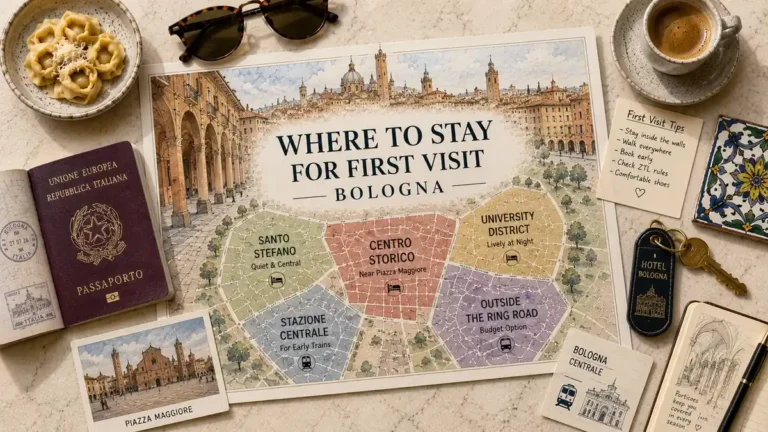
Each traveler type has one clear budget answer in Bologna, decided by noise, timing and length of stay. Solo travelers and students belong in Zona Universitaria; light sleepers in Porta Saragozza; late arrivals on the station side; longer stays on the inner fringe. The table below gives each one area and the trade-off attached to it.
| Traveler type | Best area | Relative price | Main trade-off |
|---|---|---|---|
| Solo traveler on a budget | Zona Universitaria, around Via Zamboni | Budget, the cheapest walkable base | Student-quarter noise on term-time evenings |
| Couple on a tight budget | Porta Saragozza, beyond the old gate | Budget to lower mid-range rates | Fewer cheap dinners within easy reach |
| Student or long stay | The Via San Vitale and Pratello fringe | Budget to lower mid-range, inside the walls | Evening street noise on some blocks |
| Light sleeper on a budget | Porta Saragozza, beyond the old gate | Budget to lower mid-range rates | Little street life outside the door |
| Late arrival or early train | Bologna Centrale and southern Bolognina | The lowest nightly rates in the city | A plainer, more functional setting |
| First-timer working to a budget | Zona Universitaria, around Via Zamboni | Budget, and close to the main sights | Less postcard charm than the centro |
One thing cuts across the whole table: in a city this walkable, every option is already within reach of the same sights, so how the street sounds at eleven at night separates them far more than where they sit on the map. Book by sleep, then by street.
Frequently Asked Questions
Is it safe to stay near Bologna Centrale station at night?
Yes, with the ordinary caution any European rail hub deserves after dark. The immediate forecourt and the park north of it read as the least appealing corners late at night, while Via dell’Indipendenza stays the busiest lit line south into the centre. Book a room on that side.
How much do hostels in Bologna cost?
Hostel dorm beds are the cheapest accommodation in Bologna, and the city’s year-round student population keeps that bottom tier competitive even in high season. Expect budget rates well under any private room, with private hostel rooms sitting between a dorm and a small guesthouse. Fair weeks push everything up.
Can you walk from Bologna Centrale station to Piazza Maggiore?
Yes, and it is a straightforward walk. Via dell’Indipendenza runs directly south from the station to Piazza Maggiore, and most of the route sits under Bologna’s porticoes, so rain and heat barely change it. That one street is the main reason the station side stays a viable budget base.
When are hotels in Bologna cheapest?
Rates in Bologna track demand rather than the calendar, so the cheapest nights are the ones with no trade fair and no long weekend attached to them. Check the exhibition calendar before fixing dates, and treat any fair week as the point where booking early stops being optional.
Is an apartment cheaper than a hotel in Bologna?
Not for one or two people on a short stay. An apartment’s entry rate and cleaning charge only repay themselves once they are split across a small group, or across enough nights for the kitchen and washing machine to take real weight off daily spending.
Is staying outside Bologna’s walls a mistake for a short trip?
For a two or three night trip, usually yes — stay inside the walls. A short stay has no spare hours for the walk back and forth, and Bologna’s centre is compact enough that the premium for being in it stays modest. Outside earns its keep on longer, slower stays.
Related Guides
- Where to Stay in Bologna — the master area guide covering every neighbourhood and traveler type, not only the budget ones.
- Zona Universitaria area guide — full detail on the quarter this page names as the best budget base.
- Bologna centro area guide — what the historic centre actually buys you, and when it is worth the premium.
- Santo Stefano area guide — the quiet, handsome district in full, for readers who are not price-bound.
- Centro vs Zona Universitaria — the head-to-head verdict if your choice is down to these two.
- Centro vs Santo Stefano — the comparison for travelers weighing charm against calm.
- Luxury hotels in Bologna — the opposite end of the spend spectrum, and where it concentrates.
- Bologna travel guide — city context and planning beyond the stay decision.
Did this guide save you time or money? Tripstou is independent and reader-funded — if you'd like to give something back, you can support the site with a crypto contribution of any size.