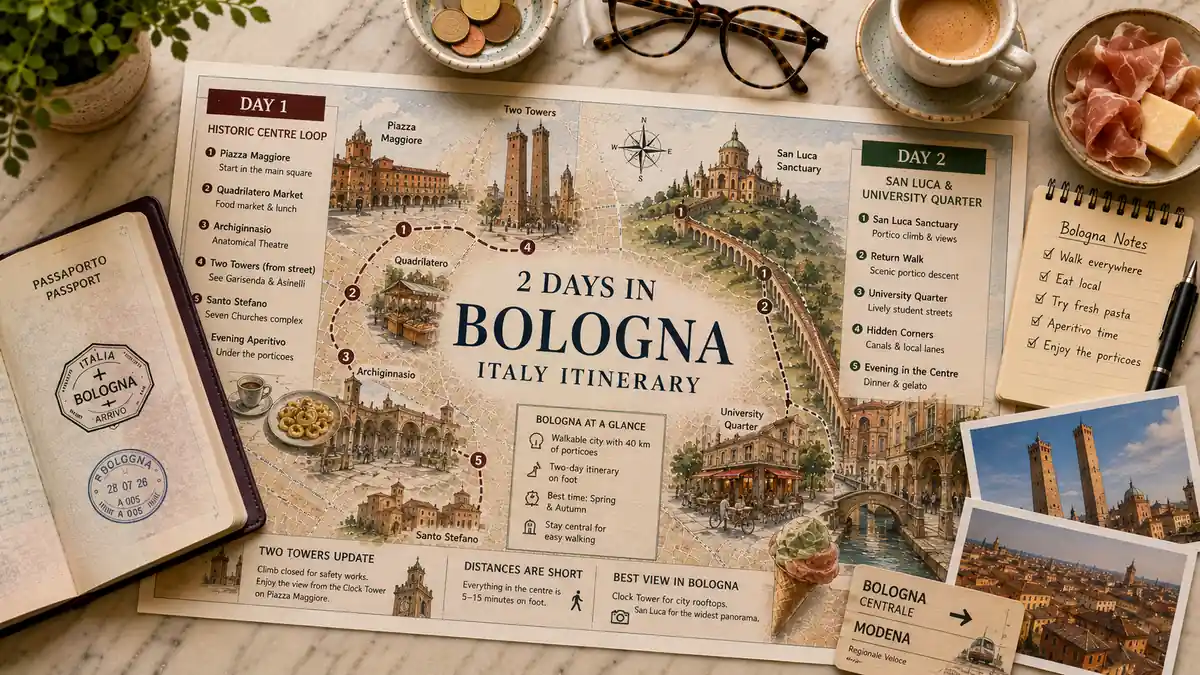
Bologna’s historic centre is small, flat and covered, which makes 48 hours here unusually productive. The problem is that the city pulls in two directions. One pull is toward a table: a long Quadrilatero lunch that eats a whole afternoon and is arguably the point of coming. The other is uphill, along the covered portico to San Luca, which is the image most people arrive with. Two days rarely allows both at leisure, and most itineraries pretend otherwise. This guide commits to one route instead. Day 1 loops the historic centre on foot; Day 2 climbs to San Luca and returns through the university quarter. You get the stop order and why it works, where meals land in the sequence, one central base, and a straight answer on the Two Towers — which most guides still route you up. No attraction catalogue, no day-trip menu.
Quick Answer
Day 1 covers Bologna’s historic centre — Piazza Maggiore, the Quadrilatero, Santo Stefano — on one walking loop. Day 2 goes up to San Luca, then back through the university quarter. Forty-eight hours buys a slow food half-day or San Luca, rarely both. It suits first-timers based centrally who walk everywhere; skip day trips at this length.
Trust Layer
Tripstou itinerary guide for travelers planning a route. Covers pacing, stop count, stop order, base logic, and trip length.
Produced with AI assistance and reviewed by Alex Perrut, working in tourism since 2015, for the Tripstou editorial team. See our editorial process for details.
Last factual review: July 28, 2026.
Official sources consulted: Italia.it, ENIT.
Key Takeaways
- Day 1 loops the historic centre on foot; Day 2 climbs the portico to San Luca and returns through the university quarter.
- Forty-eight hours covers Bologna’s centre comfortably, but it buys either a slow food half-day or San Luca, rarely both.
- Keep one central base for both nights so the entire route stays on foot with no transport planning.
- Eat the long Quadrilatero lunch on Day 1, because a slow midday meal is what pushes San Luca out.
- The Two Towers are closed to climb, so see them from the street and take the Clock Tower view instead.
- Skip day trips at this length; with one day only, cut San Luca and keep the centre loop intact.
Table of Contents
Is 2 Days in Bologna Enough?
Yes — two days is enough for Bologna’s centre. The historic core is compact and covered by porticoes, so almost no time goes into getting around. What 48 hours limits is depth: you see the city’s spine comfortably, but you choose between lingering and covering ground.
The one real tradeoff in 48 hours is a slow food half-day or San Luca. Both take an unhurried block of roughly the same size, and both are what people remember about Bologna afterwards. Compressing them into the same day produces a rushed lunch and a hurried climb, which is the worst version of either. Choose the one that matches why you came.
The half-day you give to a table is the half-day San Luca needs — the map never shows that, because the two compete over time and never over distance.
Two days suits first-timers, weekend visitors, and anyone slotting Bologna between other Italian cities on a longer trip. It suits travellers wanting museum depth, a food tour plus a cooking class, or the surrounding food towns far less well. Those need a third day. For everything about Bologna beyond this route — arrival, orientation, getting around — start with our Bologna travel guide.
The Recommended 2-Day Bologna Route at a Glance
The route runs as two walking days from one central base. Day 1 loops the historic centre — the piazza, the market lanes, the old university and Santo Stefano. Day 2 climbs the portico to San Luca in the morning and comes back through the university quarter. No transport planning required.
- Day 1 morning: Piazza Maggiore, San Petronio and Palazzo d’Accursio — the civic core
- Day 1 midday: the Quadrilatero lanes — lunch in the market quarter
- Day 1 afternoon: Archiginnasio, Anatomical Theatre, Santo Stefano — the old city’s quiet half
- Day 1 evening: the porticoed centre — dinner near your base
- Day 2 morning: Portico di San Luca and the Santuario — the climb and the view
- Day 2 afternoon: Via Zamboni and the university quarter — student Bologna
- Day 2 evening: back in the centre — the trip’s last long dinner
Each day moves in one direction, so you never cross your own path. Day 1 works south and east from Piazza Maggiore in a loop that returns you to the centre for dinner; Day 2 heads west and uphill first, then comes back east through the university quarter and down into the centre again.
The centre is small enough that stop order barely changes how far you walk. What it changes is what is open and how busy each stop is when you arrive — which is the whole reason this route runs in this direction.
Is Bologna Walkable in Two Days?
Yes — Bologna is comfortably walkable across two days, with no transport needed inside the centre. The historic core is compact and porticoed almost end to end, so the walking stays shaded in summer and dry in rain, and a full day of stops never feels like a commute. The one leg that is a genuine climb is San Luca, resolved in Day 2 below.
One base for both nights is what keeps the route on foot. Anywhere inside the historic centre puts you within a short walk of every Day 1 stop and of the start of the Day 2 portico climb, which removes buses and taxis from this itinerary entirely. Pick one base and keep it. Staying outside the centre costs you the evenings more than the days — the porticoes after dark are half the reason to be here. For choosing between central areas, see our guide on where to stay in Bologna.
Hotels and places to stay
Compare hotels, apartments and stays for your dates in one search.
Search hotels and stays on hotels.com →
Tripstou may earn a commission if you book through this link, at no extra cost to you.
Day 1: Piazza Maggiore, the Quadrilatero, and Santo Stefano
Day 1 covers Bologna’s civic and market core as one tight loop. You start in Piazza Maggiore, eat your way through the Quadrilatero at midday, then work south to the Archiginnasio and Santo Stefano. Everything sits within a few porticoed blocks, so the day walks itself.
This is night one of two in the same central base, so nothing gets packed, moved or stored between the days.
Morning — the civic core. Start in Piazza Maggiore, with the unfinished brick face of San Petronio on one side and Palazzo d’Accursio on the other. This is the square every street on the route eventually runs back to, which is why it comes first: it gives you the city’s geometry before you need it. Give it an unhurried start, then walk east into the lanes.
Midday — the Quadrilatero. The grid of medieval lanes behind the piazza is Bologna’s market quarter: delis, fresh pasta counters, fishmongers, a scatter of tiny tables. Eat here at midday instead of saving it for later, because stalls tend to wind down through the afternoon and Sundays are quieter still. Treat that as the quarter’s habit; nothing about it is published as a schedule.
Afternoon — the old university and Santo Stefano. Walk south to the Archiginnasio, the original seat of the university, and its wooden Anatomical Theatre. The theatre is small and popular. Go early. From there it is a short walk east to Santo Stefano, the layered complex of linked churches that is the quietest corner of the centre. The Due Torri sit on the line between the two — you pass them at street level and look up.
Evening — the porticoed centre. Day 1 ends where it began, within walking distance of dinner and a slow loop under the porticoes afterwards. You are back at the same base with nothing to organise for tomorrow.
The Quadrilatero is the only stop on Day 1 with a clock attached to it; the piazza, the porticoes and the churches are there whenever you arrive, which is why the market sets the day’s shape and everything else fits around it.
Each stop earns its slot for one reason: Piazza Maggiore for orientation, the Quadrilatero for the food, the Archiginnasio for the strangeness, Santo Stefano for the calm. That is the whole justification — the depth belongs elsewhere. For what each of these places actually holds, and the full menu beyond this route, see our guide to things to do in Bologna.
Day 2: San Luca and the University Quarter
Day 2 trades density for perspective. The morning belongs to the covered portico climbing to San Luca and the view back over the city; the afternoon comes down into Via Zamboni and the university quarter. It is a longer, emptier day with fewer stops and more walking.
This is the second and final day from the same central base, so the day starts and finishes without logistics.
Morning — the portico to San Luca. The Portico di San Luca runs from the edge of the centre up Colle della Guardia to the Santuario, and it is the signature piece of the UNESCO-listed porticoes that define Bologna. The climb is steady and continuous, entirely under cover, and it delivers the terrace view back over the rooftops and out to the hills. Give it most of a morning if you walk it.
Afternoon — Via Zamboni and the university quarter. Come back down into Via Zamboni, the spine of the oldest university district in Europe, where the city changes register: student bars, porticoed courtyards, bookshops, layers of posters. If the legs hold, add San Domenico or the greenery of Giardini Margherita as a third stop. Pick one.
Evening — the last dinner. The trip closes back in the centre, a short walk from base. Day 2 carries fewer stops and more distance than Day 1 by design, so you finish tired and fed, which is the right way to leave Bologna.
San Luca decides the shape of Day 2 more than any other stop: commit to it in the morning or drop it outright, because a late start turns a slow covered climb into a race against the light.
How Do You Get to San Luca From the City Centre?
You reach San Luca either on foot under the portico or on the tourist train that runs up from the centre. Both start near the historic centre and both end at the Santuario. What differs is how much of your morning it takes and how much of the portico you actually experience.
- Walk the covered portico. Best for travellers who came to Bologna for the porticoes themselves. It is a steady, continuous uphill entirely under cover, and it costs most of a morning — the walk is the attraction in its own right.
- Take the tourist train. Best for tight schedules, hot afternoons, or anyone saving the day for the centre. It delivers the view with the day still intact, and you trade away the portico experience that makes the climb worth doing.
- Split the difference. Walk one direction and ride the other. Most people who do this walk up and ride down, which keeps the portico and returns the afternoon to the city.
The tourist train runs to its own schedule, so check it before you plan a morning around it.
The Two Towers Are Closed — See Them From the Street and Climb the Clock Tower Instead
The Two Towers are closed to climb, with no reopening announced. You can still walk to the base of the Due Torri and see them from the street, which is where they belong in this route. For a panoramic view over Bologna, climb the Clock Tower on Piazza Maggiore instead.
The towers fit into Day 1 as a street-level stop between the Quadrilatero and Santo Stefano — a short detour off the line, no ticket, no queue. The Clock Tower is the panoramic replacement: it looks straight down over Piazza Maggiore and across the rooftops toward the Due Torri, which is a better photograph than you would ever take from on top of them. Entry is around €5 — check before you go.
Losing the climb costs you a view, not a stop: the Due Torri were always more striking from the pavement below than from the window at the top.
Tours and activities
Book skip-the-line tickets, day trips and local tours with free cancellation on most activities.
You can also browse everything on getyourguide.com.
Tripstou may earn a commission if you book through this link, at no extra cost to you.
Where Meals Fit Into a 2-Day Bologna Route
Meals are route beats in Bologna, not breaks from the route. Lunch belongs in or beside the Quadrilatero, where the food is the sight; dinner belongs in the porticoed centre, a short walk from wherever the day ended. Planning both is what keeps the walking loop working.
Day 1’s lunch is the big one. The Quadrilatero is where Bologna’s food is at its most concentrated, and a proper sit-down lunch there is a long commitment the route absorbs happily. Day 1’s dinner then lands in the centre near where the afternoon finished, needing no planning at all. Day 2 inverts the pattern: something light after coming down from San Luca, then the trip’s slow final dinner back in the centre.
- Day 1 lunch: in the Quadrilatero — the day’s long, unhurried meal
- Day 1 dinner: a centre trattoria near Santo Stefano, a short walk from base
- Day 2 lunch: light and quick, after the descent from San Luca
- Day 2 dinner: the porticoed centre again — the trip’s slow finish
The long lunch is the thing that pushes San Luca out of a two-day trip. If you want the full Quadrilatero half-day — market, counters, a table that runs into the afternoon — take it on Day 1 and accept a thinner Day 2, or move it to Day 2 and drop the climb. It is the same choice as before, seen from the table.
The market quarter tends to go quiet mid-afternoon and on Sundays, so schedule the long meal ahead of both. Eating well here never requires the top of the menu — the market counters and neighbourhood trattorias are where the food lives anyway. For the wider picture of what a Bologna trip costs, we break it down separately.
How to Adapt This Route With More or Fewer Days
The route flexes by two rules: what gets cut first, and what gets added first. With one day, drop Day 2’s San Luca push and keep the centre loop whole. With three, add pace and distance instead of squeezing more into these two. Nothing else needs rearranging.
- Cut first — Day 2’s San Luca push. With a single day, keep the Day 1 centre loop intact and lose the climb. The centre is what makes Bologna Bologna, and the portico needs a whole morning to be worth anything.
- Cut next — the Archiginnasio and Santo Stefano pairing. If the morning runs long or the Quadrilatero lunch overruns, drop one of the two and protect the meal. Both are quiet stops that reward time you no longer have.
- Add first — pace. A third day mostly buys slowness: the same route with room for a museum, a longer market morning, and an afternoon with nothing scheduled in it.
- Add next — beyond the centre. A third day is also when the Bologna outside the historic core, and the food towns around it, become possible without wrecking the route.
Bologna also works as a two-night hinge inside a longer Italian trip, because it sits on the main rail spine of the north and absorbs a 48-hour stop cleanly. See how it fits into a wider Italy itinerary.
Should You Day-Trip With Only 2 Days in Bologna?
No — with only two days in Bologna, skip the day trip. A day out costs you half of everything this route covers, and the half it takes is Day 2, which holds the view, the porticoes and the university quarter. Two days is exactly the amount of time the centre repays. If Modena, Parma or Ferrara are the reason you came, the honest answer is a third day: our 3 days in Bologna route builds the trip around them.
Frequently Asked Questions
Is Bologna Worth Visiting?
Yes — Bologna rewards a short visit more than most Italian cities its size. The centre is compact, covered by porticoes and genuinely lived-in, and the food is the reason most people come back. Two days is enough to understand why without rushing it.
What If You Only Have One Day in Bologna?
With one day, keep the Day 1 centre loop intact and drop the San Luca push entirely. Piazza Maggiore, the Quadrilatero at midday, then the Archiginnasio and Santo Stefano fill a full day comfortably. The portico climb needs a whole morning, which a single day cannot spare.
Do You Need to Book Bologna’s Sights in Advance?
Mostly no — Bologna’s routed sights are churches, lanes and porticoes you simply walk into. The exceptions are the small, popular interiors like the Anatomical Theatre and any guided visit or food experience, which are worth arranging ahead in peak season. Check each one before you build your morning around it.
What Is the Best Time of Year for a Short Bologna Trip?
Spring and autumn suit a two-day Bologna trip best. The walking is comfortable, the porticoes handle sudden rain, and the centre is busy without being overwhelmed. High summer is hot and many family-run places take a long break, while winter brings fog and short daylight for the San Luca climb.
What Is the Best View in Bologna Now That the Tower Is Closed?
The Clock Tower on Piazza Maggiore is the panoramic replacement while the Two Towers stay closed. It looks down over the square and across the rooftops toward the Due Torri. San Luca’s terrace is the wider view, taking in the whole city and the hills behind it.
Can You Walk This Bologna Itinerary in Reverse Order?
Yes, though the loop works better in the order given. Running Day 2 first puts the San Luca climb on the day you arrive, often with luggage and a late start. Inside Day 1, only the Quadrilatero is time-bound — everything else can be reshuffled freely.
Related Guides
- Bologna travel guide — broad orientation, arrival and how the city works.
- Things to do in Bologna — the full menu of sights behind this route.
- Where to stay in Bologna — choosing a central base for two nights.
- Bologna trip cost — what a short stay in the city typically runs.
- 3 days in Bologna — the slower route, with the food towns added.
- Italy itinerary — fitting Bologna into a wider Italian trip.