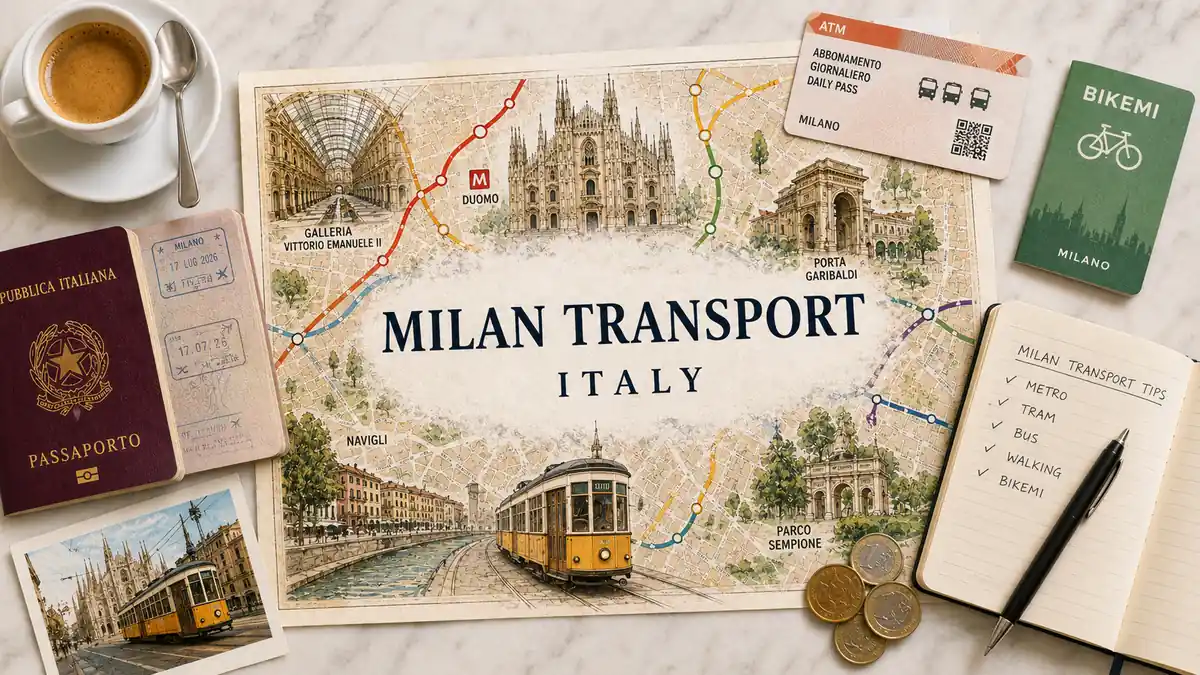
You’ve settled on Milan and now need to move around it without wasting time or money. The good news is that the system is simple. Milan’s centre is compact, and one integrated network of metro, trams, and buses connects everything beyond walking distance. Because the choices are few, deciding how to get around and which ticket to buy takes minutes, not hours. This guide covers the whole picture in one place — the five metro lines and how they connect, the ticket and pass options, how to buy and pay, validation rules, when trams and buses beat the metro, and when walking wins outright. Airport transfers and day trips are handled on their own pages; here the focus stays on getting around the city itself, day to day.
Quick Answer
Central Milan is compact and covered by a simple, integrated metro, tram, and bus network, backed by easy walking. Trip length is the deciding factor between buying single tickets and a 24-hour or multi-day pass. Most short-stay visitors do fine mixing walking with single tickets, adding a 24-hour pass on heavy metro days.
Trust Layer
Tripstou planning guide for travelers resolving one travel decision. Covers the main variable, traveler context, and practical tradeoffs.
Produced with AI assistance and reviewed by Alex Perrut, working in tourism since 2015, for the Tripstou editorial team. See our editorial process for details.
Last factual review: July 17, 2026.
Official sources consulted: Italia.it, ENIT.
Key Takeaways
- One validated ticket moves you across metro, tram, and bus for 90 minutes, so mixing modes costs nothing extra.
- Choose your ticket by trip length: singles or a carnet for occasional rides, a 24-hour or multi-day pass for heavy metro days.
- A 24-hour pass only pays off from about three rides in a day; below that, singles or a carnet cost less.
- Tap a contactless card or phone to pay and validate at once; paper tickets must be stamped at the start of every journey.
- Central Milan is compact and flat, so under about a kilometre walking usually beats the metro once stairs and waiting count.
- Fares sit in low single-digit euros per ride, but confirm current prices with official ATM before you travel.
Table of Contents
How do you get around Milan?
Milan runs on an integrated metro, tram, and bus network, plus easy walking downtown. Five metro lines handle longer, cross-city hops, while trams and buses fill the gaps between them, and the compact historic core is best covered on foot. One ticket works across all three modes.
The three modes act as one system. Metro is fastest for distance, trams and buses cover the surface streets between stations, and your feet handle the tight historic core. One validated ticket moves you across all of them within its time window. For the wider city context, see our Milan travel guide. Arriving or leaving by plane works differently — getting to and from Milan’s airports is covered on its own page, so this guide stays inside the city.
What metro lines does Milan have?
Milan has five metro lines, each known by its colour. They run as M1 Red, M2 Green, M3 Yellow, M4 Blue, and M5 Purple, interchanging at central hubs like Duomo, Cadorna, and Centrale. Switching lines to cross the city is quick.
Interchange stations tie the network together. Duomo links M1 and M3 at the very centre; Cadorna connects M1 and M2 beside the suburban rail hub; Centrale ties M2 and M3 to the main train station. The newer M4 Blue runs east–west toward Linate, and M5 Purple curves through the north. Signs are colour-coded on every map and platform, so you can navigate by colour alone even without Italian.
What time does the Milan metro run until?
The Milan metro runs from early morning until around midnight, when the last trains leave central stations. Service starts roughly around 6am, and closing times vary slightly by line and by night. Trams, buses, and a night-bus network keep running after the metro stops, so late travel is still possible. Check the official ATM timetable for the exact last departure on your route.
How much does public transport cost in Milan?
Milan’s cheapest common option is a single urban ticket, valid for 90 minutes across metro, tram, and bus. Beyond that, the fare system offers a 24-hour pass, multi-day passes, and a 10-ride carnet. Prices sit in low single-digit euros per ride, rising with pass length.
Figures are rough bands only; confirm current fares with official ATM before you travel.
| Ticket type | What it covers | Rough price band | Best for |
|---|---|---|---|
| Single urban ticket | 90 minutes across metro, tram, and bus | Around €2–€3 per ride | Occasional trips and short hops |
| 24-hour pass | One day of unlimited urban rides | Roughly €7–€8 for the day | Days with heavy metro use |
| Multi-day pass | Two or three consecutive days typically | About €12–€20 by length | Longer stays riding daily |
| 10-ride carnet | Ten separate single journeys | Around €18–€22 for ten | Groups or rides spread out |
The same fares apply whichever mode you use, since the ticket is integrated. Passes save money only once you ride enough to clear their cost; otherwise singles are cheaper. Zones matter for trips beyond the city: the STIBM fare system splits journeys into zones, with the urban core sitting in Mi1–Mi3. Stay inside that urban band and the standard city fares above apply.
Which ticket should you buy for your stay?
Pick your ticket by how many rides your trip actually needs. Single tickets or a 10-ride carnet suit occasional rides; a 24-hour or multi-day pass wins on heavy metro days. Most short-stay visitors walk more than they ride, so they need fewer tickets than expected.
Match the ticket to your rhythm:
- Occasional rides: buy single tickets as you go, or a 10-ride carnet to share across a group or several days.
- One busy metro day: a 24-hour pass usually beats buying three or more singles.
- Several active days: a multi-day pass removes the daily buying step and caps your spend.
A 24-hour pass only pays off once you take three or more rides in a day; below that, singles or a carnet cost less. Where you sleep changes the maths too. A central base near a metro node cuts how many rides you need at all, so if you’re still deciding, where to stay in Milan covers picking a base near transit.
Where do you buy tickets and how do you pay?
The easiest way to pay is to tap a contactless card or phone at the metro gate or onboard reader. You can also buy tickets from station machines, tobacconists and newsstands, or the official ATM app. Tapping the same card counts as your validation.
Buying is easy from several points:
- Station machines take cards and cash and switch to English.
- Tobacconists (tabaccheria) and newsstands sell paper tickets and carnets.
- The official ATM Milano app sells and stores tickets on your phone.
Contactless is the simplest for most visitors: tap the same card in and out and skip choosing a ticket type. Keep one card per person. You cannot share a single contactless tap across two travellers, and mixing cards mid-trip breaks the fare calculation.
Do you need to validate or stamp your ticket?
Yes, you must validate a paper or single ticket as you start each journey. Stamp it at the metro gate, or at the onboard machine on trams and buses; contactless taps validate automatically. Riding with an unvalidated ticket counts as fare evasion and can bring a fine, so validate every single time, even when the vehicle is empty. Check official ATM for the current penalty.
How do trams and buses work in Milan?
Trams and buses use the same integrated ticket as the metro and share its 90-minute transfer window. They reach neighbourhoods and surface routes the metro skips, and you can change between modes on one validated ticket until the 90 minutes expire. Trams are slower but scenic through the centre.
Trams and buses extend the network’s reach. They serve routes the five metro lines never touch and connect residential streets to the nearest station. On one validated ticket you can hop metro, then tram, then bus until the 90-minute window closes. Because that clock starts at first validation, a quick errand out and back often fits on a single ticket, so plan short round trips inside the window. Vintage orange trams still run some central lines. Slow, but a ride worth taking.
Is central Milan walkable?
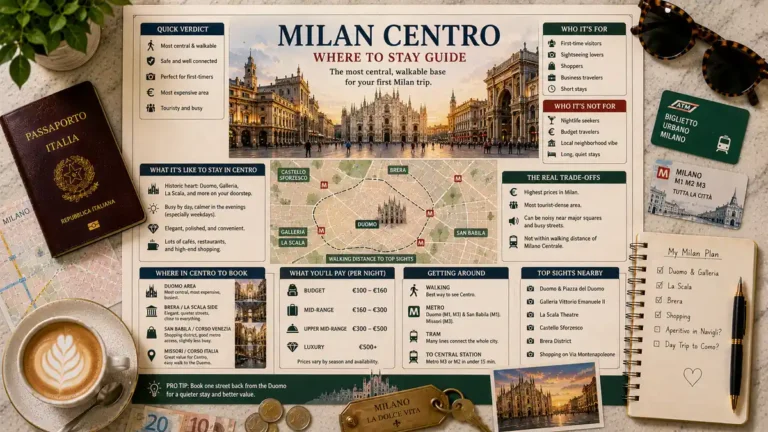
Yes, central Milan is very walkable, and the historic core is often faster on foot than underground. The main sights around the Duomo, the Galleria, and Sforza Castle cluster within a compact, flat area. Save the metro for longer, cross-city hops where walking would take too long.
Distances between the headline sights are short. From the Duomo you reach the Galleria, La Scala, and the shopping quarter on foot in minutes, and Sforza Castle and Brera sit a comfortable walk beyond. Between two central sights the metro often loses to walking once you count stairs, waiting, and the hike to and from platforms — under about a kilometre, walk. Save underground trips for the longer hops out to the Navigli, the Cimitero Monumentale, or the stadium. For a ready-made walking-led plan, our 2-day Milan itinerary sequences the centre on foot.
Are there taxis and ride-hailing in Milan?
Yes, Milan has licensed white taxis and app-based ride-hailing across the city. Both make sense for late nights after the metro closes, heavy luggage, or small groups splitting the cost. For everyday travel they are far pricier than public transport, so most visitors use them only occasionally.
Taxis wait at ranks by stations and major squares, or come by phone and app; hailing one on the street is less reliable. App-based ride-hailing works citywide and shows the price upfront. Fares run well above a metro ticket, so they earn their place mainly late at night, with bags, or when a group splits one car. Heading beyond the city afterwards is a different trip. Exploring Italy by train covers onward routes and day trips by rail.
Frequently Asked Questions
Does Milan have bike or scooter sharing (BikeMi)?
Yes, Milan has BikeMi, the city’s public bike-share, alongside several app-based e-scooter and e-bike services. BikeMi uses docking stations across the centre and needs a short-term subscription, while the scooter apps unlock rides on demand. Both suit short hops, though the metro and walking usually cover visitors faster.
Are Milan metro tickets free for children?
Young children travel free on Milan’s public transport, with older kids needing a standard ticket once they pass the set height or age limit. The exact free-travel threshold is set by ATM and can change, so check the official ATM site before you rely on it. Carry a ticket if unsure.
Is Milan public transport safe?
Yes, Milan’s public transport is generally safe day and night, used routinely by residents and visitors alike. The main risk is pickpocketing on crowded metro cars and at busy stations like Duomo and Centrale, so keep bags zipped and valuables close. Late-night trams and night buses are a reliable way home.
Which metro line goes to the Duomo?
Two metro lines serve Duomo station: M1 Red and M3 Yellow, which interchange directly beneath the cathedral square. That makes Duomo one of the network’s central hubs, easy to reach from most of the city with at most one line change. From many central sights, though, walking is quicker.
What is the ATM Milano app and do I need it?
The ATM Milano app is the official transport app for buying, storing, and showing tickets on your phone, plus checking routes and live times. You do not strictly need it: contactless tap-to-pay and station machines cover most visitors. It is handy for planning journeys and skipping ticket queues on busy days.
Related Guides
- Milan travel guide — the full city hub with everything beyond transport.
- Milan airport transfers — getting between Malpensa, Linate, Bergamo, and the city.
- Where to stay in Milan — choosing a base near the transit you’ll use.
- 2 days in Milan itinerary — a walking-led route through the centre.
- Italy by train itinerary — onward routes and day trips by rail.
Did this guide save you time or money? Tripstou is independent and reader-funded — if you'd like to give something back, you can support the site with a crypto contribution of any size.