Choosing where to stay is the first real decision of a Milan trip, and it trips up more first-timers than any sightseeing question. Milan spreads its appeal across a dozen distinct neighborhoods — a historic core, a canal district, a fashion quarter, busy station hubs — and the guides rarely agree. For a first visit, though, the choice is simpler than it looks. One central base puts you within walking distance of the landmarks you came for, on the metro lines that reach everything else, and clear of the trade-offs that catch people out. This guide names that default base, then lines up the strongest alternatives by vibe, budget, and convenience. You will also get straight answers on safety, walkability, getting around, and rough relative cost — enough to book with confidence. Start with the Quick Answer below, then match your priorities to an area.
Quick Answer
Centro Storico, around the Duomo, is the best base for first-time visitors — walkable to the sights and best connected. That central convenience costs more and feels busier than the rest of the city. Brera offers the same centrality with a calmer, more characterful feel; Navigli wins for nightlife and value.
Trust Layer
Tripstou stay guide for travelers choosing where to base. Covers area atmosphere, budget, convenience, noise, and traveler fit.
Produced with AI assistance and reviewed by Alex Perrut, working in tourism since 2015, for the Tripstou editorial team. See our editorial process for details.
Last factual review: July 16, 2026.
Official sources consulted: italia.it, enit.it.
Key Takeaways
- Centro Storico around the Duomo is the best first-time base, putting the main sights on foot and every metro line nearby.
- The central base’s tradeoff is real: you pay Milan’s top rates and accept more noise in exchange for walkable convenience.
- Brera is the strongest alternative, keeping central walkability while trading bustle for calmer, characterful streets at a slightly lower price.
- Navigli offers the best value and liveliest nightlife of the first-timer areas, but you rely on the metro to reach the sights.
- The common mistake is basing too far out or on the station’s scruffier edge to save money and losing the walkable-core payoff.
Table of Contents
Centro Storico is the best base for a first visit to Milan
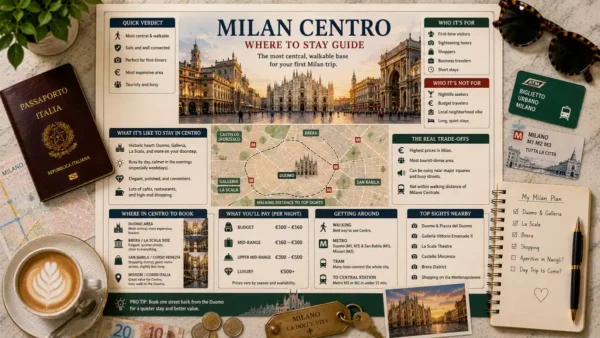
Stay in Centro Storico, the historic core around the Duomo, for your first visit to Milan. It puts the Duomo, the Galleria, and La Scala within an easy walk and sits on the city’s densest cluster of metro lines. Nowhere else pairs sightseeing and connectivity this tightly.
Day to day, the centre feels grand and busy. Elegant nineteenth-century arcades, designer windows, and a steady flow of shoppers and commuters set the tone, and the crowds thin only late at night. It reads polished more than cosy — expect movement and noise right around the Duomo, with quieter, formal side streets a few blocks off.
On convenience, nothing else in Milan competes for a first-timer:
- The Duomo, the Galleria, and La Scala are reachable on foot, with the main shopping streets alongside.
- The area sits on several metro lines, giving the easiest transfers in the city to everywhere you cannot walk.
Price positioning is high-end-leaning. Central rooms carry Milan’s top nightly rates, and they climb further during the city’s big fashion and design weeks, so book early if your dates are fixed. The payoff of a central base here is time, not luxury: Milan’s headline sights sit so close together that a Duomo-area room turns most of your itinerary into a walk and frees the metro for day trips.
For a full breakdown of the Centro and Duomo area — its exact edges, micro-locations, and where the good streets are — see our Centro area guide.
Best for: first-timers who want every major sight within walking distance.
Hotels and places to stay
Compare hotels, apartments and stays for your dates in one search.
Search hotels and stays on hotels.com →
Tripstou may earn a commission if you book through this link, at no extra cost to you.
Brera is the best alternative for quieter, characterful charm
Brera is the best alternative for first-timers who want central convenience with a calmer, characterful feel. The old artists’ quarter sits directly northwest of the Duomo, so you keep walkable access to the main sights while trading some of the bustle for cobbled lanes, galleries, and a village-like evening mood.
The atmosphere is Brera’s whole case. Narrow streets, ivy-draped facades, art galleries, and small trattorias give it an intimacy the Duomo core lacks, and evenings feel local instead of touristy. That calm is an evening quality, though, not a daytime one — the boutiques and galleries pull steady foot traffic all day, and the hush only settles once the shops close.
Convenience stays strong. You can walk to the Duomo and the Galleria in minutes, and a metro stop on the edge of the quarter links the rest of the city. Price positioning runs mid-to-high: Brera is not a budget pick, but rooms often sit a notch below the priciest Duomo-front addresses for a comparable location.
For the neighborhood in depth, see our Brera area guide. If you are weighing the two most central options directly, our Centro vs Brera comparison settles the choice.
Best for: first-timers who want a central base with a slower, more characterful mood.
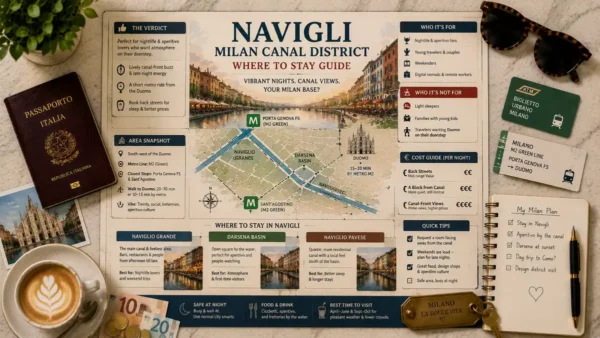
Navigli suits first-timers who want nightlife and value
Navigli suits first-timers who put nightlife and value ahead of being steps from the Duomo. The canal district southwest of the centre is Milan’s liveliest evening quarter, with better room rates and a younger, more relaxed feel. The trade-off is distance — you lean on the metro to reach the main sights.
By day the canals are pleasant and low-key; by night they turn into the city’s aperitivo and bar heartland. That energy is the draw, and it is also the catch. Navigli’s value comes with a noise cost that shifts by the exact address: canal-facing rooms buy you the view, but the crowd runs late, so lighter sleepers should book a street or two back from the water.
On convenience, plan to use the metro. The centre is a short ride away, and a station on the edge of the district connects you to the Duomo core and beyond, so you sacrifice walk-everywhere access for the livelier setting and gentler prices. Price positioning is mid-range, and Navigli usually offers the best value of the areas a first-timer should consider.
For the full picture, see our Navigli area guide, and if you are torn between the buzz and the central location, our Centro vs Navigli comparison lays out the trade.
Best for: first-timers led by nightlife and better nightly value.
Where to base for a short trip or Milan stopover
For a short trip or Milan stopover, choose your base by whether trains or sightseeing dominate your plans. Base near Milano Centrale for seamless airport and intercity rail with minimal transfers. Choose the walkable core instead to spend your limited hours on foot among the Duomo landmarks.
Milano Centrale earns its place for one reason: rail access. It is the hub for airport trains and fast intercity services, so if you are catching an early departure or hopping on to another Italian city, staying nearby removes cross-town transfers on a tight schedule. The area itself is functional rather than charming — big, busy, and built around the station.
One caveat matters for a first night in the city. A Centrale base saves transfers, but the blocks immediately around the station feel scruffier after dark than the rest of central Milan, so book toward the Porta Nuova side or the Duomo direction, not the station’s eastern edge. For anyone whose short trip is really about seeing Milan itself, the central core still wins — the walkable payoff beats the rail convenience.
Price positioning near Centrale is mixed, spanning budget rooms up to business hotels. If your stopover is part of a wider Italian route, our Milan trip planning guide covers getting around and how the city fits a broader itinerary.
Best for: rail-heavy short trips, stopovers, and early departures.
Best Milan areas by first-timer traveler type
Match your top priority to one area and the Milan stay decision resolves fast. Walkability and sightseeing point to Centro Storico, quieter charm to Brera, nightlife and value to Navigli, a rail-heavy short trip to Milano Centrale, and higher-end comfort to the Centro–Brera axis. Each priority maps to a single base.
| Area | Best for | Relative price | Convenience |
|---|---|---|---|
| Centro Storico | Walking to every major sight | High-end, among the city’s priciest | Best metro links; landmarks on foot |
| Brera | A calm, characterful central base | Mid-to-high, close to the core | Short walk to the Duomo core |
| Navigli | Nightlife and better nightly value | Mid-range, the best value here | Metro to the centre; further out |
| Milano Centrale | Rail-heavy short trips and stopovers | Mixed, a wide range near the station | Direct airport and intercity trains |
| Centro–Brera axis | Higher-end comfort near the sights | High-end, premium stays concentrated | Central, walkable, well connected |
Read the table top to bottom and the logic holds: convenience buys walkability at a higher price, and every step toward value or nightlife adds a metro ride. Travelers prioritising higher-end comfort can compare the city’s top properties in our best luxury hotels in Milan roundup.
Other Milan areas worth knowing
Milan has more usable bases, but first-timers rarely need them. Porta Venezia, Isola, and the wider Centrale district each work for specific travelers, yet none beats the core shortlist for a first visit. Here is who they suit before you route to the full neighborhood breakdown for the rest.
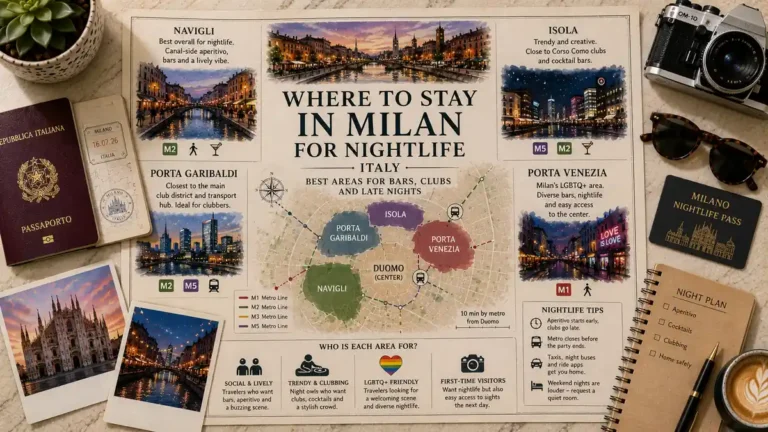
- Porta Venezia — leafy, residential, and well connected, it suits repeat visitors and anyone wanting a more local, lower-key stay a short metro hop from the centre.
- Isola — the design-forward district by the Porta Nuova skyscrapers works for travelers drawn to modern Milan and a trendier scene, though it sits away from the historic sights.
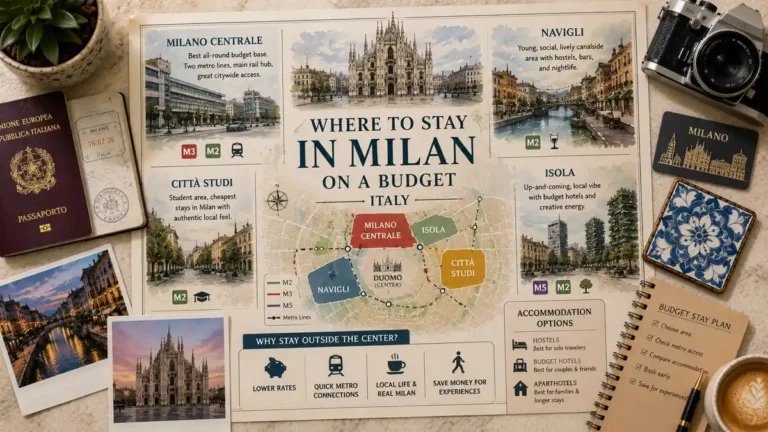
- The wider Centrale district — beyond the stopover case, it appeals to budget-minded travelers who value rail access over atmosphere and do not mind a plainer setting.
For every area the shortlist leaves out, and the full traveler-by-traveler catalogue, see our complete Milan where-to-stay breakdown.
Frequently Asked Questions
Is Milan safe, and which areas should first-timers avoid?
Milan is a generally safe city for first-time visitors, with normal big-city caution enough in the central areas. The main watch-out is the streets immediately around Milano Centrale after dark, which feel scruffier than the rest of the centre. Stay in Centro Storico, Brera, or Navigli and you will be on well-trafficked, comfortable ground.
How much does a hotel in Milan cost per night?
Milan hotel prices vary widely by area, season, and how central you stay. Centro Storico near the Duomo carries the city’s top rates, Brera sits a notch below, and Navigli offers the best value of the first-timer areas. Rates climb sharply during the big fashion and design weeks, so book early if your dates are fixed.
How far is Navigli from the Duomo, and how do you get around Milan?
Navigli sits southwest of the Duomo and is a short metro ride from the centre, not a walkable distance. Milan is easy to get around: the metro is the backbone, with several lines meeting near the Duomo, plus trams and buses. For a first visit, a central base plus the metro reaches everything without a car.
Which Milan neighborhood is best for first-time visitors with kids?
Brera works best for first-time visitors with kids, pairing a central location with calmer, walkable streets and a village-like feel that suits families. Centro Storico is the strong runner-up when you want every sight on the doorstep, though it is busier and pricier. Navigli’s late-night energy makes it the least family-friendly of the shortlist.
When should first-time visitors book a hotel in Milan?
Book as early as you can, especially if your dates fall during Milan’s fashion or design weeks, when central rooms sell out and rates spike. Outside those peaks you have more flexibility, but the best-value Navigli and Brera rooms still go quickly on weekends. Locking in a central base early protects both price and walkability.
Is it better to stay in one area or switch hotels in Milan?
Stay in one central base for a first trip to Milan — the sights sit close enough together that switching hotels adds hassle without saving time. A single room in Centro Storico or Brera keeps you walkable to the landmarks and on the metro for everything else. Save multi-base stays for longer, wider Italian trips.
Related Guides
- Where to Stay in Milan: full neighborhood breakdown
- Milan Travel Guide: planning your trip
- Milan Centro: the historic core in depth
- Milan Navigli: the canal district guide
- Milan Brera: the artists’ quarter guide
- Best Luxury Hotels in Milan
Did this guide save you time or money? Tripstou is independent and reader-funded — if you'd like to give something back, you can support the site with a crypto contribution of any size.