You’ve settled on Milan and set a budget ceiling — now you need a base that keeps costs down without stranding you far from the action. This guide names the districts that are genuinely cheaper to sleep in, explains why they cost less, and matches each to the kind of traveler it suits. Milan’s pricing follows a simple logic: the closer you sleep to the Duomo, the more you pay for the postcode. The good news is that the metro makes a slightly-off-center base feel central anyway. A neighborhood two or three stops out can cost noticeably less while still putting the cathedral within a short ride. Below you’ll find the budget areas ranked by what they actually offer — connectivity, atmosphere, and who each one fits — plus how to choose between a hostel, a budget hotel, and an aparthotel.
Quick Answer
The Milano Centrale area is Milan’s best all-round budget base for most travelers. It costs less than the historic center and connects everywhere fast, trading central charm and walkability for lower rates. Navigli suits younger, social travelers, while the student quarters around Città Studi stretch the tightest budgets furthest.
Trust Layer
Tripstou stay guide for travelers choosing where to base. Covers area atmosphere, budget, convenience, noise, and traveler fit.
Produced with AI assistance and reviewed by Alex Perrut, working in tourism since 2015, for the Tripstou editorial team. See our editorial process for details.
Last factual review: July 16, 2026.
Official sources consulted: Italia.it, ENIT.
Key Takeaways
- Milano Centrale is the best all-round budget base: below-center rates paired with two metro lines and the main rail hub.
- The student quarters around Città Studi are Milan’s cheapest bases, kept low year-round by steady university demand.
- In Milan you save by choosing a base near a metro node, not by chasing the last few euros of distance.
- Pick accommodation by trip shape: dorms for solo savings, budget hotels for privacy, aparthotels once you stay several nights.
- Navigli costs more than the student areas but rewards social travelers with hostels and canal nightlife on the doorstep.
- Milan’s budget districts are generally safe and well-connected, so a slightly off-center base rarely means an isolated one.
Table of Contents
Which Milan areas are genuinely budget-friendly, and why they cost less
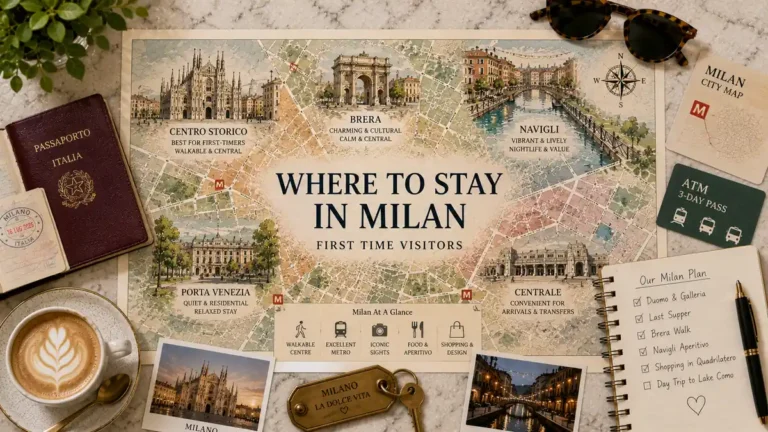
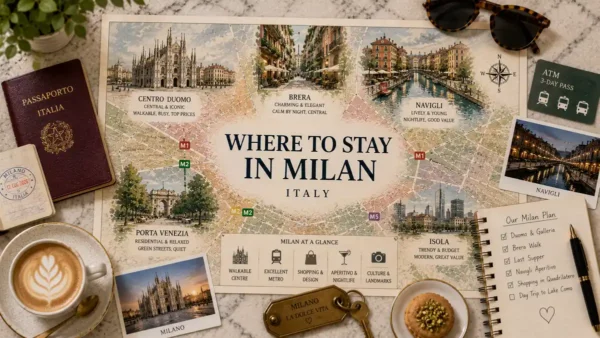
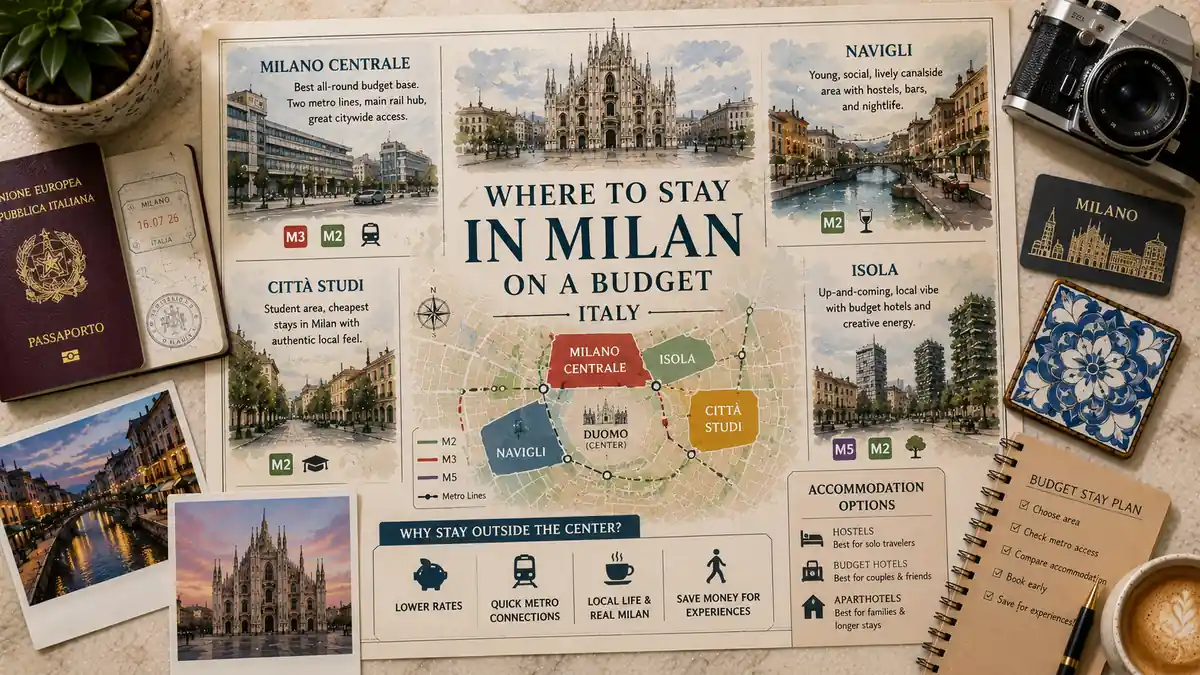
Milan’s cheapest bases cluster around transport hubs and student districts, not the Duomo. Milano Centrale, Navigli, Città Studi, and Isola all undercut the historic center because they trade cathedral proximity and postcard charm for function, distance, and steady student demand. Central, pretty districts cost more precisely because everyone wants to sleep there.
Three forces set Milan’s accommodation prices. Distance from the Duomo carries the most weight: the historic core commands a premium for walkability alone. Student demand is the second — university neighborhoods keep a permanent floor of affordable rooms. The third is atmosphere: charming, design-heavy districts like Brera charge for the setting, not just the address.
That’s why the budget map looks the way it does. The cheaper areas are functional, residential, or student-driven, and they lean on the metro to make up the distance. For the full picture across every price level, the complete Milan where-to-stay guide maps all the areas; for the pricier-charm end of the scale, Brera shows what the premium actually buys.
The saving in Milan comes from a district’s character, not its remoteness — a functional neighborhood on the M2 can sit ten minutes from the Duomo yet cost far less than an equally-connected charming one.
Milano Centrale is the best budget base for connectivity
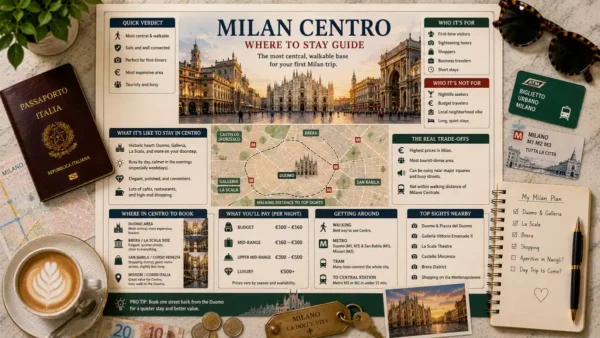
Staying near Milano Centrale is cheaper than the center and connects everywhere fast. The station area gives budget travelers the best balance of low rates and reach: two metro lines, the main rail hub, and direct airport links all start at your doorstep. You lose historic-center looks, but you gain a base that moves.
What you get around Centrale is practicality over prettiness. The immediate blocks are busy and workmanlike — hotels, cafés, and transit crowds instead of cobblestones. It’s a place to sleep and launch from, not to linger.
Convenience is the selling point. Metro lines M2 and M3 both stop at the station; the M2 threads down toward Navigli and the M3 runs straight to the Duomo in a few minutes. It’s also the rail gateway for day trips and the natural landing point from the airports.
On price, the area sits firmly in the budget tier — consistently gentler than the historic center for the same room standard, though rates climb sharply during the city’s big trade fairs. Treat any quote around those weeks as provisional and book early.
Best for: first-timers who want cheap rooms and fast access without learning Milan’s geography first.
Is Navigli a good budget base in Milan?
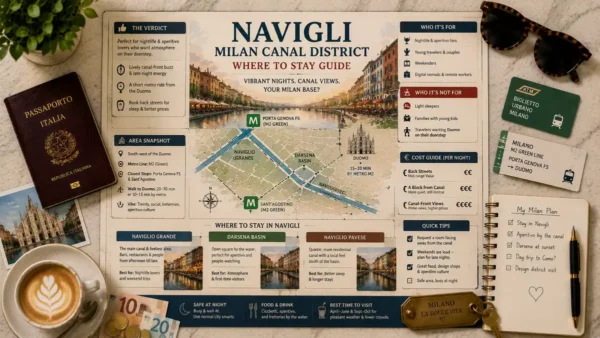
Navigli works on a budget for social travelers who want atmosphere over savings. The canal district packs hostels, guesthouses, and cheap eats into one of Milan’s liveliest quarters, so it’s ideal if nightlife matters. Rates run higher than the student areas, though — you pay a little more for the buzz and the waterside setting.
Navigli’s appeal is the evening. The canals fill with aperitivo crowds, the bars stay busy late, and the whole quarter runs on a young, social energy that suits backpackers and first-time solo travelers. Days are quieter and more residential than the nightlife reputation suggests.
For connectivity, the Porta Genova stop on the M2 anchors the area, backed by tram lines into the center. It’s walkable to the canals and a straight metro ride to Centrale.
On price, Navigli sits in the middle of the budget set — cheaper than the historic center, dearer than the student quarters. The hostel scene is what keeps it accessible; private rooms creep upward, especially on weekends.
If you want the full neighborhood picture, the Navigli area guide covers it in depth, and if you’re weighing it against a central base, the Centro versus Navigli comparison settles the tradeoff.
Best for: younger, social travelers who rank nightlife and canal atmosphere above rock-bottom rates.
Città Studi and the student quarters stretch the tightest budgets furthest
Milan’s student districts are its cheapest bases, kept affordable by steady university demand. Neighborhoods like Città Studi cater to students, so dorms and budget rooms stay low year-round. The tradeoff is buzz: these are everyday residential quarters, short on sights and nightlife, that reward travelers who care more about the nightly rate than the view.
Life in the student quarters is unglamorous and genuinely local. You get markets, canteens, cheap trattorias, and a student population that keeps prices honest — but few postcard moments. This is a base for people who spend their days out and just need somewhere affordable to return to.
Connectivity is better than the low rates suggest. Città Studi sits on the M2 with tram links across the city, so the center is a reliable, direct ride even from the cheapest rooms.
On price, this is the bottom tier of Milan’s budget map — the closest the city comes to consistently low rates. Because demand comes from term-time students, the cheapest weeks rarely line up with the tourist calendar.
The student quarters hold their low rates through Milan’s fashion weeks and Salone del Mobile, when central prices jump hardest — the university calendar, not the tourist one, sets demand here.
Best for: solo travelers and long-stay backpackers whose top priority is the lowest possible nightly rate.
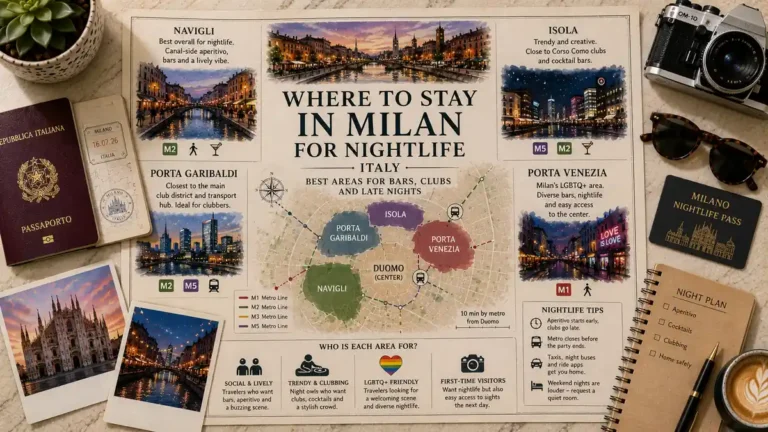
Isola and Porta Garibaldi for budget with a local, well-connected feel
Isola and Porta Garibaldi mix local atmosphere with strong transport and moderate rates. This pair sits just north of the center around the Garibaldi hub, blending residential calm with modern design and excellent metro and rail links. Rates stay gentler than the historic core, making it a comfortable compromise for travelers who want character without the central premium.
Isola in particular has shifted from working-class quarter to one of Milan’s more characterful residential pockets, all independent cafés and tree-lined streets under the skyscrapers of Porta Nuova. Porta Garibaldi next door is busier and more corporate but equally well-served. Together they feel genuinely lived-in.
The transport is a real advantage. Porta Garibaldi is a major rail station, the M5 and M2 both serve the area, and getting to the center or the airports is quick and painless.
On price, expect the upper end of the budget range — not the cheapest option here, but fair value given the atmosphere and connections. It’s where a slightly higher rate buys noticeably more neighborhood.
Best for: couples and calmer travelers who want a local, well-connected base over party energy or the rock-bottom price.
Other budget-friendly areas worth knowing
A few more districts offer budget rates if the main four don’t fit. Areas like Porta Romana, Loreto, and Lambrate can undercut the center too, each with its own quirk — a little further out, a little rougher around the edges, or simply less established as a visitor base. They’re worth a look when the obvious choices are booked or pricey.
- Porta Romana: a handsome, semi-central district on the M3 that stays cheaper than the core, good for travelers who want polish without the Duomo markup.
- Loreto: a busy, unglamorous crossroads where the M1 and M2 meet, useful purely for cheap rooms with easy connections.
- Lambrate: an eastern, slightly industrial pocket near a rail station, quiet and low-priced, best when value matters more than location.
Best budget areas by traveler type
Match your traveler type to a budget area in one line. The right budget base depends less on price alone than on how you travel. Solo backpackers, nightlife-seekers, first-timers, and couples each have a natural fit among Milan’s cheaper districts. The table below pairs each type with one area and the one reason it works.
| Traveler type | Budget area | Why it fits |
|---|---|---|
| Solo backpacker | Città Studi / student quarters | Cheapest rooms with a direct metro ride in |
| Social / nightlife | Navigli | Hostels and canal bars on the doorstep |
| Budget first-timer | Milano Centrale | Low rates plus fast access to the sights |
| Couples wanting calm | Isola / Porta Garibaldi | Local feel with strong metro and rail links |
Your budget still sets the ceiling. If some central access matters more than the last few euros, central Milan (Centro) shows what a core base costs by comparison, and if you’re torn between the pretty districts, the Centro versus Brera comparison weighs charm against price.
Hotels and places to stay
Compare hotels, apartments and stays for your dates in one search.
Search hotels and stays on hotels.com →
Tripstou may earn a commission if you book through this link, at no extra cost to you.
Hostel, budget hotel, or aparthotel: which is best value?
Hostels are cheapest for solo travelers, budget hotels buy privacy, and aparthotels win on longer stays. The best-value option depends on how many nights you’re staying and whether you’re alone or in a group. Each type trades money against space and independence differently, so the right call follows your trip shape, not a fixed price ranking.
- Hostels: the cheapest way to sleep solo, and the most social. Dorm beds sit at the bottom of the budget tier and often include a shared kitchen. The tradeoff is privacy — you’re sharing space and sleep quality varies.
- Budget hotels: the privacy upgrade. A basic private double costs more than a dorm bed but buys your own room and a reliable night’s sleep. Best for travelers who want simple comfort without paying for extras.
- Aparthotels: the value pick for longer or group stays. A small apartment with a kitchen spreads across several nights or several people better than a hotel, and self-catering trims Milan’s restaurant costs. Less service, more independence.
In Milan the aparthotel math flips around the third or fourth night — below that a budget hotel usually wins, but on longer stays the kitchen quietly offsets the city’s high eating-out costs.
How to save on Milan accommodation without ending up isolated
The biggest saving is basing near a metro node just outside the center. Pick a neighborhood one or two stops out on a metro line, and you cut the nightly rate while keeping the center a short, direct ride away. Connectivity is what makes a cheaper base work — it buys back the distance you traded for the lower price.
Three habits keep a Milan stay cheap without stranding you. First, choose your base by its metro stop, not its distance from the Duomo — a well-connected outer district beats a poorly-connected near-central one every time. Second, match the accommodation type to your trip: dorms for solo savings, aparthotels when a kitchen pays off. Third, if your dates are flexible, avoid the city’s peak trade-fair weeks, since rates across every tier jump when the fairs are in town.
Two cheap districts one stop apart can differ in price mainly by how directly their line reaches the Duomo — the metro map, more than the neighborhood name, is what you’re really booking.
Budget doesn’t have to be a hard ceiling. On a quiet week, a modest step up can land a central room for little more than a peripheral one — and if you decide to treat the trip, the luxury hotels in Milan guide covers the top end. For the wider city context around your stay, the Milan travel guide sets the scene.
Frequently Asked Questions
Is Milan expensive to stay in?
Milan is one of Italy’s pricier cities to sleep in, but only the historic center commands top rates. Budget bases near Milano Centrale, the student quarters, and the canals stay well below that ceiling. Book a well-connected outer district and Milan turns from an expensive city into an affordable one.
Are budget areas in Milan safe at night?
Milan’s main budget areas are generally safe at night, though a few call for ordinary city awareness. The immediate blocks around Milano Centrale can feel busy and rough after dark, while Navigli, Città Studi, and Isola stay lively and comfortable. Stick to well-lit, populated streets and normal precautions are enough.
When are Milan hotels most expensive?
Milan hotel rates spike hardest during its big trade fairs and fashion weeks, when business and industry demand floods the city. Salone del Mobile, the design fair, is the most extreme. Rooms across every tier jump, and budget areas fill fast. If your dates are flexible, avoid these peak weeks entirely.
How far is the Central Station area from the Duomo?
The Milano Centrale area sits a short metro ride from the Duomo — just a few stops south on the M3 line, which links the two directly. It is not walking distance, but the connection is quick and frequent. That closeness is exactly why the station area works as a budget base.
Do Milan’s budget areas have good metro connections?
Yes — every recommended budget area sits on the metro, which is what keeps a cheaper base practical. Milano Centrale has the M2 and M3, Navigli the M2, Città Studi the M2, and Isola the M5 and M2. Each puts the center within a direct, reliable ride.
How early should I book to get budget rates in Milan?
Book two to three months ahead for the best budget rates, and earlier if your trip overlaps a trade fair. Budget rooms near Centrale and in the canal district are limited and sell out first. The further ahead you lock a well-located cheap room, the more choice you keep.
Related Guides
- Where to stay in Milan — the full area map across every budget level.
- Navigli neighborhood guide — the canal district in depth.
- Central Milan (Centro) stay guide — what a core base costs and offers.
- Brera neighborhood guide — the charm-heavy end of the scale.
- Centro versus Navigli comparison — central access against canal atmosphere.
- Centro versus Brera comparison — two central bases weighed side by side.
- Luxury hotels in Milan — the upgrade path if budget isn’t fixed.
- Milan travel guide — city context around your stay.
Did this guide save you time or money? Tripstou is independent and reader-funded — if you'd like to give something back, you can support the site with a crypto contribution of any size.