San Marco is the district most first-time visitors picture when they imagine sleeping in Venice — the square, the Basilica, the gondolas gliding past palazzo windows. It is also the district most seasoned travellers quietly warn you away from. Both reactions are right, because where to sleep in Venice is a different question from where to sightsee, and San Marco answers the two very differently. This guide gives you a straight verdict: whether San Marco is a smart base for your trip, what you actually trade for that central address, and how to choose the right pocket within the sestiere. It stays focused on the stay decision — who San Marco suits, who it doesn’t, and where to look if it isn’t your fit — without wandering into a full Venice sightseeing plan. If you already know you want to be steps from St. Mark’s, read on; the nuance is in the how and the where.
Quick Answer
San Marco is Venice’s best base for first-timers who want to walk to St. Mark’s, the Doge’s Palace, and Rialto. It is the most central sestiere, but also the most crowded, most expensive, and least local-feeling district. Value- and authenticity-first travellers do better in Cannaregio or Dorsoduro.
Trust Layer
Tripstou stay guide for travelers choosing where to base. Covers area atmosphere, budget, convenience, noise, and traveler fit.
Produced with AI assistance and reviewed by Alex Perrut, working in tourism since 2015, for the Tripstou editorial team. See our editorial process for details.
Last factual review: July 16, 2026.
Official sources consulted: italia.it, enit.it.
Key Takeaways
- San Marco is Venice’s most convenient base for first-timers who want to walk to St. Mark’s, the Basilica, and Rialto.
- You trade that convenience for the city’s heaviest crowds, highest room rates, and thinnest sense of everyday local life.
- Price tracks distance from the piazza, so booking a few lanes back keeps the location and sheds much of the premium.
- Value- and authenticity-first travellers do better in Cannaregio or Dorsoduro, both central without San Marco’s piazza tax.
- The common mistake is basing here for a full week; San Marco suits a short, sight-focused trip far better.
Table of Contents
What San Marco is known for
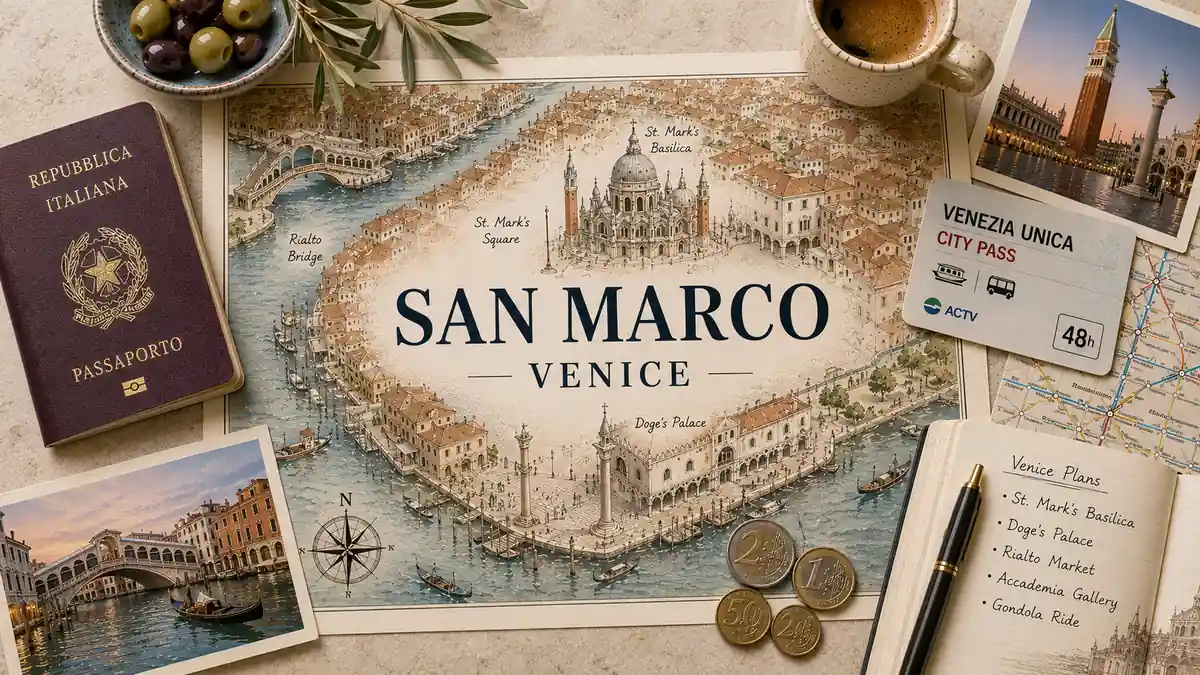
San Marco is Venice’s central sestiere and the postcard heart of the city. It holds St. Mark’s Square, St. Mark’s Basilica, and the Doge’s Palace, and sits right beside the Rialto Bridge. One of six sestieri, it packs the highest concentration of landmark sights into the smallest walkable core.
That density is the whole reason San Marco tempts first-time visitors to book here. Nearly every marquee sight people picture when they imagine Venice sits within a few minutes’ walk of the square. The district doubles as the city’s civic and ceremonial centre, so foot traffic, luxury storefronts, and guided tours concentrate here more than anywhere else in the lagoon. If you want the wider picture of how San Marco fits among Venice’s neighbourhoods, our Venice guide covers the citywide orientation. For the stay decision, hold on to one point: what makes San Marco the best district to see is not what makes it the best district to sleep in.
Is San Marco a good place to base your Venice stay?
San Marco is a good base for first-timers who prioritise walking to the top sights. For value-seekers, longer stays, or travellers chasing a local feel, it is a weaker choice. Its location is unbeatable, but crowds, cost, and a thin sense of everyday Venice pull the other way.
The catch most first-timers miss is that San Marco’s convenience is a daytime asset you mostly spend at night. You sleep beside the sights but visit them by day like everyone else, so the location premium mainly buys a short evening stroll to a floodlit, near-empty piazza. That is a real pleasure — but it is a narrower payoff than the address suggests.
The case for staying here is strongest on a short trip. On two or three nights you cannot afford to lose an hour each way on the vaporetto, and San Marco removes that friction entirely: St. Mark’s, the Basilica, the Doge’s Palace, and the walk to Rialto are all at your doorstep. That maths flips on a longer trip. The more time you have and the more you want Venice to feel lived-in instead of staged, the harder San Marco is to justify as a base.
The honest pros and cons of staying in San Marco
Staying in San Marco is a straight trade of convenience against crowds, cost, and authenticity. You buy the shortest walk to Venice’s headline sights and pay for it in noise, price, and a tourist-heavy atmosphere. Whether that trade is worth it depends almost entirely on how long you are staying and why.
| Factor | What you gain | What it costs |
|---|---|---|
| Location | Walk to every headline sight | Premium charged on that proximity |
| Crowds | Empties out after day-trippers leave | Dense, slow foot traffic by day |
| Price | Wider range near the quieter edges | Top of Venice’s stay-cost band |
| Atmosphere | Grand, ceremonial, unmistakably Venice | Little sign of everyday local life |
| Dining | Convenient food options at all hours | Tourist-priced, uneven quality near the square |
The pros and cons don’t split evenly across the district. The piazza core carries almost all of the crowd and price penalty, while San Marco’s quieter lanes keep the location and shed much of the cost. That uneven split is the single most useful thing to know before booking, and it drives every choice further down this page.
Is San Marco too crowded to stay in?
San Marco is the busiest sestiere by day, but it is not uniformly crowded around the clock. Crowd load concentrates in the piazza core and thins sharply at the quieter edges. Day-trippers also drain out after dusk, so evenings and early mornings feel far calmer than the midday crush suggests.
This is the quiet advantage of sleeping in San Marco rather than only visiting it. You get the piazza at its two best hours — just after the last day boats leave and just before the first arrive — when residents and guests briefly have it to themselves. Most day-trippers never see that version of the square.
By day, the stretch between St. Mark’s Square and Rialto is among the most congested pedestrian routes in Venice, and dragging luggage through it is genuinely slow. The fix is positional. Book a room a few lanes back from the square and the crowd problem shrinks to a short walk you choose when to make. Peak season intensifies all of this; shoulder months ease it.
Is San Marco expensive to stay in?
San Marco sits at the top of Venice’s stay-cost range. You pay a location premium for sleeping inside the city’s most central, most-visited district, and it shows up across every price tier. The premium softens at the quieter edges, where mid-range rooms exist, but budget options are scarce this close to the square.
Read San Marco through three spend styles:
- Budget: the hardest style to satisfy here — genuine budget rooms are rare, and the few that exist trade space or a canal view for the address. If value leads your decision, our guide to staying in Venice on a budget points you to easier ground.
- Mid-range: the most realistic bracket, concentrated in the quieter lanes away from the piazza, where you keep the location without the front-row premium.
- High-end: what San Marco does best, with grand-canal and piazza-adjacent properties commanding the city’s top rates.
What you are actually paying for in San Marco is metres, not quality. A room two minutes from the piazza and a comparable room ten minutes away can sit whole tiers apart on price for the same standard of bed — the difference is almost purely the walk you save.
Who should stay in San Marco — and who shouldn’t
San Marco suits first-timers, short-trip sightseers, and convenience-first travellers who value proximity over price. It works less well for value-seekers, authenticity-hunters, nightlife-focused travellers, and anyone settling in for a longer, slower stay. The deciding question is whether walking distance to the sights outranks cost and local character for you.
- Stay here — first-timers: yes; one short trip built around the marquee sights is exactly what the location serves. See the by-traveller picks for first-time visitors.
- Stay here — couples on a short break: often yes; floodlit piazza evenings and grand hotels are the draw, if the budget allows. More options for couples here.
- Stay here — luxury travellers: yes; San Marco holds the city’s grandest addresses, and it is where most luxury travellers concentrate.
- Think twice — families: mixed; the convenience helps with tired kids, but crowds, noise, and price work against a longer stay for families.
- Look elsewhere — nightlife-focused travellers: no; San Marco goes quiet after dinner, so a base built for nightlife belongs in a livelier district.
- Look elsewhere — value and authenticity seekers: no; both are easier and cheaper to find away from the piazza.
The clean split here isn’t first-timer versus repeat visitor — it’s trip length. Almost anyone benefits from San Marco for two or three nights, and almost no one should base a full week here, because the crowds and prices that stay tolerable across a sprint become wearing across a week.
Where to stay within San Marco: near the piazza or the quieter edges
Within San Marco, the real choice is the piazza core versus the quieter edges. The core, right around St. Mark’s Square, buys maximum convenience at maximum crowd and price. The edges toward the Grand Canal and the Accademia side stay central while trading a few minutes’ walk for calmer lanes and softer rates. For most travellers, the edges win.
- Right on Piazza San Marco. Best for: travellers who want the square outside the door and will pay the top tier for it. Highest prices, heaviest daytime crowds, unbeatable for a first, short visit.
- The Grand Canal frontage. Best for: those set on a landmark water view at the high-end tier. This is where San Marco’s grandest hotels cluster — for the full field, see our roundup of Venice’s luxury hotels.
- The quieter lanes toward Accademia and Santo Stefano. Best for: travellers who want San Marco’s location at a mid-range rate. Calmer, still a short walk to everything, and the best value inside the district.
A room’s price in San Marco tracks its distance from the piazza almost step by step. Nudging your search a few lanes west of the square keeps the location and sheds most of the premium — a small move that changes the bill more than the experience.
Hotels and places to stay
Compare hotels, apartments and stays for your dates in one search.
Search hotels and stays on hotels.com →
Tripstou may earn a commission if you book through this link, at no extra cost to you.
If San Marco isn’t your fit: where to look next
If value, authenticity, or a more local rhythm matters more to you than sight-proximity, base elsewhere in Venice. Two districts absorb most travellers who rule out San Marco: Cannaregio for everyday local life and better value, and Dorsoduro for art, quiet canals, and a residential-but-central feel. Both keep you close without the piazza tax.
Match the district to what San Marco couldn’t give you:
- Consider Cannaregio if you want value, real neighbourhood life, and a quieter base still within walking reach of the centre. For the head-to-head, see San Marco vs Cannaregio.
- Consider Dorsoduro if you want art museums, calmer canals, and a central-but-residential feel. The San Marco vs Dorsoduro comparison weighs them directly.
- Still deciding across the whole city? Our guide to where to stay in Venice ranks every sestiere for different travellers.
Frequently Asked Questions
How far is San Marco from Venice’s train station, and how good is vaporetto access?
San Marco is not a quick walk from Santa Lucia train station. The two sit across the Grand Canal from each other, so most travellers arrive by vaporetto. On that front San Marco is exceptionally well served — several waterbus stops ring the sestiere, with frequent lines from the station and Piazzale Roma.
Is San Marco safe to stay in at night?
Yes, San Marco is one of Venice’s safest districts to stay in at night. Venice overall has very low violent crime, and San Marco stays lightly populated after dark with a steady presence around the main monuments. The usual caution applies to daytime pickpocketing in the crowds, not to walking back to your hotel.
Is San Marco a good choice for a first trip to Venice?
Yes, San Marco is a strong choice for a first trip to Venice, especially a short one. A first visit usually centres on St. Mark’s Square, the Basilica, the Doge’s Palace, and Rialto, and San Marco puts them all within a short walk. The main caveat is length: it suits a short first trip better than a full week.
Is San Marco too noisy at night to sleep well?
It can be, but noise in San Marco is highly location-dependent. Rooms directly on or beside Piazza San Marco catch late foot traffic, cafe orchestras, and early delivery activity, so light sleepers feel it. A room a few lanes back from the square is markedly quieter, since the inner alleys empty out once day-trippers leave.
Is dining near St. Mark’s Square worth it, or a tourist trap?
Near St. Mark’s Square, much of the dining is tourist-priced and uneven. Set menus and prime-position cafes trade quality for the view, so the square itself is the weakest place to eat. Walk five minutes into San Marco’s quieter lanes, though, and standards rise while prices ease — another reason to book off the piazza.
Should you book a San Marco hotel far in advance?
Yes, booking San Marco well ahead is wise, particularly in peak season. It is Venice’s most sought-after base, and its limited stock of genuine budget and mid-range rooms goes first. Booking early widens your choice of the quieter, better-value edges instead of leaving only piazza-front rooms at top rates. Short-notice trips see thinner options.
Related Guides
- Where to Stay in Venice — the all-districts hub ranking every sestiere.
- San Marco vs Cannaregio — the direct base comparison for value and local life.
- San Marco vs Dorsoduro — the art-and-quiet alternative, weighed head to head.
- Where to stay for a first Venice trip — by-traveller picks for newcomers.
- Staying in Venice on a budget — value-first bases across the city.
- Venice’s luxury hotels — the high-end roundup for the top tier.