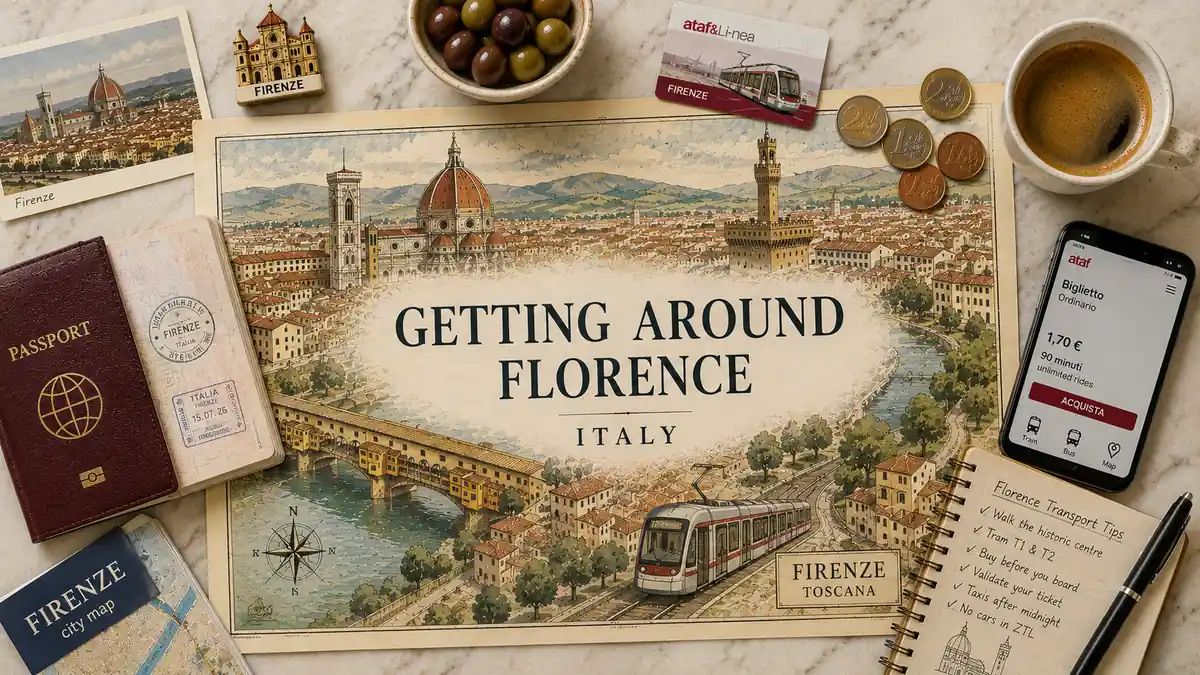
The one question worth settling before you arrive in Florence is simple: how will you actually move around the city? The good news is that the answer is mostly your own two feet. Florence’s historic centre is small and dense, with the Duomo, the Uffizi, Ponte Vecchio, and most other landmarks packed within a 10-to-15-minute walk of each other. For the vast majority of a visit, you won’t touch a ticket machine or a taxi rank. This guide covers the few situations where transport genuinely helps — luggage, late nights, the climb to Piazzale Michelangelo — and how the tram, buses, taxis, and ticketing work in practice, plus the one thing you should not do: drive into the centre.
Quick Answer
Florence’s historic centre is small and walkable, so most visitors get around almost entirely on foot. You only need a tram, bus, or taxi in specific cases — luggage, staying outside the core, Piazzale Michelangelo, or late nights. Walk by default, buy a single ticket when needed, and don’t drive inside the centre’s limited-traffic zone.
Trust Layer
Tripstou planning guide for travelers resolving one travel decision. Covers the main variable, traveler context, and practical tradeoffs.
Produced with AI assistance and reviewed by Alex Perrut, working in tourism since 2015, for the Tripstou editorial team. See our editorial process for details.
Last factual review: July 15, 2026.
Official sources consulted: italia.it, enit.it.
Key Takeaways
- Florence’s historic centre is compact enough that walking handles nearly every trip, making transport the exception rather than the rule.
- Reach for a tram, bus, or taxi only for luggage, late nights, Piazzale Michelangelo, or staying outside the core.
- Trams and buses share one operator and one cheap ticket, so a single fare covers whichever you board.
- A taxi earns its fare mainly with heavy luggage, after midnight, or when mobility rules out a long walk.
- Never drive into the historic centre — it’s a camera-enforced ZTL, and fines from your rental company arrive months later.
Table of Contents
Is Florence walkable?
Yes, Florence is highly walkable — arguably one of Europe’s easiest cities to explore on foot. The historic centre is compact, roughly 1.5 square miles, with most major sights only 10 to 15 minutes apart. Walking is the default way to get around, and often the fastest.
The layout works in your favour. The Duomo, Ponte Vecchio, the Uffizi, Santa Croce, and the main squares all sit within a tight core that a car or bus would only slow you down in. Narrow, pedestrianised streets mean you cover ground quickly and rarely wait for anything.
Comfortable, broken-in shoes matter more here than any transport pass — Florence’s centre is paved in uneven stone that punishes flat sandals and heels by the end of a long day. The one real climb is up to Piazzale Michelangelo across the river, which is otherwise still an easy city to cross end to end in under half an hour.
Do you actually need public transport in Florence?
For most trips, no — you can get around Florence without a car or any public transport. The compact centre means walking covers nearly everything. You’ll only want a tram, bus, or taxi in a handful of situations: hauling luggage to the station, staying outside the core, reaching Piazzale Michelangelo, mobility limits, late nights, or heavy rain.
The real test is your luggage, not the distance. The same walk that’s delightful with a daypack turns miserable with a wheeled suitcase dragging over cobblestones, which is why arrival and departure days are when transport earns its place. Everything in between is usually a walk.
Where you sleep changes the maths too. If you base yourself in the walkable core, you may never board a bus; if you’re further out, a daily ride into the centre adds up. Our guide to where to stay in Florence covers that trade-off, and for the broader picture of planning your days on foot, start with the Florence city guide and a 2-day Florence itinerary.
| Trip | Best mode | Why |
|---|---|---|
| Across the historic centre | Walk on foot | Major sights sit 10–15 minutes apart |
| Station with heavy luggage | Taxi or T1 tram | Cobblestones make wheeled bags hard work |
| Up to Piazzale Michelangelo | City bus or short walk | A steep climb up from the river |
| Late night across the city | Take a taxi | Night buses are limited after midnight |
| Staying outside the walkable core | Bus or tram line | Daily walks in add up quickly |
How do Florence’s trams and buses work?
Florence has trams and buses but no metro. Two tram lines, T1 and T2, run on dedicated tracks, with T2 linking the city to the airport. Buses cover the rest through a single operator, Autolinee Toscane, which runs roughly 100 lines plus limited night service across the wider urban area.
The tram (T1 and T2)
The tram is the backbone of Florence’s public transport, fast and frequent because it runs on its own tracks away from traffic. T1 and T2 connect the fringes of the city — including Santa Maria Novella station and outlying districts — to the edge of the centre, then you walk in. T2 runs directly to the airport, which makes it the simplest way to arrive with bags; the full route, fares, and timings live in our guide to getting from Florence airport into the city. Exact stop names and endpoints shift with network updates, so check the current map before you rely on a specific stop.
City buses (Autolinee Toscane)
Buses fill in the gaps the tram doesn’t reach, useful mainly for hills, outer neighbourhoods, and a few sights on the edge of the centre. The same operator, Autolinee Toscane, runs the whole network, so one ticket works across bus and tram. Frequency is good on core routes during the day and thins out at night, when a small number of night lines take over. For everyday sightseeing inside the walls, you’ll rarely need a bus at all.
How much is a ticket and where do you buy it?
A single Florence tram or bus ticket costs about €1.70 and covers both networks. It’s valid for roughly 90 minutes, long enough for one trip plus a short connection. You can buy it through the operator’s app, at tabaccherie and newsstands, from machines at tram stops, or contactless on board.
Treat that price and window as a guide and check the current fare before you travel, since ticketing details change. The purchase channels are worth knowing in advance, because the cheapest moment to sort a ticket is before you board:
- The Autolinee Toscane app — buy and validate straight from your phone
- Tabaccherie and newsstands — look for the ticket or “biglietti” sign
- Machines at major tram stops and the station forecourt
- Contactless tap on board, on buses and trams where it’s supported
Always validate a paper ticket the moment you board — the 90-minute clock starts at validation, not purchase, and travelling on an unstamped ticket counts as fare evasion. If you only expect a couple of rides across a whole trip, single tickets almost always beat a pass; the walkable centre means you rarely rack up enough journeys for a day pass to pay off.
When is a taxi worth taking in Florence?
A taxi is worth it mainly for luggage, late nights, or mobility needs — not everyday sightseeing. Distances in the centre are short enough to walk, so a meter running through traffic rarely saves time. Florence taxis charge a metered fare with a base rate plus surcharges for nights, holidays, and baggage.
Taxis here work on a meter, not a haggle. You pick them up at ranks near the station and main squares or book by phone or app; hailing on the street is less common. Expect the fare to climb with add-ons after dark, on Sundays and holidays, and for luggage, and treat any figure you see quoted as approximate until you confirm it.
One route where a taxi consistently beats walking is Santa Maria Novella station with bags — the distance to most central hotels is short, but the cobbled pavement is relentless with a suitcase. Keep in mind that parts of the historic centre fall inside the restricted-traffic zone, so a taxi may drop you at the nearest accessible point and leave the last stretch on foot.
Should you drive in Florence’s historic centre?
No — don’t drive in Florence’s historic centre; it’s a ZTL, a limited-traffic zone. Cameras enforce it automatically, and driving or parking a rental car inside risks fines that arrive months later. Walking and the tram reach almost everything, so a car is a liability here, not a convenience.
The ZTL (Zona a Traffico Limitato) rings the entire old centre and is monitored by cameras that read number plates. Cross a boundary without a permit and the penalty is issued automatically, often reaching you weeks or months afterwards through your rental company. Hotels inside the zone can sometimes register your plate, but that’s the exception, and the rules and active hours change, so never assume you’re clear.
If you’re renting a car for Tuscan day trips, park it outside the ZTL and collect it on your way out — never drive it to a central hotel’s door. Inside the walls you simply don’t need one: the tram, the odd bus, and your own feet cover the city. When it’s time to move on to other cities, the train is faster and simpler than driving anyway.
Frequently Asked Questions
How do you get to Piazzale Michelangelo from the historic centre?
Reach Piazzale Michelangelo on foot in about 20 to 30 minutes from the centre. The walk crosses the river and climbs a set of stepped ramps to the terrace. If the hill feels steep, a city bus runs up from near the centre instead. The panorama rewards the effort.
Are there bikes or e-scooters to rent in Florence?
Yes, Florence has shared bikes and e-scooters available through mobile apps, unlocked and paid per ride. In practice they help most for longer hops or the riverside, since the compact centre is quicker on foot and much of it sits inside the restricted-traffic zone. Availability and rules change, so check the app first.
Is there a metro or underground in Florence?
No, Florence has no metro or underground system, and it doesn’t need one. The historic centre is small enough to cross on foot, while two tram lines and city buses handle longer trips to the fringes and the airport. For everyday sightseeing inside the walls, walking covers almost everything.
Can you pay for Florence trams and buses with a contactless card?
Yes, you can tap a contactless card or phone to pay on Florence trams and buses where the readers are fitted. Each tap counts as one fare, so everyone travelling needs to tap. Not every vehicle supports it yet, so carry a backup ticket from the app or a tabaccheria.
How do you get around Florence late at night?
Late at night, a taxi is usually your most reliable way around Florence, since regular buses and trams wind down and only a few night lines run. Inside the compact centre, walking still works well for short distances between the main squares. Pick up taxis at ranks or book one by phone or app.
Is Florence easy to get around with limited mobility?
Florence can be challenging with limited mobility, mainly because the historic centre is paved in uneven cobblestones and a few routes involve steps or hills. Taxis reach most edges of the restricted-traffic zone and buses serve step-free stops, so plan door-to-door where you can. Allow extra time and choose accommodation close to flat, central streets.
Related Guides
- Our complete Florence city guide — plan the whole trip, from sights to timing.
- Getting from Florence airport into the city — the T2 tram, taxis, and transfers explained.
- Where to stay in Florence — choosing a base inside or outside the walkable core.
- A 2-day Florence itinerary — what to see on foot and in what order.
- Train routes between Italian cities — how to leave Florence for the rest of Italy.
Did this guide save you time or money? Tripstou is independent and reader-funded — if you'd like to give something back, you can support the site with a crypto contribution of any size.