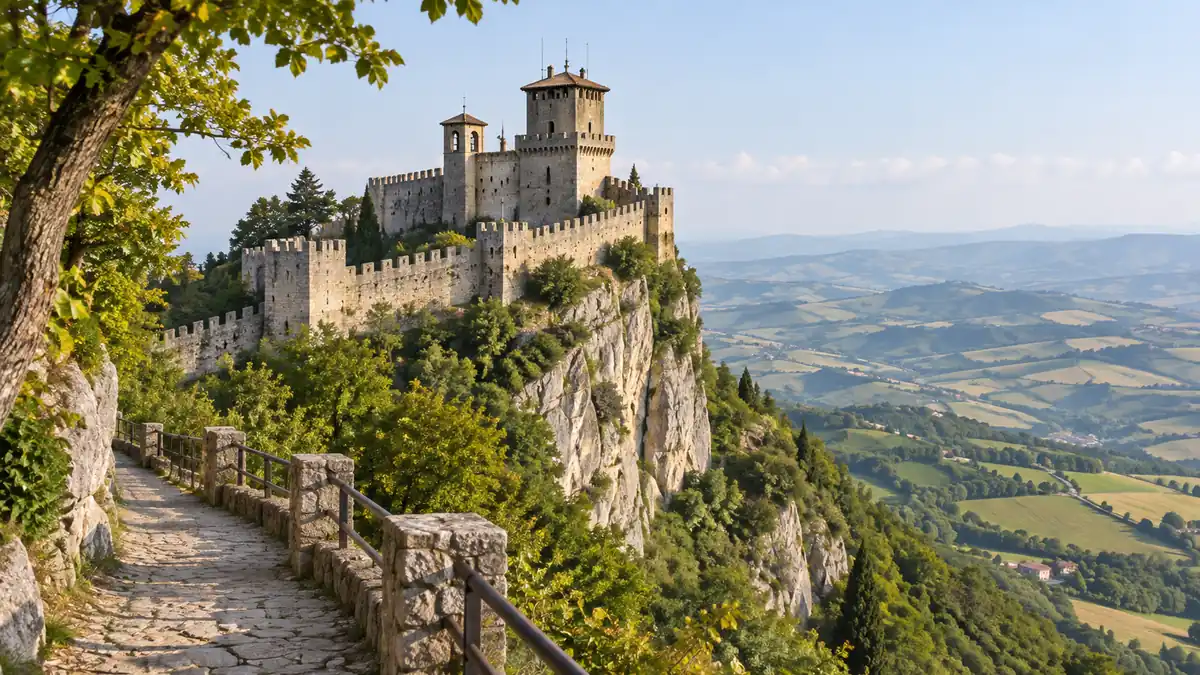
The best thing to do in San Marino is walk the Three Towers ridge: into Guaita, across the Witches’ Pass to Cesta, with Montale seen from outside, then down to Piazza della Libertà and the Basilica just below. That set fits into half a day and is the shortlist a first-time day visitor keeps. A full day adds the State Museum and the cable car down to Borgo Maggiore. Visitors who cannot or do not want to climb take the cable-car views, the square and the Basilica instead.
San Marino is a sovereign republic enclosed by Italy, and its sights sit on Monte Titano within walking distance of each other. Each one below is sorted into keep, add or skip, and marked as free or on the museum pass.
On This Page
What to Keep in Half a Day, and What a Full Day Adds
Half a day keeps the ridge — Guaita, the Witches’ Pass, Cesta and a look at Montale — plus Piazza della Libertà and the Basilica. A full day adds the State Museum, the cable car to Borgo Maggiore and back, Cava dei Balestrieri and the quieter viewpoints. The private curiosity museums are the part most visitors can drop.
Keep, even with half a day
- Guaita: the oldest tower, and the interior to pay for if you enter only one.
- The Witches’ Pass: free, and the walk itself is the view.
- Cesta: the highest point of the ridge, with the weapons collection inside.
- Montale from outside: the quiet far end of the ridge.
- Piazza della Libertà: the façade of Palazzo Pubblico and, in summer, the changing of the guard.
- Basilica di San Marino: free, and a few minutes from the square.
Add with a full day
- The State Museum: the strongest indoor stop and the fallback when the weather turns.
- The cable car to Borgo Maggiore and back: a short ride down to the lower town and its market square.
- Cava dei Balestrieri: a brief look behind Palazzo Pubblico.
- Giardino Panoramico and Piazza Sant’Agata: calmer views away from the ridge crowd.
Skip unless it is your thing
- The private curiosity museums: separately ticketed novelty collections, a detour for most visitors.
- The souvenir passport stamp: a keepsake, nothing more.
The ridge leads the list because the towers on the crest of Monte Titano, and the views from them, are what San Marino has that nowhere nearby can match. Everything else is a good addition. With half a day, the real trade is the tower interiors: enter both and the square gets rushed; enter Guaita only and the walk on to Cesta stays free.
How long to stay, and whether to spend the night on the mountain, is a planning question of its own; the guide to visiting San Marino works through both.
Can You Go Inside the Three Towers of San Marino?
You can go inside two of the three. Guaita and Cesta are entered on the museum pass, Montale is seen only from outside, and the ridge path that links them is free to walk. Ticket details sit in the section on what is free and what the pass covers.
Guaita, the First Tower
Guaita, the First Tower, is the oldest of the three, with an 11th-century core; the tourism office ties it to the first inhabitants around the year one thousand. It served as a prison until 1975. The visit takes in the old prisons and the keep, reached by stairs.
The final climb into the keep is steep. That matters for anyone with limited mobility or small children in tow. For everyone else, Guaita is the interior to choose if you pay for only one: the prison history and the climb to the top are what set it apart from Cesta.
The Witches’ Pass (Passo delle Streghe)
The Witches’ Pass is the path between Guaita and Cesta, and walking it costs nothing. The walk itself is the view, running along the crest from one tower to the next. It is the pick for anyone who wants the ridge without paying for an interior.
Cesta, the Second Tower
Cesta, the Second Tower, stands on the highest spur of Mount Titano at 755 m. Inside is the Museum of Ancient Weapons, with about 700 pieces from the 13th to the 19th century. Guaita is about the prison; Cesta is about the height and the collection. Visitors with an eye for arms and armour get the most out of it.
Montale, the Third Tower
Montale, the Third Tower, can be visited only from outside. It sits at the quiet end of the ridge beyond Cesta, where the groups thin out. Walk on to it for the calm, not for an interior.
Piazza della Libertà and the Basilica: The Centre You Can See for Free
Piazza della Libertà, the façade of Palazzo Pubblico, the changing of the guard and the Basilica cost nothing and sit a few minutes’ walk below the towers. This is the part of the list that needs no ticket and little climbing.
Palazzo Pubblico and the Changing of the Guard
Palazzo Pubblico is the seat of the Captains Regent and the Great and General Council, built between 1884 and 1894 to a design by Francesco Azzurri. Its façade fronts Piazza della Libertà. The Guardia di Rocca changes the guard outside every day during the summer season.
The interior is on the museum pass when it is open, and it also closes for official ceremonies and council sittings. The square and the guard are the reason to come, so a closed door costs a visitor little.
Basilica di San Marino
The Basilica di San Marino is a neoclassical church that holds the relics of the founder, Saint Marinus; by tradition, the republic was founded in 301. Entry is free. The Small Church of Saint Peter stands right beside it. Visitors who want the story of the place without buying a ticket should start here.
Cava dei Balestrieri
Cava dei Balestrieri, the Crossbowmen’s Quarry, sits behind Palazzo Pubblico and is where San Marino’s crossbowmen and flag-wavers perform. Outside their events it is a short stop. It earns a few minutes on a full day, for the setting behind the seat of government.
The Lanes Between the Sights
The steep stone lanes between the sights are an experience in themselves. St Francis Church stands along them, and Piazza Sant’Agata, home of Teatro Titano, is one of the calmer corners. These streets are also where the midday crowd concentrates. Wander them early or late.
The Best Viewpoints in San Marino, and When They Are Quiet
The widest views are from the Witches’ Pass and the Cantone Panoramico beside the upper cable-car station. Giardino Panoramico and Piazza Sant’Agata are the calmer alternatives, and every one of them is free.
- The Witches’ Pass: the ridge view, framed by Guaita and Cesta at either end.
- Cantone Panoramico: the first view for anyone arriving by cable car, right by the upper station.
- Giardino Panoramico: a garden viewpoint that stays quieter than the ridge.
- Piazza Sant’Agata: a small square by Teatro Titano, away from the main square’s bustle.
Crowds follow the tour groups. The centre fills in the middle of the day, while the edges of the day and the ridge beyond Cesta stay quieter. Walk the Witches’ Pass before the groups arrive and leave the tower interiors for midday, when the open path is at its busiest. For a longer loop, the Walk of the Titano is the official walking route on the mountain.
Is the San Marino Cable Car to Borgo Maggiore Worth It?
Yes, with a full day or with limited mobility. The ride from Borgo Maggiore takes under two minutes, climbs about 200 m and lands beside the Cantone Panoramico. With only a few hours on the summit, it is the first thing to drop.
- One-way, EUR 4.00: for visitors who walk one direction on the Rupe Path.
- Return, EUR 7.00: the usual pick for a trip down to Borgo Maggiore and back up.
- Day pass, EUR 10.00: only for those riding up and down several times in a day.
Children under 120 cm ride free. Cars run every 15 minutes, from early morning to evening all year and past midnight in high summer.
Borgo Maggiore and Its Thursday Market
Borgo Maggiore is the castello at the foot of the cable car, and its market fills Piazza Grande on Thursday mornings. An antiques market takes over on the third Sunday of the month from March to December. The lower town suits slow visitors with a full day who want San Marino’s everyday side below the summit.
The Rupe Path and Walks off the Summit
The Rupe Path is the walking alternative to the cable car, an official nature trail from Borgo Maggiore. Walkers who would sooner earn the summit on foot can pair it with a one-way ride for the other direction.
Which Museums in San Marino Are Worth Your Time?
The State Museum is the one to add if there is time or the weather turns. The weapons collection comes with Cesta anyway, and the private curiosity museums are a matter of taste and safe to skip.
The State Museum (Palazzo Pergami-Belluzzi)
The State Museum, in Palazzo Pergami-Belluzzi, is the indoor stop that explains San Marino beyond its towers. It is on the museum pass and sits in the historic centre, close to the main sights. On a wet afternoon it is the obvious refuge.
The other pass museums suit narrower interests. The St Francis Museum, also known as the Pinacoteca, fits visitors already at St Francis Church. The National Gallery is for art lovers. The Stamp and Coin Museum is for collectors.
The free curiosity is the Montale Tunnel at Piazzale della Stazione, home to the restored AB-03 electric train of the old Rimini–San Marino railway. It is free and open around the clock, a quick stop for rail fans and families.
The private museums — Torture, Vampires and Werewolves, Curiosities, Wax, Titanus and Optical Illusions — are ticketed separately and worth it only for visitors who enjoy that kind of thing.
What Is Free in San Marino, and What Does the Museum Pass Cover?
The ridge path, Piazza della Libertà, the Basilica, the viewpoints, the Montale Tunnel and the outside of Montale are free. The interiors of Guaita and Cesta and the national museums share one pass, EUR 11 for an adult.
| Ticket | Price | Who it is for |
|---|---|---|
| Pass Ticket | EUR 11 | Adults entering the towers and the national museums |
| Pass Mini | EUR 8 | Over-65s, university students with card, groups over 25 |
| Last Minute | EUR 5 | Late arrivals: bought in person shortly before closing, valid to the end of the day |
The Pass Ticket covers the First Tower, the Second Tower, the Public Palace when it is open, the State Museum, the St Francis Museum, the National Gallery and the Stamp and Coin Museum. Visitors under 18 enter free. Hours are shorter in winter and longest in high summer, with last entry half an hour before closing.
Buy the pass if you plan to enter both towers; skip it if the ridge, the square and the Basilica are enough. The pass buys interiors, not the ridge: holders and non-holders walk the same Witches’ Pass. First-time visitors who want the towers and the State Museum explained as they go can join a small-group guided walk of the historic centre that includes the museum pass.
Overnight guests can ask their hotel for the TuttoSanMarino Card, which gives discounts on the pass and the cable car.
Tours and activities
Book skip-the-line tickets, day trips and local tours with free cancellation on most activities.
You can also browse everything on getyourguide.com.
Tripstou may earn a commission if you book through this link, at no extra cost to you.
The San Marino Passport Stamp Is a Souvenir, Not a Requirement
The passport stamp is optional and bought: EUR 5 at the Tourist Information Office, Piazza Garibaldi 5, in the historic centre. Nobody needs it, because San Marino has no border formalities with Italy.
It is a keepsake, not an official entry stamp. Collectors and children enjoy it most. Anyone who prefers a clean passport page can pass.
What Else the Shops Sell
Hand-painted ceramics are the souvenir with local character, sold in the shops of the historic centre. Collectors head for the Philately and Numismatics Office, which sells San Marino’s own stamps and coins.
When the Tower Climb Is Not the Right Pick
With limited mobility or no head for steep stairs, swap the towers for the cable car, the Cantone Panoramico, Piazza della Libertà and the Basilica. In grey or wet weather, swap the ridge for the State Museum and the other pass museums.
The towers are the hardest part of the visit: steep lanes lead up, the interiors mean stairs, and the climb into the Guaita keep is the steepest of all. The swapped day still delivers the big view from the Cantone Panoramico, the square with its summer guard and the free Basilica. Even the lanes of the centre are steep, so take them in short stretches.
Bad weather takes away the ridge’s reward, which is the view. The State Museum, the National Gallery and the Stamp and Coin Museum sit on the same pass as the towers, so one ticket still covers a wet day indoors.
How This Shortlist Was Chosen
This page selects among the sights of the City of San Marino and Borgo Maggiore by what a half-day or full-day visitor can fit and by what is free or on the museum pass; it is not a guide to getting there or staying, and not a timed itinerary.
The selection and the ticket prices were checked by Alex Perrut, working in tourism since 2015, for the Tripstou editorial team. Drafting used AI assistance, and the steps behind it are set out in our editorial process.
Official sources consulted: Visit San Marino: First Tower, Visit San Marino: cable car, Visit San Marino: Second Tower, Visit San Marino: border formalities, State Museums of San Marino.
San Marino Sightseeing Questions
Is San Marino worth visiting?
Yes, for half a day to a full day. The walk along the Three Towers ridge and the views from the crest of Monte Titano are the reason to come, and the square and the Basilica below cost nothing. It suits travelers who enjoy views, walking and a compact historic centre. Visitors hoping for a long run of major museums may find it thin: the strongest experiences here are outdoors, and the private museums are novelty collections.
What should you eat in San Marino?
Order piadina, fresh pasta such as tagliatelle and stringhetti, and cappelletti in brodo; for something sweet, try Torta Tre Monti, Torta Titano or bustrengo. The Consortium of Typical Wines makes Brugneto and Tessano among the reds and Biancale and Roncale among the whites. Ristorante La Terrazza and Ritrovo dei Lavoratori are two places to eat listed by the tourism office.
Plan the Rest of Your Visit
- San Marino travel guide: getting there from Rimini, the usual gateway; how long to stay and whether to stay the night; where to stay; the best time to visit; and costs.
Did this guide save you time or money? Tripstou is independent and reader-funded — if you'd like to give something back, you can support the site with a crypto contribution of any size.