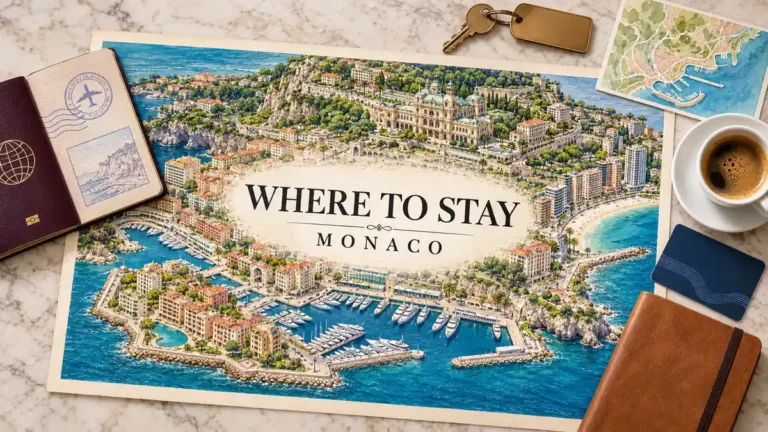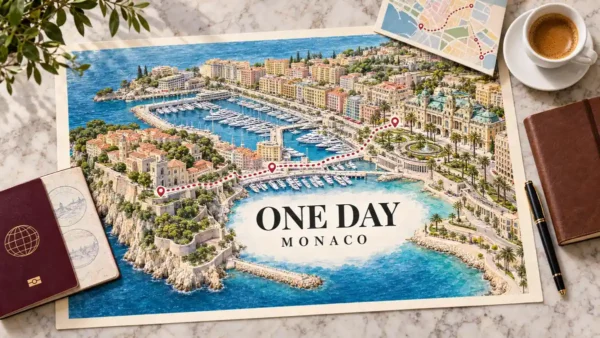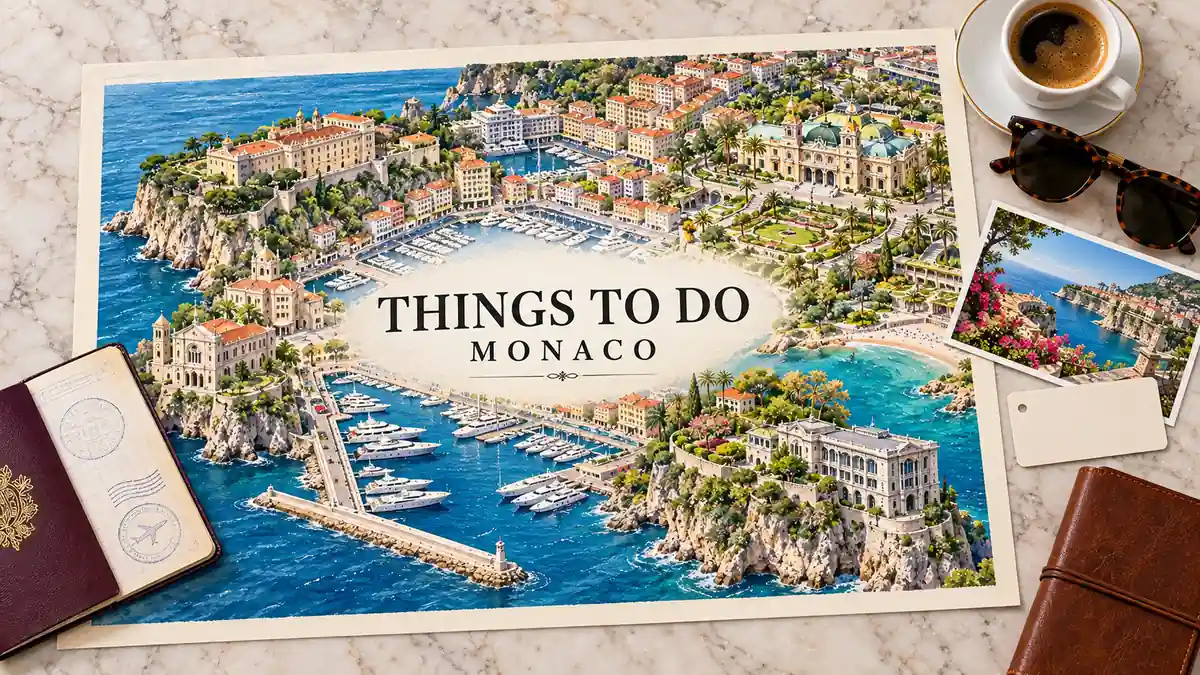
Monaco is small enough to cross on foot and steep enough to make every choice count. The principality packs its best-known sights into a handful of quarters: Monaco-Ville, the old town on the Rock; La Condamine, around the harbour; Monte-Carlo, home of the casino; Fontvieille, a quieter district built on reclaimed land; and Larvotto, the beach strip. The real question is not what exists here. It is which famous sights earn your hours, and which you can enjoy from outside without paying.
This guide groups the picks by theme — the Rock, the harbour and motorsport side, the gardens, and the museums for a wet day. Each pick ends with a one-line fit test, so you can keep or drop it quickly. After the picks come a clear verdict on what is free and what is worth a ticket, and a table matching traveler types to where they should start.
Quick Answer
Monaco’s essential area is the Rock (Monaco-Ville): the palace and guard change, the old lanes and the Oceanographic Museum. Everything else splits into harbour and motorsport spectacle, quiet gardens and rainy-day museums; most exteriors are free, interiors are paid. Garden and view lovers should add the Jardin Exotique if it is open; beach travelers should add Larvotto.
Trust Layer
Tripstou selection guide for travelers choosing between multiple places. Covers selection criteria, traveler fit, and trip value.
Produced with AI assistance and reviewed by Alex Perrut, working in tourism since 2015, for the Tripstou editorial team. See our editorial process for details.
Last factual review: September 28, 2026.
Official sources consulted: Visit Monaco, Monaco Tourist and Convention Authority, Oceanographic Museum of Monaco, Prince’s Palace of Monaco.
Key Takeaways
- Give the Rock (Monaco-Ville) real time on a first visit: the palace, guard change, Cathedral, old lanes and Oceanographic Museum share one headland.
- Monaco’s free plan works without a single ticket: the 11:55 guard change, the Cathedral, the ramparts, the Saint-Martin Gardens, Port Hercule and the circuit streets.
- The Oceanographic Museum is the one paid interior most visitors should choose, especially families and anyone caught by rain.
- The palace State Apartments open only from spring to mid-October, and for most first-timers the free square and ceremony are enough.
- The Jardin Exotique gives the highest view over Monaco, but it spent years closed for works, so check it is open on the day.
- Larvotto is the only pick for getting into the sea, an urban beach with free public sections beside private beach clubs.
Table of Contents
The Rock is the one essential for a first visit
Monaco-Ville, the Rock, is the one part of Monaco every first-timer should give real time. The Prince’s Palace, the changing of the guard, the Cathedral, the old lanes, the Saint-Martin Gardens and the Oceanographic Museum all sit within a few minutes’ walk on one headland. No other quarter concentrates so much in so little ground.
The picks below are grouped by theme, not by clock. For the order that works best, follow the one day in Monaco itinerary. Public lifts and escalators link the levels between the harbour and the Rock, which takes much of the effort out of the climb.
The guard change, the Cathedral and the Saint-Martin path cost nothing, so a first visit to the Rock needs at most one paid ticket. For most people that ticket is the Oceanographic Museum. Choose the palace rooms instead only if royal interiors are the reason you came.
Prince’s Palace and the changing of the guard
The Prince’s Palace is the ruling family’s residence, and its best moment costs nothing. The Prince’s Carabiniers change the guard on Palace Square daily at 11:55, a short, formal ceremony anyone can watch. The State Apartments are a separate, paid visit. They open seasonally, from spring to mid-October, and close in winter; an audio guide leads you through the Cour d’Honneur, the Gallery of Hercules, the Hall of Mirrors and the Throne Room.
Is it worth visiting? The exterior and the ceremony, yes, for everyone. The interiors reward palace and history fans in season. Palace Square fills well before 11:55. A front-row spot means arriving early.
Pick this if: you want Monaco’s signature ceremony and, in season, a look inside a working royal palace.
Monaco-Ville’s old lanes and the Cathedral
Monaco-Ville’s old lanes are the free half of the Rock, and the Cathedral is their anchor. Narrow, pastel-coloured streets run from Palace Square toward the Cathedral, lined with small chapels, official buildings and souvenir shops. Monaco Cathedral is free to enter. It is the burial place of Princess Grace and Prince Rainier III, and their graves draw a steady, quiet line of visitors.
Beyond the Cathedral, the ramparts give the Rock its best free viewpoints: the harbour and Monte-Carlo on one side, Fontvieille’s marina on the other. The lanes are compact. Wandering them takes less time than their fame suggests, which leaves room for a paid interior nearby.
Pick this if: you want the Grimaldi story told through streets and graves, with no ticket involved.
Oceanographic Museum
The Oceanographic Museum is the Rock’s one paid interior that works for almost everyone. Founded by Prince Albert I, it pairs a large aquarium with a monumental building set into the cliff above the sea. It opens daily except 25 December and the Grand Prix weekend, and last admission is 30 minutes before closing.
Families get the most from it, and so does anyone caught by rain, when the aquarium carries the whole visit. Skip it if you have one hour on the Rock and came for views. Combined tickets pair it with the palace State Apartments, the Prince’s car collection or the Jardin Exotique, which helps if you already plan a second interior.
Pick this if: you are travelling with children and want the Rock’s most family-friendly visit.
Saint-Martin Gardens
The Saint-Martin Gardens are a free clifftop path along the Rock’s seaward edge, linking the palace side to the Oceanographic Museum. Shaded walkways, Mediterranean planting and benches face straight out to sea, with a sheer drop to the water below. They add no ticket and almost no detour, because the path is also the most pleasant way between the two headline sights.
On a hot, crowded day the gardens beat a paid interior. You get the view, the shade and a quieter stretch of the Rock. They suit anyone who finds Palace Square’s crowds too much, and they are the Rock’s own green space, with no need to leave the headland.
Pick this if: shade and open sea views appeal to you more than another queue.
Tours and activities
Book skip-the-line tickets, day trips and local tours with free cancellation on most activities.
You can also browse everything on getyourguide.com.
Tripstou may earn a commission if you book through this link, at no extra cost to you.
Harbour, Sea and Motorsport: Monaco’s Spectacle Side
Port Hercule, the Formula 1 street circuit and Larvotto Beach are Monaco’s spectacle picks, and all three are free. They suit travelers who came for the famous image of Monaco: yachts, racing corners and a Riviera promenade. Casino Square belongs here too, as the showpiece of Monte-Carlo. Expect company: these are the most photographed corners of the principality.
The circuit and the harbour overlap. Walking the harbour chicane is the same stroll as yacht-watching on Port Hercule, so motorsport fans and harbour watchers can cover both picks in one walk.
Port Hercule
Port Hercule is Monaco’s main harbour, and watching it is the principality’s classic free pastime. Superyachts moor along the quays below the Rock, and a waterfront promenade lets you walk much of the basin at water level. Cafés and terraces line parts of the quay, which gives the promenade a lived-in feel between the yachts.
The view changes with your height. From the quay you see hulls and crews; from the Rock’s ramparts you see the whole harbour framed by Monte-Carlo’s towers. Seasonal events sometimes occupy parts of the quays, which can block sightlines. It is a pick for looking, and that is exactly its appeal.
Pick this if: you came for the yachts and the classic Monaco harbour view.
Walking the Formula 1 circuit
Monaco’s Formula 1 circuit is made of public streets, so you can walk most of it on any ordinary day at no cost. Start at Sainte-Dévote, the first corner, named after the small chapel beside it. From there the road climbs to Casino Square, drops to the Fairmont hairpin, runs through the tunnel and exits toward the harbour chicane.
Seeing how narrow and steep the route is explains the race’s reputation better than any broadcast. Race weekend transforms the town, with barriers and grandstands taking over much of the route. Outside it, these are normal city streets. Watch the traffic.
Pick this if: you follow Formula 1 and want to stand on corners you know from television.
Larvotto Beach
Larvotto is Monaco’s public beach quarter and the principality’s main place for a swim. A long strip of sand runs below a promenade lined with cafés, with free public sections alongside private beach clubs. It is the one pick on this page where you get into the sea instead of admiring it from above.
It is an urban beach. Apartment blocks rise behind it and summer brings crowds, so it lacks the wild look of a Riviera cove. For families it pairs well with the Japanese Garden a short walk away. For anyone who has already done the Rock, it is the obvious contrast: flat, sunny and unhurried.
Pick this if: a swim and a seafront promenade matter more to you than another sight.
Monte-Carlo’s Casino Square and the casino
Casino Square is Monte-Carlo’s showpiece: the ornate facade of the Casino de Monte-Carlo, manicured gardens in front and a steady parade of supercars at the door. It draws people because it is the Monaco of films and postcards, and standing outside costs nothing. The square also sits on the Formula 1 circuit, so it links naturally with the circuit walk.
Keep it as a photo stop here. For entry rules, the opera house and the rest of the quarter, the Monte-Carlo guide covers the casino and Casino Square in full. It is the place to plan anything beyond a look from the square.
Pick this if: you want to see the glamour image of Monte-Carlo in person, even briefly.
Gardens and Quieter Monaco: Jardin Exotique, Fontvieille and Beyond
Monaco’s quieter side lies in its gardens and residential quarters, away from the Rock’s crowds. The Jardin Exotique, when open, gives the highest view, Fontvieille has the Princess Grace Rose Garden, the Japanese Garden sits near Larvotto, and La Condamine’s market shows daily life. The Saint-Martin Gardens, profiled above, remain the Rock’s own green escape.
These picks are spread across different levels of the principality. Pair them by height. The Jardin Exotique sits high above Fontvieille, while the Japanese Garden is next to the beach, so matching each garden to the pick nearest it saves more climbing than any route plan.
Jardin Exotique and the Observatory Cave
The Jardin Exotique is the pick for the highest view over Monaco, but it spent years closed for works, so check it is open on the day. The garden clings to a cliff face, with paths winding through cacti and succulents above the rooftops, the harbour and the sea. The Observatory Cave, a natural cavern inside the same cliff, belongs to the same site.
The price of the view is effort. Paths are steep, stepped and narrow in places, so the garden does not suit every mobility level. It is a paid visit, and it also appears in combined tickets with the Oceanographic Museum. Allow for the climb before you commit.
Pick this if: you want the highest view over the principality and don’t mind steep paths.
Princess Grace Rose Garden in Fontvieille
The Princess Grace Rose Garden is Fontvieille’s reason to visit: a fragrant garden inside the district’s public park. Fontvieille itself is Monaco’s calm, reclaimed quarter, built on land won from the sea below the Rock. The rose garden honours Princess Grace with beds of roses set among sculptures and lawns.
It feels residential. Joggers, dog walkers and local families often outnumber visitors. The district’s small marina and park round out a short visit, but neither needs more than a passing look. The garden is at its best when the roses are in bloom, and it offers the page’s gentlest walking.
Pick this if: you prefer flowers and a residential corner of Monaco to landmark sights.
Japanese Garden
The Japanese Garden is a free, enclosed garden on the seafront near Larvotto, a calm stop on the busiest stretch of Monte-Carlo’s shoreline. Stone paths, a koi pond, a small waterfall, wooden bridges and clipped pines follow Japanese garden principles in a compact space. It takes little time to see.
That brevity is its strength. It fits between the beach and the promenade without any planning. Families like the fish, and everyone else likes the quiet. It does not replace the Jardin Exotique for views, since it sits at sea level, but it gives the beach quarter a green pause.
Pick this if: you want a short, quiet pause beside the beach.
La Condamine market and the harbour-side quarter
La Condamine’s market is the local-life pick, the place to see where Monaco’s residents shop and eat. It centres on Place d’Armes, at the foot of the Rock, where an open-air square of produce stalls sits beside a covered market hall with food counters. The quarter around it, between the Rock and the harbour, has everyday shops, cafés and bakeries.
It is Monaco at ground level. The hall’s counters turn a browse into a casual lunch among residents. Market activity varies with the day, so treat the visit as a stroll first and a market second. It pairs easily with Port Hercule, a few streets away.
Pick this if: you’d like to see where residents shop and grab an informal bite.
Which Monaco museums save a rainy day?
The Prince’s car collection and the Nouveau Musée National de Monaco are the best rainy-day museums. Add the Oceanographic Museum, profiled with the Rock, and wet weather is covered. The car collection suits families and motorsport fans; the national museum suits art lovers. Both are compact indoor visits that fill a wet spell without swallowing the trip.
Rain sends most visitors on the Rock straight to the aquarium. That makes these two museums the calmer option on a wet day, and a useful backup when the Oceanographic is at its busiest.
The Prince’s car collection
The Prince’s car collection is the princely family’s collection of cars, and it is Monaco’s most accessible museum for non-specialists. The display ranges from vintage models to classic sports cars and racing machines, with a strong motorsport thread running through it. You do not need to know engines to enjoy it.
The mix of royal provenance and racing history carries the visit. It is a natural indoor follow-up to the circuit walk, and it works for mixed groups where only some people love cars. Combined tickets with the Oceanographic Museum include it, which makes it an easy second interior.
Pick this if: classic cars and royal history interest you equally.
Nouveau Musée National de Monaco
The Nouveau Musée National de Monaco is the principality’s national museum, spread across villa sites. Its exhibitions alternate between contemporary art and Monaco’s own cultural history. The villas are part of the appeal: historic houses with gardens, so the visit feels calmer than a big-city gallery.
The programme changes between exhibitions. That suits repeat visitors and makes a first visit less predictable, so check what is showing before you go. Families with young children usually get more from the car collection or the aquarium. For adults who want quiet rooms and a different side of Monaco, it is the stronger choice.
Pick this if: contemporary art is your idea of a rainy-day plan.
What is free in Monaco, and what is worth paying for?
Most of Monaco’s headline sights are free from outside. That covers Palace Square and the guard change, the Cathedral, the ramparts, most gardens, the harbour and the circuit streets. The paid interiors worth the money are the Oceanographic Museum and, in season, the palace State Apartments. Everything else is optional spending.
The main tradeoff is seasonal. The State Apartments close in winter, so off-season visitors see the palace only from outside. For most first-timers that exterior is enough, because the ceremony, the square and the view carry the experience. Palace and history fans should plan for the spring-to-mid-October window.
- Free-only plan: the guard change, the Cathedral, the ramparts, the Saint-Martin Gardens, Port Hercule, the circuit walk and Larvotto. Suits low-spend travelers and short stops. Tradeoff: no interiors, and nothing indoors if it rains.
- One paid interior: add the Oceanographic Museum. Suits families and most first-timers. Tradeoff: it takes a real block out of a short visit.
- Two paid interiors with a combined ticket: the Oceanographic plus the State Apartments in season, the car collection or the Jardin Exotique. Suits history, car or garden fans with more time. Tradeoff: more ticketed hours, less wandering.
Winter is when the free plan wins outright. With the State Apartments closed, the Oceanographic is the only interior on the Rock that earns a ticket. For daily costs, arrival and getting around, see the guide to planning your Monaco trip.
Which picks fit your kind of traveler?
First-timers should start on the Rock, low-spend travelers with the free plan, and families with the Oceanographic Museum and Larvotto. Garden and view lovers fit the Jardin Exotique and Saint-Martin Gardens, motorsport fans the circuit walk, rainy-day visitors the museums, and photographers the ramparts and harbour. Each match rests on picks profiled above.
The table sets out where each traveler type should start, what to add and what to leave out. Rainy-day visitors have their own section above.
| Traveler type | Start with | Also worth it | Skip |
|---|---|---|---|
| First-timer | The Rock: Palace Square, guard change and Cathedral | Oceanographic Museum and a harbour walk on Port Hercule | The Jardin Exotique climb if time is short |
| Low-spend | Guard change, ramparts and the Saint-Martin Gardens | Circuit walk, Port Hercule and Larvotto Beach | Paid interiors outside your main interest |
| Families | Oceanographic Museum and the changing of the guard | Larvotto Beach and the Japanese Garden koi pond | Palace State Apartments with very young children |
| Garden and view lovers | Jardin Exotique and the Observatory Cave | Saint-Martin Gardens and the Princess Grace Rose Garden | The busy traffic streets of the circuit walk |
| Motorsport fans | Circuit walk from Sainte-Dévote to the harbour chicane | The Prince’s car collection and Casino Square | The Nouveau Musée National de Monaco exhibitions |
| Photographers | The Rock’s ramparts looking over Port Hercule | The Jardin Exotique’s high view and Casino Square | La Condamine market hall for wide scenic shots |
These picks do not need to be ordered here. For the sequence that works in a single day, use the one day in Monaco itinerary. For costs, arrival and getting around, the Monaco travel guide covers the practical side.
Frequently Asked Questions
What time is the changing of the guard in Monaco?
Monaco’s changing of the guard happens daily at 11:55 on Palace Square, outside the Prince’s Palace. The Prince’s Carabiniers perform it in the open, and no ticket is needed to watch. The ceremony is short and the square fills well ahead of time, so arrive early if you want a front-row view.
What are the best things to do in Monaco with kids?
The Oceanographic Museum is the strongest pick for kids, because its aquarium holds attention in any weather. Add the 11:55 guard change for spectacle, Larvotto Beach for a swim and the Japanese Garden’s koi pond for a quiet break. The Prince’s car collection suits older children who like cars. Skip the palace State Apartments with very young children.
Where is Grace Kelly buried in Monaco?
Grace Kelly, Princess Grace of Monaco, is buried in Monaco Cathedral in Monaco-Ville, on the Rock. Her grave lies beside that of her husband, Prince Rainier III, and entry to the cathedral is free. Visitors file past quietly, so keep voices low. The cathedral sits a short walk from Palace Square, so it pairs naturally with the guard change.
Is the Prince’s Palace in Monaco open in winter?
The palace State Apartments are closed in winter; the paid interior visit runs seasonally, from spring to mid-October. The outside stays open to everyone all year: Palace Square, the view from the square and the 11:55 changing of the guard. The interiors can also close on occasional days in season, so confirm before planning around them.
How do you get up to Monaco-Ville from the harbour?
Walk up the stepped lanes from the harbour, or ride the public lifts and escalators linking Monaco’s levels. The walk up is steep and becomes hard work in summer heat. With a pushchair, heavy bags or limited mobility, the lifts and escalators take out much of the climb. Save your legs for the Jardin Exotique’s steep paths.
Are combined tickets for the Oceanographic Museum worth it?
Combined tickets make sense only if you already plan two paid interiors. The Oceanographic Museum sells combinations with the palace State Apartments, the Prince’s car collection or the Jardin Exotique. If the aquarium is your only paid visit, a single ticket is simpler. In winter the palace pairing drops out, because the State Apartments are closed.
Related Guides
- Monaco travel guide — costs, arrival, getting around and when to go.
- One day in Monaco itinerary — how to order these picks into a single day.
- Monte-Carlo guide — the casino, Casino Square and the rest of the Monte-Carlo quarter.
Did this guide save you time or money? Tripstou is independent and reader-funded — if you'd like to give something back, you can support the site with a crypto contribution of any size.