On a first trip to Malta, put Valletta and a day on Gozo at the core, then add Mdina and the Three Cities. Those four cover the capital, the second island and two very different walled towns, with little travel time between them. Anything else is a matter of taste: swimming, prehistory or a family day out. If you come mainly to swim, give up one town day for Comino’s Blue Lagoon and the sandy beaches of the north, and come in the swimming season.
Malta the country is three islands: Malta, Gozo and Comino. “Malta” is also the name of the largest one, where you land and where most picks below sit. The list is grouped by the choices a first-timer actually faces: which walled town, which prehistoric site, which smaller island, and which part of the coast.
Best Places to Visit in Malta: The First-Trip Shortlist
Valletta, Gozo, Mdina with Rabat, and the Three Cities belong on almost any first trip to Malta. Together they give you the fortified capital, the greener second island, the quiet hilltop town inland and the harbour towns facing Valletta across the water. Short distances let you fit all four into one stay.
The list stays short on purpose. Each pick earns its place with a reason, and the picks are grouped by the decision you are making, so you can drop a whole group without losing the core. Comino’s Blue Lagoon and the Hal Saflieni Hypogeum are the two strongest additions, and both depend on booking ahead.
| Pick | What it adds | Suits | How it fits a trip |
|---|---|---|---|
| Valletta | The fortified capital and its baroque core | Every first-timer | From a base |
| Gozo | Citadel, temple, red-sand beach, Dwejra coast | Anyone with a spare full day | Day trip or worth an overnight |
| Mdina and Rabat | Quiet walled hilltop town plus catacombs | History lovers who dislike bustle | Half day |
| The Three Cities | Harbour forts and lanes with fewer people | Crowd-averse visitors | Half day |
| Comino’s Blue Lagoon | A swim in clear, sheltered water | Swimmers in season | Needs a booked slot |
| Hal Saflieni Hypogeum | An underground prehistoric burial complex | Prehistory enthusiasts | Needs a booked ticket |
Some popular entries are left out deliberately. The National Aquarium and adventure activities such as zip-lining and cliff jumping fill longer lists, yet none of them is a reason to fly to Malta. Sliema and St Julian’s are bases, not sights: where to stay, how to get around and when to go are covered in our Malta travel guide.
The shortlist does not set an order or a day count. To turn these picks into a route, see how many days in Malta the plan needs and which day suits each stop.
Valletta, the Three Cities or Mdina: Which Walled Town Suits You?
Valletta is the walled town not to miss. The Three Cities give you the same harbour history with fewer people, and Mdina is the quiet hilltop town inland. Most first trips can fit all three; if one has to go, drop the Three Cities, because Valletta already gives you the harbour setting.
Valletta
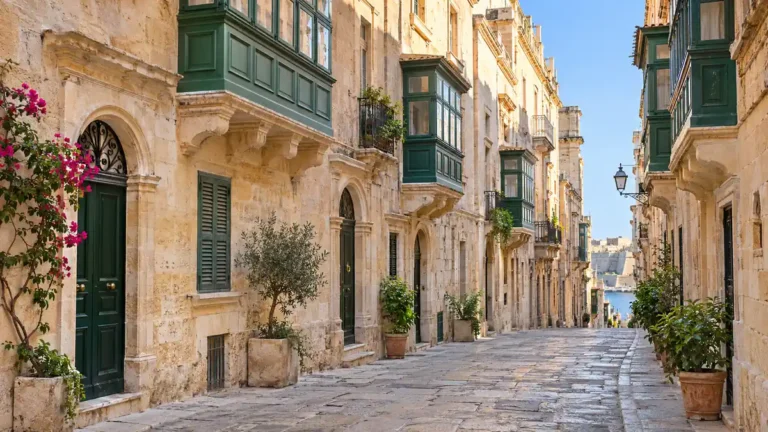
Valletta is the capital, built on a peninsula between two harbours, and it is the one pick every first trip needs. St John’s Co-Cathedral is the reason most people go inside a building here. Upper Barrakka Gardens is the reason they climb to the top of the bastions, for the view across the Grand Harbour to the Three Cities.
The city is small enough to see on foot in a day, which makes it a guided-walk town: the stories behind the bastions and the knights matter more than any single museum. Everyone on a first trip should come. Valletta works as a day out from a base elsewhere on the island, or as the base itself if you want evenings inside the walls. Sights, museums and where to eat are in our Valletta travel guide.
The Three Cities
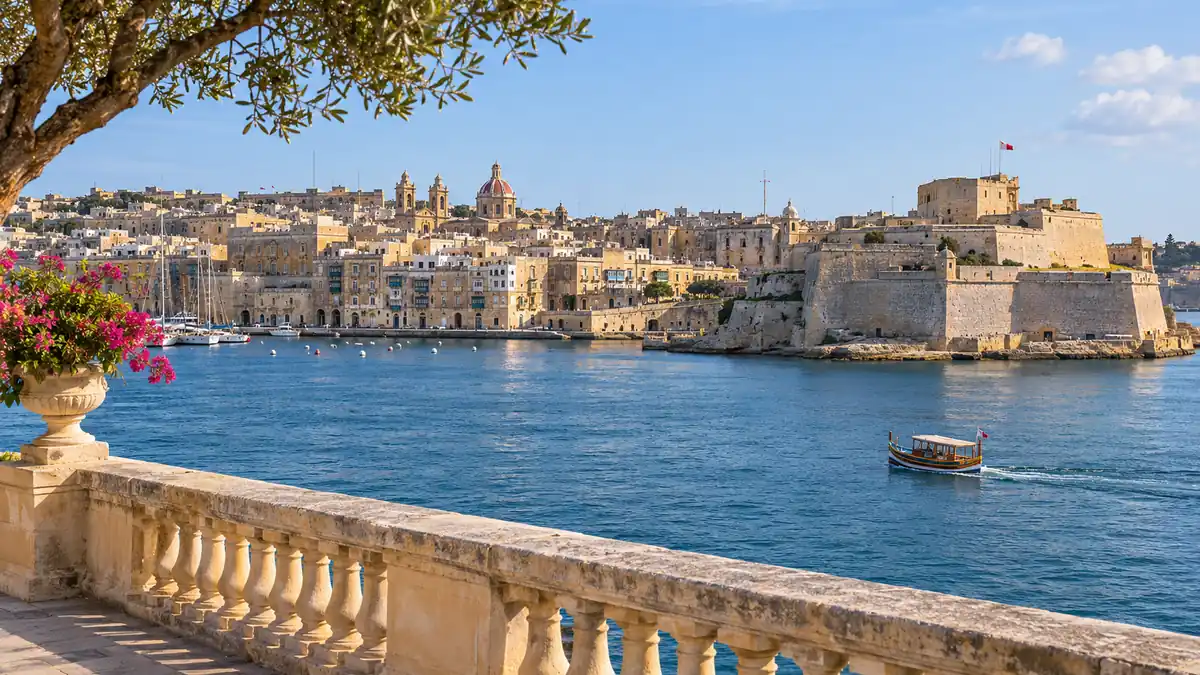
The Three Cities are Vittoriosa (Birgu), Senglea and Cospicua, the fortified towns facing Valletta across the Grand Harbour. Birgu holds most of the reasons to come: Fort St Angelo, the Inquisitor’s Palace and the Malta Maritime Museum. In Senglea, Gardjola Gardens looks straight back across the water at Valletta.
Pick them for the harbour without the crowds of central Valletta. Traditional dghajsa boats still cross the Grand Harbour, which turns the trip over into part of the visit. A guided visit that pairs the lanes with the crossing is the easy option: book the boat-and-walk tour.
Mdina and Rabat
Mdina is the walled hilltop town in the middle of the main island, and Rabat is the town next to its walls; treat them as one visit. You enter Mdina through Mdina Gate into narrow, quiet streets, with St Paul’s Cathedral at its centre. Just outside the walls, St Paul’s Catacombs in Rabat add an underground layer to the same half day.
Mdina suits travelers who prefer silence and stone to shops and traffic. It is also a Game of Thrones filming location, which brings fans to the gate. Tour groups tend to thin out later in the day, so an afternoon visit often feels calmer.
A Harbour Cruise From Sliema
A boat trip around the Grand Harbour and Marsamxett Harbour shows Valletta’s fortifications from the water, the angle they were built to face. It suits short stays and anyone who would rather sit than walk the bastions. Boats leave from the Sliema waterfront; reserve a harbour cruise if you want a seat on a set departure.
Tours and activities
Book skip-the-line tickets, day trips and local tours with free cancellation on most activities.
You can also browse everything on getyourguide.com.
Tripstou may earn a commission if you book through this link, at no extra cost to you.
Which of Malta’s Prehistoric Temples Are Worth Your Time?
The Hal Saflieni Hypogeum is the site unlike anything else in Malta, and the only pick on this page that depends on getting a ticket. Hagar Qim and Mnajdra are the open-air choice and need no planning. For most trips one of the two is enough.
The Hal Saflieni Hypogeum
The Hypogeum is an underground burial complex in Paola, in use between 4000 BC and 1500 BC and listed as UNESCO World Heritage. Only 10 people are inside at any one time, and that cap is why tickets are scarce. Photography is not allowed, children aged 1–5 are not admitted, and the enclosed chambers are a poor fit for anyone uneasy in tight spaces.
Book as early as you can. Regular tickets cost €35 for an adult and are sold online and at Heritage Malta sites. Last-minute tickets cost €50 and go on sale only the day before your visit, first come first served, at Fort St Elmo and the Gozo Museum of Archaeology, and after midday also at the National Museum of Archaeology, Domvs Romana and the Hypogeum itself.
Hagar Qim and Mnajdra
Hagar Qim and Mnajdra are two late-Neolithic megalithic sites in Qrendi, over 5,000 years old and part of UNESCO’s Megalithic Temples of Malta. Mnajdra lies 500 m downhill from Hagar Qim, so one visit covers both. Come here for Malta’s temples without a booking race: you decide on the day.
Two more temple names come up often. Tarxien sits near the Hypogeum in the south, and Ggantija is the Gozo temple, covered in the Gozo section below.
Gozo or Comino: Which Island Trip Earns the Day?
Gozo earns the day for most first-timers. It fills a full day with varied sights: a citadel, a temple, a red-sand beach and the Dwejra coast. Comino offers one thing, a swim in the Blue Lagoon, which only pays off in the swimming season and with a booked slot.
Comino’s slot rule turns the Blue Lagoon into a fixed appointment, while Gozo can be decided the same morning: you pay the ferry on the way back, not on the way out.
Is Gozo Worth a Day Trip From Malta?
Yes, Gozo is worth a day trip from Malta. A day covers the Cittadella, Ggantija and one stretch of coast, either Ramla Bay or Dwejra. An overnight adds the rest at a slower pace, and the island’s evenings are quieter once the day visitors have gone. With only one free day, go anyway. With two, sleeping on Gozo is the better use of them. If you prefer not to drive, you can book this day trip, which covers the island by jeep from Malta.
The ferry to Gozo takes 25 minutes from Cirkewwa to Mgarr, with sailings as often as every 30 minutes in daytime on a timetable that varies by season. The standard foot-passenger fare is €4.65, paid in Gozo on the way back, since tickets are validated only at the Gozo terminal on the return. A foot-passenger fast ferry also runs from Valletta to Mgarr.
Things to Do in Gozo: the Cittadella, Ggantija and Ramla Bay
- The Cittadella crowns Victoria, Gozo’s main town, and is the history stop of the day. Victoria is also called Rabat; it is not the Rabat beside Mdina.
- Ggantija Archaeological Park, on the Xaghra plateau, is Gozo’s temple site and the prehistory pick. Its ticket is a combo with Ta’ Kola Windmill.
- Ramla Bay is the swim, on red sand you will not find on the beaches of the main island’s shortlist.
- Xwejni salt pans add a short coastal stop.
Is the Azure Window Still There?
No, the Azure Window is gone: the arch collapsed into the sea, and its site is now a dive site. Dwejra is still worth the trip. Fishermen take visitors by boat through a tunnel about 100 m long that links the Inland Sea to the open sea, and the Blue Hole nearby is one of Gozo’s top dive sites.
Is Comino’s Blue Lagoon Worth It, and Do You Need to Book?
Comino’s Blue Lagoon is worth it for swimmers in season, and yes, you need to book. It is a protected site in the EU’s Natura network, and it gets crowded in high season. Everyone arriving by boat pre-books a free time slot on the official Blue Lagoon booking site run by the Malta Tourism Authority, choosing one of three daily slots. You receive a QR code and swap it for a wristband at the entry points. Visitors are capped at 4,000 at any one time, and arriving without a valid booking can lead to a fine.
Comino itself has no roads and no shops, and no facilities beyond seasonal kiosks; you explore it on foot. Bring what you need for the day.
Where to Swim and What to See Along Malta’s Coast
The main island’s coast splits by what you want from it. Sand is in the north, at Golden Bay, Ghajn Tuffieha and Mellieha Bay. A fishing village and rock swimming are in the south-east, at Marsaxlokk and St Peter’s Pool. Sea caves seen by boat are on the south coast, at the Blue Grotto.
Marsaxlokk and St Peter’s Pool
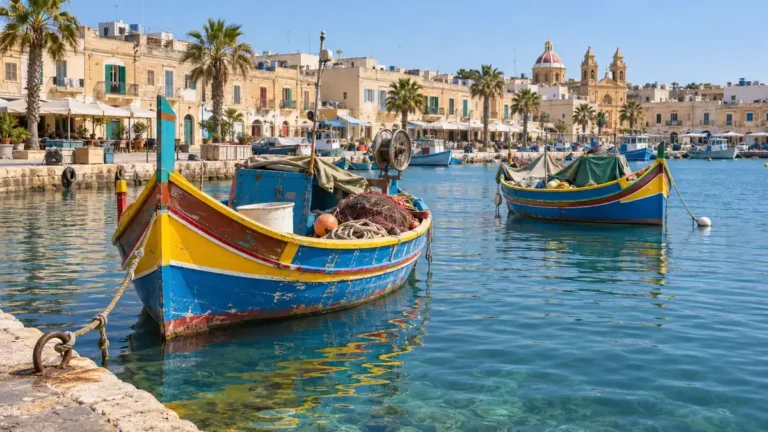
Marsaxlokk is the fishing village of colourful luzzu boats, and its Sunday fish market is the reason to time a visit. St Peter’s Pool, nearby, is a rocky swimming spot with no sand and few or no facilities, so come prepared to swim from the rocks.
The Blue Grotto
The Blue Grotto is a group of sea caves on the south coast, seen from small boats that leave from Wied iz-Zurrieq. It is a short outing for anyone who wants the cliffs and the colour of the water without a full boat day.
Golden Bay, Ghajn Tuffieha and Mellieha Bay
- Golden Bay is the easy sandy beach, for a lazy afternoon with nothing to plan.
- Ghajn Tuffieha, also called Riviera Beach, sits below a flight of steps; the climb keeps it the wilder-feeling of the three.
- Mellieha Bay is the largest sandy beach on Malta, with room to spread out for families and groups.
Snorkelling and Diving
The Blue Hole at Dwejra, on Gozo, is the dive site to name first, right beside the old Azure Window site. Cirkewwa, at the Gozo ferry point, is the name divers mention on the main island.
Popeye Village
Popeye Village is the original film set at Anchor Bay, a family pick that works best with younger children. Adults travelling without kids can skip it and spend the time on the coast.
What to Do in Malta When the Headline Picks Do Not Fit
Swap like for like from the same list. Out of the swimming season, the temples and Gozo’s coast replace the Blue Lagoon and the beaches; if you avoid crowds, the Three Cities and Gozo replace central Valletta and Comino; and without a Hypogeum ticket, Hagar Qim and Mnajdra are the prehistoric stand-in.
- Outside the swimming season: the Blue Lagoon and the beaches drop out. Put the temples, Mdina and Gozo’s coast in their place, and add Dingli Cliffs as the coastal viewpoint on the main island.
- If you avoid crowds: choose the Three Cities over central Valletta for harbour history, and Gozo over Comino for the island day.
- No Hypogeum ticket: try the day-before last-minute sale. If that fails, visit Hagar Qim and Mnajdra, and see the Sleeping Lady statuette from the Hypogeum at the National Museum of Archaeology in Valletta.
None of these swaps costs the trip its core: Valletta, Mdina and Gozo work in every season.
How This List Was Chosen
This page is a chosen set of places and experiences on Malta, Gozo and Comino for a first visit, each picked for what it adds and who it suits; it is not a Valletta sight list, a day-by-day route or a planning guide to transport, timing and where to stay.
Drafted with AI assistance, this shortlist and its booking rules were checked by Alex Perrut, working in tourism since 2015, for the Tripstou editorial team. How that check works is set out in our editorial process.
Official sources consulted: Heritage Malta, Malta Tourism Authority, Gozo Channel, Visit Gozo.
Did this guide save you time or money? Tripstou is independent and reader-funded — if you'd like to give something back, you can support the site with a crypto contribution of any size.