Whether you need a visa for Slovakia depends on your passport. EU, EEA and Swiss citizens need none. Holders of visa-exempt passports, including the United States, the United Kingdom, Canada and Australia, need no visa for a short stay. Everyone else needs a Schengen short-stay visa, obtained before travel. A short stay is capped at 90 days in any 180, counted across the whole Schengen Area.
For most visitors the job is short: check that the passport meets the validity rule, add up every Schengen day on the trip, and book, with no form to file beforehand. Visa-required travelers have a longer path, set out in the application and fee sections below.
Do You Need a Visa for Slovakia?
You need a visa for Slovakia only if your passport is on the EU’s visa-required list. US and UK passport holders enter visa-free for a short stay, as do Canadians, Australians and the other visa-exempt nationalities. EU, EEA and Swiss citizens need no visa at all. Only the third group (visa-required passports) has to act before booking: the visa comes first, flights and hotels after.
| Passport group | Visa for a short stay | Before you travel | At the border |
|---|---|---|---|
| EU, EEA, Swiss | Not needed | Valid passport or national identity card | Free movement; no EES registration |
| Visa-exempt (US, UK, Canada, Australia and others) | Not needed for up to 90 days in 180 | Nothing to apply for; check passport validity | EES registration at the first Schengen entry |
| Visa-required (India, China and others) | Schengen short-stay visa | Apply in person, at least 15 days ahead | Visa, passport and EES registration |
Both lists are set at EU level. Slovakia applies exactly the same visa-exempt and visa-required lists as every other Schengen country, so the answer for Slovakia is the answer for Austria, Czechia or Hungary too.
Which nationalities need a visa for Slovakia?
Nationalities on the EU’s visa-required list need a Schengen visa for Slovakia; the rest enter visa-free for short stays. A few examples from each list:
- Visa-free for short stays: the United States, the United Kingdom, Canada, Australia, New Zealand, Japan, South Korea, Brazil, Mexico, Argentina, Singapore, the United Arab Emirates and Israel.
- Visa required: India, China, Russia, Türkiye, South Africa, the Philippines, Indonesia, Nigeria and Egypt.
Neither line is a complete list. A passport not named here is settled by the EU’s visa list or by the Slovak embassy in your country of residence.
How Long Can You Stay in Slovakia Without a Visa?
Visa-exempt visitors may stay up to 90 days in any rolling 180-day period across the Schengen area as a whole, not per country. Slovakia does not give a separate allowance of its own.
The window is rolling. On any day of the trip, look back 180 days and count every day spent anywhere in the Schengen Area; the total must stay at 90 or below. Days in Austria, Hungary, Czechia or Poland on the same journey count exactly like days in Slovakia. Crossing out of the Schengen Area does not wipe the earlier days: they drop out of the count only once they fall more than 180 days behind.
A Central European loop shows why this matters. Two weeks in Vienna, a week in Bratislava and ten days in Budapest add up to 31 Schengen days, not three separate counts. Plan the whole route against one total before you settle the dates of your trip to Slovakia.
Travelers who return to Europe several times a year are the ones caught out: a spring trip and an autumn trip can sit inside the same 180-day window, and the EES records every entry and exit.
Staying longer than 90 days in Slovakia
A stay beyond 90 days in 180 leaves the short-stay system altogether. Study, work or a longer visit needs a national visa or a residence permit, arranged through a Slovak embassy before travel. Those permits sit outside this page.
Slovakia Entry Requirements at the Border: Passport, EES and ETIAS
A non-EU visitor entering Slovakia needs two things on border day: a passport that meets the validity rule, and biometric registration in the Entry/Exit System at the first Schengen border crossed. There is nothing to apply for in advance. Border guards may also ask for proof of the trip’s purpose and means.
Passport validity for Slovakia
Your passport must have been issued less than 10 years before the day you arrive and must expire at least 3 months after the day you plan to leave the Schengen Area. Both conditions apply together. An older passport with plenty of time left can still fail the first one.
What the EES does at the border
The Entry/Exit System registers non-EU travellers biometrically at the border and is fully operational across the Schengen area. At the first Schengen border, the officer takes fingerprints and a facial image and records the entry; the exit is recorded too. This registration replaces the old passport stamp. No one applies for it in advance, and children aged 11 or younger are not fingerprinted.
Status: the EES has been fully operational at Schengen external borders since 10 April 2026.
What border guards can ask to see
A border guard can ask any non-EU visitor to show that the trip is what it claims to be. Keep these to hand, on paper or on your phone:
- a return or onward ticket out of the Schengen Area;
- proof of funds for the length of the stay;
- proof of accommodation, such as hotel bookings or a host’s address.
Cash of EUR 10,000 or more has to be declared when entering or leaving.
Do you need ETIAS for Slovakia?
No. ETIAS is a pre-travel authorisation for visa-exempt nationals that is not yet in operation; the European Union will announce the start date several months before launch. Once it starts, it will cost EUR 20, stay valid up to three years or until the passport expires, whichever comes first, and cover 30 European countries, Slovakia among them. It is a travel authorisation, not a visa.
Is Slovakia in the Schengen Area? Arriving via Vienna, Budapest or Prague
Yes, Slovakia is in the Schengen Area, and also in the EU and the euro area. That puts the passport check and the EES registration wherever you first enter the Schengen Area. For many Bratislava trips that point is Vienna airport, not the Slovak border.
Austria, Czechia, Hungary and Poland are all Schengen members, so every crossing from them into Slovakia is an internal border. A traveler who lands in Vienna, Budapest or Prague is checked there and then reaches Slovakia without a second border desk. Ukraine is the only country on Slovakia’s external Schengen land border.
Vienna airport is the usual way in for anyone visiting Bratislava, because the Slovak capital sits close to the Austrian border. For a visitor flying into Vienna, the passport desk in Austria is where the border formalities of the whole Slovak leg happen.
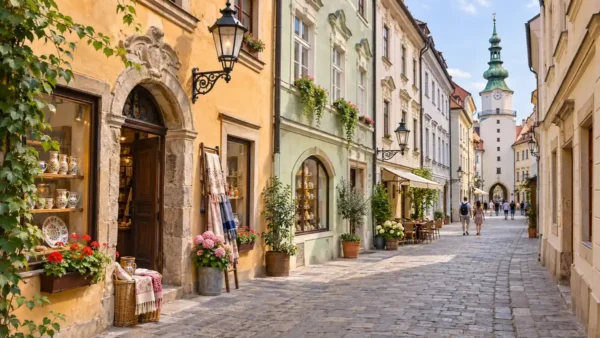
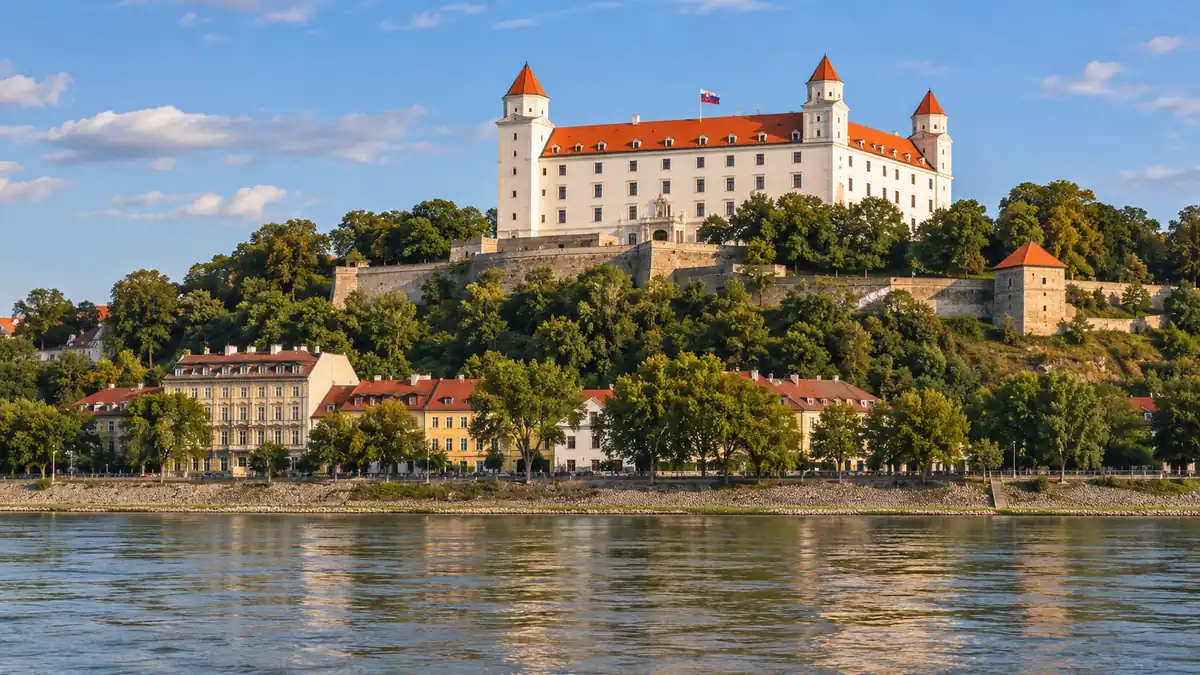
By the time you reach Bratislava’s Old Town and the castle on the hill above it, the passport check is already behind you.
Is there a passport check between Vienna and Bratislava?
There is no routine passport check between Vienna and Bratislava, because it is an internal Schengen border. Any Schengen country can bring back temporary checks at its internal borders, though, so carry your passport (or EU identity card) on every crossing.
Do You Need to Register With the Police in Slovakia?
Yes: a non-EU visitor’s stay must be reported to the foreigners police within three working days of entry. A hotel or other accommodation provider usually does it for you, so the task falls on you only in private accommodation.
The report covers when the stay began, where you are staying and how long you will be there. In practice the rule splits by type of stay:
- Hotels and other registered accommodation: the provider reports the stay for you.
- Private accommodation (friends, family, a private host): you report the stay yourself, by letter, email or in person, within the three working days.
The other paperwork a non-EU resident may meet on the trip comes at the shop counter; our guide to the VAT refund in Slovakia explains how tax-free shopping works.
How to Apply for a Schengen Visa for Slovakia
Visa-required travelers apply in person, before travel, at the Slovak embassy or consulate responsible for where they live, or at the visa centre acting for it, when Slovakia is the main or first destination. The file cannot be lodged online.
Which consulate handles your application
The consulate is set by an EU rule, based on the trip’s itinerary:
- Slovakia only: apply to the Slovak embassy or consulate.
- Several Schengen countries: apply to the country where you will spend the longest time, which may not be Slovakia.
- Equal time in each: apply to the country you will enter first.
A week in Bratislava and four days in Vienna therefore means a Slovak application; the reverse means an Austrian one.
Documents required for a Slovakia Schengen visa
The visa file follows the same EU checklist at every Slovak consulate and visa centre:
- a passport valid at least 3 months after you leave the Schengen Area;
- the completed application form;
- a photo meeting the ICAO standard;
- travel medical insurance covering emergency medical care, hospitalisation and repatriation;
- supporting documents on the purpose of the trip;
- proof of means to cover the stay;
- proof of accommodation;
- evidence of your intention to return home after the trip.
Check the minimum insurance cover with the consulate or visa centre before buying a policy.
Do you need an appointment?
Yes, you need an appointment, because your fingerprints are collected when the application is lodged. That makes the visit in person unavoidable. Appointment slots at busy consulates and visa centres can fill well ahead of the 15-day deadline, so book the slot as soon as the trip is fixed.
What a Slovakia Visa Costs and How Long It Takes
The Schengen visa fee is EUR 90 for adults and EUR 45 for children aged 6 to 12, and a decision normally takes 15 days. The application window opens 6 months before travel and closes 15 days before it.
| Item | Standard rule | What it means for planning |
|---|---|---|
| Adult fee | EUR 90 | Paid when the application is lodged |
| Fee, children aged 6-12 | EUR 45 | Budget per child in a family file |
| Earliest application | 6 months before travel | Apply once dates are firm |
| Latest application | 15 days before travel | A last-minute file risks missing the trip |
| Normal decision time | 15 days | The usual wait after the appointment |
| Maximum decision time | Up to 45 days | Leave this margin before booking anything non-refundable |
A few nationalities pay a reduced fee, and a visa centre may add its own service charge on top of the visa fee.
More Questions About Entering Slovakia
Can you travel to other Schengen countries with a Slovak visa?
Yes. A Schengen visa issued by Slovakia lets you move around the whole Schengen Area while it is valid, as long as the trip stays within 90 days in any 180. Which country issues the visa follows the consulate rule above, so a trip with more days in Austria than in Slovakia needs an Austrian visa instead.
What happens if you overstay in Slovakia?
An overstay is detected when you leave, because the Entry/Exit System records every exit and flags a stay past the allowed days. UK government travel advice says an overstay in Slovakia can bring a fine of up to EUR 1,600. The safer habit is to count every Schengen day on the rolling 180-day window before you book.
Do EU citizens need a passport for Slovakia?
No. EU citizens need no visa for Slovakia, and a valid national identity card is enough to enter; a valid passport works just as well. Carry one of the two on every crossing, internal borders included, because temporary checks can return at any of them.
How These Entry Rules Were Checked
This page answers one question: whether your passport needs a visa for a short stay in Slovakia, and what the border and your first days there require. It does not cover work, study or residence permits, and it is not a general guide to travelling in Slovakia.
Written with AI assistance, the rules on this page were checked by Alex Perrut, working in tourism since 2015, for the Tripstou editorial team; our editorial process sets out how each page is reviewed.
Official sources consulted: European Commission (Schengen visa applications), UK Foreign, Commonwealth & Development Office, European Commission (Entry/Exit System), Travel Europe (European Union).
Did this guide save you time or money? Tripstou is independent and reader-funded — if you'd like to give something back, you can support the site with a crypto contribution of any size.