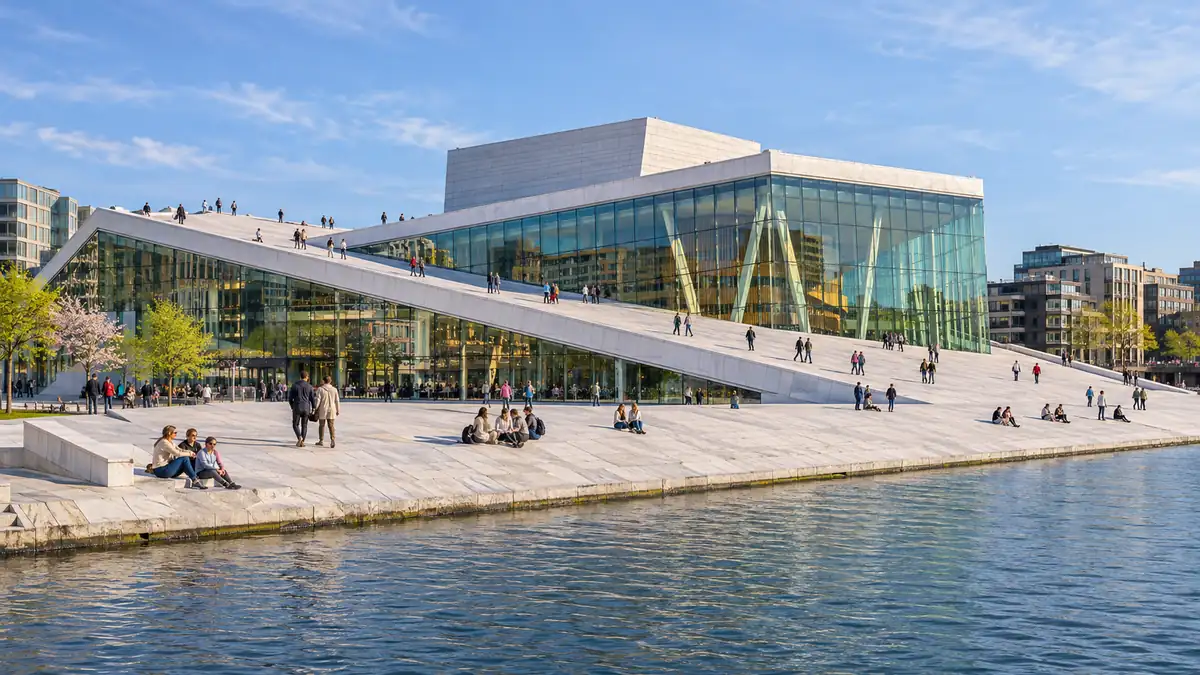
Two days in Oslo work best split by geography. Day 1 is a walk along the central waterfront: the Opera House roof and MUNCH in Bjørvika, then Akershus Fortress, City Hall and an evening at Aker Brygge. Day 2 takes the west side: Vigeland Park in the morning and two Bygdøy museums in the afternoon. One central base covers both nights. The cost of this plan is choice: a fjord cruise or Holmenkollen takes a museum slot, so the route suits a first visit or a weekend break better than a museum completist.
The order is the point. Each day stays in one half of the city, so Oslo is never crossed twice and Day 1 needs no transport ticket at all. With one day you cut the second Bygdøy museum first; with three you win back the water.
On This Route
The 2-Day Oslo Route at a Glance
Oslo’s main sights sit in two clusters, and each day takes one. The eastern and central waterfront, from Bjørvika to Aker Brygge, is walkable end to end. The west side, Vigeland Park and the Bygdøy peninsula, is linked by a short bus hop. Splitting the days this way means no stop is ever on the wrong side of town.
| When | Stops | How you move |
|---|---|---|
| Day 1 morning | Opera House roof and MUNCH in Bjørvika | On foot |
| Day 1 midday and afternoon | Akershus Fortress and City Hall, with Karl Johans gate and the Royal Palace as the walk across the centre | On foot along the waterfront |
| Day 1 evening | Aker Brygge and Tjuvholmen, or Grünerløkka and Mathallen | On foot |
| Day 2 morning | Vigeland Park | Tram 12 or tram 15 |
| Day 2 afternoon | Two Bygdøy museums | Bus, one change |
| Day 2 evening | Back to the centre | Boat to the City Hall pier in the warmer months, bus 30 otherwise |
As a weekend, the route works in either order: Saturday and Sunday can swap without changing a single leg.
Day 1: Bjørvika to Aker Brygge on Foot
Day 1 starts on the Opera House roof in Bjørvika and ends at Aker Brygge and Tjuvholmen, moving east to west along the waterfront entirely on foot. It holds the day’s one museum, MUNCH, next door to the Opera House, with Akershus Fortress and City Hall in between. If either of your two days is a Monday, put this day on it.
Morning: the Opera House roof and MUNCH
The Opera House roof is built to be walked on, which makes it the obvious first stop: you climb the sloping marble from the waterfront and see the route ahead before you start. MUNCH stands beside it in Bjørvika. It opens every day, stays open late from Wednesday to Saturday, and timed tickets are worth booking in advance.
The National Museum is the swap for MUNCH. It closes on Mondays and opens late on Tuesdays and Wednesdays, so on those two days it can move to the end of the afternoon. Pick one art museum for Day 1, not both. For a coffee stop on the way west, look for Fuglen or Kaffebrenneriet.
Midday: Akershus Fortress and City Hall
Akershus Fortress sits on the central waterfront, a short walk west of Bjørvika, and its ramparts look straight across the harbour. City Hall comes next, just beyond it at the head of the inner harbour. If you want the inland view of the centre too, walk up Karl Johans gate to the Royal Palace and come back down to the water; it adds the city’s main street without breaking the east-to-west line.
Evening: Aker Brygge, or Grünerløkka and Mathallen
The day ends on the Aker Brygge and Tjuvholmen waterfront, a short walk past City Hall, where the boardwalk and restaurants fill up as the light goes. The alternative evening is inland: Grünerløkka, north of the centre, for a livelier neighbourhood, or the Mathallen food hall in Vulkan for an informal dinner.
Day 2: Vigeland Park First, Then the Bygdøy Museums
Day 2 belongs to the west side. Vigeland Park goes first because it is free and never closes, so it can be done early and leaves the afternoon for the museums. A bus then takes you to the Bygdøy peninsula for two museums, and you return to the centre by boat in the warmer months or by bus 30.
Vigeland Park holds more than 200 sculptures by Gustav Vigeland inside Frogner Park, free and open all year, 24 hours a day. Tram 12 from Jernbanetorget takes about 15 minutes; tram 15 from Nationaltheatret takes about 8.
How to get to Bygdøy and back
From Vigeland Park, Bygdøy is about 15–20 minutes by bus with one change. From the centre, bus 30 runs from Jernbanetorget (Oslo S) to the museums in about 20–25 minutes, all year. In the warmer months a boat also runs between Bygdøy and the City Hall pier (Rådhuskaien).
When it runs, use the boat for the return leg. It turns the ride home into a small fjord crossing that lands beside City Hall, a short walk from the Aker Brygge evening you may have skipped on Day 1.
Which Bygdøy museums to pick
Three Bygdøy museums are open to choose from, and two of them fill the afternoon:
- Fram Museum — built around the polar ship Fram; the pick for anyone drawn to expeditions and ice.
- Kon-Tiki Museum — open every day, with longer hours in summer; the compact choice when time is short or the group includes children.
- Norsk Folkemuseum — an open-air museum whose stave church came from Gol and dates to around 1200; it closes on Mondays outside summer and needs the most time of the three, so pair it with one quick museum.
Three museums in one afternoon turns Day 2 into a checklist; two leave time for the walk between them and the boat back. The former Viking Ship Museum on Bygdøy is closed with no opening date published, and Viking Age finds are shown at the Historical Museum in central Oslo, which fits Day 1’s walk near Karl Johans gate.
Tours and activities
Book skip-the-line tickets, day trips and local tours with free cancellation on most activities.
You can also browse everything on getyourguide.com.
Tripstou may earn a commission if you book through this link, at no extra cost to you.
Where Does a Fjord Cruise or Holmenkollen Fit?
A fjord cruise or Holmenkollen each takes a half-day slot, and in two days that slot comes out of the plan: it replaces one Bygdøy museum or the second half of Day 1, never both. Make the swap when the fjord or the view matters more to you than a second museum.
- A sightseeing cruise on the Oslofjord — the swap for travelers who came for the water. It leaves from the harbour front and takes a half-day slot, so it fits best in place of Day 1’s afternoon, with the fortress and City Hall moved up to the morning after MUNCH.
- The island boat B1 to Hovedøya — about 8 minutes from Aker Brygge, a warmer-months outing for anyone who wants a swim, a picnic or a quiet walk on an island instead of a guided cruise.
- Holmenkollen ski jump — about 25 minutes by metro line 1 from the centre, best on a clear day for the view over the city and the fjord, and the natural pick in winter.
Guided formats that fit two days
A guided walk through the centre fits Day 1’s morning and covers the same Opera House to City Hall stretch; you can book a guided walk and do the rest of the day alone. A hop-on hop-off bus suits travelers who would prefer not to walk the whole waterfront.
A bike tour covers City Hall, the Royal Palace and the waterfront faster than the walk, so it can replace Day 1’s midday; reserve a bike spot if you would sooner ride. A fjord cruise is the guided format for the half-day swap above.
How to Get Between the Stops
Day 1 needs no transport at all. Day 2 needs one tram or bus to Vigeland Park, one bus hop to Bygdøy and one ride back, so the whole route runs on a handful of single journeys.
| Journey | Line | Time |
|---|---|---|
| Jernbanetorget (Oslo S) to Vigeland Park | Tram 12 | About 15 minutes |
| Nationaltheatret to Vigeland Park | Tram 15 | About 8 minutes |
| Vigeland Park to the Bygdøy museums | Bus, one change | About 15–20 minutes |
| Jernbanetorget (Oslo S) to the Bygdøy museums | Bus 30 | About 20–25 minutes |
| Aker Brygge to Hovedøya | Boat B1 | About 8 minutes |
| City centre to Holmenkollen | Metro line 1 | About 25 minutes |
A single zone-1 adult ticket costs NOK 46 and is valid for 60 minutes with transfers. Buying a single on board a bus or boat adds a surcharge, and tickets are not sold on board the tram or metro, so buy before you board. Zones, other ticket types and the airport journey sit outside this route.
One Central Base Covers Both Nights
Stay in one place for both nights, in Sentrum near Oslo S or Karl Johans gate. Day 1 starts within walking distance of Bjørvika, and every Day 2 stop is one tram or bus ride away, so a second base buys nothing.
Grünerløkka is the livelier alternative, at the price of a tram ride at each end of Day 1. Arrive the evening before so the route starts on the Opera House roof in the morning. Area choice, hotels, food and arrival detail are covered in the Oslo travel guide.
Hotels and places to stay
Compare hotels, apartments and stays for your dates in one search.
Search hotels and stays on hotels.com →
Tripstou may earn a commission if you book through this link, at no extra cost to you.
Is the Oslo Pass Worth It for This Route?
On this route the 48-hour Oslo Pass pays only if Day 2 stacks several paid Bygdøy museums on top of the transit and the summer boat. With one paid museum a day, single tickets come out cheaper.
The pass is sold for 24, 48 or 72 hours. It covers public transport in Oslo and the surrounding Akershus area, travel to and from Oslo Airport, and free admission to a number of museums and attractions; the Kon-Tiki Museum is free with it.
Buy it if you plan all three Bygdøy museums in one afternoon, or if your journeys to and from Oslo Airport fall inside the pass window. Skip it for the Vigeland-and-one-museum version of Day 2, where Vigeland Park costs nothing and the rest is a few single fares. Whether the pass suits a longer trip to Oslo is a broader question with a different answer.
Is 2 Days Enough in Oslo?
Two days are enough for a first visit: they cover the waterfront, one art museum, Vigeland Park and two Bygdøy museums without rushing. What they do not cover is a fjord cruise or Holmenkollen on top of all that, so the real limit is choosing between museums and the water.
The plan fits a first visit and a weekend city break. It runs tight for art and museum completists, for anyone who wants both MUNCH and the National Museum, and for anyone who wants an island afternoon as well as Bygdøy. A shorter or longer trip changes what goes first.
One Day in Oslo: What to Keep and What to Cut
With one day, keep the waterfront walk (Opera House roof, Akershus Fortress, City Hall) and Vigeland Park, and choose MUNCH or one Bygdøy museum, not both.
- Cut first: the second Bygdøy museum, the fjord half-day and the Grünerløkka evening.
- Choose one: MUNCH beside the Opera House, or a single Bygdøy museum.
- Keep: the Opera House roof, Akershus Fortress, City Hall and Vigeland Park.
Walk the waterfront in the morning and take the tram to Vigeland Park in the afternoon. Go on to Bygdøy only if it holds your chosen museum, since it adds the bus out and back to a day that has no spare hours.
What to Add With 3 Days in Oslo
A third day adds first the half-day the two-day plan made you drop: the fjord cruise or the islands, or Holmenkollen. After that, spend the rest on a slower Bygdøy with the third museum, on Ekebergparken, or on a forest walk in Oslomarka (Nordmarka).
The order follows what two days cost you. The water or the view was the trade made to fit two museums, so it comes back first; the third museum and the green edges of the city fill the remaining hours. A day trip out of the city to Drøbak, Fredrikstad or Lillehammer is a different plan, one that spends the third day on travel instead of Oslo.
After Oslo, the route west by rail on the Bergen Line is laid out in the Norway itinerary, and the wider choice of where to go next is in the Norway travel guide.
What This Route Covers and How It Was Checked
This page plans one two-day order through Oslo: which sights go on which day, how you move between them, and what to cut or add. It is not a full Oslo guide, a list of things to do or a hotel selection.
Alex Perrut, working in tourism since 2015, checked this itinerary for the Tripstou editorial team after it was drafted with AI assistance. Read about our editorial process.
Official sources consulted: Entur, Ruter, Visit Norway, MUNCH, Kon-Tiki Museum.
Oslo in 2 Days: Questions Left Over
What is closed on Mondays in Oslo?
Of the stops on this route, the National Museum closes on Mondays and Norsk Folkemuseum closes on Mondays outside summer. MUNCH and the Kon-Tiki Museum open every day, and Vigeland Park never closes. So give a Monday the Day 1 route, with MUNCH as its museum, and put Bygdøy on the other day.
Does this Oslo itinerary work in winter?
Yes, with shorter days and two changes. Do the outdoor stops, the Opera House roof and Vigeland Park, in daylight, and watch your footing on both when there is ice. The Bygdøy boat runs only in the warmer months, so the ride back to the centre is bus 30. Holmenkollen is the half-day swap that suits the season.
What can you do for free in Oslo in 2 days?
Vigeland Park is free and open all year, around the clock, and it fills the morning of Day 2. Walking up the Opera House roof, along Karl Johans gate to the Royal Palace and around the Aker Brygge and Tjuvholmen waterfront costs nothing either.
Did this guide save you time or money? Tripstou is independent and reader-funded — if you'd like to give something back, you can support the site with a crypto contribution of any size.