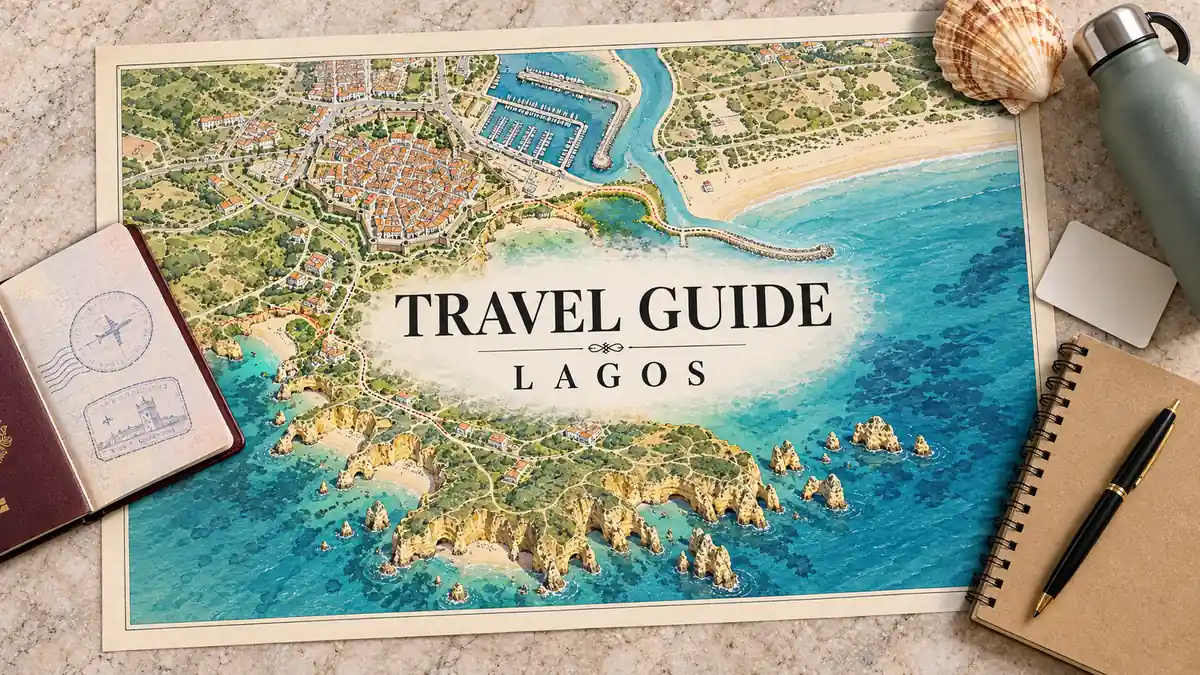
Choosing where to sleep in the Algarve decides most of what the trip feels like. Lagos is the western Algarve candidate: a walled old town of narrow lanes and squares, with Ponta da Piedade’s ochre sea stacks and a run of cove beaches close enough to reach on foot. Faro, the region’s gateway airport, sits about an hour east by road. That combination — a working town, cliffs and coves within walking distance, an airport within an easy transfer — is what separates Lagos from the built-for-holidays addresses further along the coast. This guide resolves the planning variables in order: whether Lagos is worth your base, what it is known for, how many days it needs, when to go and when to avoid it, the stay styles available, how you arrive, whether a car earns its cost, what a trip costs by spend style, which day trips are genuine, and who the town actually suits.
Quick Answer
Yes — Lagos is the Algarve’s best base for cliffs, coves and a walkable old town without a car. Give it two to three days, ideally in late spring or September; August is the crowd penalty. It suits first-timers, couples and families who want beaches on foot; a car matters only for day trips.
Trust Layer
Tripstou city guide for travelers planning a city trip. Covers trip length, stay style, season, cost, and mobility tradeoffs.
Produced with AI assistance and reviewed by Alex Perrut, working in tourism since 2015, for the Tripstou editorial team. See our editorial process for details.
Last factual review: September 7, 2026.
Official sources consulted: Visit Portugal, Turismo de Portugal.
Key Takeaways
- Lagos works best as the Algarve base for travelers who want cliffs, cove beaches and a walkable old town.
- Give Lagos two days minimum and three ideally; a fourth night buys the west coast, not more town.
- Late spring and September balance warm sea with space; July and August press hard on physically small coves.
- Skip the rental car unless you want Sagres or the Costa Vicentina; the coastal boardwalk reaches Ponta da Piedade on foot.
- Faro is the gateway airport, about an hour east by road, with the Algarve rail line ending at Lagos.
- Walking removes the biggest fixed cost, which makes Lagos unusually kind to budget and mid-range spend styles.
Table of Contents
Is Lagos, Portugal Worth Visiting?
Lagos is worth visiting as the Algarve base that puts cliffs, cove beaches and a real town on foot. Its walled centre still works as a town with its own routines, and the coastline starts minutes from the last lane. The honest limit is high summer, when that same compactness turns crowded.
Lagos sits at the western end of the Algarve, where the coast stops being long open sand and starts being carved limestone. That geography is the reason to choose it. The headland scenery most people picture when they imagine the region is concentrated here, in a few walkable kilometres, and it thins out as you travel east toward the centre of the coast.
The travelers who get the most from Lagos want three things at once: streets worth walking in the evening, beaches within reach of those streets, and the wild west coast an easy drive away. A purpose-built holiday address delivers the second and rarely the first. The tradeoff is scale — the town is small, so July and August press hard on the same handful of coves and the same few squares.
Choosing Lagos is really choosing scenery over position. It sits at the far end of the region, so every eastward excursion costs you the drive back the same evening.
For how the town fits the wider coast, the Algarve travel guide sets the frame. If you are still planning a trip to Portugal at country level, or weighing how Lagos ranks against the best places to visit in Portugal, start there and come back to the base decision.
What Lagos Is Known For: Cliffs, Coves and a Walled Old Town
Lagos is known for the Ponta da Piedade headland and the string of cove beaches beside its walled old town. Praia Dona Ana, Praia do Camilo, Praia da Batata and the long sweep of Meia Praia all sit within easy reach, alongside the working marina and the covered fish market.
A coastal boardwalk runs from the edge of town out to Ponta da Piedade — roughly 2.5 km, about 30 to 40 minutes each way — passing Praia Dona Ana and Praia do Camilo on the way. Dona Ana itself is under 30 minutes’ walk from the centre. That path is the orientation. Cliffs, the two most photographed coves and the lighthouse point all connect on it, which is why so much of a Lagos trip happens without a vehicle. Boat trips to the grottoes leave from the marina for anyone who wants the headland seen from the water instead.
Praia da Batata sits directly below the old town walls, the closest sand to a coffee. Meia Praia runs east from the marina as the town’s long, open, family-scale beach — the one with room on an August afternoon. Behind them the old town is walled, compact and pedestrian-scale: squares, a church, the fish market, and lanes that fill after dark.
Those names are the map; what to do with them is a separate question. For that, see things to do in Lagos. To compare coves along the coast, the guides to the best beaches in the Algarve and Portugal’s best beaches handle the selection this page deliberately skips.
How Many Days You Need in Lagos
Three days is the sweet spot in Lagos. Two days covers the essentials — the old town, the boardwalk out to Ponta da Piedade and one full beach afternoon. A third day adds a slower pace or the west coast, and three to five makes room for a genuine day trip.
| Trip length | What it buys | Who it fits |
|---|---|---|
| Two days | Old town, the boardwalk headland walk, one beach afternoon | Travelers slotting Lagos into a wider Portugal route |
| Three days | All of the above plus a slow beach day and unhurried evenings | First-timers who want the Algarve without rushing it |
| Three to five days | Room for Sagres, the west coast or a second town eastward | Travelers with a car or a true holiday pace |
The fourth night rarely buys you more Lagos; it buys the west coast. Without a car, three nights is roughly the point where the town starts repeating itself and the boardwalk stops surprising you.
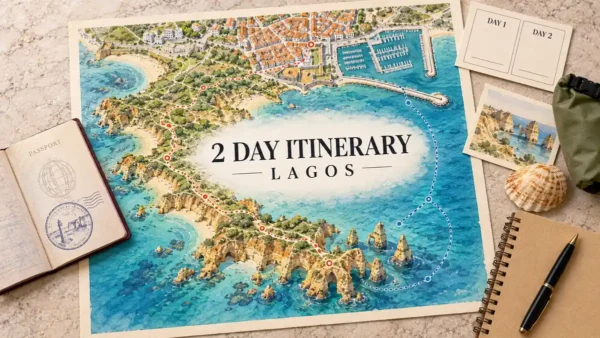
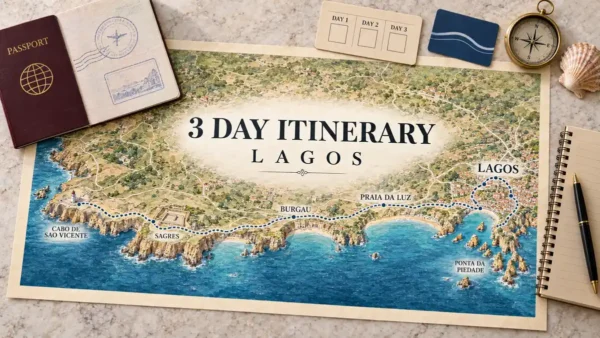
Day-by-day pacing lives elsewhere: the 2-day Lagos itinerary for a short stop, the 3-day Lagos itinerary for the recommended length. If Lagos is one leg of a bigger loop, the one-week Portugal itinerary shows how many nights the Algarve can realistically claim.
When to Visit Lagos and When to Avoid It
Late spring and September give Lagos its best balance of warmth, sea and space. April and May bring green cliffs and quiet beaches with a cooler Atlantic. September into early October keeps late-summer sea warmth while the crowds thin out. July and August are the months to avoid if queues bother you.
- April to May — the quiet balance. Suits walkers, photographers and anyone who wants the boardwalk to themselves. The tradeoff is the sea: the Atlantic is still cold, and beach days are shorter than the sunshine suggests.
- June — the shoulder that still works. Suits travelers who want warmer water without peak intensity. The tradeoff is that the busy pattern has already started on the small coves at midday.
- July to August — the crowd penalty. Suits families locked into school holidays and anyone who wants the town at full volume. The tradeoff is real: the busiest weeks of the year on beaches that are physically small.
- September to early October — the best overall window. Suits couples, returning visitors and slow travelers. The tradeoff is a shorter run of warm evenings as October advances.
- November to March — the empty months. Suits walkers, remote workers and long off-season stays. The tradeoff is a much quieter town and unreliable swimming weather.
Season choice moves the experience here more than the budget does — a cove that feels remote in May feels like a queue in August, and no amount of money changes that. For the country-wide picture, see the best time to visit Portugal. Shoulder-season travelers should read the Portugal packing list before assuming shorts: the Atlantic wind on those cliffs is the thing most visitors underpack for.
Where to Stay in Lagos: Old Town, Marina or Meia Praia
Stay in the old town if you want everything on foot. The marina suits travelers who value newer, quieter rooms and easy boat access. Meia Praia is the beach-first choice, with space and sand at the door and a longer walk back into town after dinner.
- Old town. Best for travelers who want restaurants, bars and the boardwalk trailhead within a few minutes’ walk. The tradeoff is noise on summer nights and stairs in older buildings.
- Marina and the river side. Best for travelers who want a calmer, more modern stay with boat departures nearby. The tradeoff is a slightly less atmospheric address.
- Meia Praia. Best for beach-led trips and families who want space and a long flat stretch of sand. The tradeoff is distance: reaching the old town becomes a decision each evening.
Those are stay styles, not an address. The street-level resolution — which side of town, how far is too far — sits on where to stay in Lagos, and the property-level picks on beach hotels in Lagos.
Hotels and places to stay
Compare hotels, apartments and stays for your dates in one search.
Search hotels and stays on hotels.com →
Tripstou may earn a commission if you book through this link, at no extra cost to you.
How to Get to Lagos from Faro or Lisbon
Fly into Faro and reach Lagos by road in about an hour, or take the Algarve rail line. Faro is the nearest international airport, roughly an hour’s drive east of the town. Lisbon is the long approach: a connecting train or a considerably longer drive down the country.
Lagos is the western terminus of the CP Linha do Algarve, the coastal line that runs west from Faro, and the journey takes around an hour and a half. Faro airport has no rail station of its own, so reaching the train means a separate short hop into Faro first. That extra leg is why most travelers landing at Faro simply continue to Lagos by road. From the north, connecting services link the Algarve line to Lisbon.
The mechanics of the airport leg — which option suits which arrival — belong on Faro airport to Lagos. If you are stitching the country together on rails, the Portugal by train itinerary shows where the Algarve line fits in a longer route.
Do You Need a Car in Lagos?
You do not need a car in Lagos itself. The old town, Praia da Batata, Praia Dona Ana, Praia do Camilo and Ponta da Piedade all connect on foot along the coastal boardwalk. You need a car only for the wider Algarve — Sagres, the Costa Vicentina and the towns strung out along the coast.
Walking is the default here, and the town is built for it. The old town, the marina and the train station form three fixed points, all close together, and everything cliff-side runs west from them along the boardwalk. Meia Praia is the one beach that feels farther: it stretches east from the marina, and reaching its quieter end is a proper walk in summer heat.
The boardwalk is why Lagos breaks the usual Algarve assumption that good beaches require wheels. Few towns on this coast put their best cliffs at the end of a footpath.
- Rent a car if your trip includes Sagres, the Costa Vicentina or two or more Algarve towns, or if you are travelling with small children and a lot of beach equipment.
- Skip the car if your plan is Lagos, its coves and the headland — you would be paying for a vehicle that spends most of the trip parked.
- Decide late if you are unsure: hiring for one or two days of the stay often beats hiring for the whole stay, since parking pressure near the small coves builds through the summer.
If the car wins and the trip grows beyond the Algarve, the Portugal road trip guide covers the routes that make the rental worth its keep.
What a Lagos Trip Costs by Spend Style
Lagos rewards the walker: leaving a car out of the plan removes the largest fixed line in most Algarve budgets. What the rest costs comes down to stay style and eating pattern, and the town covers the full range — hostel dorms, family apartments and cliff-top hotels all exist within the same few kilometres.
- Budget. Hostel dorms or simple rooms slightly back from the old town, self-catered breakfasts, grilled fish at lunch when menus are cheaper, and no transport spend at all because everything is walkable. Lagos is unusually kind to this style — its headline attraction is a free footpath.
- Mid-range. A guesthouse or apartment in the old town or near the marina, dinner out most nights, one boat trip, and the occasional taxi to the far end of Meia Praia. This is where the town sits most comfortably, and where a shoulder-season stay stretches furthest.
- High-end. A cliff-side or beachfront hotel, restaurant dinners, private boat time and a rental car for the west coast. Lagos punishes this style in August, when the best-located stays are booked earliest and hold their rates hardest.
Timing moves the total more than style does: the same room in September and in August is not the same purchase. For the daily numbers, see the Lagos trip cost breakdown and the wider Portugal trip cost page. Eating patterns — where the value sits at lunch, what a tourist menu really buys — are covered in the Portugal food guide.
Day Trips from Lagos That Are Worth the Detour
Sagres and the Costa Vicentina are the day trips that justify a car from Lagos. West of town the coast turns wild, empty and cliff-bound, and the drive is short. Eastward, Carvoeiro and the smaller Algarve towns work as half-days. Lisbon is the approach to the region, not a day out.
- Sagres and Cabo de São Vicente — the continent’s south-western corner, all wind, fortress walls and open Atlantic. Car strongly preferred.
- Costa Vicentina — the wild west-coast beaches north of Lagos, the surf side of the peninsula. Car required; there is no walkable version of this.
- Carvoeiro and the central Algarve coast — more cliffs, more coves, a different town rhythm. Car or a longer public journey; works well as a half-day.
- Eastern Algarve towns — flatter, quieter and lagoon-facing, a genuine contrast to the west. Reachable on the Algarve rail line, though the distance grows quickly.
Lisbon works as the trip’s bookend: arrive or depart through it and give it its own nights. Madeira and the Azores are a separate flight and a separate holiday, which the Portugal’s islands guide explains. If the day-trip list is outgrowing the base, that usually means the trip wants a route: see the Portugal itinerary options, or the longer 10-day Portugal itinerary and 14-day Portugal itinerary for how the Algarve slots into a country-wide plan.
Tours and activities
Book skip-the-line tickets, day trips and local tours with free cancellation on most activities.
You can also browse everything on getyourguide.com.
Tripstou may earn a commission if you book through this link, at no extra cost to you.
Who Lagos Suits: Families, Couples, Solo and Beginner Surfers
Lagos suits first-timers, families and couples who want beaches without driving. Families get Meia Praia’s space and a town small enough to cross with children. Couples get the old town and the cliff walk. Solo travelers get a walkable base with an easy social scene around the marina and hostels.
First-timers to the Algarve get the clearest version of the region here, since the scenery and the town sit in the same place. Families trade that for crowding: the small coves fill fast, and Meia Praia is the sane summer answer. Couples get evenings that work without a car, though the old town is loud in peak weeks. Solo travelers find company easily and a compact geography that makes short stays worthwhile; the tradeoff is a social scene that skews young and seasonal.
Beginner surfers are well served, with lessons run out of Lagos to the west-coast beaches where the waves suit learners. Lagos suits you less if you want a resort strip with big nightlife, or if you intend to tour the whole Algarve without renting a vehicle.
Lagos feels relaxed and ordinary precautions are enough; the usual pickpocket awareness in crowded summer streets covers most of it. For the specifics, read up on common scams in Portugal and, if you are travelling alone, solo female travel safety in Portugal. The small practicalities of the town itself are collected in Lagos travel tips.
Frequently Asked Questions
Is Lagos, Portugal safe?
Yes. Lagos is a relaxed, low-crime town where ordinary precautions are enough for most travelers. Watch bags in crowded summer streets, on busy beaches and around the marina at night. The cliffs deserve more caution than the streets do, so keep well back from the edges at Ponta da Piedade.
Is Lagos too crowded in July and August?
Yes, high summer is the busiest stretch of the year, and Lagos feels it more than most Algarve towns because its best coves are physically small. Praia Dona Ana and Praia do Camilo fill early; Meia Praia absorbs the pressure. Shifting to June or September removes most of the problem.
Is Lagos or Albufeira the better base?
Lagos for scenery and walkability; Albufeira for resort facilities and nightlife. Lagos puts a working old town, cove beaches and the Ponta da Piedade boardwalk within walking distance, and sits closer to the wild west coast. Albufeira suits travelers who want a bigger strip, more hotels and a louder evening scene.
Do people speak English in Lagos?
Yes. English is widely spoken in Lagos’s hotels, restaurants, bars, tour offices and shops, and the town’s long history with international visitors makes it one of the easier places in Portugal to travel without Portuguese. A few polite Portuguese phrases are still welcomed, particularly away from the tourist streets.
Can beginners surf in Lagos?
Yes. Lagos is one of Portugal’s easier places to take a first surf lesson, with schools based in town running transfers to the west-coast beaches where the waves suit learners. Book a lesson instead of hiring a board on your own — the west-coast beaches are exposed, and the value is being taken to the right one.
Can you swim in Lagos in October?
Yes, for most swimmers in early October, when the sea still holds late-summer warmth and the beaches have emptied. The Atlantic here is cooler than the Mediterranean at any time of year, so expect a bracing first minute. By late October, swimming becomes a shorter, sunnier-day proposition.
Related Guides
- Things to do in Lagos
- Where to stay in Lagos
- 3-day Lagos itinerary
- Faro airport to Lagos
- Algarve travel guide
- Portugal travel guide
Did this guide save you time or money? Tripstou is independent and reader-funded — if you'd like to give something back, you can support the site with a crypto contribution of any size.