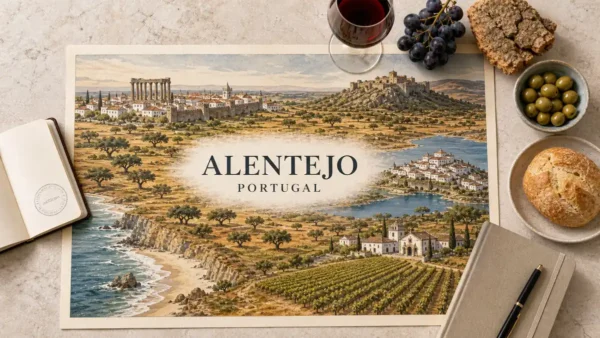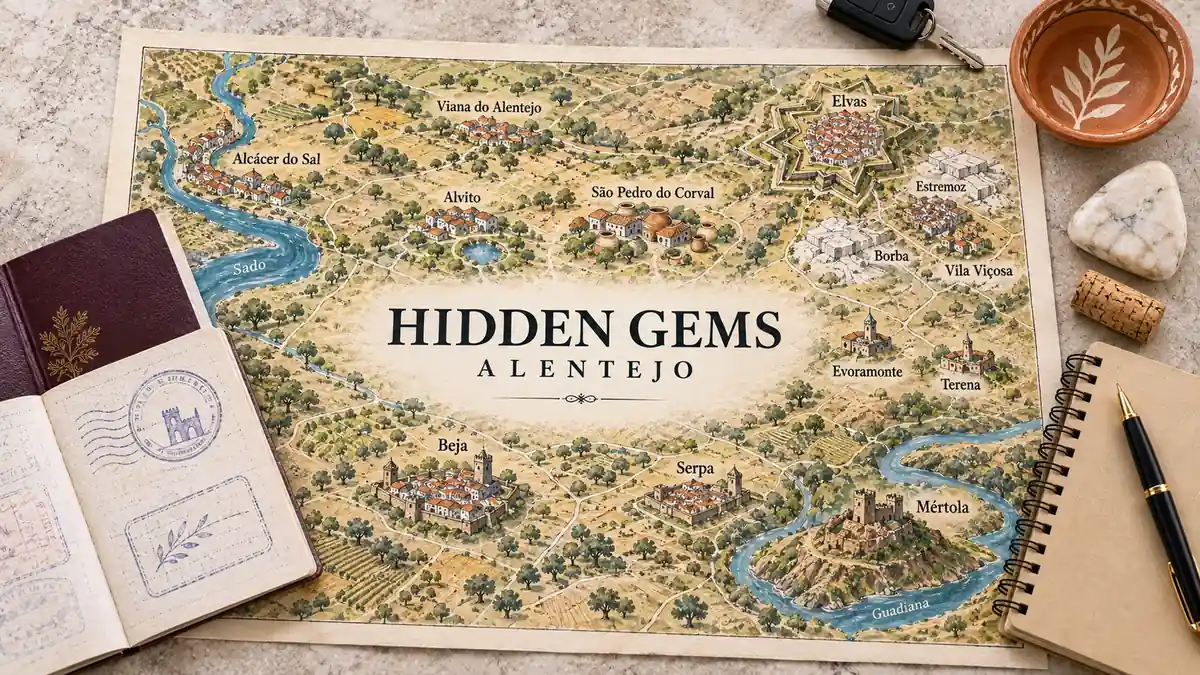
You already know Évora and Monsaraz. You have also seen the same handful of names on every hidden-gems list for the Alentejo, and you want to know which places are actually still quiet. The real gems sit inland: border fortresses on the Spanish frontier, marble and pottery towns through the middle, and a walled river village above the Guadiana in the south. They stay quiet because the region is enormous, almost entirely car-bound, and skipped by day-trippers who turn back after Évora. This page names ten of them, sorted into three geographic groups so two or three can be combined on one loop. Each pick gets what is there, what makes it different from the other nine, and one condition that tells you whether it is yours. There is a fit grid too, and a closing verdict on the famous names that no longer deserve the label.
Quick Answer
The Alentejo’s genuinely hidden gems are inland: Mértola, São Pedro do Corval, Elvas and the marble towns around Estremoz. They stay quiet because the region is large and car-bound, and most visitors stop at Évora and Monsaraz. Choose Mértola for a slow river-and-castle day, Corval for craft; the coast villages are no longer hidden in high summer.
Trust Layer
Tripstou selection guide for travelers choosing between multiple places. Covers selection criteria, traveler fit, and trip value.
Produced with AI assistance and reviewed by Alex Perrut, working in tourism since 2015, for the Tripstou editorial team. See our editorial process for details.
Last factual review: September 11, 2026.
Official sources consulted: Visit Portugal, Turismo de Portugal.
Key Takeaways
- Mértola is the strongest single pick: castle, mosque-church and the Guadiana within one walk, and the only one worth a night.
- Match the pick to the interest: Elvas for fortifications, São Pedro do Corval for pottery, the marble triangle for a palace-and-quarry loop.
- Nearly every pick needs a car, and that car dependence is the reason these towns stayed quiet in the first place.
- Combine two picks from one geographic group; crossing between groups spends the day you came to spend in the towns.
- Alcácer do Sal is the water pick for anyone who wants a river town and none of the Comporta scene.
- Porto Covo, Zambujeira do Mar, Comporta, Melides, Arraiolos and Troia are worth visiting, but no longer for quiet.
Table of Contents
The Alentejo’s real hidden gems are inland towns, not the coast villages
The least-visited Alentejo is its inland east and south: the border towns, the marble country and the Guadiana valley. Nothing there sits on a coach loop, the region has no airport gateway, and most day-trippers turn back at Évora. Every pick below is a place, not an experience, and absent from the standard list.
The ten are Elvas, the marble triangle of Estremoz, Borba and Vila Viçosa, Évoramonte and Terena in the north-east; Alcácer do Sal, Alvito and Viana do Alentejo, and São Pedro do Corval across the centre; Beja, Serpa and Mértola in the south. They are sorted by geography because picks from the same group combine on one drive and picks from different groups do not.
Almost every one of them needs a car. They are quiet precisely because no bus route makes them convenient, and the exception proves it: the coast villages are the easiest places in the region to reach without driving, and they are exactly where the crowds go. How many days the region needs, which town to base in, when to come and how to get there are settled in our Alentejo travel guide — this page only decides where to point the car.
The Alentejo’s day-trip radius is drawn around Évora, and everything on this page sits outside it. That is the only reason any of it is still quiet.
The Alto Alentejo’s hidden gems are its border and marble towns, not Marvão
Elvas, the marble triangle, Évoramonte and Terena are the Alto Alentejo’s under-visited stops, all on one border-country loop. They share a fortress-and-marble character — walls, quarries and a palace — and none of them appears on the standard hidden-gems list. The famous alternatives up here are Marvão and Castelo de Vide.
Marvão and Castelo de Vide are superb and belong on any Alto Alentejo drive, but they are famous, so they sit with the region’s other headline names in our guide to things to do in the Alentejo instead of on this page.
Elvas, the garrison town on the Spanish border
Elvas is a UNESCO-listed garrison town on the Spanish frontier, and its fortifications are the whole reason it is here. They wrap a working town that still goes about its business inside them — this is not a museum village with a ticket office at the gate. The scale is what surprises people: walking the defences is the day, not a stop between two other things.
That makes it distinct on this page. Every other pick can be seen in an hour or a morning; Elvas asks for a full one, and it is the only entry where military engineering, not scenery, is the subject.
Pick this if: you want one serious military-history day on the Spanish border.
Position is the catch. Elvas is the furthest east of the ten, and it rewards a night far more than a pass-through on the way somewhere else.
Estremoz, Borba and Vila Viçosa: the marble triangle
Estremoz, Borba and Vila Viçosa are known collectively as the marble triangle, and the three together make one loop. Vila Viçosa was the seat of the House of Braganza and holds the marble-fronted Ducal Palace. Estremoz is the centre of marble production and names the stone quarried around it. Borba sits between them, marble-built and quiet. The Rota do Mármore threads the working side of the industry through all three, though it is a theme here, not a pick of its own.
What makes the triangle distinct is the combination: a ducal palace and a live extractive industry inside the same afternoon’s driving, which no other entry on this page offers.
Pick this if: you like a palace and a quarry town in the same day and have the car to link them.
Three towns is one too many for most trips. Take Vila Viçosa if you only do one.
Évoramonte, the castle village between Évora and Estremoz
Évoramonte is a tiny walled village on a hill with a castle at the top, and it sits directly on the road between Évora and Estremoz. That position is the whole argument for it: it stands on a road visitors already drive, and almost none of them take the turning. You can see the castle from the road, which is usually where the decision gets made. The village inside the walls is a handful of lanes and a view over the plain.
It is the easiest pick here to add without changing a plan. Nothing else slots into an existing drive so cleanly.
Pick this if: you want a castle village to yourself for an hour between two bigger stops.
The hour is the visit. Évoramonte is a stop, not a destination, and treating it as one will disappoint you.
Terena, the quietest hilltop village on this page
Terena is the quietest place on this page: a small walled village with a castle, out in the Alandroal country towards the Alqueva side of the region. It appears on essentially no English-language list, which is unusual for somewhere this photogenic, and the effect on the ground is immediate — you are likely to have the walls, the lanes and the silence entirely to yourself.
That is what separates it from the other nine. Every other pick has some infrastructure behind it: a workshop street, a palace, a city, a route. Terena has the least of anything.
Pick this if: you rank silence above sights and are content with an hour instead of a day.
Be clear about what you are getting. Little is open, there is almost nothing to buy, and nothing to book — go expecting an empty village, because that is exactly what it is.
Central Alentejo’s hidden gems are working towns, not viewpoints
Alcácer do Sal, the fresco villages of Alvito and Viana, and São Pedro do Corval work; they do not pose. A river town, a set of painted chapels and a pottery street: none of them is a viewpoint, which is precisely why the coach loop skips all three. Évora and Monsaraz are the famous neighbours they sit between.
Alcácer do Sal, the river town most visitors drive past
Alcácer do Sal sits on the Sado with a castle above it, and most people meet it as a name on a road sign heading for the coast. It is the westernmost pick on this page and the only one where the water is a river, not a beach. That difference is the whole character of the place: water without a beach resort attached to it.
That gives it a role none of the others can fill: it is the honest alternative for a traveler who wants water and a town without Comporta’s scene next door.
Pick this if: you want a river town near the coast and no interest in the Comporta crowd.
Geography limits it. Alcácer sits west of everything else here, so it works as a stop on the way to or from the coast, not as a base for the interior picks.
Alvito and Viana do Alentejo, the fresco country
Alvito and Viana do Alentejo are the two anchor villages of the Rota do Fresco, a route of fresco-painted chapels and churches spread across Alvito, Cuba, Portel, Vidigueira and Viana do Alentejo. The paintings are interiors — walls and vaults inside small rural churches, the kind of thing that never makes a listicle because you cannot photograph it from a car park. Visits along the route are arranged through the route’s operator.
No other entry works like this: the sights sit behind doors you organise in advance, not streets you wander into.
Pick this if: you care about painted chapels and will arrange a visit instead of turning up.
Arrive unarranged and you get a locked door and a pretty village square, which is a thin reward for the drive out.
São Pedro do Corval, Portugal’s largest pottery village
São Pedro do Corval, in the municipality of Reguengos de Monsaraz, is Portugal’s largest pottery centre and one of the two largest in Iberia. Working workshops line the main road through the village, open doors with wheels turning behind them, and the Casa do Barro interpretive centre occupies a former workshop as the place to understand what you are looking at. Monsaraz stands on its hill a short drive away, and the Cromeleque do Xerez lies in the same municipality.
Nowhere else on this page can you watch something being made and then carry it home. That is the entire case for coming.
Pick this if: watching a potter at the wheel appeals to you more than another viewpoint.
Corval is a working street, not a pretty village. Come for the workshops and the clay, or skip it.
The Baixo Alentejo is the region’s quietest circuit: Beja, Serpa and Mértola
The Baixo Alentejo is the region’s least-visited corner, and Beja, Serpa and Mértola are its three essential stops. A working city, a walled cheese town and a river village with a mosque-church: they sit on one southern loop, and not one of them has a coach park. This is the group that most rewards a night.
Moura sits on the same circuit if you want a fourth stop.
Beja, the working city of the south
Beja is the Baixo Alentejo’s main town and the only pick on this page that is a proper city. It has a historic core, streets laid out for daily use, and cafés that fill because people live and work here, not because a coach emptied outside. A visit amounts to a few hours in a real southern town: the old streets on foot, a long lunch, and no queue for anything.
That everyday quality sets it apart from the villages on this list. Beja is not preserved; it is simply used.
Pick this if: you want a working city with everyday life, not a postcard village, as your southern stop.
The honest catch is that Beja feels the least hidden of the ten, because a regional capital never feels undiscovered. It is also the first name to drop if your southern loop is short.
Serpa, the walled cheese town
Serpa is a walled town with a castle above it, and it gives its name to Queijo Serpa, the sheep’s-milk cheese made in the country around it. The walls and the castle are only half of the reason to stop. The cheese is not a souvenir detail here — it is the local product the town is known for, sold and eaten as a matter of course.
That double claim makes Serpa different from the other walled towns on this page. Everywhere else the walls are the reason; here the food matters just as much.
Pick this if: you want a walled town where lunch counts as much as the castle.
Pacing decides this one. The walls take an hour and the cheese takes a meal, so build the visit around a long lunch or the stop will feel thin.
Mértola, the best town on this page
Mértola is worth visiting, and it is the one pick here that justifies a whole night. The village is walled and stacked on a hill above the Guadiana, with a castle on top and, below it, a main church that was built as a mosque and still keeps that fabric inside. It is the rarest thing on this page. The Vale do Guadiana natural park runs around the village, and Pulo do Lobo, the big waterfall on the Guadiana, is a short drive north.
River, castle and mosque-church sit within one walk, in the wildest setting on this page. Nothing else here comes close.
Pick this if: you can give one place a full slow day and want river, castle and mosque-church in a single walk.
Distance is the price. Mértola is the furthest south of the ten and the hardest to combine with the Alto Alentejo picks.
Which Alentejo hidden gem suits your trip?
Mértola suits the slowest trips, Corval the craft-minded, Elvas the history-minded and Alcácer do Sal anyone wanting water without Comporta. The prettiest village, honestly answered, is Mértola — with Terena and Évoramonte if you want it empty. Two or three picks from one group combine on a single drive; picks from different groups do not.
The grid routes you to a pick; it does not rank the ten.
| Trip style | Best pick | Why it fits | Pairs with |
|---|---|---|---|
| One serious history day | Elvas, on the Spanish border | UNESCO fortifications fill a full day on the frontier | The marble triangle on the same border loop |
| Craft you can take home | São Pedro do Corval | Working potters’ workshops along the village’s main road | Alvito and Viana do Alentejo on the same sweep |
| Prettiest village for a slow stop | Mértola, above the Guadiana | Castle, mosque-church and river valley in one walk | Serpa and Beja on the same southern loop |
| Palace and quarry in one loop | Estremoz, Borba and Vila Viçosa | Ducal palace and working marble towns in one loop | Évoramonte and Terena just to the south |
| Water without the Comporta scene | Alcácer do Sal, on the Sado | A castle-topped town on a river, not a beach resort | The fresco villages a short drive inland |
| Painted chapels off any list | Alvito and Viana do Alentejo | Fresco interiors arranged through the route’s operator | São Pedro do Corval on the same central run |
Two picks in one group beat four picks across two, because the driving between groups eats the day you came to spend in them. A group is a grouping, not an itinerary: take two neighbours and let the third go.
Some readers should not be choosing here at all. If the trip is really Lisbon plus one region, and the Alentejo is still competing with the Douro or the Algarve, start with the national picture in our round-up of hidden gems in Portugal and come back once the region is settled. And how many days the region needs is the hub’s call, not this page’s.
Which Alentejo “hidden gems” are no longer hidden?
Porto Covo, Zambujeira do Mar, Comporta, Melides, Arraiolos and Troia appear on every hidden-gems list and no longer qualify. The coast fills with Portuguese holidaymakers in high summer, Comporta and Melides have become a scene, and Arraiolos and Troia are simply famous. Go to all of them — just not for quiet.
- Porto Covo — quiet out of season, busy with Portuguese holidaymakers in high summer. Good off-season; Terena for silence.
- Zambujeira do Mar — the same pattern, one village south. Suits walkers outside summer; Mértola is the year-round version.
- Comporta and Melides — no longer under the radar, and priced for it. Fine for the scene; Alvito and Viana are the opposite.
- Arraiolos — famous for its carpets and on every list. Worth a craft stop; São Pedro do Corval is the working version.
- Troia — a resort peninsula, not a village and never hidden. Suits a family beach break; Alcácer do Sal is the town nearby.
The coast and the interior crowd on opposite schedules — the beach villages in high summer, Terena and Évoramonte never. None of these names deserves a skip. Évora, Monsaraz, Marvão and the Rota Vicentina simply live on other pages — among the best places to visit in Portugal, and in our guide to the Alentejo’s best experiences.
Frequently Asked Questions
Which Alentejo hidden gems can you visit as a day trip from Lisbon or Évora?
From Évora, São Pedro do Corval, Évoramonte, the marble triangle and the fresco villages all work as day trips. From Lisbon, Alcácer do Sal is the honest one. Mértola and Elvas sit too far out to rush; both deserve a night. Our Alentejo travel guide settles days and bases.
Do you need a car to visit the Alentejo villages?
Yes, for practically every pick on this page. They stay quiet because public transport never made them convenient, which is the whole mechanism this page runs on. Without a car the realistic Alentejo shrinks to Évora and the coast. Transport is covered in our Alentejo travel guide.
Are the Alentejo coast villages crowded in summer?
In high summer, yes — the Alentejo coast fills with Portuguese families on holiday, and the villages are busy. Outside that short window the same shoreline is close to empty, which is the version most foreign visitors never see. Timing, not the choice of village, decides what you get.
Is Porto Covo still a hidden gem?
Out of season, yes; in high summer, no. Porto Covo keeps its looks year-round but loses its quiet exactly when most foreign visitors arrive. If you are travelling in summer and still want water, Alcácer do Sal on the Sado is the honest swap; for quiet, go inland.
What is the Rota do Fresco?
It is a route linking fresco-painted chapels and churches across five Alentejo municipalities: Alvito, Cuba, Portel, Vidigueira and Viana do Alentejo. The paintings are interior work, so the sights are behind doors instead of out on the street. Visits along the route are arranged through the route’s operator.
Is Elvas worth visiting?
Yes, if fortifications interest you at all. Elvas carries UNESCO listing for its garrison defences, and they take a full day to see properly. It suits history-minded travelers and pairs naturally with the marble triangle on the same border loop. Treat it as a quick stop and you will wonder what the fuss was.
Related Guides
- Alentejo Travel Guide — how many days the region needs, which town to base in, when to come and how to get around.
- Things to Do in the Alentejo — the experiences behind the famous names, from the Alqueva night sky to the coast walk.
- Best Places to Visit in Portugal — the headline destinations, including the Alentejo names that are famous for good reason.
- Hidden Gems in Portugal — the same famous-versus-quiet question asked across every region of the country.
Did this guide save you time or money? Tripstou is independent and reader-funded — if you'd like to give something back, you can support the site with a crypto contribution of any size.