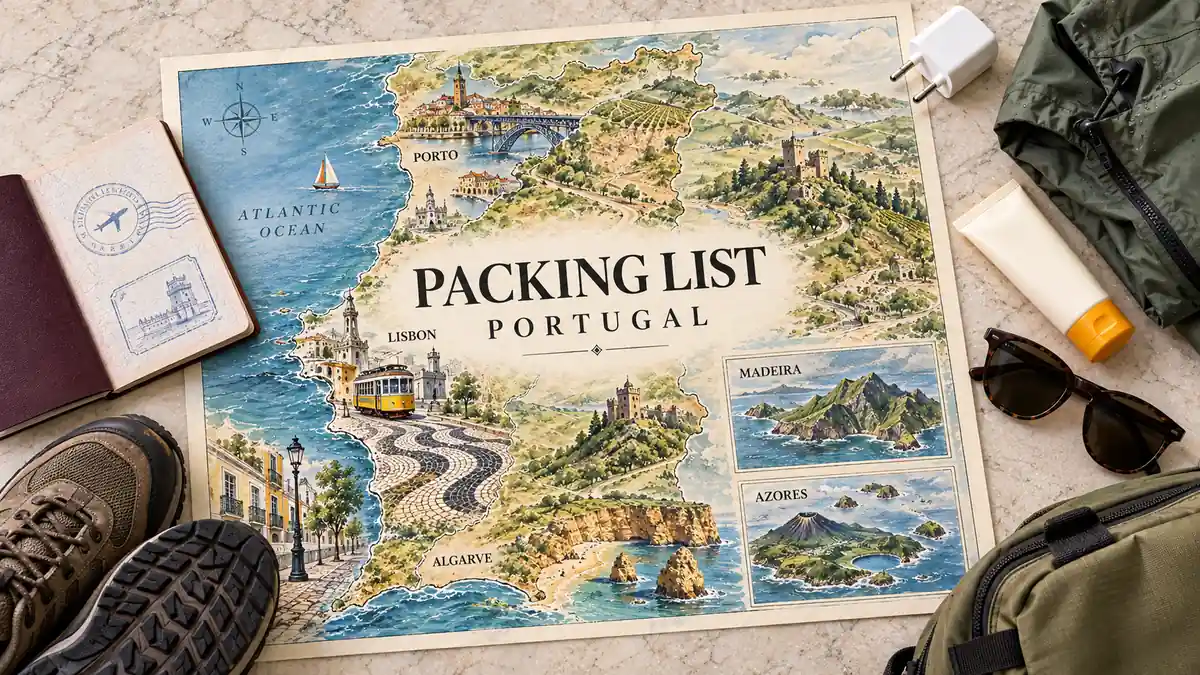
Almost every Portugal packing list is interchangeable with one written for Spain or Greece. Swap the country name and nothing breaks. That is the tell: these are inventories, and an inventory is not a decision.
One thing about Portugal genuinely is Portugal-specific, and it gets asserted everywhere and explained nowhere — the surface you will be walking on all week. Portuguese towns are paved in small polished limestone blocks, laid on flat ground and slopes alike, and the country’s own municipal engineers have written down why that is a problem. Everything downstream of it follows from that one condition: which shoes, which bag, how much you can realistically carry up a stairwell.
So this page argues about conditions and categories instead of items. You will leave with a footwear decision, a layering decision, and three splits that change what goes in the bag — coast or interior, mainland or islands, city or beach.
Quick Answer
Grip-soled shoes and layered clothing are the two packing decisions that matter in Portugal. Everything else is ordinary travel kit. What changes the contents is season plus where you are heading: Atlantic coast, dry interior, or the islands. A soft bag, layers instead of one heavy coat, and a Type C or F adapter cover most trips.
Trust Layer
Tripstou planning guide for travelers resolving one travel decision. Covers the main variable, traveler context, and practical tradeoffs.
Produced with AI assistance and reviewed by Alex Perrut, working in tourism since 2015, for the Tripstou editorial team. See our editorial process for details.
Last factual review: September 10, 2026.
Official sources consulted: Visit Portugal, Turismo de Portugal, Câmara Municipal de Lisboa, Eurostat.
Key Takeaways
- Lisbon’s municipal accessibility plan states calçada was laid on inclined streets where polishing makes limestone slippery — sole grip decides everything.
- Judge a sole by tread depth, rubber softness and wear at the contact points, not by comfort or looks.
- Three thin layers beat one heavy coat, because Atlantic afternoons change the temperature more than the forecast does.
- Eurostat records around one in five in Portugal cannot heat the home adequately — the winter layer is for indoors.
- Upwelling keeps the west and north coasts cold in summer, turning a rash vest into a real swim-kit decision.
- A soft bag beats a hard-shell case where small wheels catch in paving joints and stairwells replace lifts.
Table of Contents
The Four Conditions That Decide What Goes in Your Portugal Bag
Four conditions decide a Portugal bag: season, coast or interior, mainland or islands, city or beach. The checklist follows from them, never the other way round. Settle those four first and most packing arguments resolve themselves without a list of items at all.
Season is the input you already know, and it does less work here than travelers assume. Summer changes the daywear; winter changes what you wear indoors, which is a separate problem covered further down. If your dates are still open, the seasonal case belongs on the month-by-month timing guide — this page takes your dates as given.
The geographic splits do the heavier lifting. A trip that hugs the Atlantic edge, a trip that pushes inland, and a trip that includes an island leg produce three different bags from the same wardrobe, mostly because of wind, humidity and how fast conditions change. Route matters more than dates. A worked route plan will tell you which of the three you are actually taking, and the wider country context sits in the main Portugal guide.
The fourth split is the one people underpack for: city days and beach days ask for opposite footwear, and that is where the second pair of shoes comes from. Everything in the table below reads the same way — a condition on the left, a consequence on the right.
| Condition | The split you face | What it changes in the bag | Where it shows up |
|---|---|---|---|
| Season you travel in | Summer heat, or damp and unheated winter interiors | Layer count, plus a warm layer meant for indoors | Everywhere, hardest inland in the cold months |
| Coast or dry interior | Breezy and moderate, or hot and dry inland | A windproof layer, or lighter and looser daywear | Silver Coast and Alentejo on one trip |
| Mainland or the islands | Steady days, or conditions that shift within hours | A shell and a warm layer travel year-round | Madeira and the Azores, even in summer |
| City days or beach days | Polished stone underfoot, or sand and salt water | Grip-soled shoes, or swim kit and a rash vest | Historic centres against long Atlantic beach days |
| How much you walk | Long days on foot, or short hops by car | Sole quality, and whether a second pair earns space | Lisbon and Porto days against a driving route |
Footwear Is the Highest-Consequence Choice You Will Make
In Portugal the sole matters more than the shoe. The walking surface in most historic centres is polished limestone laid in small blocks, often on a slope, and it turns slick when damp. Grip is the variable that decides whether a week of walking feels comfortable or nervous; cushioning and style barely register.
This is the one section of a Portugal packing list that could not have been written for another country. Calçada portuguesa is the standard pavement of Portuguese towns — squares, side streets and main shopping drags alike — and it behaves in a way ordinary city shoes are not designed for. Three things follow: why the surface misbehaves, how to test a sole before it goes in the bag, and where the problem is sharpest.
Why polished limestone on a slope is the problem
The problem is documented by the city that has the most of it. Lisbon’s pedestrian accessibility plan, approved by the city’s municipal assembly, records that calçada was generalised onto inclined streets where it is not at all suitable, because accelerated polishing of the limestone makes it slippery. The same plan logs excessively slippery streets on inclines, requires paving finishes that grip in the presence of moisture or water, and describes the resulting loss of quality as structural.
That is an engineering position, written by the people responsible for the pavement. The stone starts with reasonable grip and loses it to foot traffic, so the more central and the more walked a street is, the more polished it has become. Add overnight damp, sea mist or the first minutes of rain and the friction drops away exactly where the gradient is steepest. That combination — heavy polish, steep incline, a thin film of water — is why visitors describe Lisbon as slippery and cannot quite explain why. Lisbon’s hills and old-town streets are where you meet all three at once.
The shoes that fail here are usually the smart ones bought for the trip: new, stiff-soled, unworn. Break them in at home, or leave them behind.
How to judge a sole before it goes in the bag
Turn the shoe over and look at three things: pattern, material and wear. A sole that passes all three will handle wet calçada; a sole that fails any one of them will slide on it. The test takes five seconds, works on shoes you already own, and settles the question more reliably than any shopping decision.
- Visible tread. You want a pattern with real depth and open channels that can push water sideways. A shallow decorative pattern moulded into a flat sole is not tread.
- Rubber that gives. Press the sole with your thumb. Soft, slightly tacky rubber grips polished stone; hard rubber that feels glassy behaves like the stone it is standing on.
- Wear at the heel and ball. Soles polish the same way the pavement does. If the tread is worn flat at the contact points, the shoe has already lost the thing you are packing it for.
- Smooth leather and hard plastic soles. Both come close to frictionless on wet limestone, whatever they cost and however comfortable the upper feels.
- Heel geometry. A narrow or raised heel concentrates your weight on a small polished contact patch, which is the worst possible arrangement on a slope.
Where the surface bites hardest
Calçada covers the whole country, Lisbon included. The same paving runs through streets and squares across the mainland and both island groups, so the sole you chose for the capital is the sole you will be wearing on an Atlantic island as well. What changes is the terrain it was laid on.
The surface bites hardest where a town is built on hills or cliffs, because that is where polish and gradient meet. Porto’s stepped riverside districts put you on worn stone at an angle for most of a sightseeing day. Funchal, which climbs from the harbour, does the same on Madeira, with damp arriving off the sea more often than mainland visitors expect. Even in flatter resort towns like Albufeira’s old-town streets, the hazard shifts instead of disappearing: sand tracked across polished stone acts like ball bearings underfoot.
What to Wear in Portugal, and Why Layers Beat One Heavy Coat
Dress Portugal in layers, not in one decision. The day swings — bright and still at midday, windy and noticeably cooler once the Atlantic breeze arrives in the afternoon — so a single heavy garment is either too much or too little for most of it. Layers you can shed and rebuild travel better in every season.
The working formula is three thin things instead of one thick thing: a base you are happy to be seen in, a mid layer that packs down small, and a wind-resistant outer. That combination covers a much wider band of conditions than any one coat, and it collapses into a daypack when the afternoon turns warm. It also survives the most common Portuguese day shape, which is a warm inland morning followed by a cool coastal evening.
The layer travelers regret leaving out is almost never the warmest one. It is the windproof one: on this coast the afternoon is made by the breeze more than by the temperature.
One observation on register, offered as observation only. People dress a little more put together in Portuguese cities than the beach-town default suggests, so at least one outfit that is not beachwear is worth the space if your trip mixes both. If your route runs through the country’s most-visited destinations you will feel the shift within a day, and a stop like Sintra’s hillside palaces and damp microclimate will ask for the mid layer in the same week the coast asks for none of it.
Summer: heat by day, wind and a cooler evening
Summer packing fails on the evening. The middle of the day looks after itself — breathable fabrics, something covering your shoulders when you want it, and shoes that still pass the grip test. The variable is what happens when the sea breeze strengthens and the sun drops, which on the Atlantic coast is a real change in how the air feels.
Carry one light layer with you. Leaving it at the accommodation is the classic summer error, because the warmth that made it look unnecessary at two o’clock is gone by nine. A long-sleeved shirt or a thin knit weighs almost nothing in a daypack and turns a cold terrace dinner into a comfortable one. Cotton soaked with sweat by three o’clock will not do that job.
Winter and shoulder season: what actually changes in the bag
Winter and shoulder season change the bag through wet and wind more than through cold. The outer layer moves from optional to structural, the mid layer stops being a nicety, and footwear that shrugs off a soaked pavement stops being a preference. The daywear underneath barely changes at all.
Shoulder season is the awkward one, because it contains both patterns inside the same week, which is a further argument for thin layers over committed ones. Treat the season as an input to the bag; the case for travelling in one month over another belongs on the seasonal timing guide. Winter also adds one category no ordinary packing list prints, and it gets its own section below.
The rain-jacket call
A packable shell earns its space if your route touches the north or northwest, and stays closer to optional if you stay south. Portugal is not one rainfall region, and treating it as one is where the mistake begins — the windward northwest and the southern interior sit at opposite ends of the same country.
The practical test is where you sleep. A shell that lives in the daypack all week is doing its job even on the days you never open it, because rain on the Atlantic coast arrives in short bursts and passes. A trip built around the green, wettest corner of the country should treat the shell as core kit; a trip built around the southern coast can treat it as light insurance. An umbrella is the weaker of the two answers, because the wind that brings the rain makes it useless.
Portuguese Homes Are Colder Inside Than Visitors Expect
In winter, the cold you feel in Portugal is mostly indoors. The climate is mild by northern European standards, yet heating is the weak link, so living rooms and bedrooms often sit below what visitors treat as normal. Indoor warmth is a genuine packing factor here.
The scale of it is measured. Eurostat records that around one in five people in Portugal cannot keep the home adequately warm — among the highest shares in the European Union, against an EU average nearer one in ten. That is a country-wide condition, and short-term rentals and guesthouses come from the same building stock as everything else.
The packing consequence is the one no checklist prints: something warm you would only ever wear inside. Thick socks, a fleece or a heavy cardigan for the evening in the room, and sleepwear with sleeves. It looks absurd packed next to a forecast that reads mild, and it is the difference between an enjoyable winter evening and one spent under a blanket by nine o’clock. The effect sharpens away from the coast — a winter stay in the Douro Valley’s river towns combines colder nights with the same heating pattern.
Coast, Interior and Islands: Where the Bag Changes
Portugal’s coast, interior and islands ask for three different bags. The Atlantic edge stays breezy and moderate, the inland plains and valleys run to extremes in both directions, and the islands change conditions faster than anywhere on the mainland. Decide which of the three your trip is built around before you pack anything.
Atlantic coast versus the interior
The mainland carries a large coast-to-interior gradient, and it changes clothing decisions more than any other geographic fact here. IPMA’s climate mapping shows the pattern in qualitative terms: the interior runs hotter in summer and colder in winter than the coast at the same latitude, and the windward northwest is far wetter than the southern interior.
Translated into kit, the coast asks for wind protection and the interior asks for heat management. Inland summer days reward loose, light, covering clothes and a hat over minimal beachwear, because shade is the scarce resource. Inland winter nights pull the warm layer out of the bag earlier than a coastal itinerary would. The distance between the two is small. A route through the Alentejo’s open inland plains and back out to the exposed Silver Coast beaches covers both extremes inside a few hours’ drive, which is precisely why thin layers beat committing to one weight of clothing.
Madeira and the Azores
The islands change the bag by making a shell and a warm layer year-round items. Altitude and aspect shift conditions inside a single day’s walk, so the coast you landed on is a poor guide to what you will meet an hour later and a few hundred metres higher. Sun at the harbour and cloud on the ridge is the ordinary state of things.
That argues for the same layering logic used on the mainland, carried in a daypack from the start, plus footwear that copes with wet ground — and calçada is on the islands too, in the town centres where most days begin and end. On Madeira the mistake is packing for the coast you land on; twenty minutes uphill is a different set of conditions. Trail selection and what each island’s days actually involve are separate questions: what a Madeira trip involves and how the Azores are structured across the islands carry those, and the comparison between the two island groups is where you settle which one you are packing for.
Is the Atlantic Really That Cold in Portugal?
Yes — the Atlantic off Portugal runs colder than the latitude suggests, and predictably so. Summer sunshine on the beach tells you nothing about the water, because the mechanism that chills it is strongest exactly when the weather is best. Plan swim kit around the water and ignore the air temperature.
The mechanism is coastal upwelling. The nortada, the persistent summer northerly along the west coast, pushes surface water offshore, and cold water rises from depth to replace it. The result is a coast where the west and north run distinctly colder than the south through the summer months, and where the coldest water often coincides with the clearest, brightest days. It is a seasonal pattern with a physical cause.
For packing, that turns swimwear into a real decision instead of a default. A rash vest or a thin wetsuit earns its space for anyone planning genuine water time on the west or north coast, while the southern coast and its sheltered coves sit closer to ordinary swimsuit territory. A surf lesson booked on the west coast comes with a wetsuit; a beach day imagined in advance does not, and that gap is what catches people out. Which stretch of coast you actually swim on is the deciding input — the beach comparison across the country sorts that, and the southern coast’s sheltered character and Lagos and its cove beaches sit at the warmer end of the range.
Power, Documents and the Small Things Worth Sorting Before You Fly
Portugal uses Type C and Type F plugs at 230 volts, 50 hertz. The only check that matters is on the device itself: anything marked 100–240 V needs a plug adapter and nothing more. The rest of this category is documents, connectivity, and how you carry things day to day.
Read the small print on the charger or the base of the appliance. Phones, laptops, tablets and camera chargers are almost universally dual-voltage; heat styling tools and small appliances frequently are not, which is what makes them the awkward category, and the plug shape has nothing to do with it. Documents are simpler: passport or ID, your travel insurance details, and a copy stored somewhere that does not depend on the phone in your pocket.
Three adjacent categories are worth a sentence each, and each of them is another page’s job on this site. Data and calls sit with the SIM and eSIM options for Portugal, which is where the operator and coverage detail belongs. How you carry a phone and a wallet through a crowded tram or a busy square routes to the country’s practical safety picture. Tap water, tipping, cards and the rest of the everyday questions sit in general Portugal travel advice.
The Hard-Shell Suitcase Is the Wrong Bag for Portugal
In Portugal the wrong luggage costs you more than the wrong clothes. Historic centres run on stone streets, stairwells and narrow hallways, and older buildings frequently have no lift, so a large rigid case has to be carried rather than rolled. A soft bag you can lift one-handed wins.
The reasoning is mechanical. Small wheels and calçada are a bad match — the joints between blocks catch them, the noise is considerable, and on a slope you end up steering the case instead of walking. A soft-sided bag absorbs all of that, squeezes into a tight hallway or an overhead rack, and can be shouldered up two flights without a second person. Weight on your back beats weight dragged behind you on this surface, which is the footwear argument applied to luggage.
What to leave at home, and why
Leave behind anything whose only job is a scenario this trip does not contain. That single principle removes more from a bag than any list of alternatives adds to it. A handful of categories account for most of the dead weight travelers carry through Portugal.
- The large hard-shell case. Stairs, narrow hallways and stone streets make it the item you will resent daily, and its capacity encourages the packing that makes it heavy.
- Single-voltage heat styling tools. They will not run correctly on a 230-volt supply through a plug adapter alone, and the workaround weighs more than the tool.
- Smart shoes with smooth soles. They fail the grip test, and on wet calçada they perform worse than the trainers already in your wardrobe.
- A second full outfit for every day. The layering approach recycles the same base pieces, and laundry is easier than carrying the difference.
- Kit for a scenario you have not booked. Hiking gear for a trip with no hikes, formal wear for a trip with no formal night.
Is carry-on only realistic in Portugal?
Carry-on only is realistic for most Portugal trips, and the layering approach is what makes it work. Thin layers that repeat across outfits compress far better than the heavy garments they replace, and a soft bag flexes into space a rigid one cannot use. Three specific items are what push people over the line.
Those three are the shell, the second pair of shoes and an island leg. Any two of them stay manageable inside a cabin bag; all three at once usually means a checked bag, because shoes are the least compressible thing you own and island weather removes the option of leaving the shell behind. The honest target is a bag you can lift into an overhead rack unaided, sized inside your own airline’s cabin allowance.
The other argument for travelling light is what happens between cities. Luggage handling is where the choice actually bites — station platforms, overhead racks and short connection windows on a rail-based route through the country, or boot space and narrow village streets on a driving itinerary. Bags get carried far more than travelers expect. That is the whole case.
Frequently Asked Questions
Is there a dress code for churches and restaurants in Portugal?
There is no dress code you need to build a wardrobe around. Portuguese cities read a little more put together than the beach-town default, so one outfit that is not swimwear handles restaurant evenings comfortably. Treat it as register rather than a rule, and nothing in the bag changes much.
Do you need sunscreen in Portugal in winter?
Yes, on any day you spend outdoors for hours. Winter light in Portugal is low and direct, and it bounces off water and pale limestone paving, so faces catch more of it than the temperature suggests. A small tube in the daypack covers the walking days without taking real space.
Do you need hiking boots for Portugal?
Not for towns and cities, where a grip-soled shoe outperforms a stiff boot on polished paving. Boots earn their space only if your route includes real trail days, particularly on Madeira or the Azores, where ground stays wet. For everything else, judge the sole, not the category.
Do UK plugs work in Portugal?
No. UK three-pin plugs do not fit Portuguese sockets, which take Type C and Type F. A plug adapter solves the shape. Voltage is the separate question: check the device for a 100–240 V marking, which most phone, laptop and camera chargers carry.
Is a swimsuit worth packing outside summer?
Yes, if your accommodation has a pool or you are heading to the sheltered southern coves. Open Atlantic swimming outside summer is a wetsuit proposition on the west and north coasts, where upwelling keeps water cold, so the swimsuit is for pools more than for the ocean.
Can you buy what you forget once you arrive?
Almost anything, in any Portuguese city or larger town. Clothing, toiletries, adapters and swim kit are all easy to replace, which makes underpacking the smaller mistake. The exception is footwear: a new pair bought mid-trip is unworn, stiff and exactly wrong for polished paving.
Related Guides
These pages pick up the decisions this one deliberately leaves alone — dates, route, budget, food and the islands.
- Portugal travel guide — the country overview this packing list hangs off.
- Best time to visit Portugal — the seasonal case, month by month.
- Portugal itinerary — worked routes that tell you which bag you are packing.
- Portugal trip cost — the budget side of the same plan.
- Portugal food guide — what to eat and where.
- Madeira guide — what an island leg actually involves.
Did this guide save you time or money? Tripstou is independent and reader-funded — if you'd like to give something back, you can support the site with a crypto contribution of any size.